
The fastest way to lose good staff in a new clinic is to mess with their money.
You can have beautiful branding, a spotless waiting room, and the best equipment. If paychecks are wrong, late, or unclear, your people will start job searching on their lunch break. I have watched more than one promising new practice bleed talent because the physician-owner treated payroll and compensation like admin background noise instead of core infrastructure.
Let me walk you through the specific payroll and compensation mistakes that quietly (and sometimes loudly) push staff out the door of new clinics—and exactly how to avoid them.
1. Underestimating How Fast Payroll Mistakes Destroy Trust
Most new practice owners think: “If something is off, they will tell me and I will fix it.” That is naïve.
Here is what actually happens. A medical assistant notices overtime missing from her check. She asks the office manager. The office manager says, “I will look into it.” Nothing changes. Next pay period, same problem. She stops trusting the system. She stops trusting you. She starts applying to the big multispecialty group down the road.
Payroll errors are not “minor glitches.” Staff interpret them as:
- You do not know what you are doing.
- You do not value their work enough to get it right.
- You might be violating labor laws.
One missed hour can be forgiven once. A pattern of problems becomes a story in their head: “This place is a mess.”
The compounding effect
The danger is not just the single error. It is how errors snowball:
- First error: staff give benefit of the doubt.
- Second error: they start keeping their own detailed records.
- Third error: they start venting to coworkers.
- Fourth error: they contact HR at a prior job for advice… or an attorney… or the state labor board.
- Fifth error: they leave, and they do not leave quietly.
Do not make the mistake of thinking, “We are small, this is informal.” Employment law does not care that your clinic is new or that you are a physician, not a CFO.
2. Sloppy Timekeeping and Overtime: The Lawsuit Starter Kit
If you are in the United States, wage and hour law is unforgiving. I have seen more damage from bad timekeeping than almost any other admin issue in a new clinic.
Common timekeeping mistakes that make staff quit (and sometimes sue)
- No real time clock; relying on “we work 8–5” as if everyone is a robot.
- Managers editing time entries “to keep overtime down.”
- Not paying for required pre-shift tasks (opening, logging in, room setup).
- Automatic deduction of 30 minutes for lunch whether they took it or not.
- Misclassifying non-exempt employees as “salary” to avoid overtime.
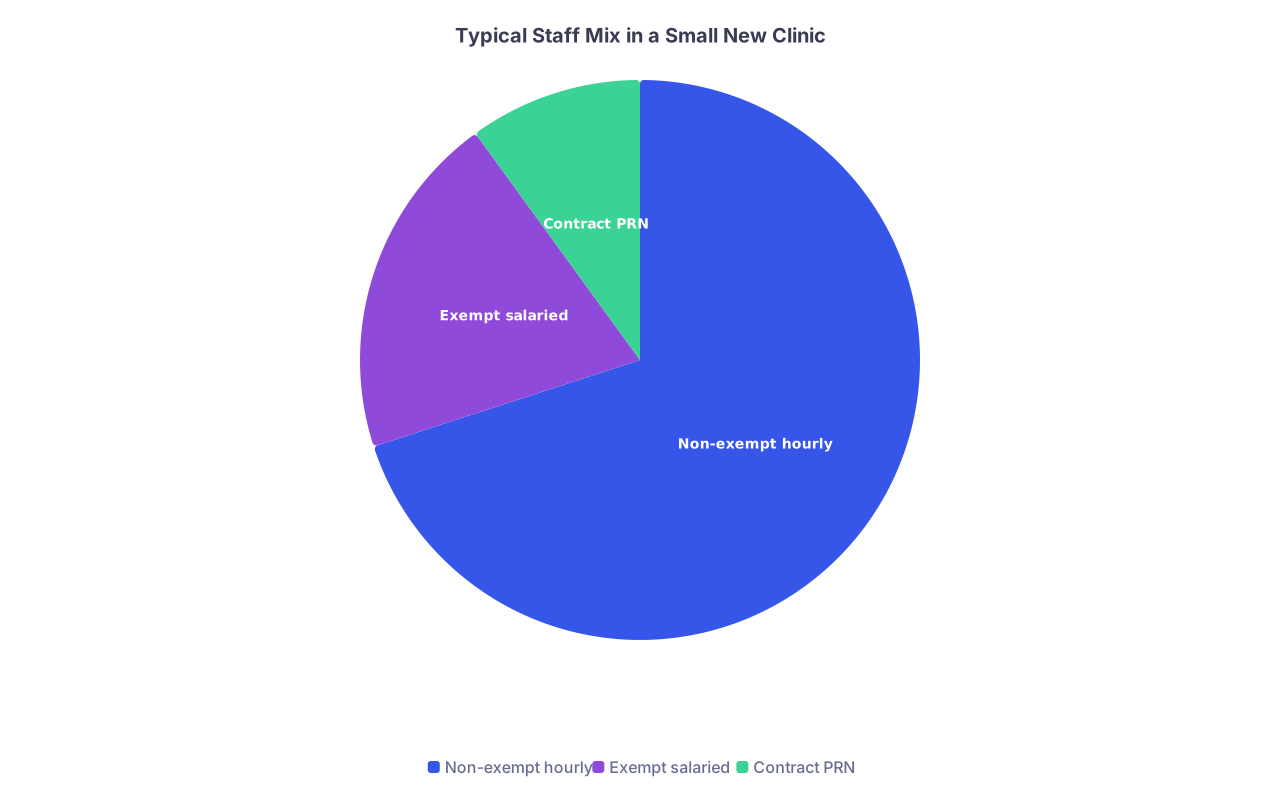
| Category | Value |
|---|---|
| Non-exempt hourly | 70 |
| Exempt salaried | 20 |
| Contract PRN | 10 |
Most front-desk, MA, LPN, and many biller roles are non-exempt. That means:
- They must track actual hours worked.
- They must be paid overtime (usually 1.5x) for hours over 40/week (or daily limits in some states).
- You cannot “volunteer” them for unpaid extra tasks.
The worst signal you can send is: “We are family here, we all pitch in” while effectively expecting free labor. Staff will recognize that gap within a month.
How to avoid the timekeeping trap
Do not improvise this.
- Get a real timekeeping system from day one. Even basic, low-cost cloud systems are better than spreadsheets or “honor system” sign-in sheets.
- Train managers explicitly: they are not allowed to edit time except for obvious mistakes, and they must document why.
- Pay every minute of required work. If you schedule a weekly 15-minute unpaid “huddle,” you are already in violation.
- Do not auto-deduct lunches unless the system allows employees to override it and you actually enforce uninterrupted meal breaks.
If staff discover that their documented time is being “adjusted” to cut overtime, they will not raise it gently. They will leave, or they will escalate.
3. Late, Inconsistent, or Confusing Paydays
You want your staff to act like professionals. Show them the same respect through your payment habits.
There are three payroll sins that instantly lower morale:
- Late paychecks
- Changing pay dates or methods without clear notice
- Pay stubs that are impossible to understand
Late or “flexible” paydays
I have heard new owners say: “We had a billing delay; everyone is getting paid on Monday instead of Friday just this once.” Staff hear: “My rent is now late because my boss did not plan cash flow.”
That “just this once” quickly turns into a pattern when:
- Your payer mix is heavy Medicaid / slow commercial.
- You have not built a cash cushion.
- You are paying vendors before payroll.
- You are guessing income month-to-month.
Let me be blunt. Never, ever let payroll be the bill that floats. If money is tight, you pay staff first, yourself last. If you get that backwards, they will not stick around to watch you fix your financial literacy.
Unclear pay structure
When staff do not understand:
- How their hourly rate was set.
- How PTO is accrued.
- When raises happen.
- How bonuses are calculated.
They will assume you are playing games.
| Element | Staff Expect To Know By Day 1 |
|---|---|
| Pay frequency | Weekly, biweekly, or monthly |
| Overtime rules | When OT starts, rate |
| PTO policy | Accrual rate, usage rules |
| Holiday pay | Which days are paid |
| On-call pay | Rate, minimums |
If people have to ask three different coworkers “How does PTO work here?” you have already lost credibility.
4. Misclassifying Employees and Playing Games with “Contractor” Status
One of the most expensive mistakes I see in new practices is misclassification. Not just expensive financially—expensive in staff goodwill.
Common scenario:
You hire an MA to “get started,” pay them as a 1099 contractor, say you will convert them to W-2 later, and give them a flat rate with no overtime, no benefits, but full-time hours under your direct supervision.
Congratulations. You have just:
- Violated IRS and state labor guidelines.
- Created tax headaches for them.
- Signaled that you cut corners with people’s livelihoods.
Staff talk about this. “She pays everyone as a contractor so she does not have to give benefits.” Word spreads faster than your marketing plan.
Quick reality check: employee vs contractor
If you:
- Set their schedule.
- Control how, when, and where they work.
- Provide tools and equipment.
- Prohibit them from working for others during your hours.
They are almost certainly an employee, not a contractor.
Do not rely on “but my friend does it this way.” Your friend is one audit away from a nightmare.
How misclassification makes people quit
Beyond the legal risk, this is what pushes them out:
- Surprise tax bills because no one withheld for them.
- No access to unemployment if you suddenly reduce their hours.
- Feeling used when they realize peers in other clinics are employees with protections.
People will tolerate a lot in a start-up if they feel you are honest and trying to do right by them. They will not tolerate being treated like disposable gig workers in a medical setting.
5. Opaque or Unfair Pay Differences
Nothing will fracture a new clinic’s culture faster than hidden or arbitrary pay discrepancies.
You might think: “Comp is private; no one will know.” That is fantasy. Staff talk. They compare.
Typical disaster pattern:
- You hire one MA hurriedly at $18/hr because you are desperate.
- Two months later, you hire a stronger MA at $21/hr because “that is what she asked for.”
- The first MA trains the second. Finds out she makes less. Resents both you and the new hire.
- That first MA eventually leaves for a $0.50/hr raise elsewhere because the principle bothers her more than the money.
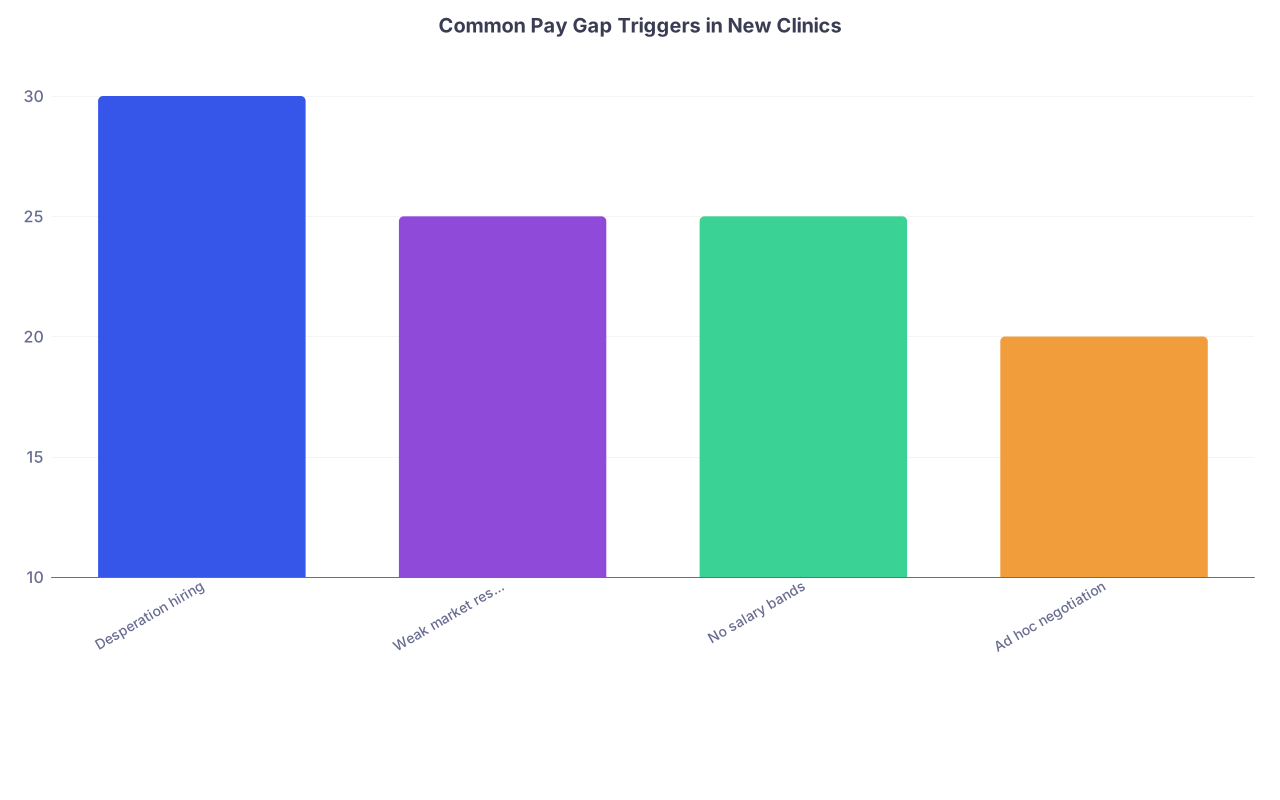
| Category | Value |
|---|---|
| Desperation hiring | 30 |
| Weak market research | 25 |
| No salary bands | 25 |
| Ad hoc negotiation | 20 |
The mistake: no defined pay bands
Most new owners wing it. They look at what they paid somewhere else or what a recruiter casually mentioned. No defined ranges. No structure. Just improvisation.
That leads to:
- Wide, unjustifiable gaps between people in the same role.
- Bias creeping into who negotiates higher and who does not.
- A minefield when you try to give raises and “fix” inequities later.
What staff experience
They might not see the spreadsheets, but they feel the pattern:
- The loudest complainers get more.
- Long-term loyalty is punished because new hires get higher starting rates.
- Raises feel random, not tied to performance.
Once people decide that compensation is unfair, they disengage or exit. You will not talk them out of that with “we are like a family here.”
6. Broken Bonus and Incentive Promises
If you are not absolutely sure you can pay a bonus, do not promise it. The damage from promised-but-not-paid bonuses is far higher than the benefit of motivating people short-term.
I have seen new clinics dangle:
- “End of year bonuses once we are profitable.”
- “Productivity bonuses after we hit X RVUs.”
- “Quarterly incentives for good reviews.”
Then they:
- Never define the formula.
- Never communicate progress toward the target.
- Quietly “forget” about it when cash is tight.
Staff remember. They build that expectation into their mental income. When it vanishes, they feel cheated—even if you technically never guaranteed a number.
How to avoid incentive disasters
- Do not roll out any bonus plan at all until payroll is rock solid.
- If you announce a plan, put the rules in writing, in plain English.
- Use simple, trackable metrics (e.g., on-time arrival rate, days without no-show errors, patient call-back times).
- Show staff the numbers regularly, not just at payout time.

| Step | Description |
|---|---|
| Step 1 | Start Clinic |
| Step 2 | Lock in base pay and payroll system |
| Step 3 | Stabilize cash flow |
| Step 4 | Define clear roles and pay bands |
| Step 5 | Add small, simple bonuses |
| Step 6 | Consider more complex incentives later |
Do not launch a complicated revenue-share system before you can even get people paid correctly twice in a row. That is backwards.
7. Ignoring Benefits and Total Compensation Communication
You might think you are paying competitively. Your staff might disagree simply because they do not see the full picture.
Big mistake: focusing only on hourly rates and ignoring:
- Health insurance contributions.
- Retirement match (if any).
- Paid holidays and CME for clinical staff.
- Scrub allowance or parking reimbursement.
When staff do not see a clear breakdown, they will compare your $20/hr to a hospital’s $20/hr and assume it is equal. If the hospital adds strong benefits on top, they will walk.
The communication gap
Most small clinics:
- Never give a written total-comp statement.
- Mention benefits vaguely during onboarding.
- Do not update staff when benefits improve (or quietly worsen).
If you upgrade health insurance mid-year but do not explain what that costs you per person, they will miss that you are actually investing in them.
Avoid this mistake by:
- Preparing a simple one-page “total compensation summary” annually for each staff member.
- Being explicit: “We pay $X toward your health insurance monthly,” etc.
- Explaining trade-offs: “We pay more in hourly rate but do not have a 401(k) yet; we plan to add that once we reach X revenue.”
Clarity here keeps people from overreacting to small wage differences elsewhere.
8. No Written Policies, Just Verbal Promises
Verbal promises are payroll grenades. They go off months later when memories differ.
I have heard every version of this fight:
- “You said I would get a raise after 90 days.”
- “No, I said we would review your performance after 90 days.”
- “You said I could work from home if the phones were slow.”
- “I said maybe, once we see how things go.”
Now multiply this across PTO exceptions, extra hours, call coverage, “one-time” cash bumps.
When pay and benefits live in casual hallway conversations instead of a written handbook and signed offer letters, you are guaranteeing future conflict and turnover.
What must be in writing at minimum
For every staff role, each person should get:
- A written offer letter with pay rate, pay frequency, exempt/non-exempt status, and basic schedule.
- A concise employee handbook section that covers:
- Overtime rules.
- PTO and sick time.
- Holiday pay.
- Call or after-hours expectations.
- Clear start dates for any promised future changes (e.g., “eligible for health insurance after 60 days of full-time employment”).
You do not need a 100-page manual. But if everything is “we will figure it out as we go,” you are dragging your staff into uncertainty they did not sign up for.
9. Letting One Toxic Pay Situation Rot the Whole Team
There is a quieter, more insidious compensation mistake: tolerating exceptions for problematic people.
Examples I have seen:
- A long-time biller you brought from residency gets paid far above market because of loyalty, but does very average work.
- A front-desk employee threatens to quit; you give her a surprise raise to keep the schedule from imploding.
- A nurse negotiated a special deal with you before anyone else was hired; everyone eventually finds out and resents it.
Once others see that pay is driven by drama, threats, or personal history, they stop trusting any “standard” you try to create.
You cannot undo years of inequity easily, but you can avoid baking it into your new clinic.
How to handle legacy or special cases
- Decide: either bring people over into your new clinic at market-aligned rates, or be prepared to justify (in detail) why their role is truly different.
- Do not give hostage-based raises. If someone uses “pay me more or I leave” repeatedly, you have already let them gain too much leverage.
- When you do give a raise, tie it to documented responsibilities, performance, or expanded role—not to emotion.
Otherwise, you will spend your time explaining “why she got X and I did not,” instead of building the practice.
10. Fixing Payroll Problems Too Slowly (or Defensively)
Last critical mistake: treating payroll errors as annoyances rather than emergencies.
Staff do not quit because you made one mistake. They quit because:
- You denied the mistake.
- You minimized its impact.
- You took weeks to fix it.
- You made them feel like a problem for raising it.
If someone says, “My check seems off,” the worst responses are:
- “Are you sure? No one else has had an issue.”
- “We will look at it for next pay period.”
- “It is probably the taxes.”
That tells them their time and money are not a priority.
How to respond correctly when pay is wrong
- Stop what you are doing. Investigate the same day.
- If they are right, own it plainly: “You are correct; we made a mistake.”
- Correct the underpayment immediately, not on the next check.
- Explain what changed in the system so it will not recur.
- Document the fix in writing.
Staff will forgive you once if they see urgency, transparency, and respect. They will not forgive repeated “we will fix it next time” excuses.
FAQ (Exactly 3 Questions)
1. How much should I budget for payroll services in a new small clinic?
For a very small clinic (2–10 employees), expect to pay a reputable payroll provider somewhere in the range of a modest monthly base fee plus a per-employee charge each pay period. The percentage of total payroll cost is usually small compared to the risk of fines and staff turnover. If a provider seems extremely cheap compared to others, that is a red flag; you are not saving money if they mis-handle taxes or timekeeping and you end up with penalties or angry staff.
2. Should I handle payroll myself at the beginning to save costs?
That is a classic mistake. As a physician-owner, your time is valuable, and payroll is not trivial data entry. It is tax law, labor law, and compliance. Doing it yourself guarantees more errors, delayed corrections, and a constant distraction from clinical and strategic work. Outsource the mechanics of payroll early, but stay deeply involved in setting compensation structure, reviewing reports, and approving any changes.
3. How do I know if my pay rates are competitive for my area?
Do not guess. Look at several sources at once: hospital system job postings for similar roles, local competitor clinic postings, and regional wage data from reputable salary surveys or professional associations. Talk directly to staff you trust from prior jobs; ask what typical ranges are for MAs, LPNs, front desk, and billers in your city. If you find you are paying significantly under local norms, expect higher turnover unless you offset that gap with unusually strong benefits, culture, or schedules—and you explain that trade-off clearly.
Key points to keep front and center:
- Staff will quit your new clinic faster over payroll and compensation problems than over clinical workflows or decor. Get the money right first.
- Do not improvise: use real systems, clear written policies, defined pay ranges, and transparent communication.
- Fix every pay mistake immediately and visibly. Trust in your practice is built—or destroyed—one paycheck at a time.