
It’s 11:47 p.m. You just finished another shift as an employed physician, still in half-wrinkled scrubs, and you’re staring at your student loan balance on one tab and “how to start a private practice” on another. The numbers don’t feel real. $250k. $350k. Maybe more.
And in your head you’re thinking:
“I already owe a mortgage worth of debt without the house. If I add a line of credit, office lease, payroll… is that basically career suicide? What if I fail? What if I can’t make payroll? What if I end up bankrupt and unemployable and everyone finds out I crashed a practice in less than two years?”
You’re not crazy for thinking this way. Almost everyone who even considers starting a private practice with six-figure loans has this exact spiral. The people who pretend they didn’t either forgot how it felt or had family money.
Let’s be blunt and specific:
Private practice is not inherently financially reckless.
Doing it blindly, over-leveraged, and too fast? That absolutely can be.
So the real question isn’t “Is private practice reckless?”
It’s: Under what conditions does it become reckless for you?
Let’s pull that apart instead of just doom-scrolling.
The Big Fear: Stacking Practice Debt on Top of Med School Debt
The nightmare in your head usually looks like this:
- You already owe $250–400k in federal loans
- You take another $150–300k to start a practice
- Insurance payments are delayed
- You can’t get enough patients
- You burn through savings, default, and lose everything
You’re picturing some dramatic “practice foreclosure” like it’s a TV show.
Reality is more… boring. And slower.
Most practices don’t suddenly explode and bankrupt the owner in 6 months. They:
- Struggle for a while
- The owner reduces staff or hours
- The owner moonlights or picks up locums to stay afloat
- Worst case, they shut down, sell off equipment, negotiate out of leases, then go back to employed work
Is that fun? No.
Does it ruin your entire life permanently? Almost never.
The real problem isn’t taking on practice debt; it’s taking on too much fixed overhead relative to how fast you can reliably bring in revenue.
So if the thought is: “Private practice = another $400k loan and fancy build-out right away” — yes, that’s reckless, especially with huge student loans.
If the thought is: “Carefully planned, lean start, side-moonlighting as backup, realistic patient ramp-up expectations” — that’s cautious, not reckless.
What Actually Costs Money (And What You Can Control)
Let’s strip the magic off “starting a practice” and talk concrete numbers. These are ballparks, they vary a ton by specialty and location, but this is the order of magnitude you’re playing with.
| Category | Approximate Annual Range |
|---|---|
| Office rent | $24k–$60k |
| Staff (1–2 people) | $60k–$120k |
| Malpractice | $10k–$40k |
| EHR & practice tools | $6k–$18k |
| Billing services | 3–8% of collections |
| Equipment/supplies | $10k–$100k+ |
Yes, the numbers are big. But notice something important:
You control almost every one of these:
- You choose the square footage and neighborhood
- You choose how many staff and how skilled/expensive they are
- You choose whether you need expensive in-office procedures Day 1
- You choose fancy custom build-out vs “generic but clean office in an existing suite”
The horror story version of private practice usually assumes:
- Brand new build-out
- High-rent “doctor building”
- 3+ staff before you have volume
- Every gadget you ever wanted
- Office designed like a boutique hotel
That’s not entrepreneurship. That’s ego with a loan.
If you’re debt-terrified, your version should be:
- Smaller footprint, modest but professional space
- Minimal staff at the beginning
- Only essential equipment
- Cheap-but-functional EHR and tools
- Possibly subleasing space or joining an existing shared suite
A lot of “this is financially reckless” feelings come from imagining the most expensive version possible. Delete that version from your brain. You don’t have to start that way.
The One Thing That Actually Makes It Reckless
Let me be really direct:
The most reckless thing is starting a practice without a clear, conservative plan for getting patients in the door fast enough to cover overhead.
Not the loan size alone.
Not the student debt alone.
Not the EHR choice.
It’s the fantasy that “if I build it, they will come.”
Patients do not magically appear because you signed a lease.
What makes starting a practice safer, not reckless:
- You pick a location with existing demand, not a total guess.
- You have referral sources lined up (PCPs, therapists, urgent cares, etc.) who know you’re coming.
- You accept major insurance plans people actually use in that area.
- You start lean so your break-even point is as low as possible.
That last piece is huge. If your monthly fixed costs are $35k, that’s a very different stress level than $12k.
Worst-Case Scenario: What If the Practice Flops?
Let’s play it all the way out, because that’s what your brain is already doing at 2 a.m.
Say you:
- Take out a $150k practice line of credit
- Sign a 3–5 year lease
- Hire a front desk + MA
- Spend $30k on equipment and setup
- Open your doors… and it’s slow. Very slow.
Worst-case chain:
- Patient volume stays low
- You’re paying staff and rent from your line of credit and/or personal savings
- You’re stressed and miserable, doing more admin than medicine
- After 12–24 months, you’re still not close to where you need to be
- You decide to cut your losses
What happens next in reality, not in your nightmares:
- You negotiate with landlord — maybe buyout, maybe find someone to take over the space
- You sell what equipment you can
- You may still owe on the LOC, but it’s usually an unsecured business loan, not tied to your house
- You pick up an employed job or full-time locums
- You’re bruised and embarrassed, but you’re still a physician with a high income ceiling
Does it suck? Absolutely.
Does it mean “I’ll be in debt forever and can never recover”? No.
The part that’s actually smart to fear is this: not planning for a slow ramp-up and not having a backup income plan if that happens.
Most physicians have one big advantage compared to non-medical entrepreneurs: if your business fails, you can usually still walk into a $200–350k employed job somewhere and pay down that additional debt over time. It’s painful, but not life-ending.
When Is It Not Financially Reckless to Start a Practice?
Debt-terrified you is probably assuming the bar for “safe” is impossibly high. It’s not. Here are scenarios where I’d say starting a private practice is reasonable, not reckless, even with big loans:
- You have at least 3–6 months of business + personal expenses in cash or easily accessible savings.
- Your monthly loan payments are manageable on an income-based or SAVE/REPAYE plan while you ramp up.
- You start part-time in your practice while staying employed or doing locums to keep money coming in.
- You keep your overhead low: small space, minimal staff, nothing fancy.
- You’re in a specialty and region where there’s obvious demand: primary care, psych, certain surgical fields, etc., with long waitlists locally.
The financially reckless situations are more like:
- No savings, no backup plan, no spouse income, and immediate full-time leap into a high-overhead model.
- Taking on personal guarantees for huge loans + build-outs because you want the “dream office” right away.
- Assuming you’ll hit full panel in 6 months in a saturated, competitive urban area with no built-in referral base.
So if you’re willing to build slow, keep your lifestyle modest for a while, and treat your first 2–3 years like an extended, risk-managed project? That’s not reckless. That’s just… uncomfortable.
Comparing Employed vs Private Practice From a Debt-Anxiety Lens
Let’s compare what your brain is probably glossing over: the risk is not “employed = safe” and “private = insane.” Both have risk, just different flavors.
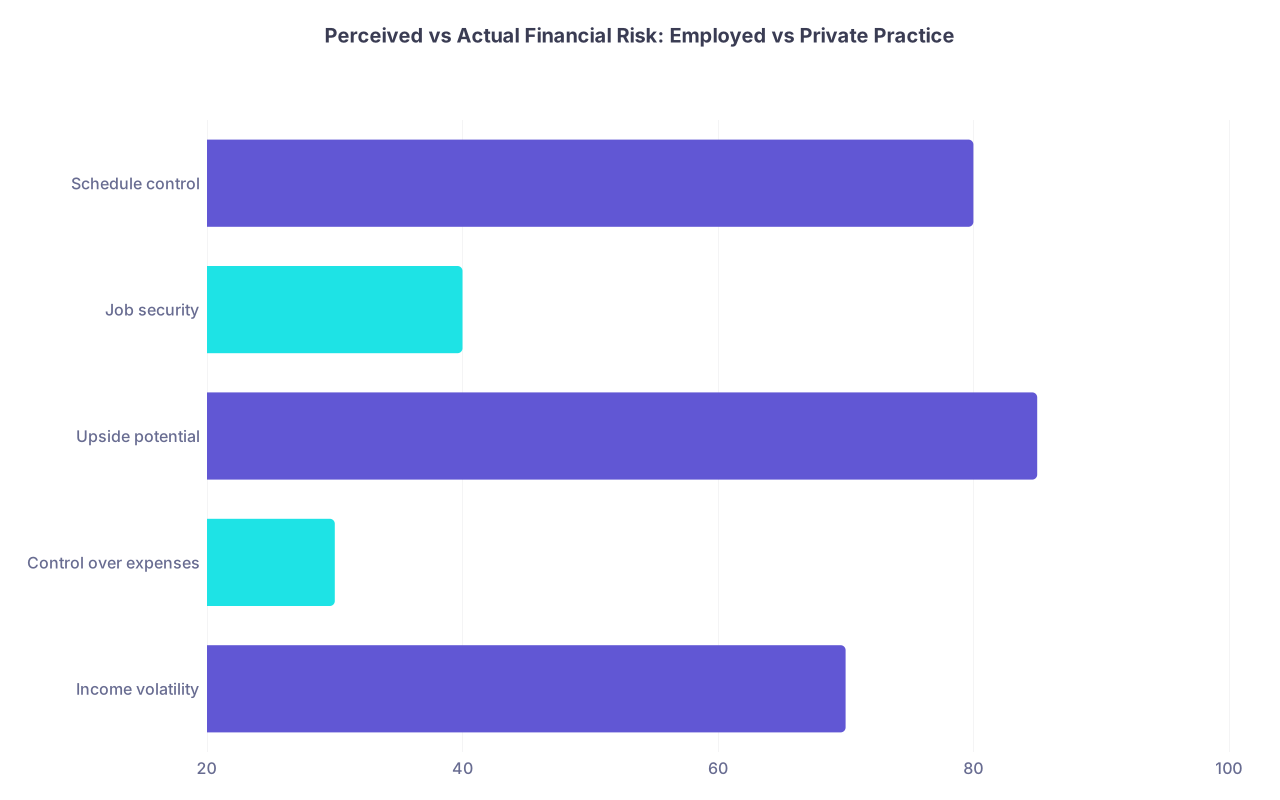
| Category | Value |
|---|---|
| Income volatility | 70 |
| Control over expenses | 30 |
| Upside potential | 85 |
| Job security | 40 |
| Schedule control | 80 |
(Think of 0 as “employed” and 100 as “private practice” on each line — the point is: risk shifts, it doesn’t vanish.)
Employed job risks people ignore:
- They can cut your RVU rate or bonus structure.
- They can load you with more patients with no extra pay.
- They can terminate your contract or non-renew, and you’re stuck with a restrictive non-compete.
- You have almost zero control over staffing, scheduling, or how the clinic is run.
Private practice risks you obsess over:
- Income volatility, especially in the first 1–2 years
- Responsibility for payroll, rent, malpractice, etc.
- Dealing with insurance credentialing and billing
- Start-up debt and opportunity cost
But you know what private practice gives you that directly helps a debt-terrified person?
Real control over:
- Overhead
- How many days you work
- Whether you add higher-margin services
- How many insurance plans you accept vs cash options
- How much you take home once you’re established
You can literally sit with your accountant and say, “What does my overhead need to be to make $X/year?” Then adjust.
Try doing that with a hospital admin.
A Saner Way to Think About “Risky” vs “Reckless”
Here’s how I’d draw the line:
Risky but potentially smart:
- Starting lean, with backup employment or locums
- Taking a modest business LOC or loan ($50–150k) with a realistic plan
- Accepting that your first 1–2 years income might be lower while you build something that has higher upside later
Reckless:
- Borrowing huge amounts for build-out, branding, and equipment that don’t directly generate revenue
- Assuming unrealistic growth (“I’ll be at 80% capacity in 6 months”)
- Ignoring your own anxiety and just “hoping it works out” without tracking cash flow constantly
- Locking into a long, expensive lease without a clear exit strategy
If you’re already living in spreadsheet mode, already anxious, already making “what if” plans? You are actually less likely to be reckless. Reckless people are not up at midnight reading articles like this. They’re already arguing with contractors about backsplash tile.
A Simple Example: Super-Lean vs High-Risk Start

Let’s compare two imaginary you’s.
Version A: “I’m Terrified, So I Go Lean”
- Sublease 2 rooms in an existing office, short-term lease
- One part-time front desk / MA combo
- Basic EHR, no fancy in-office lab or imaging
- You keep a 0.5–0.6 FTE employed or locums job
- You build your practice 2–3 days/week and grow slowly
Outcome range:
- Worst case: Practice never really takes off, you close it after a couple years, you’re out maybe tens of thousands, but you stayed employed and kept paying your loans.
- Best case: Panel grows, you eventually drop the employed job, and now you control your work and income.
Version B: “I Want It All Now”
- New build-out, 5–7 year lease
- Full-time staff from day one
- Big bank loan or line of credit $300k+
- You quit your job completely and rely on this practice on Day 1
- You assume referrals will just “come”
Outcome range:
- If you hit it perfectly? You can crush it financially.
- If you miss? Burn rate is brutal, loan pressure is suffocating, and this is the version where things start to feel genuinely dangerous.
The debt amount doesn’t tell the whole story. The burn rate and flexibility do.
Concrete Guardrails So You Don’t Blow Yourself Up
Here’s how you keep “risky but doable” from becoming “what the hell did I just do”:
- Decide your maximum total practice debt and commit to it (for example: “I’m not crossing $100k in loans/LOC for this.”)
- Make a spreadsheet with best-case, realistic, and worst-case patient volume for each month for 24 months. Then plan assuming the realistic or slightly-worse-than-realistic line.
- Keep your personal expenses low the first couple of years. This is not the moment to also buy your dream house and Tesla.
- Build in exit strategies: shorter lease, options to sublease, equipment that holds resale value.
- Get an accountant who actually works with small medical practices, not some random generalist who just does W-2 returns.
And honestly? Keep that anxious part of your brain in the loop. If your numbers aren’t adding up on paper and your gut is screaming “No,” listen. But if the numbers make sense with a conservative model and your only barrier is fear of trying — that’s a different conversation.
You’re Not Reckless For Wanting More Control
Wanting to start a private practice when you already have massive student loans does not automatically mean you’re irresponsible or delusional. It might just mean:
- You can’t stand RVU hamster wheels
- You want autonomy over how you treat patients
- You know that long-term, ownership is usually how people get out from under debt faster, not slower
Years from now, you won’t remember the exact dollar amount of your practice line of credit. You’ll remember whether you hid from risk completely, or took a calculated one with eyes open and a plan.
FAQ (Exactly 6 Questions)
1. How much student loan debt is “too much” to safely start a private practice?
There’s no magic number, but once you’re in the $300–500k+ range, you need to be extra conservative. That means:
- Keeping your practice start-up lean
- Making sure your loan payments are on an income-driven plan while revenue is small
- Avoiding giant personal guarantees or massive build-outs
It’s less about the absolute debt and more about whether your combined monthly obligations (personal + practice) can be covered under a realistic, not fantasy, income projection.
2. Should I wait until my loans are mostly paid off before starting a practice?
If you wait until they’re “mostly paid off,” you might be waiting 10–20 years. By then you might have golden handcuffs, kids in school, aging parents, and be completely stuck.
A more realistic approach:
Start when you’ve:
- Built a financial cushion (3–6 months expenses)
- Run conservative projections that actually work
- Gotten at least a couple years of employed experience to understand volume, coding, and clinic flow
You don’t need your loans near zero. You need your plan to make sense.
3. Is it safer to buy into an existing practice instead of starting from scratch?
Sometimes. But not automatically.
Buying into a practice is safer only if:
- The financials are transparent and solid (3+ years of P&Ls, tax returns, actual collections)
- There’s a proven patient base and referral stream
- You’re not massively overpaying for “goodwill”
I’ve seen people buy into a “busy practice” only to find out the overhead is bloated and the senior partner was barely taking home more than an employed doc. Do not assume “existing” = safe. Verify the numbers.
4. What if I start and then realize I hate running a business?
Then you pivot. Seriously.
Options:
- Hire a practice manager and shift more administrative work off your plate
- Merge with or sell to a group where you keep some autonomy but offload operations
- Close and go back to employed or locums work
You won’t be the first or last doctor to start a practice, decide it’s not for them, and move on. That’s not failure; that’s data.
5. Can I start a practice while on an income-driven repayment plan like SAVE?
Yes, and a lot of people do. In fact, being on an income-driven plan can reduce your early cash flow stress while your practice grows.
The key is to:
- Know how your payments will change as your income increases
- Plan for eventual higher payments once your practice is stable
- Avoid lifestyle creep when your income starts to climb — use that phase to strengthen both loan payoff and practice reserves
6. What’s one concrete step I can take this month if I’m curious but terrified?
One low-risk move: build a detailed two-year financial pro forma.
Not in your head. On paper or a spreadsheet.
- Estimate your overhead (rent, staff, malpractice, EHR, supplies)
- Model conservative, realistic, and stretch revenue paths
- Include your student loan payments and personal expenses
- See if there’s a version that works while staying lean and maybe doing part-time employed work
If the numbers never work, you’ve got your answer for now.
If they do, and your only response is “I’m scared”? Then you’re not looking at a reckless plan. You’re looking at a scary but manageable one.