
The idea that “insurance companies control everything” in private practice is an excuse, not a reality. They control some things. They absolutely don’t control all the things that actually determine whether your practice survives and whether you stay sane.
You finished residency, you’re staring at a brutal job market, and everyone is telling you the same story: private practice is dead, payers set all the rules, you’ll just get squeezed to death. That story is comfortable because it lets physicians off the hook. “It’s the system” becomes a blanket justification for never learning the business side.
Let me be blunt: if you enter private practice assuming payers dictate everything, you will practice like a victim. And your numbers will look like a victim’s numbers.
If you instead sort what’s truly locked in by payers versus what’s under your control, the picture changes fast.
Let’s separate myth from reality.
What Payers Actually Control (And What They Don’t)
Payers do have real leverage. I’m not romanticizing this.
They control:
- Fee schedules for covered services
- Prior auth requirements and utilization rules
- Covered vs non‑covered services under a given plan
- Timing and process of claims payment
- Contract language on things like timely filing, appeals windows, etc.
That’s the stuff you can’t just “mindset” your way around. Medicare isn’t going to pay you more because you’re nice.
But here’s what insurance payers do not control, even though physicians routinely act like they do:
- Your panel mix
- Your scheduling templates
- Your visit lengths
- Your coding discipline and documentation quality
- Your ancillary services and revenue streams
- Your overhead structure and staffing model
- Your marketing, referral strategy, and patient experience
- Your decision to accept or drop specific low‑value plans
- Your decision to be hybrid (insurance + direct pay) instead of only fee‑for‑service
There’s a pattern here. Payers control prices per unit. You control what units you generate, how many, at what cost, and for whom.
In other words, they set the chessboard. You still play the game.
The Biggest Myth: “Reimbursement Rates Determine My Income”
No, your payer fee schedule determines your revenue per encounter. Your income comes from revenue minus expenses, multiplied by how intelligently you structure your time.
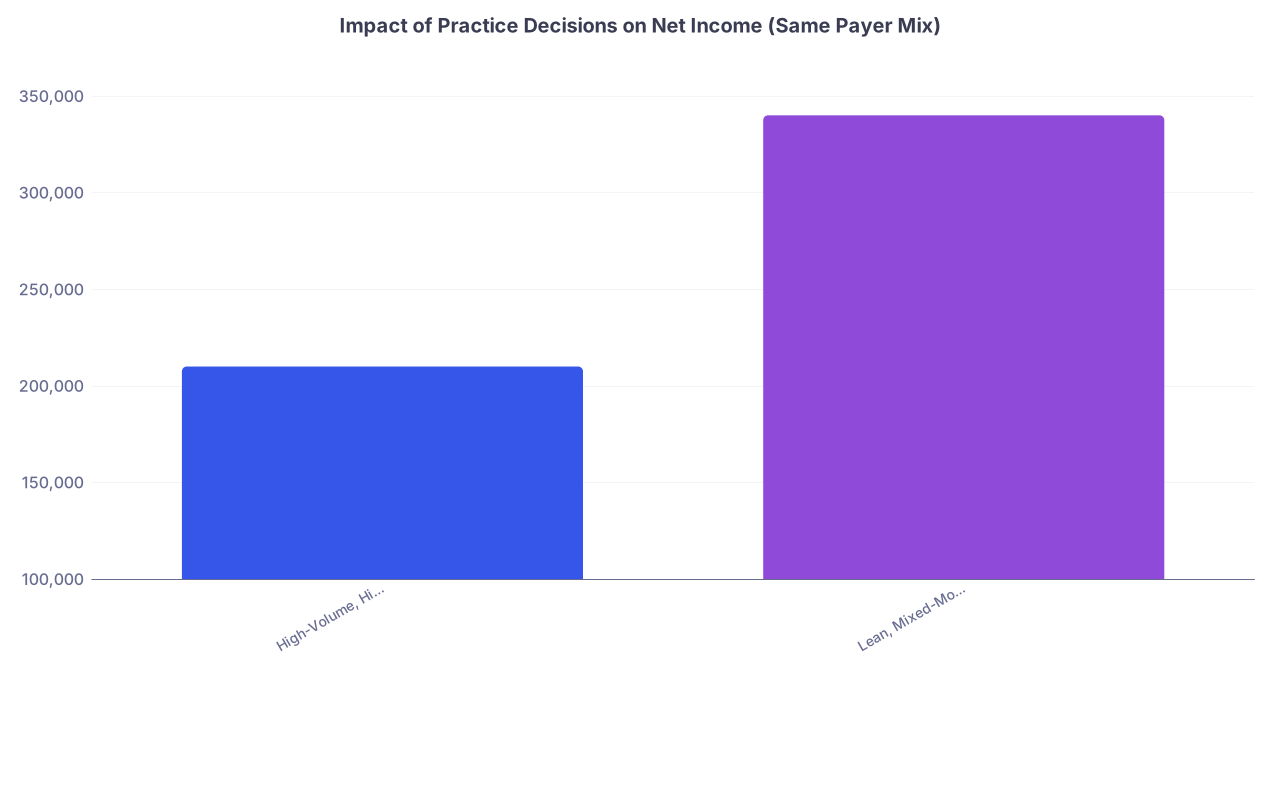
I’ve seen practices in the same city, same payer contracts, same specialty, and wildly different take‑home pay. One primary care doc killing herself at 28 patients/day and taking home less than a lean, disciplined practice across town seeing 18–20/day but with better coding, better service mix, and lower overhead.
That’s not hypothetical; it shows up in the numbers.
| Category | Value |
|---|---|
| High-Volume, High-Overhead | 210000 |
| Lean, Mixed-Model | 340000 |
Same city, similar payers. Massive spread. Because reimbursement rates are one variable, not the variable.
Think of it this way:
- You don’t control that a 99213 pays $X.
- You do control:
- How often your documentation and complexity legitimately support 99214 instead of defaulting to 99213
- Whether you add billable services (procedures, diagnostics, behavioral health integration, CCM, etc.)
- Whether 40% of your week is eaten by unpaid admin work you never designed around
If your mental model is “they set the rates, so I’m screwed,” you will not even look for the levers you do have.
Where You Have Real Power #1: Panel and Payer Mix
New attendings almost always underestimate this one, because early on you feel you “have to take everything” to fill a schedule. That mentality, if you never reevaluate it, is how you end up working mostly for your worst payers.
You can manage panel and payer mix. Not overnight. Not without data. But you can.
There are three very basic, very actionable moves:
Know your payer-level profitability
Not just top-line revenue. Revenue minus cost to generate that revenue.That means tracking:
- Average payment per visit by payer
- Denial rates and write-offs by payer
- Staff time per claim (some payers are admin nightmares)
Stop reflexively signing every contract
If a contract pays 40–50% of Medicare and comes with high denial friction, you are not adding “volume.” You’re subsidizing that payer with your time and staff salaries.Gradually shape your panel
Common, boring, effective tactics:- Close to new patients for payers that are loss-makers once you’re busy
- Keep them for existing patients if you must, but stop feeding the fire
- Steer your marketing, location, and referring relationships toward better-paying or more reliable plans
Here’s what this looks like in practice when someone actually runs numbers instead of complaining over coffee.
| Payer | % of Visits | Net Profit/Visit | Monthly Net Profit |
|---|---|---|---|
| Medicare | 35% | $80 | $28,000 |
| Commercial A | 25% | $95 | $28,500 |
| Commercial B | 20% | $60 | $12,000 |
| Medicaid | 15% | $30 | $4,500 |
| Exchange Plan X | 5% | $10 | $600 |
That Exchange plan? It feels like “only 5% of visits.” But those visits burn staff time and clog your schedule for almost no net return. Dropping just that one plan and replacing those visits with a mix of Medicare and Commercial A changes your monthly net. Multiplied over a year, that’s tens of thousands of dollars and a lot less stress.
You do not need to go concierge to exercise this kind of control. You just need to stop treating your contracts like the weather and start treating them like business decisions.
Where You Have Real Power #2: Scheduling and Time Use
Insurance does not tell you how long your visits have to be. Your EMR vendor and your own fear do.
Most new private practice docs copy whatever factory model they trained in. Fifteen-minute slots. Double-booked in spots. Catch-up “admin” time that evaporates instantly.
Then they conclude, “Well, payers force me to see 25–30 a day.”
No. Your practice design did that.
Let me translate the typical week of a new independent doc who has not done the math:
- 32 clinical hours “on paper”
- 10–15 hours of unpaid admin (inbox, refills, prior auths, messages, forms) at night or early morning
- No protected time for coding review, revenue cycle oversight, or intentional growth
You can’t bill payers for everything. That’s reality. But you absolutely control how much non-billable chaos you tolerate.
Even small changes in schedule design have real impact:
- Blocking actual admin time in core hours so it’s not always midnight and Sunday
- Structuring slots to cluster similar visit types (e.g., procedures, complex follow-ups) so your brain and workflow are not constantly switching gears
- Removing “squeeze-ins” by policy, replacing them with same-day telehealth or nurse visits where appropriate—still revenue, far less chaos
I’ve seen practices gain back 4–6 hours a week of physician brain-time just by formalizing this. That time then gets invested in higher-yield activities: billing audits, designing a small cash-pay service, or actually meeting with your biller to figure out why your denial rate is 12%.
That’s not theory. That’s how practices claw back control.
Where You Have Real Power #3: Coding, Documentation, and Revenue Integrity
Payers do not stop you from being paid fairly for work you actually do. Your coding habits do.
Most residents finish training essentially under-coding by default. Not because they’re noble. Because nobody taught them how E/M or procedural coding actually works in the real world, and they’re terrified of audits.
The result: years of leaving 10–25% of legitimate revenue on the table. For no reason.
There’s a predictable pattern:
- You default to lower-level E/M codes even when complexity and time justify higher levels
- You miss billable services (prolonged services, care coordination, behavioral health integration, minor procedures) because “we never did that in residency”
- Your documentation doesn’t reflect the actual work you’re doing, so your coder has to guess low
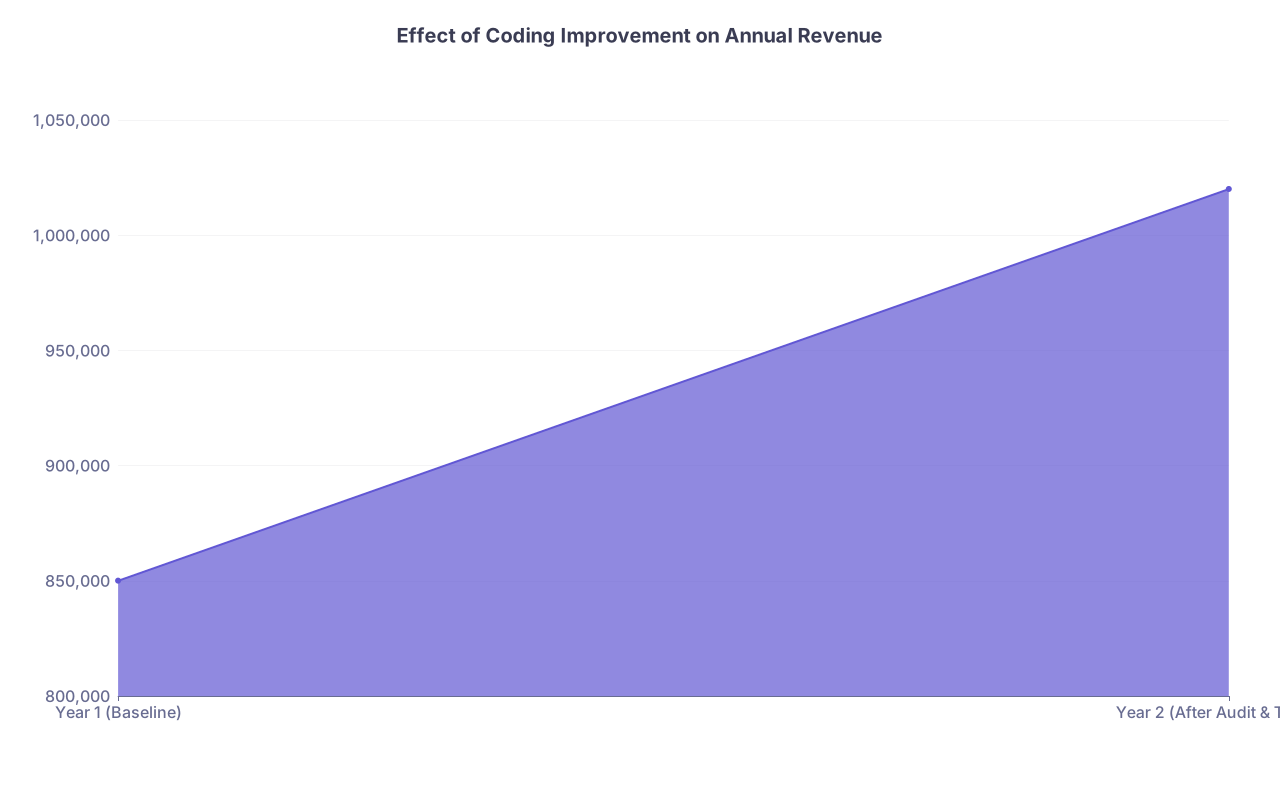
Reimbursement rates are fixed. Your ability to actually capture them is not.
This is one of those boring, unsexy levers that makes or breaks private practice finances.
| Category | Value |
|---|---|
| Year 1 (Baseline) | 850000 |
| Year 2 (After Audit & Training) | 1020000 |
Same payer contracts. Same location. Same physician. The only change: structured coding audit + targeted documentation training + quarterly follow-up.
If you’re finishing residency and flirting with private practice, put “learn coding properly” higher on your list than “perfect my logo.”
Where You Have Real Power #4: Diversifying Revenue Beyond Basic Office Visits
Payers heavily influence what a 99213 pays. They have much less influence over several other things:
- In-office procedures and diagnostics (depending on specialty)
- Hybrid models: part insurance, part direct-pay
- Ancillary services that are either well-reimbursed or cash-based
No, I’m not talking about turning your office into a med spa unless that actually fits your training and market. I’m talking about rational, aligned services that help patients and stabilize your revenue.
Examples that I’ve watched transform shaky practices:
- A family med clinic adding basic in-office procedures they were trained for but never billed (skin biopsies, joint injections, IUDs, vasectomies)
- A psychiatry practice adding a small panel of direct-pay therapy slots with extended visits, while still billing insurance for med management
- An endocrinology group implementing remote monitoring and structured chronic care management, which payers do cover when used properly
You don’t need twenty ancillaries. You need one or two that actually fit your patient base and skills, executed cleanly.
This is where a lot of physicians sabotage themselves with purity tests: “I only want to do core clinical work.” Fine. Then accept that you’re voluntarily limiting one of the major levers you control, and stop complaining about payers.
If you want independence, you can’t pretend revenue design is beneath you.
Where You Have Real Power #5: Deciding How Much Insurance You Even Want
The most delusional myth on both ends of the spectrum:
- Myth from burned-out docs: “You either take all insurances and get crushed or you go full concierge and abandon everyone.”
- Myth from some consultants: “Just go cash-only and your problems are solved.”
Reality is messy and more flexible.
You can:
- Be mostly insurance-based but cut the truly abusive plans
- Run a hybrid practice: insurance for most primary care or basic services, direct-pay for extended visits, lifestyle, or complex care bundles
- Gradually migrate a portion of your panel to membership or direct-primary-care style models while keeping payers in the mix for specific services
I’ve worked with practices that started 100% insurance-based, then:
Year 1–2: Took everything to build volume and survive.
Year 3–4: Dropped 1–2 bottom-tier plans and added a small direct-pay extended-visit offering.
Year 5+: Built out a stable hybrid: 70–80% insurance, 20–30% direct-pay.
The right mix depends on your market, specialty, and risk tolerance. But pretending that “payers won’t let me” is just a story you tell yourself to avoid difficult, multi-year planning.
If you want a sense of how the decision landscape really looks, here’s a stripped-down view.

| Step | Description |
|---|---|
| Step 1 | Start Practice |
| Step 2 | Take broad payer mix |
| Step 3 | Select higher value plans |
| Step 4 | Track payer profitability |
| Step 5 | Close to new patients for those plans |
| Step 6 | Maintain current mix |
| Step 7 | Consider hybrid or direct pay add ons |
| Step 8 | Need rapid volume? |
| Step 9 | Plans below threshold? |
No insurance executive is stopping you from going down that right-hand branch. The friction is mostly fear and ignorance, not regulation.
Where You Have Power But Pretend You Don’t: Overhead and Staffing
Payers are very convenient villains when your rent is bloated, your staff is inefficient, and your tech stack is a junkyard of overlapping subscriptions.
I’ve sat in offices where the physician complains about “low reimbursements” while:
- Paying for three EMR-adjacent tools they barely use
- Running with two front-desk people when one cross-trained high-performer plus a part-time virtual assistant would handle the same volume
- Leasing way more space than their panel and local market justify “because it looks nice”
You do not control what UHC pays for a 99214. But you absolutely control whether you:
- Sign a 10-year lease for a cathedral office you don’t need
- Tolerate low-performance staff or redundant roles out of avoidance
- Pay for an overpriced billing company that doesn’t own your denial rates
Overhead is not sexy. It is, however, one of the most physician-controllable variables in private practice viability.
The Psychological Trap: Learned Helplessness in a White Coat
The most dangerous effect of “payers control everything” isn’t financial. It’s psychological.
If you believe you’re powerless, you will not learn:
- Basic financial statements
- Contract evaluation
- Coding strategy
- Process design and workflow improvement
You’ll simply do more visits and hope volume fixes structural problems it never fixes.
I’ve watched residents go into hospital employment because “private practice is too risky,” only to get crushed by RVU quotas, opaque compensation formulas, and corporate priorities that make payer contracts look benign.
Then some of those same docs jump to private practice five years later. The ones who succeed are almost never the ones with the best raw clinical skills. They’re the ones who let go of the victim story and treat the business side as part of their job.
If You’re Post-Residency and Thinking About Private Practice
Here’s the reality check.
Yes:
- Payers are powerful.
- Contracts can be terrible.
- There will be plans you simply cannot negotiate with.
But also yes:
- You can choose which payers you work with over time.
- You can control how efficient or wasteful your practice is.
- You can control how much non-billable chaos exists in your day.
- You can expand beyond basic E/M visits in rational, ethical ways.
- You can structure hybrid or partial direct-pay elements that give you leverage.
The question isn’t “Do payers control everything?” They don’t.
The questions are:
- Are you willing to learn enough business to use the control you do have?
- Are you willing to suffer 1–3 years of deliberate, data-driven building instead of trying to copy the job you just left?
The doctors who answer “yes” to those tend to stay independent longer than the ones who simply complain and wait for a rescue.
The Short Version
Three core truths, without the drama:
- Payers control rates; you control mix, efficiency, coding, and strategy. Most private practice success or failure lives in the variables you actually own.
- “I have no power” is often a cover for “I haven’t bothered to learn the levers I do have.” Panel management, schedule design, revenue integrity, and overhead are all on your side of the ledger.
- Independence isn’t dead; it’s just incompatible with passivity. If you’re willing to treat the business as seriously as the medicine, insurers become a constraint to work around—not an iron cage.