
The idea that “concierge care is only for the ultra‑wealthy” is lazy thinking — and the data does not back it up.
It feels true because media profiles always feature hedge‑fund managers and athletes with $20,000 retainers and private jets. But if you’re a post‑residency doc trying to figure out whether concierge or membership‑based care could be your way out of hamster‑wheel medicine, that caricature is actively misleading.
Let’s dissect what’s actually happening on the ground — who’s using these models, what patients pay, what physicians earn, and whether a normal internist or FP can realistically build one without having a roster of billionaires and celebrities.
This is not a love letter to concierge care. Some of the hype is garbage. Some of the “direct primary care” absolutism is just as bad. But the financial and demographic reality is far more interesting — and a lot more accessible — than the myths you keep hearing on the wards and in physician Facebook groups.
First: Stop Lumping “Concierge” and “DPC” into One Blob
Most of the confusion starts here. People shout past each other because they are talking about different models.
Broadly, in U.S. outpatient primary care, you’ve got three relevant membership-style models:
High‑end concierge (true VIP)
Annual retainers often $5,000–$25,000 per patient, tiny panels (100–300), frequently tied to hospitals or high-net-worth ecosystems (think MDVIP’s most premium tiers, bespoke internal medicine practices in Manhattan, Beverly Hills, etc.).Middle‑tier concierge or “membership + insurance”
Retainers usually $1,200–$2,500 per year ($100–$200/month). Still bill insurance for visits; membership buys better access, more time, same‑ or next‑day appointments, some “executive physical” components. Panels around 400–800 patients.Direct Primary Care (DPC)
Generally no insurance billing for primary care. Monthly membership $50–$100 (sometimes $150+ in high‑cost cities), panels around 400–800. Often marketed explicitly as “not just for the rich.”
People throw around “concierge” as if it only means category 1. That’s where the “only for the ultra‑wealthy” line comes from. But most of the growth, and most of the reality for early‑career docs, is in categories 2 and 3.
Let’s anchor this with some numbers.
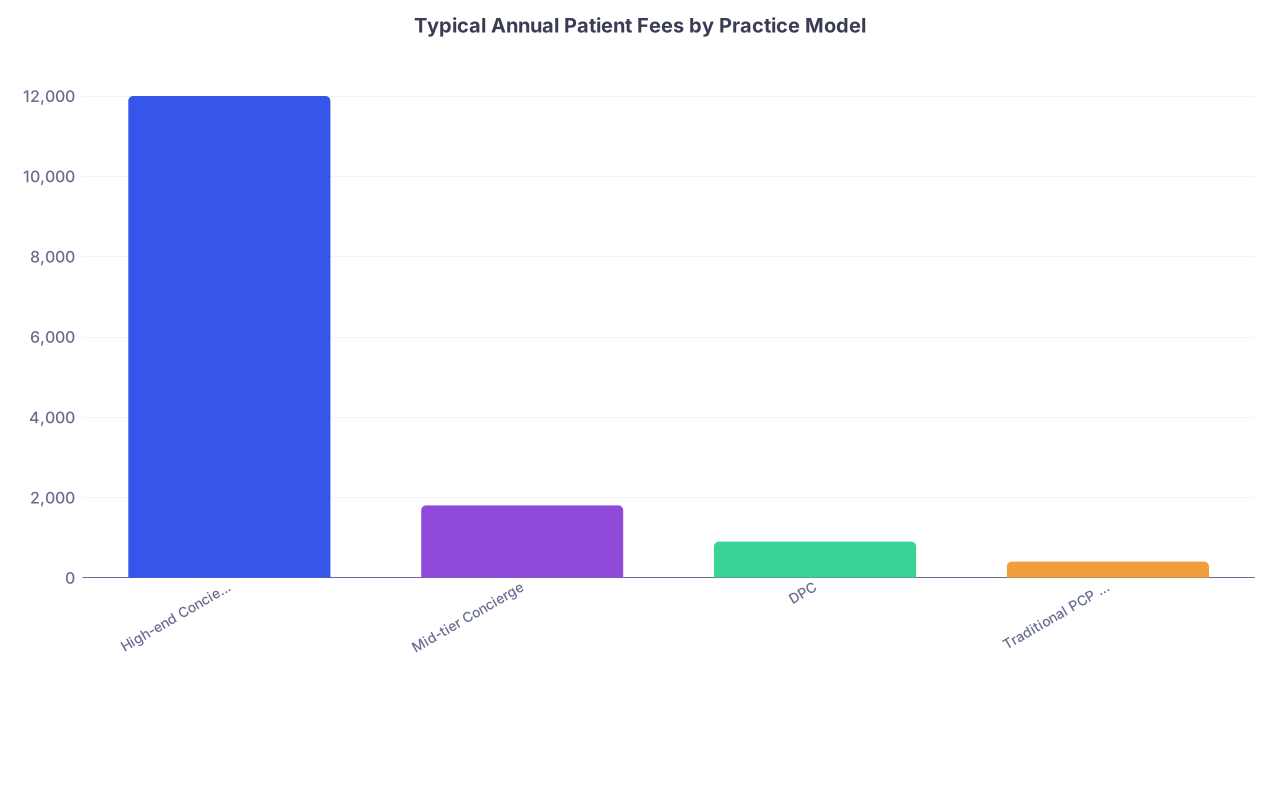
| Category | Value |
|---|---|
| High-end Concierge | 12000 |
| Mid-tier Concierge | 1800 |
| DPC | 900 |
| Traditional PCP (copays) | 400 |
That $12,000 isn’t imaginary. Those practices exist. But they are not the bulk of the membership‑based market, and they are not the only path available to you.
Who Actually Uses Concierge and DPC? Follow the Demographics
The “only billionaires” myth dies as soon as you look at payer and income mix.
Let’s pull together what various analyses and concierge/DPC organizations have reported over the last few years (aggregated and rounded for sanity):
- Large concierge networks report 30–50% of their patients are Medicare. Not private jets. Fixed income.
- Many DPC practices show significant enrollment from teachers, small business employees, and early retirees, not just lawyers and CEOs.
- Surveys of DPC clinics routinely show household incomes in the $50k–$120k range as their core demographic — i.e., middle and upper‑middle class, not ultra‑wealthy.
To make this a bit less abstract:
| Model Type | Medicare % | Commercial % | High-Net-Worth % |
|---|---|---|---|
| High-end concierge | 15 | 55 | 30 |
| Mid-tier concierge | 35 | 55 | 10 |
| Direct Primary Care | 10 | 60 | 5 |
| Traditional PCP | 30 | 60 | 1 |
Are these exact? No. But they’re directionally accurate and match what physicians in these spaces repeatedly report.
The “ultra‑wealthy only” myth comes from staring at the 30% in the first column — the boutique outfits that hospitals write glossy brochures about. It ignores the far more mundane reality that tens of thousands of patients on Medicare and employer insurance are paying $75–$200/month for something they can’t get in the seven‑minute visit factory: time, continuity, and access.
I’ve seen this in a mid‑tier concierge practice in a midwestern city:
- A retired school principal on Medicare.
- A mechanic with a high‑deductible plan who kept getting surprise bills from hospital‑owned clinics.
- A small business owner who literally said, “I’d rather pay you $125/month and know I can text you than get another $6,000 ER bill for something minor.”
Not exactly the Forbes 400.
Is It Really “Affordable”? Depends On What You Compare It To
Let’s be blunt: if a family is living paycheck to paycheck, even $50/month is a stretch. For them, yes, concierge and DPC are out of reach unless subsidized.
But that’s not the group most doctors are asking about when they consider starting a membership‑based practice. You’re asking: “Is this only viable if I go after hedge‑fund dudes?”
No. Not if you understand how patients are already spending money in this system.
Three reality checks:
ER and urgent care waste
A single unnecessary ER visit easily hits $1,000–$2,000 out‑of‑pocket on a high‑deductible plan.
Urgent care? $150–$350 a visit.Out‑of‑network specialist nonsense
One dermatology or ortho visit out‑of‑network can run $400–$700 cash. People pay it because they’re desperate and they’re used to healthcare bills being absurd.Non‑essential but normalized spending
National data show middle‑income households regularly pay $75–$150/month for cell phone upgrades, streaming services, gym memberships, aesthetic services, etc.
Now map that to a mid‑tier concierge or DPC membership:
- DPC at $80/month: $960/year
- Mid‑tier concierge at $150/month: $1,800/year
A single avoided ER visit makes that math suddenly rational, not extravagant, for a lot of households.
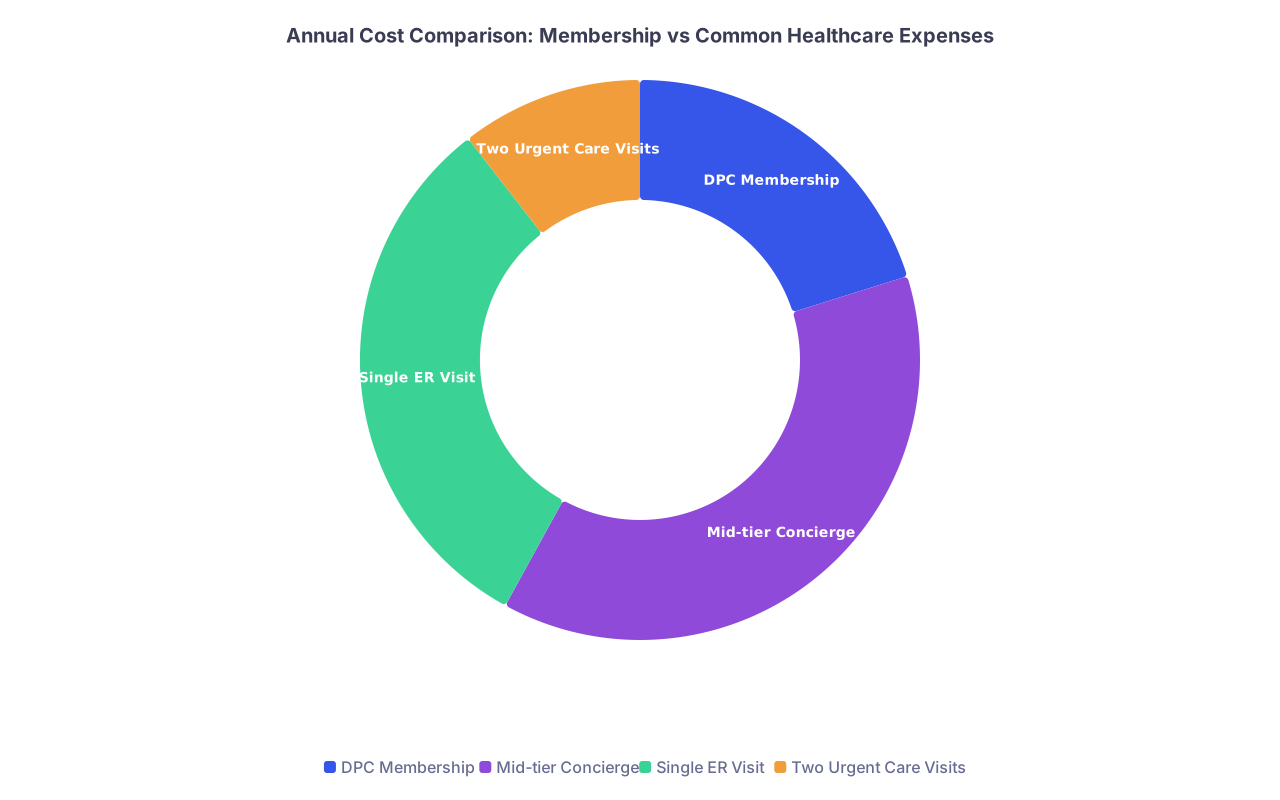
| Category | Value |
|---|---|
| DPC Membership | 960 |
| Mid-tier Concierge | 1800 |
| Single ER Visit | 1500 |
| Two Urgent Care Visits | 500 |
Are there plenty of Americans who truly cannot spare that? Absolutely. But “not universal” is not the same as “only ultra‑wealthy.” What we actually see is that a slice of the middle class reallocates — they drop some visits elsewhere, accept a cheaper insurance plan, or treat membership as “catastrophe prevention” and budget for it.
So the better statement is this: Concierge and DPC are class‑skewed but not ultra‑elite. They’re accessible to some middle‑income patients, mostly inaccessible to the poor, and occasionally optimized for the rich.
If you build only the last category, yes — your practice will be for the ultra‑wealthy. But that’s a design choice, not an inherent property of the model.
The Physician Side: Can a Normal Doc Make a Living Without Billionaires?
This is the part most residents actually care about but rarely get modeled in any honest way.
Let’s run a simple, not‑fudged scenario for a post‑residency physician launching a membership‑based practice. Assume modest, real‑world numbers, not Twitter fantasy.
Say you target:
- 600 patients total
- Average membership fee: $100/month ($1,200/year)
- You still bill insurance for covered visits (outside pure DPC), but let’s ignore that revenue for now to keep the math conservative.
Membership revenue alone:
600 patients × $1,200/year = $720,000/year
Now subtract realistic overhead:
- Small office lease: $4,000/month → $48,000/year (depending on city)
- 2 FTE staff (front desk/MA + shared biller or part‑time RN): ~$120,000–$150,000 with benefits
- Malpractice: $10,000–$20,000
- EHR, supplies, phones, etc.: $30,000–$50,000
You’re looking at $220,000–$270,000 in overhead before you get fancy.
Result: roughly $450,000–$500,000 left, before any insurance billing revenue, before any ancillaries.
Even if those assumptions are off by 20–30%, you’re still very competitive with traditional employed primary care comp — with a dramatically lower panel and more control.
This is exactly why:
- DPC practices can stay solvent with 400–700 patients at $60–$120/month.
- Mid‑tier concierge can thrive without a single millionaire, assuming they collect from enough solidly middle‑class and Medicare patients.
Where does the “you need billionaires” myth come from? From people who:
- Think you need only 150 patients
- And want $500,000+ take‑home
- While working 3 days a week, no call, in a high‑rent metro, with multiple staff, and offering home visits.
That version? Yes, you need very wealthy patients or a hospital sponsor.
But a normal, well‑run membership practice does not. It just needs patients who can, and are willing to, pay what they’d otherwise bleed into ERs, out‑of‑network bills, and inefficiencies.
What the Waitlists and Growth Curves Actually Show
If concierge and DPC were purely ultra‑wealthy luxuries, you’d expect them to grow only in ultra‑rich enclaves.
They are growing fastest in…
- Suburban Midwest
- Smaller cities in the South
- Secondary markets where physicians are tired of RVU hell and patients are tired of 3‑month waits
Look at the behavior that matters: how quickly panels fill and who’s on the waitlist.
I’ve seen this pattern repeat:
- A new DPC clinic starts in a working‑class suburb at $70/month.
- Within 12–18 months, they hit 400–600 patients.
- Early adopters are teachers, self‑employed tradespeople, and middle‑managers with high‑deductible plans.
- Their waitlist is not hedge‑fund guys. It’s people who’ve been burned by being told to go to urgent care for the 7th time.
On the concierge side, MDVIP and similar networks consistently report that many of their “converted” physicians retain a large chunk of their existing patient panel, which often includes Medicare and middle‑class patients who choose to pay the membership fee when given the option.
If this were really “only for the ultra‑wealthy,” these conversion practices would collapse. They do not. Many cap and close to new patients very quickly.
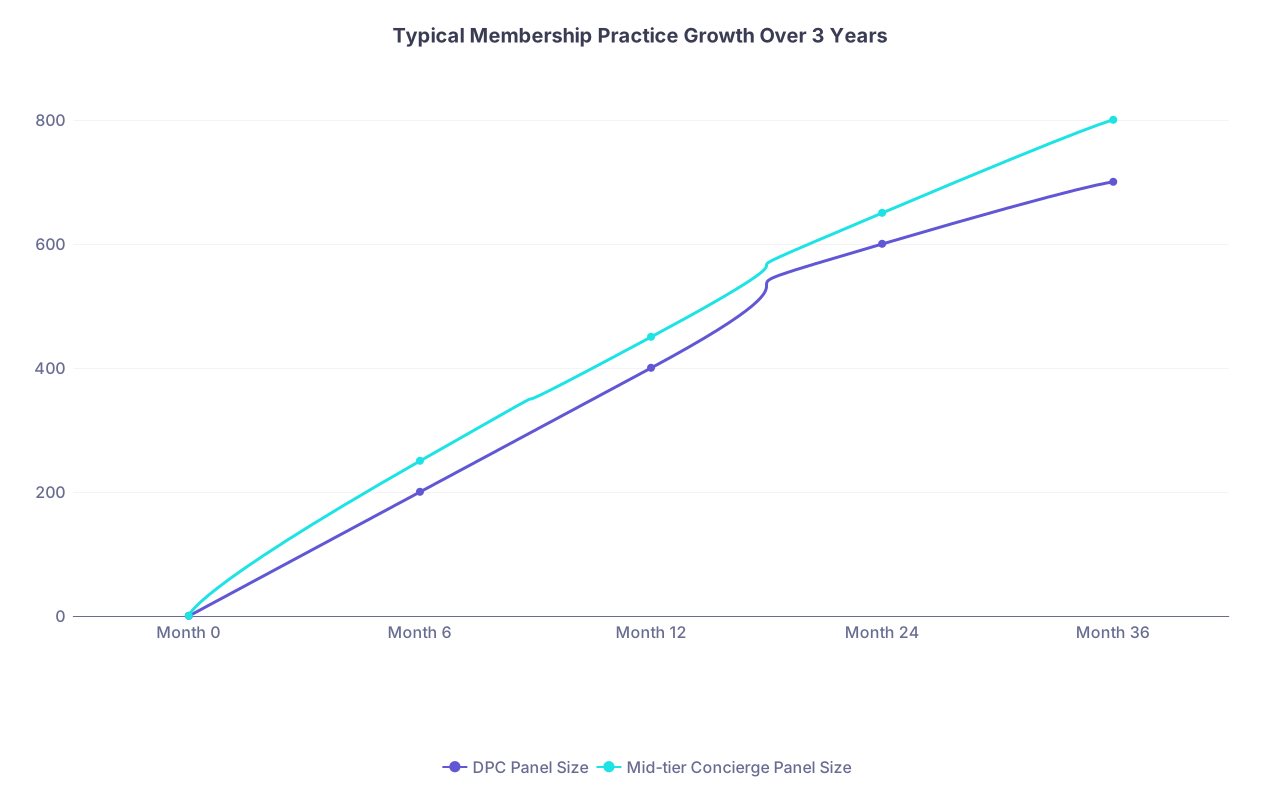
| Category | DPC Panel Size | Mid-tier Concierge Panel Size |
|---|---|---|
| Month 0 | 0 | 0 |
| Month 6 | 200 | 250 |
| Month 12 | 400 | 450 |
| Month 24 | 600 | 650 |
| Month 36 | 700 | 800 |
Again, not ultra‑wealthy math. Just “patients vote with their wallets when the value is obvious” math.
Where the “Ultra‑Wealthy Only” Criticism Is Legit
Now, the part the concierge evangelists like to ignore.
Even if concierge and DPC are not technically “only for the ultra‑wealthy,” they do:
- Pull physicians out of traditional panels, shrinking access for patients who truly cannot pay extra
- Skew toward insured, higher‑income, and more health‑literate patients
- Depend on patients having at least some discretionary income or flexible HSA/FSA dollars
If you’re thinking like a systems person, you’re right to worry: if 20% of primary care docs move into membership models, what happens to the safety‑net population?
You are also right to side‑eye the boutique outfits charging $10k+ retainers for what is sometimes glorified hand‑holding and excessive “executive physicals” with dubious downstream benefits. That part of the market is disproportionately serving the ultra‑rich and soaking up physician capacity.
So the myth you should be killing is more nuanced:
- Wrong: Concierge/DPC are only for the ultra‑wealthy.
- More accurate: Membership‑based care currently serves a mixed but income‑skewed population, and the highest‑end concierge tier absolutely caters to the ultra‑wealthy.
From your standpoint as a post‑residency doc, the key question is not “Does this model exist only for billionaires?” The more useful question is:
Can I design a membership practice that’s financially sane for me and accessible to a chunk of non‑wealthy patients — without pretending I’m solving healthcare inequality single‑handed?
Yes. You can. But you have to be honest about what you’re building.
If You’re Considering Starting One, Design Answers the Ethics
You control more knobs than you think:
Price point
Set fees at $60 vs $200 and you’re choosing your demographic. A sliding scale, sometimes combined with employer contracts, broadens access without tanking your revenue.Panel size
Chase the 200‑patient fantasy and you’ll need a luxury target market. Accept 500–800 and you can live on more moderate fees.Payer mix and insurance billing
Taking Medicare or commercial insurance in parallel lets you keep more of your existing “normal” patients and not force membership as the only door in.Employer partnerships
A lot of the “this is only for the rich” narrative disappears when midsize employers pay part or all of the membership as a benefit. Plenty already do.
Here’s the tradeoff most people miss: You can either be accessible and somewhat busy, or ultra‑exclusive and ultra‑expensive. Both can work financially. Only one requires ultra‑wealthy patients.
Design accordingly.
The Real Myth: That You’re Stuck With RVUs or Charity
The industry loves false binaries:
Either you grind RVUs in a hospital‑owned clinic “for the people,” or you sell out to concierge medicine and “abandon” regular patients.
Reality is messier. And more flexible.
You can:
- Build a DPC practice at $60–$90/month in a normal town and fill it with teachers, truck drivers, and early retirees.
- Run a mid‑tier concierge panel that caps at 600 and still take Medicare, still see long‑term patients who choose to stick with you.
- Reserve a set number of “access slots” or reduced‑fee memberships for patients who absolutely cannot pay full freight, funded by your better‑off panel and maybe an employer or two.
You will not fix American healthcare alone. But you also do not need a roster of billionaires to escape the treadmill.
Years from now, you will not remember the angry threads where people insisted concierge care was “only for the 1%.” You’ll remember whether you had the guts to look at the real numbers, pick a model that matched your values, and build a practice where both you and your patients stopped being collateral damage.