
Think your life will magically “open up” once you leave residency and join or start a private practice—fewer hours, more control, better pay, easy Fridays? Let’s put that fantasy under a microscope.
I keep hearing the same line from residents: “I’ll grind in residency, then go to private practice and finally have balance.” That belief is powering some truly bad decisions right now.
You are not wrong to want control over your schedule and your income. But the idea that “private practice = less work” is mostly fiction, and sometimes dangerously so.
Let’s dissect the myths with actual data and what real physicians experience after training.
Myth #1: Private Practice Automatically Means Fewer Hours
The core misconception: “Hospital employment is grind; private practice is lifestyle.”
Reality: your hours are driven by three things, none of which magically improve just because the sign on the door says “Medical Associates, PLLC”:
- Patient volume needed to cover overhead
- Payer mix and reimbursement rates
- How efficient your systems are (scheduling, documentation, staff, billing)
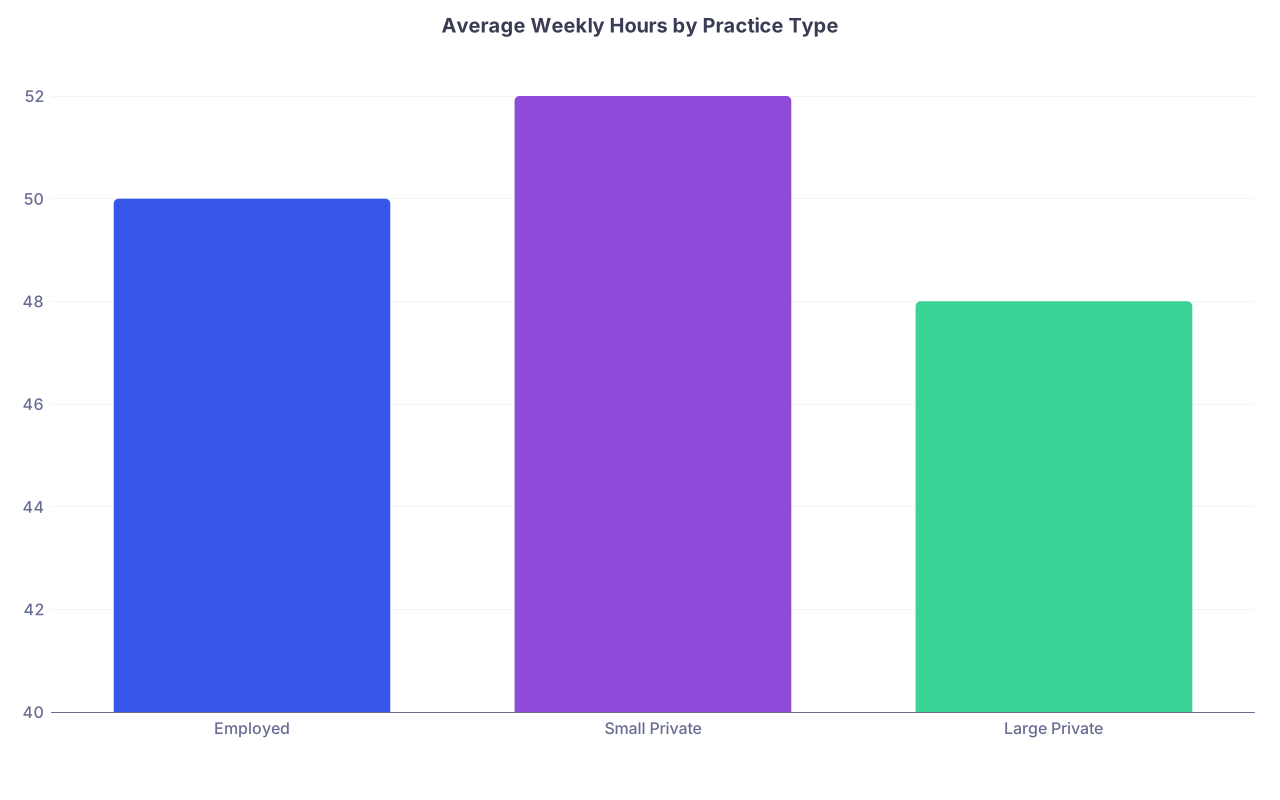
| Category | Value |
|---|---|
| Employed | 50 |
| Small Private | 52 |
| Large Private | 48 |
Survey data from MGMA and AMA Physician Practice Benchmark surveys have shown, over and over, that average weekly work hours between employed physicians and those in private practice are similar. Sometimes private practice is slightly higher, especially early on.
Why? Simple math.
You’re not just “seeing patients.” In private practice you’re:
- Reviewing claims and denials
- Dealing with prior auth nonsense yourself or overseeing it
- Hiring, firing, and training staff
- Meeting with your accountant, lawyer, IT vendor, EMR vendor, landlord
- Handling HR issues (yes, even that front desk conflict about who covers lunch)
When you’re employed, those headaches are someone else’s job. You might still have admin, but you are not the one whose take-home pay dies if claims don’t go out for a week.
Early Years: The “More Work, Less Security” Phase
The most misleading part of the myth: timing. The first 2–5 years in private practice are often the worst from a lifestyle standpoint.
You’re:
- Building a panel
- Establishing referral networks
- Negotiating contracts
- Learning how to run a small business on the fly
That’s usually more work, not less. I’ve seen new attendings go from 65–70 hour resident weeks to… 55–60 hour private-practice weeks that feel worse because now the stress is financial and operational, not just clinical.
You may eventually claw your way to more control and better hours. But it’s a longer, messier game than residency-trained optimism suggests.
Myth #2: “But I’ll Control My Schedule, So It’ll Feel Lighter”
You very likely will have more direct control over your daily schedule in private practice. That part isn’t total fiction.
But “control” is not the same as “freedom.”
Here’s the trap: when every open slot equals revenue that pays your staff, your rent, your malpractice, and your own salary, empty time doesn’t feel like freedom. It feels like bleeding.
So what happens in real life? A lot of physicians in private practice:
- Add early-morning and late-evening slots “temporarily” that never disappear
- Work through lunch because they overbook to compensate for no-shows
- Do charting at home because they’re squeezing max patient volume into clinic hours

| Step | Description |
|---|---|
| Step 1 | Finish Residency |
| Step 2 | Join or Start Private Practice |
| Step 3 | Increase Patient Volume |
| Step 4 | Extend Clinic Hours |
| Step 5 | Charting After Hours |
| Step 6 | Perceived Loss of Lifestyle |
| Step 7 | Lower Initial Income |
| Step 8 | Better Hours but More Financial Stress |
| Step 9 | Need Income Stability |
You do get to decide, theoretically, to leave Fridays light or block off school events for your kids. But if your overhead is high, your payer mix weak, or you took on too much debt, those “luxury blocks” get very hard to justify.
Control is a tool. Not a guarantee.
You can absolutely engineer a saner schedule in private practice—but it takes discipline, ruthless boundary-setting, and often accepting lower income than your maximal potential.
Myth #3: More Money Automatically Buys You Better Lifestyle
Here’s where the conversation usually goes next: “Even if I work a bit more, I’ll get paid more. I can always cut back later.”
Sometimes true. Often twisted.
Average compensation in private practice can be higher—if:
- You’re in a relatively high-reimbursement specialty (GI, ortho, derm, some subspecialty IM)
- You’re in a market where independent practices still have leverage
- You run a lean operation and don’t drown in overhead
- You don’t sell your soul to RVU madness to keep revenue up
But the key word is average. That hides the spread between:
- Owners who’ve spent 10–15 years building efficient, high-volume practices with good contracts
- Newly minted attendings who bought into a practice with opaque finances and bloated expenses
- “Owners” who are owners on paper but functionally glorified employees with risk and not much upside
| Factor | Hospital Employed | Small Private Practice |
|---|---|---|
| Income Variability | Low–Moderate | Moderate–High |
| Startup Risk | None | High (first 3–5 years) |
| Schedule Control | Moderate | High (but tied to revenue) |
| Admin Burden | Lower | High |
| Benefits Package | Generally Strong | Varies, often weaker early |
The lifestyle myth comes from watching the end state of a successful owner in a favorable market and assuming that is the default.
You’re seeing Dr. 20-Years-In leaving early on Fridays. You are not seeing 35-year-old Dr. Just-Joined who’s still hustling to fill their schedule, or Dr. Practice-Founder who almost went under twice during COVID shutdowns and payer changes.
Money can absolutely buy you margin—extra staff, scribes, better systems, more vacation. But it won’t automatically show up in year one because you hung a shingle.
Myth #4: “I’ll Escape Hospital Politics”
You probably will escape some of the worst hospital committee nonsense. No more “mandatory” 7 a.m. departmental town halls about a new logo.
But you’re trading one set of politics for another.
Private practice politics include:
- Insurance company games: prior auths, denials, underpayments, retroactive recoups
- Local referral turf wars: protecting referral streams, competing with big systems
- Internal group dynamics: partnership tracks, unequal call burdens, silent income disparities
- Vendor relationships: EMR contracts that feel like hostage situations
You may no longer answer to a hospital administrator evaluating your “productivity metrics,” but you do answer to payers and market forces that don’t care about your lifestyle either.
Some people prefer private practice politics because they at least feel more “aligned with the business.” Others find it more stressful because they personally carry the financial consequences.
Point is: you’re not “escaping politics.” You’re switching ecosystems.
Myth #5: Owning a Practice = Being Your Own Boss (Period)
You will hear this line endlessly: “In private practice, I’ll be my own boss.”
No. You will be one of your bosses. The others:
- Major commercial payers
- Medicare/Medicaid policy
- Your landlord
- Your bank (if you’ve taken out practice loans)
- Your staff—because if they walk, you’re cooked
In an employed job, you have a single big boss: the health system. In private practice, you have multiple bosses and they don’t talk to each other.
I’ve watched docs in solo or small practices:
- Bend their schedule to accommodate one high-referring PCP who constantly dumps last-minute “urgent” visits
- Add entire service lines (weight loss, cosmetics, extra procedures) just to keep the doors open because payer rates cratered
- Delay hiring necessary staff because one more salary would push them underwater
Are you more autonomous over some decisions? Yes. You choose your EMR. You choose (within reason) how quickly you see follow-ups. You design your workflows.
But you’re still operating inside a system that dictates much of what actually drives your day—reimbursement rules, quality metrics, audit risk, and patient expectations.
“Being your own boss” is partly real freedom. Partly marketing slogan.
How Private Practice Can Improve Lifestyle (If You’re Ruthless About It)
So far I’ve been tearing down illusions. Now let’s be fair.
You can absolutely build a better lifestyle in private practice than you’d get in most employed jobs—if you treat it as a long, intentional project rather than an automatic benefit.
Here’s what the physicians who actually pull it off tend to do differently:
They pick the right market, not just the right specialty.
Going solo primary care in a saturated urban area with 3 dominant hospital systems? Brutal. Joining a well-run group in a growing suburb with good commercial payer mix? Very different story.They understand the numbers cold.
Not vibes. Numbers. Things like:- Overhead percentage
- Average revenue per visit
- Days in accounts receivable
- No-show/cancellation rates
- Payer mix breakdown
If you can’t glance at a P&L and know what’s wrong in 30 seconds, you’re flying blind.
They build systems early instead of “muscling through.”
They don’t just “work harder” and drown in inbox and charting. They:- Hire good support staff and actually delegate
- Standardize visit templates and order sets
- Use scribes or smart documentation workflows
- Put hard rules around when they’ll be in clinic vs doing admin
They deliberately trade some income for time.
That might mean:- Capping daily visits at a level that allows same-day charting
- Closing one half-day per week for admin and not re-opening it “just this once”
- Not following every possible revenue stream (e.g., certain low-yield ancillaries) if they compromise sanity
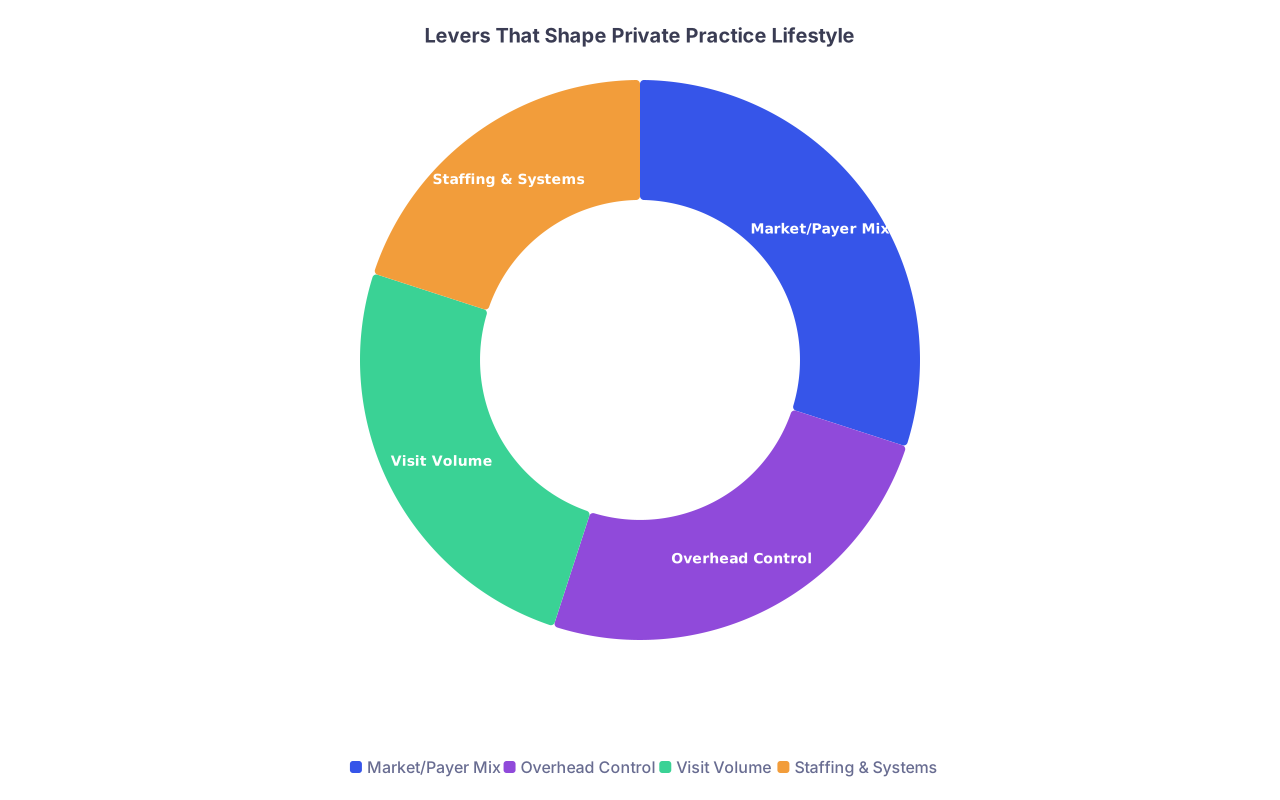
| Category | Value |
|---|---|
| Market/Payer Mix | 30 |
| Overhead Control | 25 |
| Visit Volume | 25 |
| Staffing & Systems | 20 |
- They plan financially for a long runway.
The ones who don’t panic and overstuff their schedules are usually the ones who:- Kept personal expenses sane for the first 5 years
- Built a cash reserve for the practice
- Didn’t assume year-one income needed to match their highest-employment offer
Those are the people who actually get to say, ten years in: “I work 4 days a week, my income is solid, and I control my schedule enough to make it work for my family.”
That outcome is possible. It’s just not automatic.
A More Honest Way To Think About Private Practice After Residency
So what do you do with all this, practically, as you face the post-residency job market?
A few hard-nosed principles:
Treat private practice as a business decision, not a lifestyle fantasy.
Assume your first 3–5 years will not be easier than an employed role. They may be harder, with different stressors.
Be crystal clear on what problem you’re trying to solve:
- Hate RVU pressure?
- Want more say in clinical decisions?
- Need geographic flexibility?
- Want ownership upside over 10–20 years?
“Less work” should not be your primary justification. It will betray you.
If you’re joining an existing private group, demand transparency:
- Actual wRVU expectations
- How overhead is allocated
- Realistic ramp-up timeline to partnership (and what partnership actually means)
- Historical turnover—why did the last two associates leave?

- If you’re starting your own practice, build your education first:
Talk to at least 5–10 owners in your specialty, in different markets. Ask what they got wrong. Look at sample pro formas. Understand credentialing timelines, payer enrollment, build-out costs, and how long they went without a real paycheck.
And—this is the part nobody wants to hear—strongly consider doing 3–5 years of employed work first while you:
- Pay down high-interest debt
- Study how your employer actually runs the business side
- Build relationships and referrals
- Learn which parts of private practice you crave and which realities you’re not willing to tolerate
That doesn’t mean you give up on private practice. It means you go in with leverage, cash, and open eyes.
The Bottom Line
Strip away the marketing and the wishful thinking, and here’s what’s left:
- Private practice does not inherently mean fewer hours. Early on, it often means more—and different—work.
- The real advantage of private practice is control and upside over the long term, not automatic lifestyle bliss in year one.
- The physicians who truly gain lifestyle from private practice treat it like a business, know their numbers, and consciously trade some income for time once the practice is stable.
If you want private practice, go for it. Just don’t confuse “being an owner” with “working less.” The system will not hand you that outcome. You’ll have to build it. Deliberately.