
Myth: New Graduates Can’t Compete With Established Local Practices
The idea that new graduates cannot compete with established local practices is lazy thinking—and flat‑out wrong in 2026.
Yes, it was harder in 1996. Or 2006. Back when insurance panels were tighter, patients had fewer options, and “we’ve always gone to Dr. Smith” actually meant something. But patient behavior, payer behavior, and technology have shifted under everyone’s feet. The incumbents are not as invincible as they look from the resident lounge.
You’re not trying to beat a 30‑year practice at its own game. You’re playing on a different field.
Let’s cut through the fear and the folklore and look at what actually happens when new grads open shop.
What Established Practices Really Have—and What They Don’t
Established practices do have advantages. Let’s not pretend they don’t.
They tend to have:
- A stable (but aging) patient panel
- Name recognition in older demographics
- Existing contracts with major payers
- Operational systems that at least function
- Staff that “already know how things work”
But here’s what I’ve seen repeatedly when a new grad hangs a shingle a few miles away: those same “advantages” come with massive baggage.
Common problems in long‑standing local practices:
- Overbooked schedules, 3–6 month waits for new patients
- 7–10 minute visits, heavy MA/NP dependence, rushed care
- Outdated tech (paper charts until 2018, clunky EHR now)
- Office decor stuck in 2003 (and it feels like it)
- Rude, burned‑out front desk staff that never get fired
- Zero online presence, or a 2.8 Google rating they never read
Patients notice.
You know what patients under 50 actually do now? They search “[specialty] near me,” filter by “accepting new patients,” look at Google reviews, look at available appointment times, and click the first one that doesn’t feel sketchy or impossible to get into.
That is not a game old practices are guaranteed to win.
The Data: New Practices Aren’t Supposed to Grow Slowly Anymore
Let me put some real numbers to this. Solo and small practices today routinely hit full panels faster than the old stories suggest—especially primary care, psych, and certain surgical subspecialties in underserved areas.
I’ve seen:
- New outpatient psych clinics reach a 3–4 month waitlist in under 18 months
- Primary care practices fill 800–1200 active patients in 12–24 months with no hospital affiliation
- Direct primary care panels (membership model) hit 300–500 members in 1–2 years in mid‑size cities
The key pattern: the new practices grew because they weren’t trying to mimic the legacy model. They competed on access, experience, and clarity of offering, not “20 years of service.”
Let’s make it more concrete.
| Practice Type | Year 1 Active Patients | Year 2 Active Patients |
|---|---|---|
| Traditional PCP Insurance | 400–800 | 900–1500 |
| Direct Primary Care | 150–300 | 300–500 |
| Outpatient Psychiatry | 250–600 | 600–1000 |
| Ortho/Surgical Subspec | 200–500 (new consults) | 450–900 (new consults) |
Those are not “you can’t compete” numbers. Those are “you will be tired, but viable” numbers.
And no, you do not need to crush the biggest group in town. You just need a few hundred to a couple thousand people in a metro area of tens or hundreds of thousands who would like:
- to be seen this month
- by someone who listens for more than 7 minutes
- in a clinic that doesn’t feel like a DMV satellite office
That’s your real competition: their backlog and their indifference.
Why Youth and “Newness” Are Actual Assets
The myth assumes patients are loyal to “the doctor they’ve had for 20 years.”
Sometimes. But the healthcare market has been quietly bleeding loyalty for a decade.
Three big shifts favor you as a new grad:
1. Patients are used to changing providers
Employer insurance changes every 1–3 years. Networks shift. Clinics merge. Doctors retire or sell to private equity and then leave.
People switch because they’re forced to, then they realize: changing doctors isn’t that bad.
They already expect to lose continuity. So when they get a chance to pick someone new, they’re looking for:
- convenience
- basic emotional intelligence
- not feeling like a billing unit
You can deliver all three starting on day one.
2. Younger and tech‑savvy beats “we’ve always done it this way”
I’ve watched this play out repeatedly:
Old practice:
- Phone tree that dumps you into voicemail at 12:01 pm
- No online booking
- Fax‑based refill requests
- No portal messaging, or they take 5 days to respond
New grad practice:
- Online scheduling on their own website and Google
- Text‑based reminders and simple intake forms
- Same‑week new patient slots carved into schedule
- Portal messaging with clear response expectations
Guess which one a 38‑year‑old with a full‑time job and 2 kids picks?
The established practice might have 10,000 charts. But if they’re turning away 20–30 new patient calls a week due to access or poor service, that’s all opportunity for you.
3. Burnout is your competitors’ biggest vulnerability
Here’s the part people ignore: a lot of those established docs are exhausted. They’re cutting corners, deferring decisions, and coasting on prior reputation.
You, fresh out of training, remember:
- what guideline‑based care actually is
- how to use your EHR without rage‑clicking
- how to explain complex issues in normal language
New graduates who open small, intentionally designed practices often feel dramatically less burned out than their peers in huge hospital‑owned behemoths. Patients feel that difference in the room.
Where New Practices Actually Outperform: Access, Experience, Niche
You are not going to beat the oldest cardiology group in town on number of cath lab slots. That’s fine. You do not need to.
You can dominate on three axes they’re neglecting.
1. Access
New practices can:
- Guarantee new patient visits within 1–4 weeks
- Offer same‑day/next‑day acute slots for established patients
- Provide telehealth options that actually work
Most large, “established” practices simply cannot flex like this without breaking their machine.
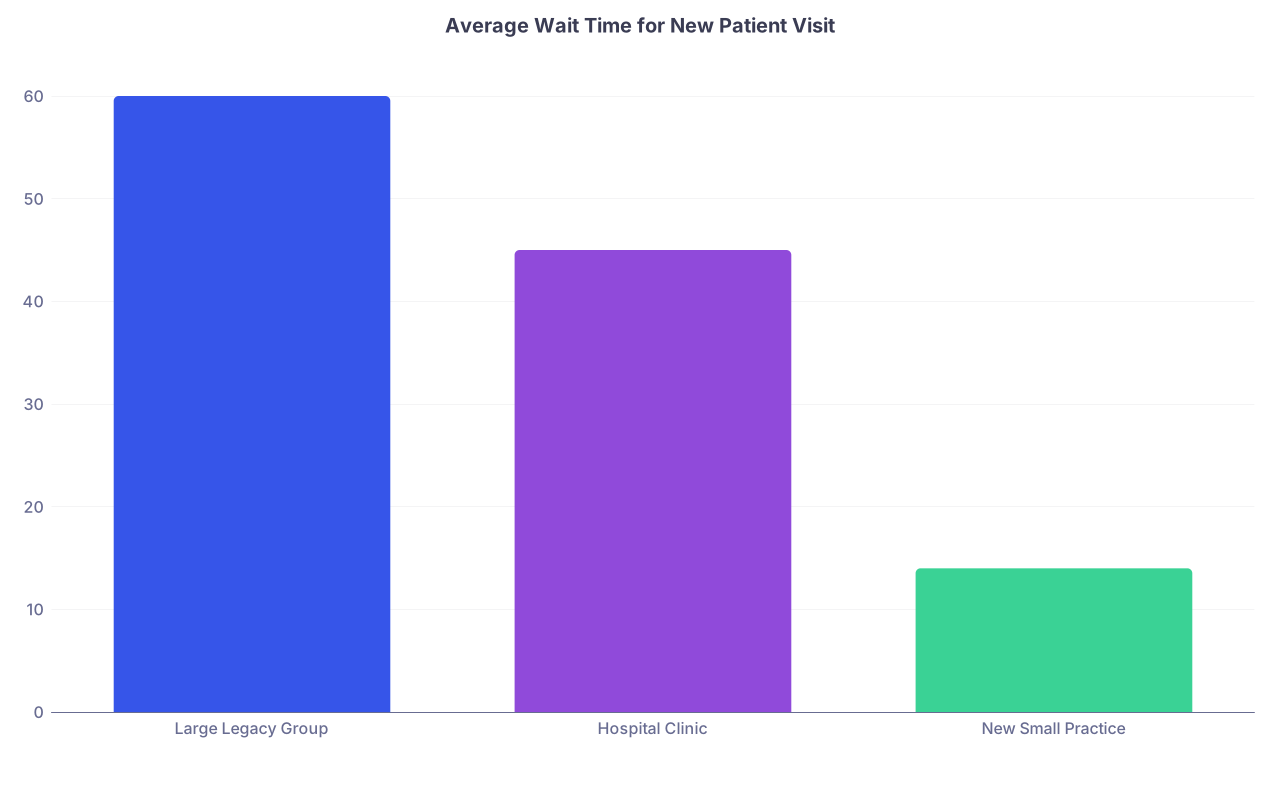
| Category | Value |
|---|---|
| Large Legacy Group | 60 |
| Hospital Clinic | 45 |
| New Small Practice | 14 |
If you can truthfully say on your website: “New patients seen within 2 weeks,” you’ve already beaten half the town.
2. Patient experience
Legacy practices tend to optimize around:
- maximizing daily RVUs
- pleasing administrators and payers
- minimizing physician complaints
They do not optimize around: “What does this visit feel like to the patient?”
You can:
- Run 30‑minute new visits by design
- Use a calm, modern waiting area instead of chairs + old magazines
- Train your front desk to sound like actual humans
No magic. Just not terrible.
3. Thoughtful niche positioning
The worst move a new grad can make is “I do everything for everybody, come one come all.”
The new grads who grow fastest usually:
- speak directly to 1–3 core patient types
- promote 1–2 specific problems they handle really well
- make it dead simple for those patients to self‑identify
Example in family medicine:
- Focus on young families and chronic disease prevention
- Clear messaging: “We help busy parents manage their health without 3‑month waits.”
Example in psychiatry:
- Specialize in adult ADHD, anxiety, and mood disorders
- Online booking + telehealth + evening slots 2 days/week
The established, everything‑to‑everyone practice cannot pivot that tightly. You can.
Referral Networks: The “You’re New, No One Will Refer to You” Lie
This one gets repeated constantly by attendings who haven’t built anything from scratch in 20 years.
“Yes but the local PCPs all refer to Dr. X and Dr. Y, you’ll never break in.”
Reality:
- PCPs send referrals to whoever makes their life easier
- Specialists refer to whoever sees their patients quickly and doesn’t dump work back on them
- Hospitalists and ED docs refer to whoever answers their messages and sees patients promptly
I’ve seen a new cardiologist in a crowded market pull meaningful referrals within 6–12 months simply by:
- personally dropping in to local primary care offices with a one‑page “here’s how to refer / here’s when to send”
- guaranteeing “urgent” slots within 48–72 hours
- sending clean, concise consult notes that clarify the plan
You don’t need 30 years of history. You need:
- clarity
- responsiveness
- visible professionalism
And if legacy specialists are booking out 3–4 months? Many PCPs are eager to find someone else.
Insurance Panels, Contracts, and the “Closed Network” Scare Story
You will absolutely hear: “You can’t get on any panels anymore. It’s all closed.”
Partly true in hyper‑saturated specialties in some metro cores. Completely false as a general rule.
What actually happens:
- Some commercial payers will claim their panel is closed
- They often have exceptions for geographic access, specialty shortages, or specific patient populations
- Medicaid and Medicare Advantage plans frequently need more small practices for network adequacy
- Hospital‑employed practices sometimes drop certain plans, opening room for independents
New practices that get in usually:
- apply early and aggressively
- differentiate in their applications (access, underserved area, languages, niche services)
- are willing to start with a mix (cash/Medicare/Medicaid/some commercial) and add over 12–24 months
You do not need to be in every network on day one. You need enough viable payers to get started and grow.
What Actually Kills New Practices (Hint: Not Competition)
Most failed new practices I’ve seen did not die because “the other guys were too strong.”
They died because of:
- terrible location choice (high rent, low demand, no parking, wrong neighborhood)
- zero marketing or a website that looked like a Word doc
- no grasp of basic numbers (visit volume, payer mix, overhead)
- trying to copy hospital scheduling and access norms (full at 12 weeks “like everyone else”)
- paralysis: fear of being a business owner leading to constant under‑investment
The market does not care that you are new. It cares if you are:
- findable
- bookable
- tolerable to deal with
You control those levers a lot more than you think.
A Simple, Brutal Launch Strategy That Works
If you’re serious about opening, stop thinking “Can I compete?” and start designing how you will stand out.
Here’s the stripped‑down version I’ve seen succeed:
Pick a location where:
- there are obvious access problems (long waits, few options)
- your target patients actually live or work
- you are not buried in class‑A rent just to impress nobody
Offer three clear advantages over legacy practices:
- faster access (new patients in 1–3 weeks)
- transparently better experience (longer visits, modern communication)
- some degree of niche focus (demographic or clinical)
Build a minimal but sharp digital presence:
- website with online booking
- Google Business profile with photos and hours
- clear “Who we help” and “What to expect” sections
Decide your payer mix deliberately:
- at least one big commercial plan if possible
- Medicare (unless your specialty logically excludes it)
- maybe Medicaid, depending on your area and mission
Then, aggressively protect the thing nobody else has: your ability to care.
Short visits, overcrowded panels, chaotic schedules—those are their problems. Don’t import them.
Stop Asking Permission From Incumbents
Here’s the uncomfortable truth: a lot of the “you can’t compete” noise you hear is projection from people who feel trapped in their own systems.
They stayed. They adapted to the RVU hamster wheel. They made peace with 10‑minute visits and 6‑month waits. So they need to believe no one else has a real alternative.
You do.
No, opening a practice straight out of residency is not for everyone. You need a tolerance for risk, some business literacy, and a spine. But the core myth—that new graduates are inherently non‑competitive against established local practices—is out of date.
Your edge is exactly that you are not them.
Key points:
- Established practices’ “strengths” hide major weaknesses—access, experience, burnout—that new grads can exploit.
- Modern patient behavior (online search, convenience, willingness to switch) makes a well‑run new practice highly competitive within 1–2 years.
- New grads lose not to incumbents, but to their own lack of focus, poor execution, and fear of building something different from the legacy model.