
The most dangerous part of taking over an aging physician’s panel is thinking it will “just work itself out.” It won’t. If you do this passively, you’ll bleed patients, burn out, and inherit all of their problems with none of their loyalty.
You’re stepping into a high‑risk, high‑upside situation. Handled right, you can launch your private practice with a full panel, stable revenue, and built‑in community trust. Handled wrong, you’ll be doing 40‑minute visits with complex 80‑year‑olds reimbursed at Medicare rates while charting until midnight and watching the schedule slowly empty.
Let’s walk through how to do this like a grownup business owner, not a grateful new grad hoping for the best.
1. First: Understand Exactly What You’re Inheriting
Do not sign anything until you’ve seen real data on this panel. Not vibes. Not “they’ve been with me forever.” Actual numbers.
If you’re in this situation, pull or request:
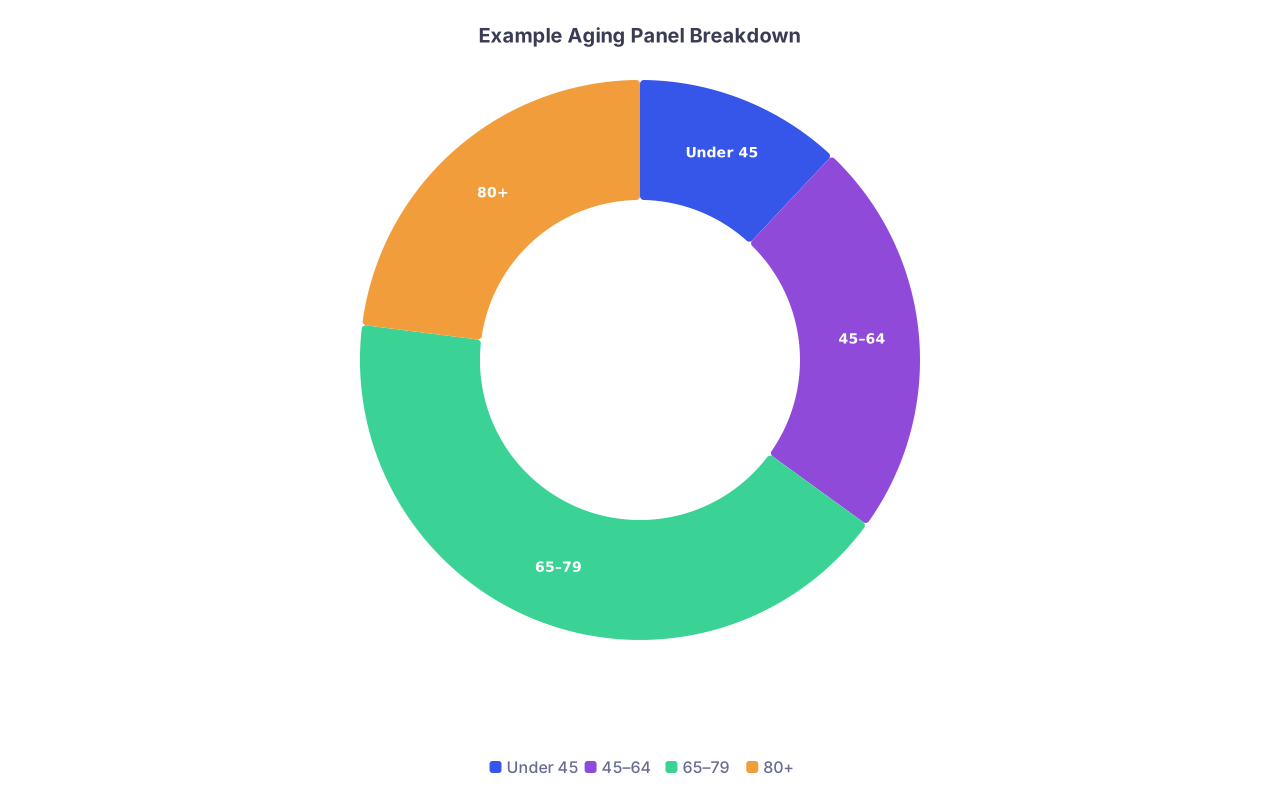
| Category | Value |
|---|---|
| Under 45 | 12 |
| 45–64 | 23 |
| 65–79 | 42 |
| 80+ | 23 |
You want at least:
- Active patient count: Defined as seen in the past 18–24 months, not “ever.”
- Age distribution: Aging panel can mean 65+, but I’ve seen panels where 25% are over 80. That’s a different world.
- Payer mix: Medicare, Medicare Advantage, Medicaid, commercial, self-pay.
- Visit volume: Average visits per day/week, no‑show and cancellation rate.
- Panel churn: New patients per month vs patients lost per month over the last 1–2 years.
- Top diagnoses and complexity: A quick pull of ICD codes + chronic problems gives a sense of how sick this group is.
- Care gaps: How many are overdue for AWVs, cancer screening, immunizations, etc.
If the practice can’t give you this, that’s already a red flag about operations and data hygiene.
Here’s how I’d sanity‑check whether this panel can support you:
| Metric | Green Light | Yellow Flag | Red Flag |
|---|---|---|---|
| Active patients | ≥ 1,500 | 1,000–1,500 | < 1,000 |
| 65+ proportion | 40–60% | 60–75% | > 75% |
| Payer mix Medicare/MA | 40–70% | 70–85% | > 85% |
| Avg daily visits | 16–22 | 12–15 | < 12 |
| New pts/month | ≥ 15 | 8–14 | < 8 |
You can make a Medicare‑heavy practice work. But if 80% are 75+ and every second chart reads like a board exam question, your schedule and staffing need to reflect that from day one.
If you’re buying into a private practice, couple this with financials: revenue, overhead, accounts receivable, and denial rates. You are not just inheriting patients—you’re inheriting the business habits that shaped that panel.
2. Set the Ground Rules Up Front (With the Senior Doc)
This transition lives or dies on expectations. Yours, the retiring physician’s, and the patients’.
Common mistakes I’ve seen:
- Retiring doc “half retires” for 3–4 years and never really lets go.
- New doc is treated as a temp rather than the future.
- Patients are told “you can see Dr. New if you want” instead of “I trust Dr. New; they will be your doctor now.”
You need a blunt, detailed talk with the senior physician about:
Timeline
Not “I’ll cut back over the next few years.” Get specific.- When do they stop taking new patients?
- When do they drop to fewer clinic days?
- When is their firm end date?
Messaging authority
Who controls the messaging around the transition? If the older doc is vague or keeps telling patients “I’m not sure how long I’ll be here,” patients will just…wait. And you’ll sit with half‑empty templates.Naming you as successor
This is non‑negotiable. They should be saying, everywhere:- “I’ve chosen Dr. X to take over my panel.”
- “If I were choosing a doctor for myself/my spouse, it would be Dr. X.” The language matters. Patients pick up every nuance.
Clinical boundaries
You are the physician of record once you take over. That means:- You are not obligated to continue unsafe or sloppy prescribing (chronic benzos, opioids, nonsense polypharmacy).
- You may change referrals, workups, and management based on your judgment.
Make sure the older doc understands and supports this in front of patients. “Medicine changes. I trust Dr. X’s approach” is what you want them to say.
Write out a brief transition plan and have both of you sign it. Not for court. For clarity.
3. Design the Handover Process Like a Project, Not a Vibe
This is where people wing it and regret it.
You need an actual transition structure:
A. Timeline and phases
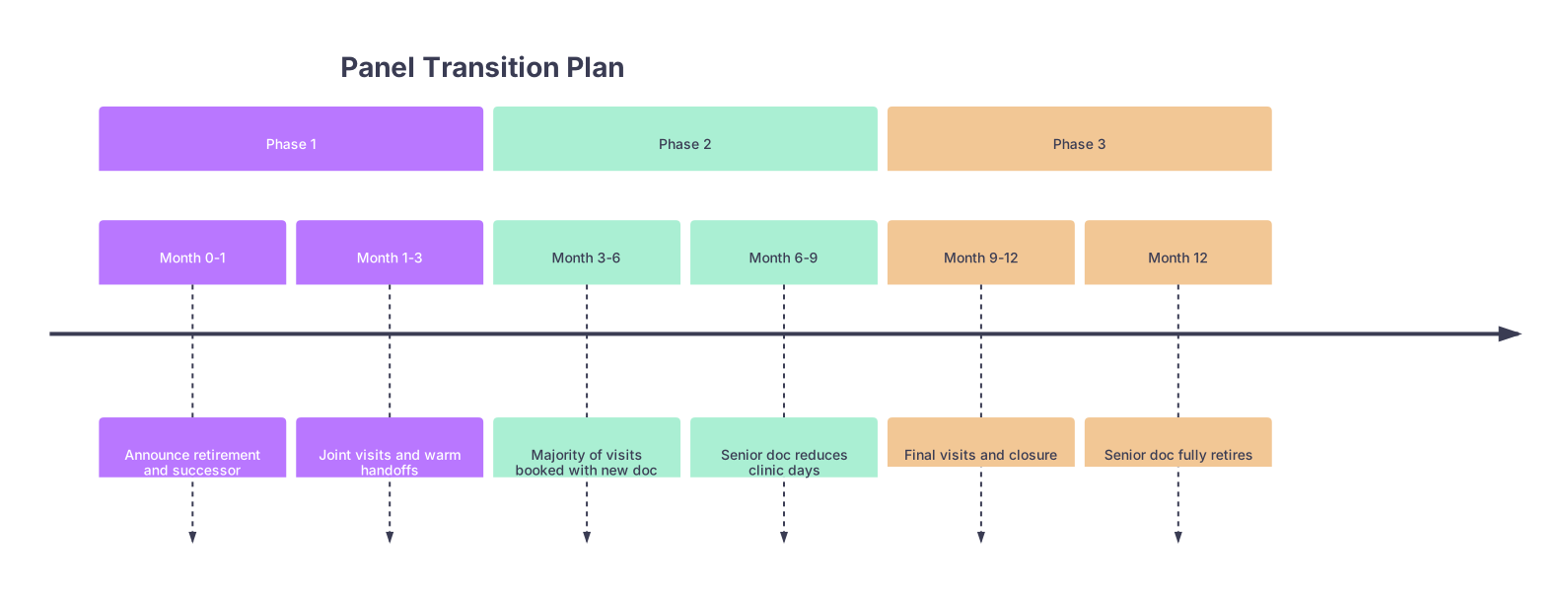
Sketch something like:
| Period | Event |
|---|---|
| Phase 1 - Month 0-1 | Announce retirement and successor |
| Phase 1 - Month 1-3 | Joint visits and warm handoffs |
| Phase 2 - Month 3-6 | Majority of visits booked with new doc |
| Phase 2 - Month 6-9 | Senior doc reduces clinic days |
| Phase 3 - Month 9-12 | Final visits and closure |
| Phase 3 - Month 12 | Senior doc fully retires |
Do not leave it open‑ended. Once you start, you move forward, not back.
B. Joint visits and warm handoffs
For the first 2–3 months, book a chunk of visits as shared:
- Senior doc + you + patient in the room (even if only for 5–10 minutes together).
- Senior doc explicitly introduces you as their successor.
- You close the visit, set follow‑up with you, not them.
This is time‑consuming. It is also your best marketing and trust‑building tool.
You can structure the schedule: 30‑minute slots where the older doc does the first 10 minutes while you finish charting, then calls you in for the last 10–15. Or vice versa.
C. Proactive outreach to high‑risk and high‑value patients
Don’t sit back and wait to see who schedules.
Generate a list of:
- Patients with 3+ chronic conditions.
- Patients with > 4 medications.
- Recent hospitalizations or ED visits.
- Patients with strong community “influence” (the ones whose opinion spreads fast).
Have the practice call them personally:
- “Dr. Smith is transitioning his practice to Dr. Lee. We want to get you scheduled with Dr. Lee in the next couple of months.”
- Offer them “welcome visits” that aren’t just problem-based—especially for complex patients.
These 50–100 patients will disproportionately shape how the rest of the panel views you.
4. Get Control of the Clinical Chaos Early
You will inherit some messy medicine. Everyone does.
Old‑school docs who have practiced for 30+ years often:
- Renewed meds forever without clear indications.
- Avoided deprescribing because “they’ve been on it for 20 years.”
- Documented sparsely (“HTN stable”) with little rationale.
You can’t fix this in one visit, but you need a strategy.
A. Create a “transition script” for clinical changes
You will repeat this, so get good at it. Something like:
- “You and Dr. Smith have been together a long time. Medicine changes, and so does our understanding of safety.”
- “Now that I’m your doctor, part of my job is to take a fresh look at everything you’re on and make sure it still makes sense for you now.”
- “I’m not changing everything today. But over the next few visits, you’ll see me adjust some things to keep you as safe and functional as possible.”
Then tackle the worst offenders first: overlapping sedatives, dangerous antihypertensive stacks in frail 85‑year‑olds, no statin in high‑risk diabetics, etc.
B. Build clear visit types into your schedule
For the first 6–12 months, don’t run a generic “15 minutes for everything” template. You will drown.
Have scheduling categories like:
| Visit Type | Length | Purpose |
|---|---|---|
| New to me – simple | 20 min | Younger, few meds, 1–2 chronic issues |
| New to me – complex | 30–40 min | Elderly, polypharmacy, multiple comorbidities |
| Transition AWV | 40 min | Medicare wellness + medication review |
| Hospital/ED follow up | 30 min | High‑risk, recent event |
Train front desk and MAs how to triage into these buckets. For example, >5 meds or >3 chronic conditions = complex.
C. Use your team aggressively
If you try to personally do every care gap, med reconciliation, and education piece, you’ll burn out.
- MAs/RNs: pre‑visit med list cleanup, vitals, screening tools (PHQ‑9, falls, cognition), immunization review.
- Care coordinator (if you have one): AWV scheduling, closing care gaps, arranging DME, home health, etc.
- Pharmacist (if available): polypharmacy reviews on your highest‑risk patients.
You want your face‑time to be thinking and deciding, not hunting for flu shot dates buried in scanned PDFs.
5. Nail the Patient Communication and Trust Transfer
Older patients do not automatically trust you because you trained recently or “know the newest guidelines.” Many actively distrust that.
You don’t win them with a CV. You win them with how you handle their attachment to the old doc.
What the retiring physician should say
Coach them. Literally give them phrases.
- “I picked Dr. Patel for a reason.”
- “We’ve talked about your care; I trust them to look after you the way I would.”
- “I’ll be stepping back, and Dr. Patel will be the one making the decisions going forward.”
If the retiring doc is vague or undermining (“You can always come see me if you’re not comfortable”), expect chaos.
What you should say in the room
Hit three notes in almost every first visit:
Respect
“You and Dr. Smith have done a lot of good work together over the years.”Continuity of values
“My goal is the same as his: keep you independent, comfortable, and out of the hospital as much as possible.”Clear ownership
“From here on out, I’ll be your main doctor. I’ll be the one reviewing everything and making recommendations.”
Then shut up and listen for a few minutes. Ask:
- “What matters most to you right now—what are you most worried about?”
- “Is there anything you wish we had done differently in your care before?”
You’ll learn very fast where landmines are—untreated pain, ignored symptoms, family drama, etc.
6. Protect Yourself Legally and Financially
You are responsible for your clinical decisions, but you’re also stepping into someone else’s documentation and legacy.
A. Documentation standards
From day one, chart like this is a brand‑new patient, even if they’ve “been here 20 years.”
At the first visit with you, capture:
- Problem list cleaned and prioritized.
- Medication list reconciled with your actual understanding.
- Allergies clarified (half of “allergies” in old charts are side effects).
- Code status and basic goals of care on anyone with serious illness or 80+.
You don’t have to fix every issue, but your note should show: you recognized complexity, acknowledged prior approach, and made a reasonable plan.
B. Malpractice coverage and prior acts
If you’re joining or buying the practice:
- Confirm how claims‑made vs occurrence coverage is handled.
- Check whether you have “prior acts” coverage for care after you take over, even if based on longstanding prescriptions or conditions created under the prior doc.
- If the old doc is retiring, make sure they get tail coverage. You do not want finger‑pointing later.
C. RVUs and compensation realities
A geriatric, Medicare‑heavy panel is cognitively harder and often pays less per unit of your brain power.
If you’re on pure RVUs with no adjustment for panel complexity, you may be undervalued.
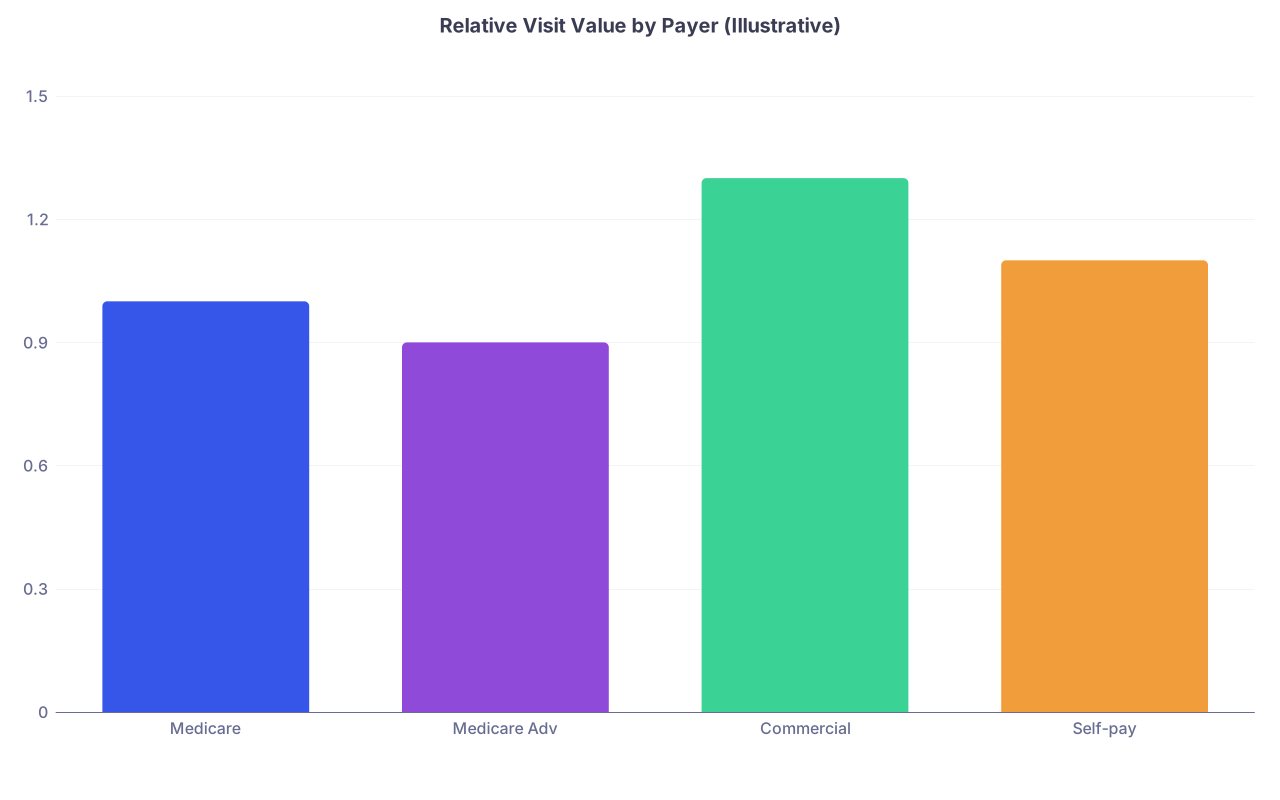
Look at:
| Category | Value |
|---|---|
| Medicare | 1 |
| Medicare Adv | 0.9 |
| Commercial | 1.3 |
| Self-pay | 1.1 |
Ask bluntly:
- Is there a panel management or quality bonus tied to this?
- Any extra stipend for taking on a “difficult to recruit” geriatric panel?
- Any flexibility in templates to allow longer visits without punishing RVU targets?
If they act like a 90‑year‑old with CHF, CKD, dementia, and 15 meds is “just another level 3,” you’re in the wrong deal.
7. Start Modernizing—Without Alienating Everyone
You’re not there just to keep the ship afloat. You’re there to update it without capsizing it.
A. Introduce changes in layers
Do not walk in day one and announce:
- New portal
- New check‑in workflow
- New refill policy
- New “no refills without visits” rule
- New everything
You’ll trigger a small rebellion.
Instead, something like:
Month 1–3:
- Stabilize the handoff.
- Learn the culture, staff, and patient patterns.
- Fix only safety issues and egregious prescribing.
Month 4–6:
- Implement 1–2 key process improvements (e.g., structured refill policy, improved phone/portal routing).
- Start gently nudging people toward portal use (family members can help a lot).
Month 7–12:
- Tighten up visit intervals, AWV programs, chronic disease protocols.
- Introduce group visits or chronic care management if appropriate.
B. Use the staff as cultural translators
The MA who’s been there for 15 years knows exactly which patients hate change and which are quietly waiting for modernization.
Sit with them. Ask:
- “Who’s going to be my toughest critic?”
- “Who’s surprisingly open to new things and will talk about it positively in the waiting room?”
Win over a few key skeptics with extra time and attention. They will talk.
8. Grow Beyond the Inherited Panel (You Must)
If you rely only on the aging panel, you’re building on a slowly shrinking base. People move, die, or eventually stop coming.
You need a growth plan from day one, even if the old doc insists “my panel’s full.”
A. Accept new patients strategically
Yes, you’re busy learning the old panel. But set aside at least:
- 3–5 new patient slots per week at first.
- More later as you get efficient.
Use simple marketing levers:
- Update the practice website to feature you clearly as “accepting new patients.”
- Make sure Google Business profile is accurate and highlights you.
- Let local specialists know a younger doc has joined and is happy to take new complex patients.
B. Balance age and payer mix over time
Left alone, your panel will skew older and more Medicare‑heavy. You want some counterbalance.
Your future self will thank you if you intentionally:
- Allow some younger commercial patients in each week.
- Maintain a mix so every session isn’t wall‑to‑wall 80‑year‑olds with 10 meds.
Over 2–3 years, the panel will organically become “yours” rather than “the old doc’s,” but only if you cultivate the next wave.
9. Watch for Burnout Traps and Fix Them Early
Taking over an aging panel is mentally and emotionally heavy. You’re walking into long‑standing relationships, end‑of‑life decisions, and a lot of grief.
Common traps:
- Spending 30–40 minutes with everyone but coding level 3 because you “feel bad.”
- Doing all your reconciliation and chart cleanup after hours.
- Taking on every emotional burden the old doc carried, without the decades of relationship that made it sustainable.
You need boundaries:
- Use time‑based coding appropriately when your documentation supports it.
- Batch certain tasks: med reconciliation for the worst offenders, then refine over time.
- Build a palliative/hospice referral network you trust and actually use.
If you’re exhausted and bitter after three months, that will leak into how you treat patients and staff. And they will absolutely pick up on it.
FAQs
1. How long should a typical panel transition from an aging physician to me take?
Plan for 9–18 months from first announcement to full handoff. Anything under 6 months tends to feel abrupt and can spook patients; anything over 2 years risks endless limbo where nobody is sure who their doctor really is. I like a structure where the first 3 months are heavy joint visits, the next 3–9 months are progressive handoff, and the final 3–6 months the senior doc is mostly seeing last‑visit “goodbyes” and a few stragglers.
2. What if patients refuse to follow me and insist on waiting for the older doctor?
You don’t chase everyone. Some will only trust the retiring doc, and that’s not a failure on your part. The key is that the older physician doesn’t enable permanent limbo; they should clearly state their retirement date and that ongoing care will be with you or another designated provider. For the stubborn cases, offer one joint visit where all concerns are aired, you align with the senior doc in front of the patient, and then you let them decide. Some will still leave. That’s fine. Focus on the ones who are at least mildly open to you.

3. How do I handle unsafe or questionable prescribing patterns I inherit?
You cannot just shrug and continue everything “because that’s how it has always been.” Once you’re the treating physician, you own the risk. Prioritize what’s actually dangerous: opioid and benzo combos, anticholinergics in dementia, insane blood pressure targets in frail patients. Use a consistent script explaining that medical understanding has evolved and your obligation is to keep them as safe as possible. Change the worst issues over several visits, not all at once, but don’t let fear of upsetting people lock you into bad practice.
4. Should I offer longer visits for all inherited patients initially?
Not all. That’s how you blow up access and your sanity. Use some triage rules: anyone over 75 with 4+ meds or 3+ chronic conditions gets a longer slot at first. Younger or relatively healthy inherited patients can be booked more like standard new visits. Over time, as the panel stabilizes and you’ve “cleaned up” the most complex charts, you can gradually normalize visit lengths. The key is to front‑load sufficient time for the highest‑risk, most complex patients so you’re not constantly playing catch‑up.
5. How can I tell if the financial deal to take over this panel is actually fair?
Look at concrete data, not promises. You want at least 12–24 months of revenue reports, payer mix, encounter volumes, and denial rates. Calculate realistic collections given the age and payer mix, then subtract actual overhead, not fantasy numbers. Compare that to your proposed compensation structure—if you’re salaried, does your salary plus benefits fit comfortably within expected net revenue? If you’re buying in, are you paying a premium for goodwill that’s actually a shrinking, high‑workload panel? When in doubt, pay a health‑care savvy accountant or consultant for a few hours to review the numbers. That small bill can save you from a multi‑year mistake.
Key points: Treat this like a structured, time‑bound handoff project, not an informal “you’ll take over my patients eventually” promise. Take clinical and business control early—visit structures, documentation, panel data, and messaging. And while you respect the legacy you’re inheriting, you’re not there to be a carbon copy; you’re there to build a sustainable, modern practice on top of that foundation.