
The worst mistake new attendings make is thinking “ownership” is automatically good—then grabbing the first clinic that falls in their lap.
You’re smarter than that. You’ve got two offers on the table: buy an existing clinic or start your own from scratch. This is where careers fork. One path can trap you in someone else’s bad decisions. The other can waste years of your life in an empty waiting room if you misjudge the market.
Let’s walk through how to decide—step by step—like a grown-up business owner, not a starry-eyed new attending.
Step 1: Get Clear on What’s Actually on the Table
Before you even think “buy vs build,” you need brutal clarity on what exactly is being offered.
Ask these hard, specific questions about the clinic you’re being offered:
- What, exactly, am I buying?
- How much, exactly, will it cost me per month to keep the doors open?
- How many real patients are there, and how many are fictional (charts that haven’t been seen in 2+ years)?
Here’s what you should demand in writing from the selling clinic:
- Last 3 years of:
- P&L (profit and loss statements)
- Tax returns
- Production and collections reports by provider and by payer
- Active patient panel count: patients seen in the last 18–24 months
- Payer mix: commercial vs Medicare vs Medicaid vs self-pay, by percentage
- New patient numbers per month for the last 12 months
- List of major contracts (insurances, hospital affiliations, subleases)
- List of staff with tenure, salaries, benefits
- Lease details: term, rent escalations, renewal options, assignment clauses
- Any outstanding debt tied to equipment, EMR, or build-out
If the seller hesitates, delays, or “forgets” these documents, that’s not a red flag—that’s a blaring siren. I’ve watched deals die (and careers saved) because a seller couldn’t produce clean numbers.
At the same time, outline what “starting from scratch” really means in your situation. Not dreams. Actual numbers and tasks.
- Area you’d open in
- Rough square footage
- Tentative timeline (credentialing, build-out, opening)
- How you’ll pay rent and yourself for the first 12–18 months
Only after you have both pictures—real numbers for the purchase and realistic projections for a start-up—does the “which should I choose?” question mean anything.
Step 2: Understand the Core Tradeoff
Owning a clinic is basically buying or creating 4 things:
- Patients
- Cash flow
- Infrastructure (staff, lease, systems, EMR)
- Reputation/brand in the community
Buying an existing clinic = you’re paying upfront for those 4 things.
Starting from scratch = you’re paying with time and risk to build those 4 things.
That’s it.
So the real question is: in your specific market and life situation, is it smarter to pay with money (buying) or with time and uncertainty (starting from zero)?
Step 3: Run the Numbers Side by Side (Not in Your Head)
Stop trusting vibes. Run the math.
Let’s set up a simple comparison to keep your brain honest.
| Item | Buy Existing Clinic | Start From Scratch |
|---|---|---|
| Upfront cost | Purchase price + closing costs | Build-out + equipment + legal |
| Time to full schedule | 0–6 months (if stable) | 12–24 months (often longer) |
| Risk of low volume | Lower if numbers are real | High first 1–2 years |
| Ability to change systems | Slower (inherit old habits) | Max control from day one |
| Staff situation | Inherited team | Must hire and train |
| Brand and community presence | Already known | Must build from scratch |
Now put real numbers to it.
For the existing clinic
You want at least:
- Purchase price
- Average annual collections (not charges) for last 3 years
- Net income (owner take-home) for last 3 years
A reasonable sanity check:
- If the clinic is stable and you plan to step into the owner’s role:
- A common ballpark for primary care/low-acuity specialties is 1.0–1.5× last year’s net income
- For very desirable markets / high demand / great payer mix, maybe up to 2×
- If they’re asking 3× net or more, it had better be a unicorn practice
If the practice is struggling or you’ll need to rebuild it, the value may be mostly equipment + accounts receivable and little to no “goodwill.” And I’ve seen naïve buyers overpay massively for “potential.” Potential doesn’t pay your student loans.
For starting from scratch
Build a brutal, conservative projection:
- Months 1–6: Maybe 5–10 patients/day (if you’re hustling).
- Months 6–12: 10–14 patients/day.
- Year 2: You might reach 16–20/day depending on specialty and location.
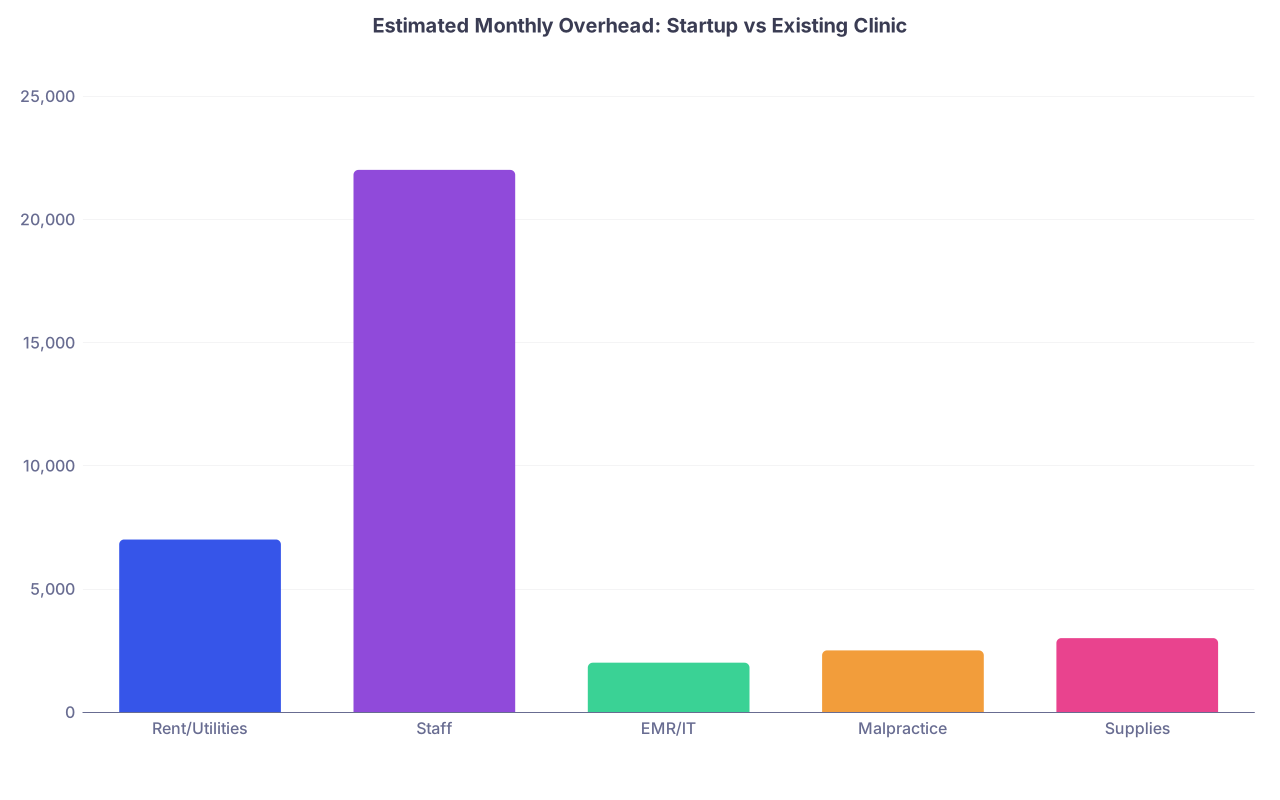
Then layer in your fixed costs:
- Rent + CAM
- Staff: front desk, MA/nurse, biller (in-house or outsourced)
- Malpractice
- EMR and IT
- Supplies, equipment leases, insurance, accounting, legal
| Category | Value |
|---|---|
| Rent/Utilities | 7000 |
| Staff | 22000 |
| EMR/IT | 2000 |
| Malpractice | 2500 |
| Supplies | 3000 |
Ask yourself: how many months can you personally float $25–40k/month in overhead plus your own living expenses before the clinic breaks even?
If your stomach drops when you run these numbers, that’s good. You’re finally seeing the real decision.
Step 4: Match the Option to Your Life Stage and Personality
Some people should almost never start from scratch. Others should almost never buy certain existing practices.
Let me be blunt.
You’re likely a better fit to buy an existing clinic if:
- You value income stability more than creative control.
- You’re in a market with long wait times and high demand.
- The clinic is in a killer location and you’d want that exact spot anyway.
- You’re not excited about negotiating leases, overseeing construction, or dealing with permit nonsense.
- You already have a family, mortgage, and minimal tolerance for 12–18 months of low income.
You’re likely a better fit to start from scratch if:
- You’re picky about workflow, EMR, staffing culture, or clinical model (e.g., DPC, lifestyle clinic, hybrid telemed).
- You strongly dislike inheriting someone else’s habits, panel, or problematic staff.
- You’re in a rapidly growing area with demand but little competition, and good spaces are available.
- You have some financial cushion or spouse income to absorb 1–2 years of lower earnings.
- You want to differentiate (even slightly) from the standard insurance-based churn model.
Neither is morally superior. I’ve seen brilliant, ethical physicians choose both and do well. The disasters usually happen when someone picks an option that doesn’t match their risk tolerance, energy, and personal life.
Step 5: How to Evaluate the Existing Clinic Like a Shark, Not a Friend
This is where new attendings get sentimental. They like the seller. They trained there. Patients “need continuity.” And they overpay.
You’re not buying a relationship. You’re buying a cash-flowing asset (or you’re not).
Here’s how to dissect it.
1. Is the revenue reproducible by you?
If the seller is triple-boarded, does niche procedures, or is the only gyn-onc in town, and you’re a straightforward IM doc, those numbers are not reproducible. You can’t assume their collections become your collections.
You want:
- Most revenue from services you also provide.
- Minimal dependence on one or two huge referral sources tied to the seller personally.
- Evidence patients already see NPs/associates or other doctors in the practice, not just the seller.
2. Patient panel quality
Not all “2,500 active patients” are actually active. I’ve seen practice brokers inflate this shamelessly.
Focus on:
- Patients seen in last 18–24 months.
- Payer mix:
- If 60–70%+ is Medicaid in a low-reimbursement state, margins will be tight.
- Out-of-network or cash-heavy panels are worth more if they’re loyal.
- New patients/month trend: increasing, flat, or shrinking?
If the clinic’s new patient numbers are dropping year over year, you’re buying a slowly dying asset.
3. Overhead and staffing
Study their expenses like your life depends on it. Because it does.
Pay attention to:
- Staff salaries relative to local market
- One particularly overpaid “office manager” or long-term biller no one wants to fire
- Multiple family members on payroll
- Rent that’s above market for the area
If overhead is bloated, your “deal” might just be a mess you’ll have to fix in year one—while you’re learning to be an owner.
4. Reputation and risk
Search Google, Yelp, Healthgrades. Ask nurses and primary care docs at nearby hospitals: “What have you heard about Dr. X’s clinic?”
If the clinic has:
- Lots of recent 1-star reviews
- Known billing complaints
- A reputation for pill-mill behavior or overtesting
—run. I don’t care how cheap it is.
Step 6: How to Sanity-Check a Startup in Your Market
On the other side, don’t romanticize a fresh, shiny clinic either.
Before you commit to starting from scratch, you need:
- Hard data on local competition
- Realistic timeline to get on insurance panels
- Confirmation that landlords actually have decent medical build-out spaces
Use these questions:
- How many clinics of your specialty are within a 5–10 mile radius?
- How long is the wait time for new patient appointments at those clinics?
- Can you get on key payers’ panels? Some are closed in saturated markets.
- Are there health systems aggressively buying up PCPs or specialists and funneling everything in-house?
If you call 3 local practices and they all say “We can see new patients in 2–4 weeks,” your dream of being overwhelmed with demand on day one is fantasy.
In contrast, if they say “We’re booking new patients in 4–6 months,” you’re in a market where even a startup has a fighting chance.
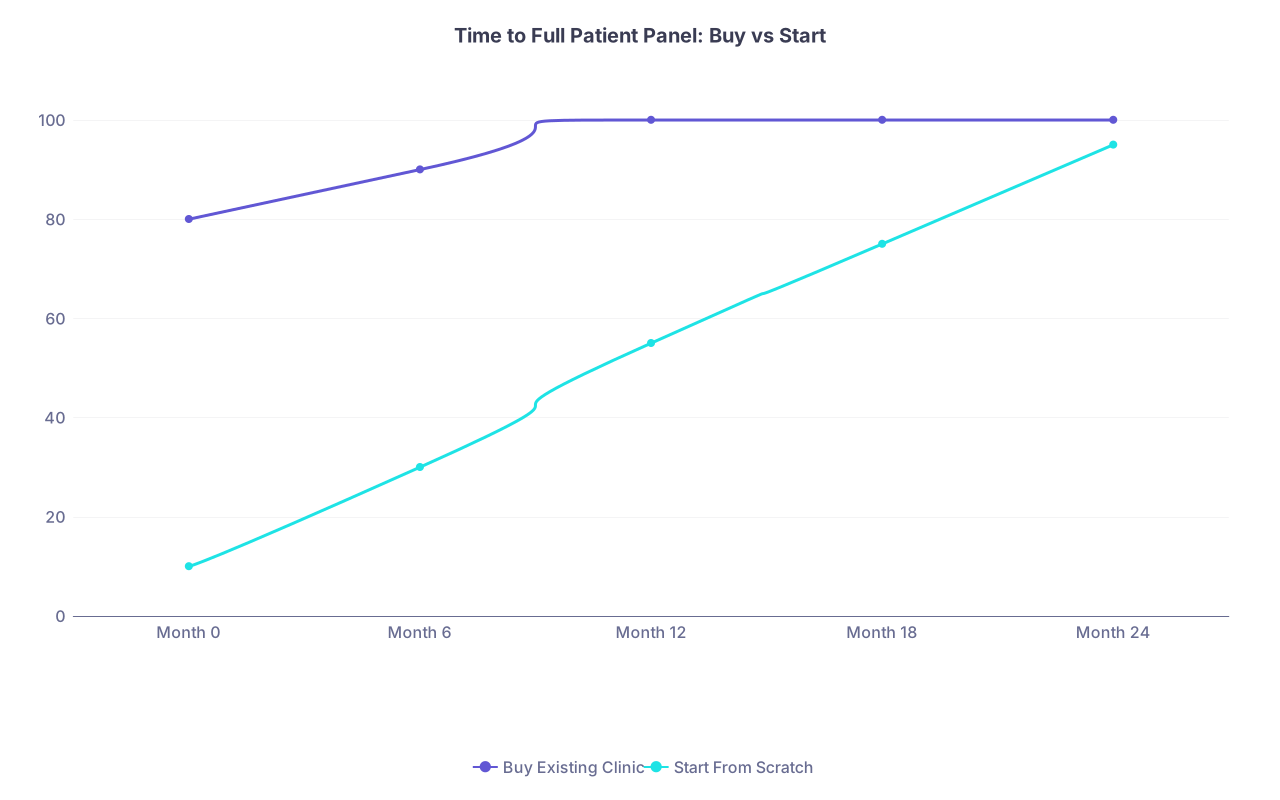
Here’s a simple trend to think about:
| Category | Buy Existing Clinic | Start From Scratch |
|---|---|---|
| Month 0 | 80 | 10 |
| Month 6 | 90 | 30 |
| Month 12 | 100 | 55 |
| Month 18 | 100 | 75 |
| Month 24 | 100 | 95 |
Percentage values are “panel fullness” relative to your target. The exact numbers are hypothetical, but the shape is real.
Step 7: Structuring the Deal So You Don’t Get Crushed
If you lean toward buying, you still have enormous control over whether it becomes a smart move or a financial anchor.
Non-negotiables:
- Hire your own healthcare attorney who regularly does practice purchases.
- Insist on:
- Asset purchase (not stock purchase) in most cases.
- Detailed allocation of purchase price (goodwill vs equipment vs AR).
- Representations and warranties about:
- Accuracy of financials
- No undisclosed investigations
- Compliance with Stark and Anti-Kickback
Strongly consider:
- Tying part of the price to performance:
- Holdback or earn-out based on collections in year 1–2.
- Getting a non-compete and non-solicit that actually makes sense in your state.
- Keeping the seller on briefly (3–6 months) for warm handoffs—but with clear end dates and boundaries.
This isn’t about being “nice” or “mean.” It’s business. If the seller stands behind the health of their clinic, they won’t balk at reasonable protections.
Step 8: A Hybrid Model Too Many People Ignore
There’s a third path that works absurdly well but doesn’t get enough attention:
Start your own clinic slowly while working part-time employed or per diem.
Example pattern I’ve seen succeed:
- Year 0–1:
- 0.6–0.8 FTE employed job for stable income.
- 1–2 days/week in your own small clinic (shared space, lean overhead).
- Year 1–2:
- As your clinic volume rises, drop to 0.4 FTE employed.
- Add more clinic days.
- Year 2–3:
- Transition to full-time in your own clinic once your schedule can support the overhead and your desired income.

| Step | Description |
|---|---|
| Step 1 | Full time employed |
| Step 2 | Part time employed + 1 day own clinic |
| Step 3 | Part time employed + 2-3 days own clinic |
| Step 4 | Full time own clinic |
This hybrid approach:
- Gives you control and clean systems (like a startup).
- Reduces financial terror because you have baseline income (like buying established cash flow).
- Lets you test your market before committing to a huge build-out.
It’s not always possible, depending on non-compete clauses and market density. But if you can swing it, it often beats both “buy big” and “go all-in on a brand-new clinic from day one.”
Step 9: Red-Flag Scenarios Where You Should Walk Away
I’ve seen people talk themselves into truly terrible decisions because they’re desperate to own “something.”
Here are common deal-killer situations:
- The seller refuses to share tax returns or gives you homemade spreadsheets only.
- Collections have dropped significantly in the last 2–3 years and no one can explain why.
- Key staff say off the record they’re planning to leave when the seller leaves.
- Lease terms are brutal, non-assignable, or expiring soon with big rent hikes.
- There’s an open payer audit, OIG issue, or malpractice mess hanging over the clinic.
- The only reason the practice is busy is one major hospital or facility funneling referrals to the seller, not the clinic.
On the startup side, deal-killers include:
- Closed panels for most major payers in your specialty and area.
- A hospital system that owns almost every primary care practice within 20 miles.
- Zero savings, no access to credit, and a spouse who’s already overwhelmed with financial pressure.
- No reasonable locations with medical-appropriate build-out and parking in your target area.
In all of these cases, “wait 12–24 months, strengthen your financial position, and reassess” is often the best move—even if it bruises your ego.
Step 10: Making the Call
By now, you should not be asking “Which is objectively better, buying or starting from scratch?”
The question is:
Given my market, my numbers, my life situation, and my tolerance for uncertainty:
- Which path gets me to a sustainable, ethical, reasonably profitable clinic with the least unnecessary risk?
- And which path aligns with how I actually want to practice day-to-day?
If you want a simple decision rule, here’s the closest thing:
- If you find a clean, well-run, fairly priced clinic whose revenue you can reproduce, in a location you’d pick anyway, in a market with solid demand—buy it.
- If every available clinic has weird numbers, bad staff, lousy location, or inflated pricing—and you have at least 12–18 months of financial runway plus some hustle—strongly consider starting from scratch or using the hybrid path.
And if both options look shaky, do the thing no one wants to do: stay employed a bit longer, stack cash, learn how these businesses actually function, and wait for a better opening.
You’re not behind. You’re avoiding a landmine.
Final Takeaways
- You’re not choosing “clinic vs no clinic.” You’re choosing how to pay for ownership—upfront with money (buy) or over time with risk and sweat (start from scratch).
- Let numbers, not feelings, drive the decision: real financials, payer mix, patient panel, lease terms, and your actual financial runway.
- Don’t forget the third option: a hybrid path where you build your own small practice while keeping part-time employed income. It quietly solves a lot of the risk that terrifies new owners.