
Most micro‑subspecialty clinics fail not for lack of expertise, but for lack of structure.
You can be the best in the country at a niche procedure and still bleed cash if your referral flow, visit templates, and fee structure are an afterthought.
Let me break this down specifically, as someone who has watched multiple post‑fellowship “dream clinics” either explode in growth or quietly wither away based on these exact decisions.
We are talking about clinics like:
• Advanced endometriosis surgery consult service
• Complex arrhythmia / VT ablation clinic
• Neuro‑immunology / NMOSD and MOGAD clinic
• Complex foot and ankle deformity clinic
• Ehlers‑Danlos / hypermobility service
• Advanced heart failure / LVAD follow‑up clinic
Ultra‑narrow, high‑complexity, often consultative. That is the game.
1. Define the Micro‑Subspecialty Tightly Before You Touch Anything Else
Most people start with décor and EMR. Wrong place to start.
You must first define, in writing, three things:
- What conditions you do see
- What conditions you do not see
- What you uniquely offer that generalists and general subspecialists cannot or will not
If you cannot state those in 2–3 sentences each, you are not ready to open.
Example: complex headache / CSF pressure clinic.
- Do see: suspected idiopathic intracranial hypertension, spontaneous CSF leak, refractory chronic migraine after failure of ≥3 prophylactics, shunt evaluation.
- Do not see: primary tension headaches, “headache x 3 days” with no red flags, undifferentiated dizziness.
- Unique offer: integrated imaging review, lumbar puncture with opening pressure, rapid access to neuro‑ophthalmology, and protocol‑driven management with standardized follow‑up endpoints.
That clarity will drive:
- Referral criteria
- Triage protocols
- Template design
- Coding patterns
- Your consult letter content
Without this, your clinic becomes a generic neurology shop, and your micro‑niche value evaporates.
Make an Inclusion / Exclusion One‑Pager
Draft a single PDF you will send to referrers and keep at your front desk:
- “Appropriate referrals” list
- “Please refer elsewhere” list
- Required pre‑referral workup (e.g., basic labs, imaging, trialed therapies)
You will revise it every 3–6 months as reality hits. But you need a version 1.0 before you even buy a chair.
2. Map the Referral Flow Before You Market
Referrals are the lifeblood of a micro‑subspecialty clinic. Walk‑ins and self‑referrals are almost never enough.
You need a concrete, visual map of how patients arrive, get filtered, and get scheduled.

| Step | Description |
|---|---|
| Step 1 | Referring provider |
| Step 2 | Referral received |
| Step 3 | Triage with algorithm |
| Step 4 | Return to referrer with guidance |
| Step 5 | Schedule new consult slot |
| Step 6 | Previsit workup and questionnaires |
| Step 7 | Clinic visit |
| Step 8 | Consult letter to referrer |
| Step 9 | Follow up or discharge |
| Step 10 | Meets criteria |
Sources of Referral
Be explicit. Common channels:
- Internal health system referrals (if you are attached to a hospital)
- Community specialists (e.g., general cardiologists feeding an EP clinic)
- High‑volume PCP groups and FQHCs
- Self‑referrals (often from patient advocacy groups or online)
- ER and urgent care “frequent flyer” channels for complex cases
Now assign rules for each.
Example, complex arrhythmia clinic:
- Internal cardiology group: direct EMR referral, no pre‑screening. Your staff triages based on urgency (e.g., recurrent VT vs stable SVT).
- External cardiologists: require ECGs, echo report, recent labs attached to referral. Missing data triggers staff call.
- PCPs: standardized referral form with key boxes (e.g., Holter done? Echo ordered?). If none, you either decline or convert to a general cardiology referral elsewhere.
- Self‑referrals: online form requesting upload of prior reports; nurse review before accepting.
Create Triage Algorithms, Not Vibes
You do not want your front desk making medical decisions. You also do not want to personally review every referral once you hit volume.
You need a triage protocol that a trained MA or RN can execute 80–90% of the time.
Write a doc with stuff like:
- “If new onset focal neurologic deficits in last 14 days → send to ED / urgent neurology, do not schedule in clinic.”
- “If recurrent dislocation with prior stabilization surgery and normal imaging → schedule as high‑complexity new patient, 60 min slot.”
- “If chronic pain >5 years, multiple prior surgeons, no records and no imaging in last 2 years → request records first, then present case to MD before scheduling.”
This is unglamorous. But I have seen it be the difference between a clinic that runs on rails and one that collapses under inappropriate consults.
3. Design the Visit Architecture: New, Return, and Procedural
Visit types are the skeleton of your clinic. Get sloppy here and you will either:
- Tank your access (3‑month waits)
- Tank your revenue (underbilling, burned slots)
- Or both
At minimum, you need:
- 2–3 tiers of new patients
- 2 tiers of follow‑ups
- Dedicated procedural blocks (if applicable)
Example for a complex rheumatology / vasculitis clinic:
- New consult – complex (75–90 min): referrals with multi‑organ involvement, unclear diagnosis, immunosuppressants in play
- New consult – moderate (45–60 min): single‑organ suspected vasculitis, workup initiated
- Return – complex (30 min): med changes, flare evaluation, infusion planning
- Return – routine (15–20 min): stable disease, lab monitoring
- Procedure block: biopsy slots, ultrasound‑guided injections, etc.
You then marry these visit types with time blocks and coding expectations.
| Visit Type | Typical Length | Usual Codes |
|---|---|---|
| New - complex | 60–90 min | 99205 / 99245 |
| New - moderate | 45–60 min | 99204 / 99244 |
| Return - complex | 30 min | 99215 / 99245-25 |
| Return - routine | 15–20 min | 99214 |
| Procedure-only visit | 15–30 min | Procedure + 99212 |
These are example codes; you tailor them to your specialty and payer mix. But the structure matters.
Protect the Complex New Slots
Micro‑subspecialty clinics live or die by appropriate new patient slots.
You must decide:
- What percentage of your template is reserved for high‑complexity new referrals
- What percentage is for moderate new
- How many are held as “urgent slots” for key referrers
A common starting point for 4 clinic days per week:
- 40–50% of bookable time: new patients (split complex / moderate)
- 40–50%: returns
- 10–20%: protected urgent new slots (that expire 24–48 hours prior and convert to returns if unused)
If you let follow‑ups fill everything, you will slowly become a chronic management clinic that does not have capacity for the cases you actually want.
4. Build a Weekly Template That Matches Reality, Not Fantasy
Micro‑subspecialists often overestimate how many complex new patients they can see in a day without drowning in documentation and after‑visit messaging.
Let me be concrete. For the first 6–12 months, your week might look like this (assuming 0.8–1.0 FTE clinical):
| Day | Morning | Afternoon |
|---|---|---|
| Monday | 2 complex new, 2 moderate new | 4 returns |
| Tuesday | 6 returns | Procedure block |
| Wednesday | Admin / outreach / research | Admin / case reviews |
| Thursday | 2 complex new, 2 moderate new | 4 returns |
| Friday | 4 returns | Mixed (2 new, 2 returns) |
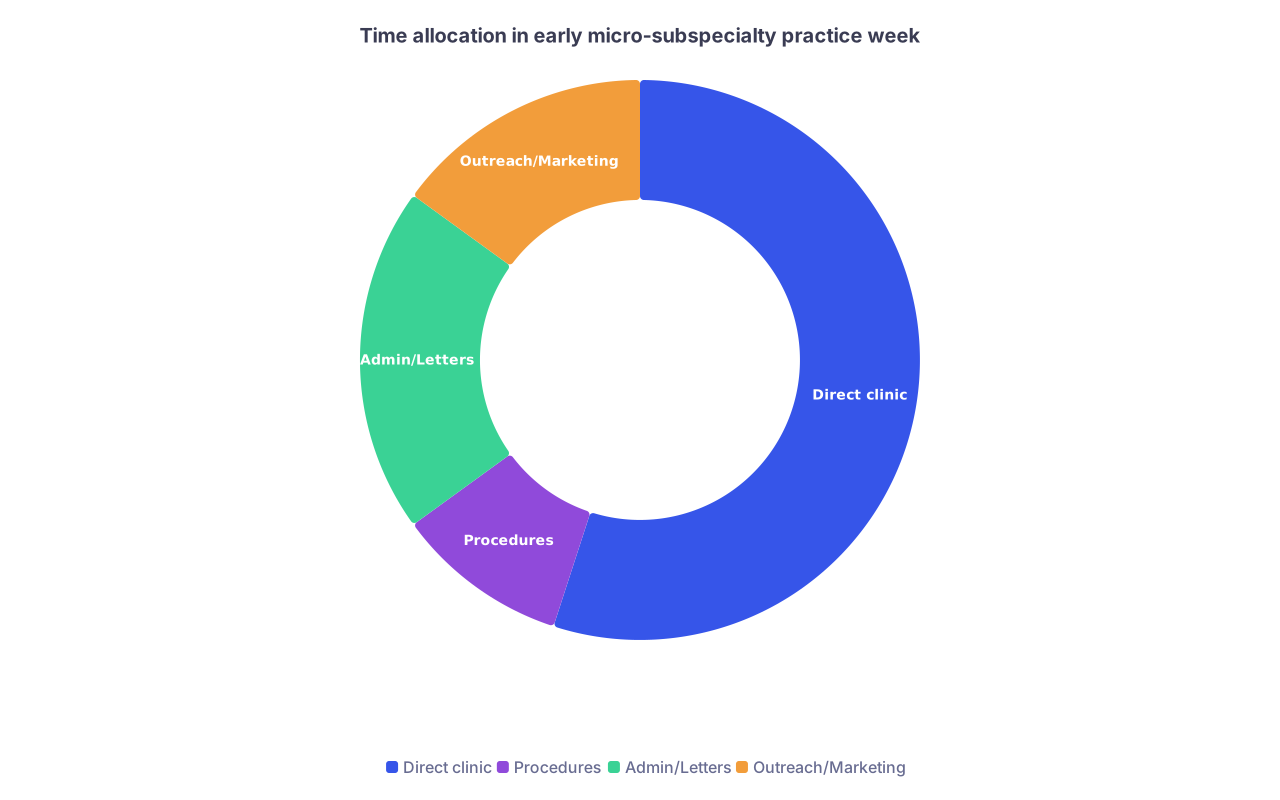
This is not “maximized RVUs.” It is survivable. You will see 6–8 new patients per week at high complexity and 14–18 returns. Plenty to build a panel, but with enough space for letters, coordination, and referral relationships.
Notice Wednesday is blocked. Most micro‑subspecialty clinics severely underestimate outreach/admin time:
- Writing long consult letters (which are your best marketing)
- Answering eConsults / informal curbside questions
- Calling surgeons / oncologists / PCPs to coordinate
- Creating and revising protocols
Once you stabilize, you can convert some of that admin time to more clinic. But if you start at “5 days of packed clinic,” you will burn out and your quality will drop.
| Category | Value |
|---|---|
| Direct clinic | 55 |
| Procedures | 10 |
| Admin/Letters | 20 |
| Outreach/Marketing | 15 |
Those proportions are far closer to reality than “90% clinic, 10% admin.”
5. Integrate Procedures Strategically (If You Do Them)
For procedural micro‑subspecialties (EP, interventional pain, advanced endoscopy, some ortho, etc.), you have to make a call: office‑based, ASC, or hospital‑based procedures.
Each has a different financial and operational footprint.
Key principles:
Separate cognitive and procedural time.
Do not sprinkle complex new consults between procedures. You will run late and destroy both experiences.Use procedure days as referral magnets.
Referrers care that their patients get definitive procedures quickly. Offer short wait times for indicated procedures, and your consult volume will follow.Standardize pre‑procedure workup.
Written checklist. Labs, imaging, anticoagulation management, anesthesia clearance if needed. If you rely on “someone will remember,” you will have cancellations and uncompensated time.
You can get fancy with blended days once you and your staff are seasoned. But build with clear procedural blocks at the beginning.
6. Coding, Fees, and Financial Structure: Do Not Wing This
Here is where a lot of brilliant clinicians get wrecked.
A micro‑subspecialty clinic lives heavily in high‑complexity E/M codes, sometimes with procedures and care coordination layered on top. Done correctly, this is viable. Done sloppily, you end up giving away 45–90 minutes of work for a 99203 equivalent.
Start with three pillars:
- Your payer mix
- Your contracts (or decision to be out‑of‑network / cash only)
- Your typical visit complexity
Know Your Payer Mix Before You Sign a Lease
Look at your hospital / employed practice data or regional norms:
- What percentage is Medicare?
- What percentage is commercial?
- Any Medicaid / safety net populations you care about?
If 60–70% of your target patients are Medicare and your niche is complex, you will live in 99204–99205 and 99214–99215 land with occasional prolonged services codes. That is fine—but margins will be tighter and volume matters.
If 70%+ are commercial and you negotiate smart contracts, you have more flexibility. In that scenario, many micro‑subspecialty clinics successfully run hybrid models:
- In‑network for major plans
- Out‑of‑network or cash pay for time‑intensive second opinions or ultra‑specialized services
Decide Early: Insurance‑Based, Cash‑Based, or Hybrid
You cannot be vague about this. Each model dictates everything else.
Very simplified comparison:
| Model | Pros | Cons |
|---|---|---|
| Insurance-based | Higher volume, easier referrals | Lower control over pricing, admin load |
| Cash-based | High control, longer visits | Smaller patient pool, marketing heavy |
| Hybrid | Flexibility, tiered offerings | Complex to message and administer |
For most post‑residency physicians starting out, fully cash‑only is unrealistic unless your niche is rare, high‑demand, and you have an established name. Think “national expert in EDS” or “renowned endometriosis surgeon.”
Most will land in hybrid:
- Core consult services in‑network
- Special packages (e.g., complex case conference, comprehensive record review for out‑of‑state patients, teleconsult packages) as cash services not billed to insurance
Structure Fees Around Value and Time
For cash or hybrid services, you need rational, clearly communicated fees.
Example structure for a neuro‑immunology second‑opinion clinic (numbers illustrative):
- Comprehensive second opinion – 90 minutes in person + record review + dictated letter: $850–1,200
- Follow‑up – 45 minutes: $350–450
- Teleconsult for out‑of‑state physician‑to‑physician advice (not direct patient care): contracted hourly rate $350–500
You anchor these in:
- Local market rates
- Your subspecialty’s typical reimbursement
- The intensity / uniqueness of what you do
Then you communicate them clearly in advance. Sticker shock after the fact destroys trust.
For insurance‑based visits, your “fee schedule” is largely imaginary above what insurers pay, but you should still have a rational, consistent internal fee schedule pegged to a multiple of Medicare (e.g., 150–200% of Medicare) when you set your chargemaster.
Do Not Ignore Prolonged Services and Complexity Codes
For truly micro‑subspecialty, complex, time‑intensive visits, prolonged services codes (e.g., 99417 attached to 99205 / 99215) and sometimes care management codes are justified and essential.
You must:
- Document time clearly
- Build EMR templates that capture relevant components
- Train yourself and staff to capture all billable work (record review, coordination, extended counseling)
If you routinely spend 75–90 minutes on a “45‑minute” complex new patient, and you always bill 99204, you are subsidizing the system.
7. Build the Communication Loop: Consult Letters as Marketing
Your consult letter is your most powerful marketing tool in a micro‑subspecialty clinic. Not your website. Not your logo.
Busy referrers remember two things:
- How quickly their patient was seen
- How useful and clear your letter was
Structure your letters with ruthless clarity:
- 3–5 line “Assessment and Plan” at the very top, in plain language
- Bulleted recommendations, clearly indicating what you will handle vs what the referrer should manage
- Brief, relevant rationale (not a page of pathophysiology)
- Clear follow‑up plan and contingency instructions
Example opening:
Assessment / Plan (summary)
- Suspect autoimmune small fiber neuropathy based on…
- Recommend confirmatory skin biopsy; we will coordinate.
- Initiate trial of IVIG pending biopsy; we will manage authorization and infusion.
- PCP to continue managing diabetes, BP, and lipids; no changes from our side.
That level of clarity makes you indispensable to busy clinicians who do not want another 4‑page note that hides the plan on page 3.
Also: respond quickly. Goal is letter out within 24–72 hours of visit. This is why you protected admin time earlier.
8. Staffing and Roles: Do Not Overbuild, Do Not Underbuild
You are building a team, not just “you and a front desk.”
For a lean micro‑subspecialty clinic at launch, minimum viable staffing:
- Physician (you)
- One cross‑trained MA / RN
- One front office / scheduler (may be part‑time shared initially)
As you grow:
- Add a dedicated RN for triage, calls, and complex education
- Add a part‑time or full‑time practice manager (billing, contracts, HR, metrics)
- Consider a midlevel only if you have clearly defined tasks that truly leverage them (stable follow‑ups, protocolized care, education)
The worst pattern I see: one physician and one overwhelmed front desk staff, with the physician trying to also be biller, coder, marketer, and IT support.
You do not need a bloated team, but you do need:
- Someone obsessed with getting referrals scheduled and prepped
- Someone obsessed with clean claims and collections
- Someone obsessed with clinical quality and patient flow (you)
9. Metrics: How You Know the Structure Is Working
If you cannot see your clinic’s vital signs, you are flying blind.
For micro‑subspecialty practices, track:
Operational:
- Time from referral receipt to first contact
- Time from referral to first available new patient appointment
- No‑show and late‑cancel rate (by visit type)
- Percentage of new slots filled vs held/unused
Financial:
- RVUs per clinic session (or revenue per session if you prefer)
- Average reimbursement per new vs return visit
- Denial rate and top 3 denial reasons
Clinical / relational:
- Referrer “loyalty”: how many referrers send ≥5 patients per quarter
- Patient‑reported satisfaction (simple, not a 50‑item survey)
- Percentage of consult letters sent within 72 hours
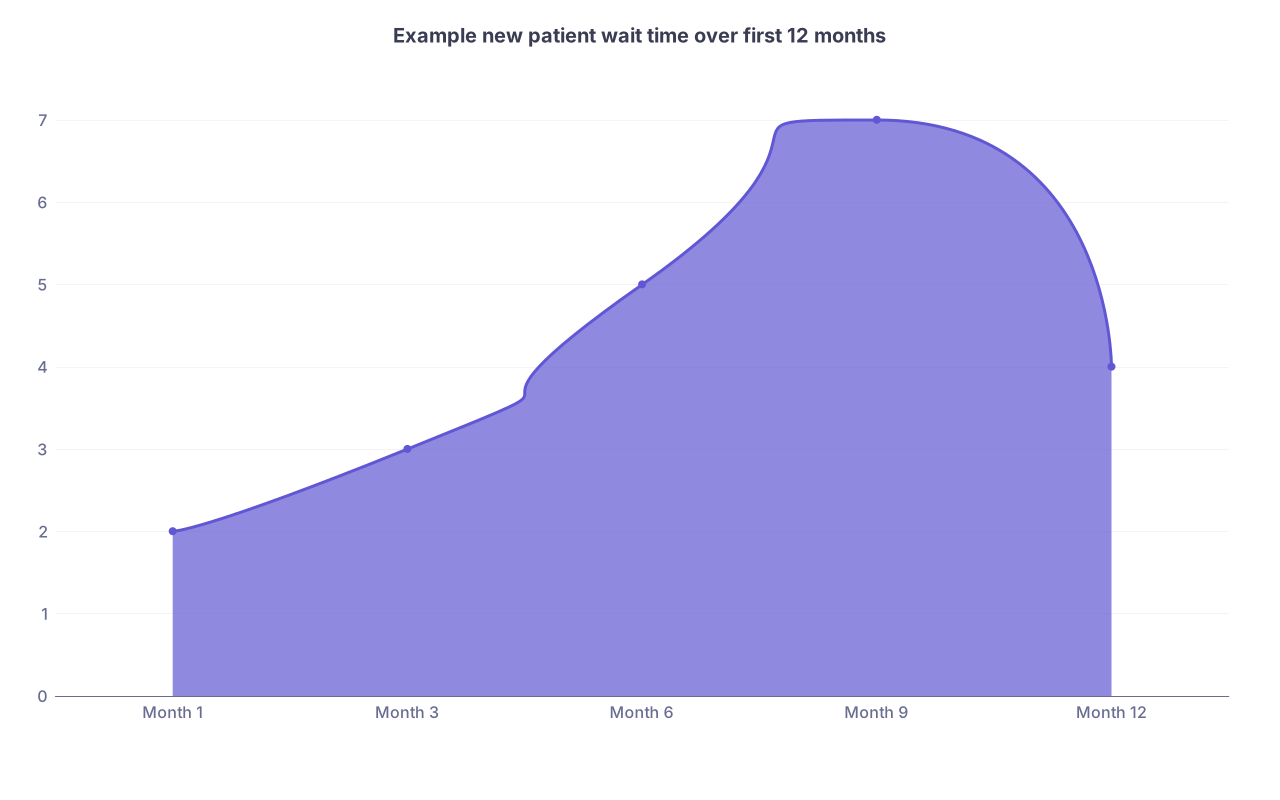
Set thresholds. If, for example, new patient wait time exceeds 4–6 weeks routinely, you either:
- Add clinic capacity
- Tighten referral criteria
- Create a parallel, lower‑intensity pathway (tele‑triage, eConsults, group education)
| Category | Value |
|---|---|
| Month 1 | 2 |
| Month 3 | 3 |
| Month 6 | 5 |
| Month 9 | 7 |
| Month 12 | 4 |
You want that curve to rise as your reputation grows, then normalize after you adjust capacity or complexity thresholds.
10. Common Structural Mistakes I See (And How To Avoid Them)
Let me be blunt about the patterns that sink micro‑subspecialty clinics:
No hard inclusion / exclusion criteria.
You end up seeing everything, which kills your niche and crushes your schedule with low‑yield visits. Solution: one‑pager criteria, trained staff enforcing.Templates packed with too many complex new patients.
Day looks full, revenue looks good on paper, and you are writing notes until midnight. Solution: cap complex new visits to what you can document and coordinate in real time.Underpricing or giving away second opinions.
You spend hours reviewing 300 pages of outside docs and imaging and bill a single level‑4 E/M. That is financial suicide. Solution: clear cash pricing / hybrid structure for true second opinions, or mandatory pre‑visit record review time documented and billed when allowed.Sloppy referral handling.
Lost faxes, unreturned calls, “we’ll call you back” chaos. Referrers move on to someone else. Solution: one person owns the referral queue, daily huddle on pending cases, scripts for staff.Being vague about “who manages what” in comanagement.
Patients fall into gaps. PCPs get angry. Solution: every note explicitly states what you manage vs what goes back to referrer.Ignoring contracts and under‑negotiating.
Signing whatever payers send because “you just want to start seeing patients.” Solution: get a healthcare attorney or experienced consultant to review contracts, even if you are cash‑heavy. Underpayment is very hard to fix later.
FAQ (Exactly 5 Questions)
1. Should a micro‑subspecialty clinic ever start fully cash‑only right out of training?
Rarely. Unless you have a nationally recognized niche (books, key publications, speaking, advocacy presence) and patients are already trying to find you, going 100% cash out of the gate is risky. A more realistic path is hybrid: take major insurers for core services to build volume and relationships, and layer on clearly defined cash‑pay offerings for time‑intensive second opinions or out‑of‑state consultative work. You can always move further toward cash once you have demand and data.
2. How long should I block for a “complex new” in a micro‑subspecialty clinic?
For the first year, block 60–90 minutes. That includes history, exam, on‑the‑spot imaging / record review, counseling, and same‑day documentation. If you are consistently finishing in 40–45 minutes with high‑quality notes and clear plans, then compress to 60. If you are always running over, add time or split certain evaluations into two visits (initial data gathering, then formal plan visit). Do not delude yourself into thinking you can safely do complex, tertiary‑level consults in 30 minutes.
3. When is it appropriate to bring on a PA/NP in a micro‑subspecialty context?
Only when you have: (1) more stable follow‑up demand than you can personally handle without compromising access for new complex cases, and (2) well‑defined, protocol‑driven tasks that do not require your constant real‑time input. Good uses: stable disease monitoring, medication titration under clear algorithms, patient education, and post‑procedure follow‑ups. Terrible use: expecting them to handle the same vague, ultra‑complex new referrals without robust oversight.
4. How do I prevent becoming a dumping ground for non‑niche problems?
You enforce your criteria with discipline. That means: a published referral guideline sheet, firm triage rules, staff empowered to redirect inappropriate referrals with polite but clear wording, and consult letters that gently push back scope creep (“This patient’s chronic low back pain is best managed by primary care and general pain services; our role is limited to X”). You also stop saying “yes” to every informal “favor” referral that obviously falls outside your niche.
5. How soon should I start tracking metrics after opening?
Immediately. From month one, track new referrals, time‑to‑appointment, fill rate of complex vs moderate new slots, no‑show rate, and basic revenue per clinic session. You do not need a fancy dashboard—an Excel sheet is fine initially—but you must see trends. By 3–6 months, you should also be tracking which referrers send you repeat patients and how long your consult letters take to go out. Structure without feedback is just wishful thinking.
Key takeaways:
- Define your niche ruthlessly and design your referral flow and triage rules around that definition before opening your doors.
- Build realistic templates that protect complex new slots, preserve admin time, and align with a conscious financial model (insurance, cash, or hybrid).
- Treat consult letters, staff roles, and metrics as core infrastructure, not afterthoughts—they are what keep a micro‑subspecialty clinic viable and respected long‑term.