
The biggest mistake growing clinics make is hiring their second provider either 12 months too late or 12 months too early.
Let’s fix that.
You shouldn’t add another physician or APP because you’re “busy.” You should add them when specific, measurable signals line up: your schedule, your finances, your operations, and your strategy. I’ll walk you through exactly what to track and what thresholds I recommend.
The Core Rule: Hire When Demand Is Predictable, Not When You’re Drowning
You add another physician or APP when three things are true:
- Your schedule is consistently full.
- The numbers say a new provider will be profitable, not just “helpful.”
- Your operations can handle more volume without collapsing.
“Consistently full” has a definition:
- New patient wait time: routinely 2–4 weeks out
- Established patient next available: 7–14 days out (and even that feels tight)
- Daily schedule: regularly ≥90–95% filled over the previous 3–6 months
- You’re turning away or pushing out new patients you’d like to keep
If that’s you and your books show real profit (not just top-line revenue), you’re already late.
If you’re only randomly overscheduled a couple days a week, you’re early.
Step 1: Watch These Capacity and Demand Metrics Like a Hawk
You can’t make a smart hiring decision if you’re going on vibes.
Track these every month in a simple spreadsheet:
| Metric | Healthy Range to Consider Hiring |
|---|---|
| New patient wait time | 14–28 days consistently |
| Established patient wait | 7–14 days for routine visits |
| Daily schedule fill rate | 90–95%+ for 3–6 months |
| Turned-away new patients | At least 5–10 per week |
| Provider hours per week | > 40–45 clinical hours + admin |
If you’re in primary care, pain, psych, endocrine, cards, derm, etc., you’ll usually feel the crunch first as:
- New patient slots booked out 4–6 weeks
- Patients complaining about “soonest available”
- Staff squeezing in double-booked returns that ruin your day
Once those complaints and constraints are stable, not just occasional, demand is real.
To visualize how this usually looks over time:
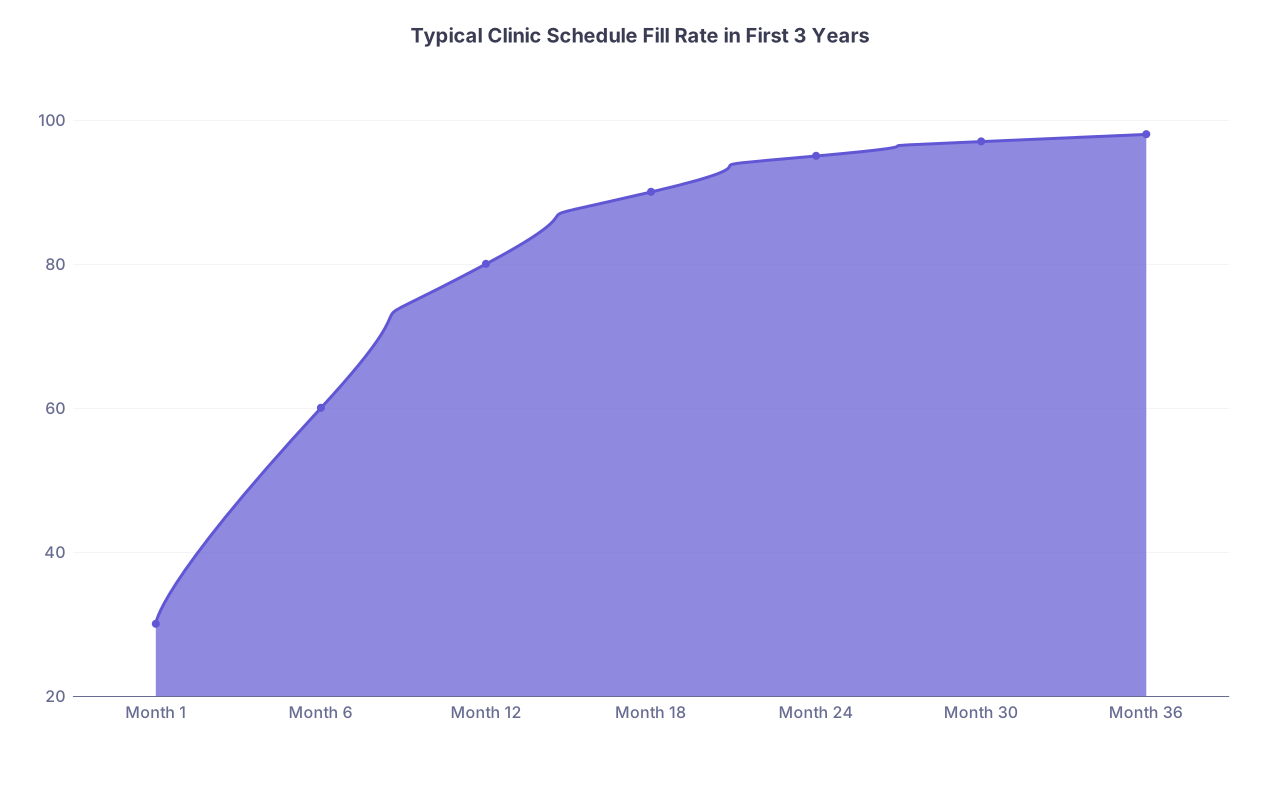
| Category | Value |
|---|---|
| Month 1 | 30 |
| Month 6 | 60 |
| Month 12 | 80 |
| Month 18 | 90 |
| Month 24 | 95 |
| Month 30 | 97 |
| Month 36 | 98 |
You don’t hire at Month 6 when you hit 60%.
You don’t hire the same month you hit 95%.
You start planning at ~80–85%, and you pull the trigger once you’ve sat at ≥90–95% for several months and the financials work (we’ll get to that).
Step 2: Run the Numbers Before You Post a Job
“Feels busy” is not enough. You need a back-of-the-envelope pro forma.
A. Know your expected revenue per provider
Rough ballpark (you’ll adjust based on your specialty, payer mix, and RVUs):
- Community PCP (mostly insurance): $350k–$550k collections per full-time APP; $500k–$900k per full-time physician
- High-acuity or procedure-heavy specialties (cards, GI, ortho): easily higher
- Psych / telehealth-heavy: often lower per visit but high-margin if overhead is lean
Be conservative. Assume 70–80% of what you hope they’ll do in year 1.
B. Know your cost to employ them
Include:
- Base salary
- Benefits (health, retirement, payroll tax) – usually +15–25% of salary
- Malpractice
- Licensing / CME
- Extra staff time (MA, front desk hours, maybe another part-timer)
- Incremental overhead: more supplies, EHR seats, phones, small space upgrades
For a mid-market example (adjust for your region):
- Physician: $250k salary + 20% benefits = $300k
- Overhead allocated (space, staff, systems): $120k–$180k
- Total cost: $420k–$480k per year
C. Do a simple break-even check
Let’s say you estimate a new physician can collect $650k in year 2, $450k–$500k in year 1.
If cost is ~$450k and realistic year-1 revenue is ~$475k, that’s razor-thin. You can still do it if:
- You personally are over-capacity
- You’re okay with a lower owner draw in the short term
- You’re building strategic value (more patients, better call coverage, expanded hours)
If cost is $450k and you reasonably expect $600k+ collections by year 2, that’s a comfortable hire.
Here’s a simple side-by-side to anchor your thinking:
| Provider Type | Est. Year 1 Collections | Total Annual Cost | Approx. Year 1 Margin |
|---|---|---|---|
| Physician | $500,000 | $450,000 | $50,000 |
| APP | $350,000 | $220,000 | $130,000 |
That’s why many clinics bring on an APP before adding a second physician. Lower risk, easier to ramp.
Step 3: Decide: Physician vs APP – Which Should You Add First?
This is where people get weirdly ideological. Don’t.
Think in terms of work you’re doing that doesn’t require your level of training.
If your day is 60–70%:
- Simple chronic disease follow-up
- Medication checks
- Low-complexity acute visits
- Routine post-ops
- Stable psych follow-ups / med management
You’re overqualified for half your schedule. An APP (NP/PA) makes sense as your first addition.
If your clinic is heavy on:
- Complex diagnostics
- High-stakes decision-making
- Procedures that pay well and require you specifically
- Referrals that expect “the doctor” personally
Then the first add might still be an APP, but your second should probably be another physician.
Here’s a brutally simple decision snapshot:
| Situation | Better First Hire |
|---|---|
| High volume of routine follow-ups | APP |
| Long wait for complex new consults | Physician |
| Need better access / same-day slots | APP |
| Want to expand to new procedures | Physician |
| Thin cash flow, need lower risk | APP |
Step 4: Time the Hire: When to Start Recruiting vs Start Date
You don’t start recruiting when you’re already maxed out. If you do, you’ll be miserable for 6–12 months.
General rule of thumb:
- Recruiting another physician: start 9–12 months before you need them
- Recruiting an APP: start 4–6 months before you need them
Why so early?
Because the timeline is ugly:
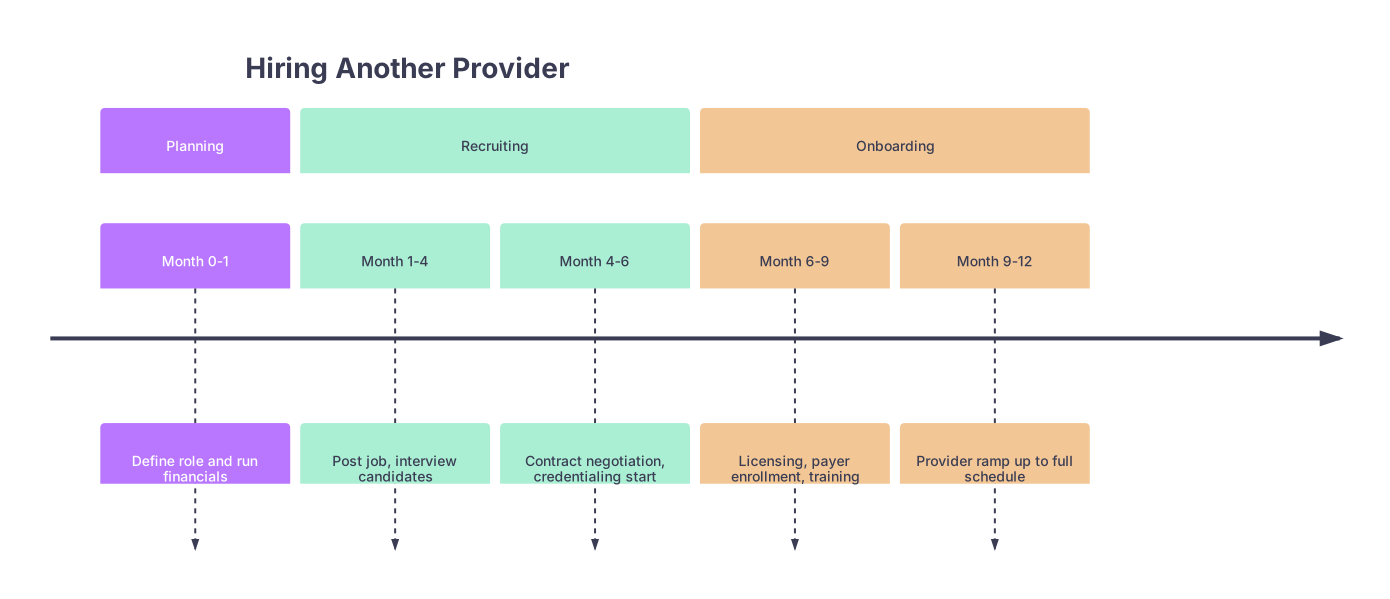
| Period | Event |
|---|---|
| Planning - Month 0-1 | Define role and run financials |
| Recruiting - Month 1-4 | Post job, interview candidates |
| Recruiting - Month 4-6 | Contract negotiation, credentialing start |
| Onboarding - Month 6-9 | Licensing, payer enrollment, training |
| Onboarding - Month 9-12 | Provider ramp up to full schedule |
So if your metrics are already screaming today, you’re late. Start anyway. But next time, you’ll watch the trend and start earlier.
Step 5: Make Sure Your Operations Won’t Break
More providers without better systems is just more chaos.
Before you add another MD/DO or APP, you need:
Reliable scheduling rules
- Clear new vs follow-up templates
- Protected same-day slots if that’s part of your model
- Policy on double-booking (ideally: don’t)
Front desk and phone capacity
- If your phones are already a disaster from 9–11 am daily, another provider will magnify it
- Look at call abandonment rate, hold times, and front office workload
Clinical support
- 1:1 MA/Provider in many outpatient settings is now bare minimum
- For procedure-heavy clinics, 1.5:1 or 2:1 isn’t crazy
Basic workflows documented
- Refill policies
- Messaging / portal handling
- Lab / imaging follow-up processes
- Prior auth handling
I’ve watched clinics add a second provider, double volume, and then lose both staff and patients because inboxes became black holes and phones rang unanswered. That’s not a growth problem. That’s poor ops.
Step 6: Hire for the Right Stage of Growth
You don’t need a future partner visionary if what you actually need is someone dependable who will show up, see patients, and not require babysitting.
Be honest about your stage:
- Stage 1: You + skeleton crew, still proving the model
- Stage 2: Stable, profitable, but owner still doing everything
- Stage 3: Multi-provider, building systems and leadership
If you’re moving from Stage 1 to Stage 2, your first hire should:
- Be okay with a growing, slightly scrappy environment
- Not need guaranteed full template on day 1
- Be comfortable flexing roles a bit while you grow
If you’re already Stage 2 and adding your third or fourth provider, you can start talking about leadership roles, partnership tracks, and more structured career paths.
Step 7: Common Red Flags You’re Hiring Too Early
You’re probably too early if:
- Your new patient wait time is under 7–10 days consistently
- Your schedule has more than 3–4 open slots most days over several months
- You’re not yet paying yourself a consistent, reasonable owner salary
- You’re still guessing on your monthly P&L instead of actually knowing your margins
- You’re hoping “more providers” will fix a cash flow problem created by underbilling / poor contracts
In that case, your next “hire” might not be a provider. It might be:
- A really good biller / RCM company
- A fractional practice management consultant
- A competent clinic manager or lead MA
Because if underlying efficiency and collections are broken, adding another provider just multiplies the leak.
To make this concrete:
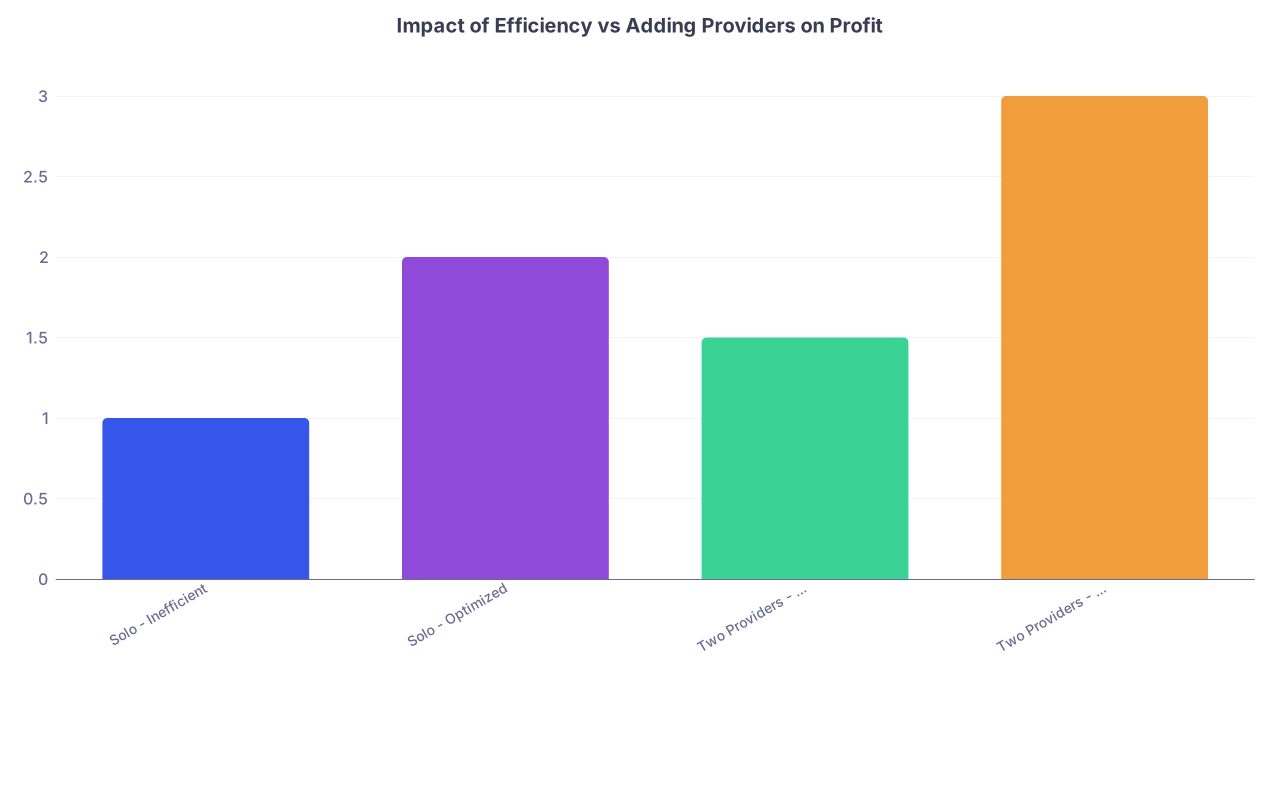
| Category | Value |
|---|---|
| Solo - Inefficient | 1 |
| Solo - Optimized | 2 |
| Two Providers - Inefficient | 1.5 |
| Two Providers - Optimized | 3 |
Think of “1” as baseline profit. Many clinics jump from “Solo - Inefficient” straight to “Two Providers - Inefficient” and wonder why they just feel busier and poorer.
Step 8: When You’re Clearly Too Late
On the flip side, here’s when you’ve waited too long:
- You’re booked out 8–12 weeks for new patients
- Referring docs are calling your cell asking for “just one patient” squeezed in
- You’re regularly working 50–60+ hours a week, documenting nights and weekends
- You’re turning away procedures or higher-margin work because you’re stuck in routine follow-ups
- Your staff is burning out from constant overbooking and patient complaints
At that point, you don’t “consider” hiring. You must. Or your growth will stall and your reputation will start to suffer.
A Simple Decision Framework
If you want a very blunt decision aid, here it is:

| Step | Description |
|---|---|
| Step 1 | Check 3-6 month metrics |
| Step 2 | Do NOT hire yet - optimize ops |
| Step 3 | Fix billing, contracts, efficiency |
| Step 4 | Start planning but delay posting |
| Step 5 | Hire APP first |
| Step 6 | Recruit physician |
| Step 7 | New pt wait 2+ weeks and 90%+ full? |
| Step 8 | Owner profit stable and positive? |
| Step 9 | Owner >45 hrs/week and turning away pts? |
| Step 10 | Mostly routine follow ups? |
Print that and stick it above your desk.
FAQs: Adding Another Physician or APP to Your Clinic
1. How long should I be consistently full before I hire another provider?
Aim for at least 3–6 months of 90–95%+ schedule utilization, with new patients booking 2–4 weeks out, before you actually sign a contract. You can start recruiting slightly earlier, when you consistently hit 80–85%, because of the 4–12 month lag between “post job” and “provider actually seeing patients.”
2. Is it safer to hire part-time first instead of full-time?
Often yes. A 0.5–0.8 FTE APP or physician can act as a pressure relief valve without overcommitting your payroll. It lets you test whether demand holds, refine workflows, and grow into full-time. The downside: recruiting good part-time clinicians is harder, and some will eventually want full-time elsewhere if you can’t offer it.
3. Should I hire an APP or a physician first in a new private practice?
If your schedule is dominated by routine chronic care, med checks, and low-complexity follow-ups, hire an APP first. If you’re drowning in complex new consults, procedures, or referrer expectations to “see the doctor,” then a second physician (or at least a physician with procedure/pro consult focus) should come earlier. Most primary care and psych startups do very well with an APP as their first add.
4. How do I know if I can actually afford another provider?
Run a simple pro forma: estimate conservative year-1 collections for the new provider (using realistic visit volume and your average collections per visit), subtract total cost to employ them (salary, benefits, malpractice, overhead). If that math leaves you with a negative or razor-thin margin and you’re not willing to tighten your own pay for a year or two, you can’t afford it yet. Fix revenue cycle and efficiency first.
5. What if my schedule is packed but my cash flow is still tight?
Then you don’t have a volume problem; you have a collections or contract problem. Before you hire another clinician, audit your billing, denials, no-show rate, payer mix, and contract rates. I’ve seen “busy” clinics under-code, fail to chase denials, or accept terrible contracts, then try to fix that by adding providers. That just multiplies bad margins.
6. How do I ramp up a new provider’s schedule without killing my own?
Use a phased template. First 2–4 weeks: light schedule, longer visits, lots of shadowing and onboarding. Weeks 5–12: grow to 50–75% capacity by shifting routine follow-ups and low-risk new patients to them. After 3–6 months: aim for them to carry a full panel for their role while you shift more toward high-value visits, procedures, or leadership. Don’t just dump your overflow on day 1 and expect magic.
7. What if I’m afraid of hiring, then having the volume drop?
That fear is real—and healthy. Reduce your risk by: starting with an APP or part-time role, using a compensation model with a productivity component, keeping 3–6 months of overhead in reserve, and making sure your referral sources and marketing are stable, not random. If your demand is totally unpredictable month to month, you’re not ready; stabilize that first.
Key Takeaways:
- Don’t hire off gut feeling—hire when your metrics (wait times, fill rate, and profit) prove stable demand.
- Decide physician vs APP based on the actual work on your schedule, not ideology.
- Fix billing and operations before you “solve” problems by adding more providers, or you’ll just scale chaos.