
The biggest mistake new attendings make when moving states is getting cute with the timing. You try to “save” a few months of license fees, and you end up losing three months of income.
If you’re finishing residency, moving to a new state, and planning to launch your own clinic, you are in a tight, unforgiving timeline. The rules are not intuitive. And state boards do not care that you just graduated and need to eat.
I’m going to walk you through exactly how to time your state license, DEA, payer enrollment, and clinic launch so you aren’t sitting in a beautiful empty office without the ability to bill a single visit.
1. First, Get Clear on Your Real Constraints
Before you touch a single application, you need to map your hard constraints. Not vibes. Actual dates and rules.
You’re dealing with five overlapping clocks:
- Residency end date
- State medical license timeline
- DEA registration timeline
- Payer credentialing (commercial + Medicare/Medicaid)
- Lease / build‑out / “grand opening” date
If you don’t stack these correctly, you bleed cash. I’ve watched people sign a lease in March, finish residency in June, and still not be billing until October. That’s not “entrepreneurial risk.” That’s poor sequencing.
Do this first:
- Confirm your residency completion date and last day on payroll.
- Decide your target move date (key exchange, actual relocation).
- Pick a realistic patient-ready date, not your fantasy date. Add 1–2 months buffer.
Now, hold those in your head as we walk through each piece.
2. Understand How Long Each Piece Actually Takes
Nobody tells you these numbers in residency. You’re supposed to just know. Here’s the reality, assuming you’re organized and not a chaos goblin.
| Item | Typical Range |
|---|---|
| State license (new) | 8–16 weeks |
| DEA registration | 2–6 weeks |
| Medicare enrollment | 60–120 days |
| Commercial payers | 60–180 days |
| Office build-out/IT setup | 4–12 weeks |
| Malpractice underwriting | 2–6 weeks |
This table is why so many people end up “cash-pay only for now” even if that was never the plan. They simply started payer credentialing way too late.
Key thing: you can often overlap a lot of this. But you can’t skip steps:
- No DEA without an active or pending state license (varies by state).
- No payer contracts if you’re not licensed in that state.
- Many malpractice carriers want your license number before final binding.
So if you’re moving states, your state license is the first domino. Mis-time that and everything behind it slips.
3. When to Start Your New State License (By Scenario)
Let’s talk actual situations. Because “start 3–6 months early” is useless advice unless we anchor it to real dates.
Scenario A: You’re Moving July 1 and Want Patients by September 1
Residency ends: June 30
Move: around July 1
Target first clinic day: Sept 1
Work backwards.
- State license: you want it in hand by July 1 at the latest.
That means your file should be complete with the board by about April–May.
Given typical 8–16 week processing:
- You should be starting your new state license application between February and March of your PGY-3/PGY-4 year (or final year).
Yes, while you’re still a resident. Yes, even if that feels absurdly early. It isn’t.
Steps:
January–February:
- Confirm which license you need (full vs training vs temporary).
- Request your FCVS profile if you don’t have one. That alone can save you from redoing this hell later.
February–March:
- Submit the online application for the new state.
- Trigger primary-source verifications (medical school, residency, USMLE/COMLEX).
March–April:
- Answer board questions immediately. Missing one email can add a month.
Result: You’re likely licensed by June/July, and you can start DEA + payer enrollment as soon as the license is active (or sometimes once it’s “pending” but with a file number).
Scenario B: You’re Taking 2–3 Months Off Between Residency and Opening
Residency ends: June 30
Move: whenever
Planned clinic opening: November 1
Temptation: “I’ll just apply for the license in September. No rush.”
That’s how you end up with no revenue in November.
Better sequence:
- You still start your license process on roughly the same timeline (Feb–March).
- You may request the license be issued closer to your opening date if the state allows (some boards let you delay activation; others do not).
The point isn’t to delay your license to save a few hundred dollars. It’s to ensure:
- Your DEA is ready by September.
- Payers are processing your enrollment during the months you’re “off.”
So your “time off” is when payer contracting and credentialing are chugging along in the background. By November, you’re in-network or at least close.
Scenario C: You’re Moving to a Very Slow or Very Strict State
Some states are infamously slow or picky: California, Texas, Florida, for example. I’ve watched people wait 6+ months.
If you’re moving to one of these:
- Start 6 months before graduation. Yes, really.
- Expect multiple back-and-forths about paperwork, logs, explanations.
If you have any “red flags” (old DUI, board investigation, gaps, multiple failed attempts):
- Add another 1–2 months.
- Get your PD or a faculty member ready to write explanatory letters.
You absolutely do not want to discover in July that your board wants an in-person interview or additional documentation.
4. How to Sequence License, DEA, and Payer Enrollment
Think of this as a chain:
- State license
- DEA + state controlled substance registration (if required)
- Malpractice
- Payer enrollment (commercial, Medicare, Medicaid)
- Clinic launch
Let’s stack them with a realistic timeline for that July move / September open scenario.
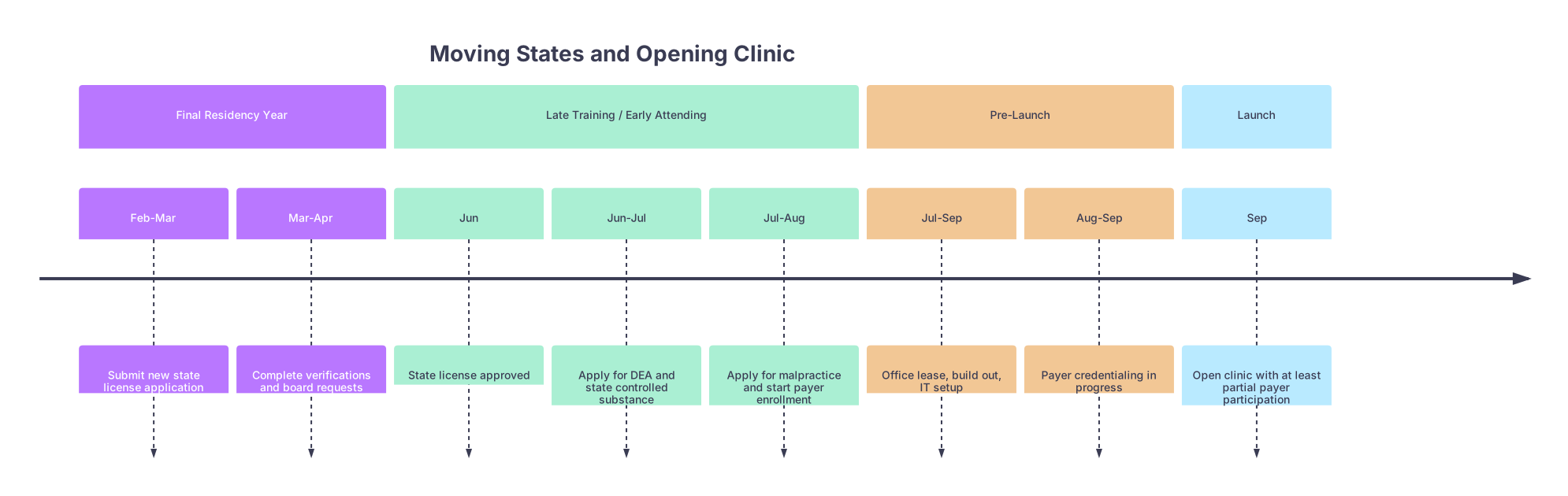
| Period | Event |
|---|---|
| Final Residency Year - Feb-Mar | Submit new state license application |
| Final Residency Year - Mar-Apr | Complete verifications and board requests |
| Late Training / Early Attending - Jun | State license approved |
| Late Training / Early Attending - Jun-Jul | Apply for DEA and state controlled substance |
| Late Training / Early Attending - Jul-Aug | Apply for malpractice and start payer enrollment |
| Pre-Launch - Jul-Sep | Office lease, build out, IT setup |
| Pre-Launch - Aug-Sep | Payer credentialing in progress |
| Launch - Sep | Open clinic with at least partial payer participation |
State License → DEA
Once your license is issued (or sometimes once it’s “pending with number” depending on jurisdiction):
- Apply for DEA registration with your new practice address or at least a realistic address you control.
- If your new state requires a separate state controlled substance registration (e.g., NY, IL, CA, etc.), file that at the same time.
Do not:
- Use your old residency hospital address for your new DEA if you’re leaving that state. It just creates correction work later.
- Wait until a week before clinic opens. You won’t be prescribing Schedule II anything for your first month.
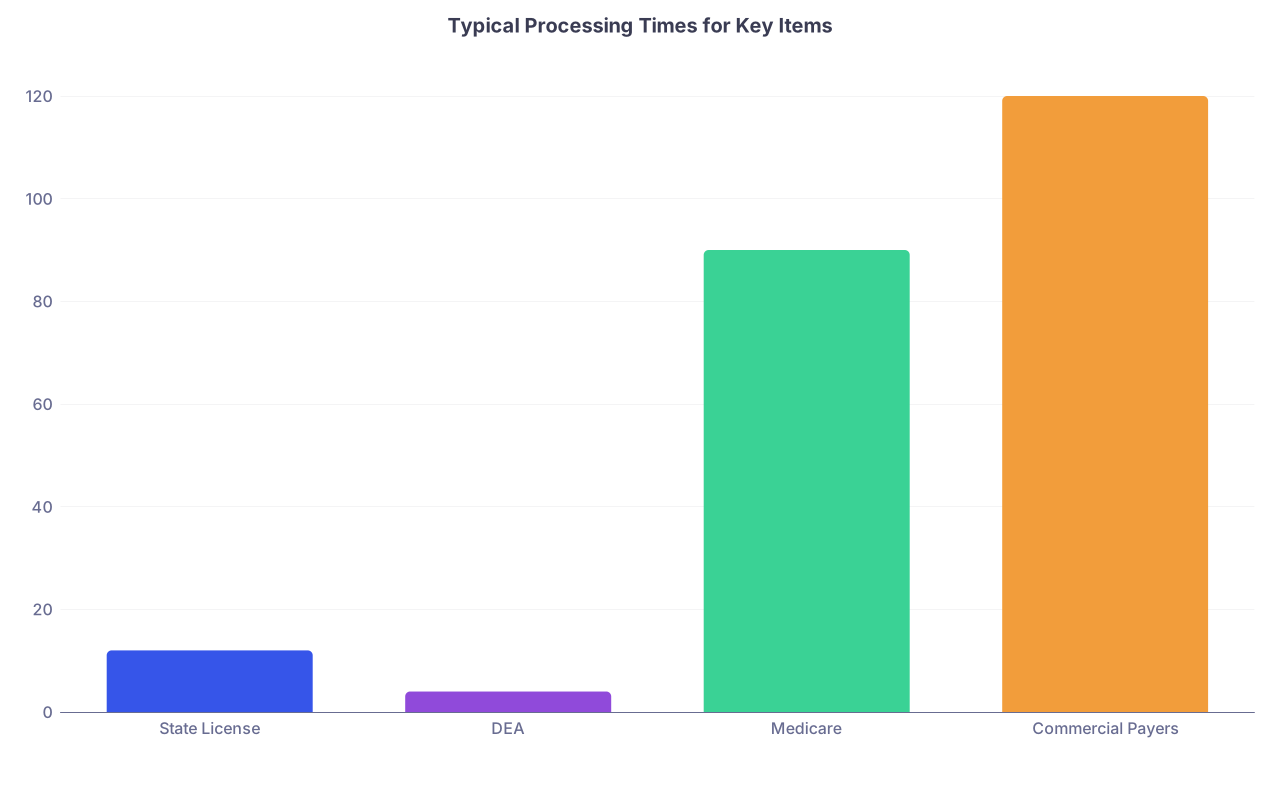
| Category | Value |
|---|---|
| State License | 12 |
| DEA | 4 |
| Medicare | 90 |
| Commercial Payers | 120 |
License + DEA → Malpractice
Malpractice carriers want to know:
- Your specialty and procedure mix
- Your practice location
- Your anticipated start date
- Your license status
You can start quotes before your license is active, but binding often requires:
- An active license number
- Sometimes proof of DEA (for certain policies)
Plan to:
- Start malpractice shopping 1–2 months before your planned start date.
- Bind coverage to start on your first billable clinic day.
License + DEA + Malpractice → Payer Enrollment
This is where most new attendings lose the plot. They assume:
- “I’ll get paneled in a month or two.”
Wrong.
Real world:
- Medicare: 60–120 days
- Big commercials (BCBS, UHC, Aetna): 90–180 days
You can usually submit payer applications as soon as:
- You have your state license number
- You know your practice address and tax ID (or at least entity in formation)
That means:
- You may be submitting to payers before you have furniture. Completely normal.
If you want to accept insurance on day one, payer enrollment needs to start 2–4 months before your clinic opening date. Not after.
5. How to Time the Business Entity, Lease, and Build-Out
Now we add the physical and legal side of “private practice.”
You can’t credibly enroll with most payers without:
- A legal entity (LLC/PC)
- An EIN (tax ID)
- A practice address
- (Often) an NPI-2 for the organization
This means your business timeline runs slightly ahead of your clinical start.
Basic Sequence
4–6 months pre‑open:
- Form your entity (PC/PLLC/LLC depending on state rules).
- Get an EIN from the IRS.
- Apply for your Type 2 NPI for the practice.
3–5 months pre‑open:
- Negotiate and sign your office lease.
- Lock in your practice address for all applications.
3–4 months pre‑open:
- Start payer enrollment using:
- Entity name
- EIN
- NPI-2
- Practice address
- Your personal NPI-1 and license
- Start payer enrollment using:
This is why waiting until “after you move” to start this process is a revenue killer. The system wasn’t built for you to be hyper-cautious and slow.

6. What to Do if You’re Already Behind
Maybe you’re reading this in June. You graduate in two weeks. License isn’t filed. No DEA. No entity. It’s salvageable, but you need to stop pretending and start sequencing aggressively.
Here’s the damage-control version.
Step 1: Get the License Application Out Yesterday
- Submit the new state license application immediately, even if some documents will follow.
- Use FCVS if it speeds up primary-source verification.
- Stay on top of your email like it’s a code pager.
You’re not opening in September if you submit in July in a slow state. Adjust expectations now.
Step 2: Decide on Interim Work
If the license timeline means:
- You can’t see patients for 2–3 months after moving
Consider:
- Locums in your current state or telemedicine with an existing license
- A short employed stint in the new state if you can sign with a group that’s already credentialed (and will bill under their TIN while your personal enrollment catches up)
This buys you income while you build your own practice foundation in the background.
Step 3: Adjust Your Clinic Launch Strategy
If payer credentialing will lag:
- Start as out-of-network / cash pay with clear pricing
- Offer superbills for patients to submit for reimbursement
- Gradually transition as payer contracts go live
No, this is not ideal. But it’s better than sitting in an empty office because you insisted on “taking all insurances” from day one without the paperwork to back it.

7. Special Pitfalls When Moving States
Moving adds a layer of bureaucracy that catches people off guard.
Training License vs Full License
Some states issue a “postgraduate training license” for residency and require a completely separate application for a full license.
Don’t assume:
- Your training license upgrades automatically. It often doesn’t.
- Your new state will recognize your PGY license for anything.
You’ll be applying for a brand new full license in the new state. Completely separate process.
Address Issues
You will have at least three relevant addresses floating around:
- Your home address
- Your clinic address
- Old residency institution address
Use your clinic address consistently on:
- DEA registration
- Payer applications
- Malpractice policies
Use your home address only where required for mailing or background checks. Mixing addresses randomly is how things get lost or flagged.
Multiple State Moves
If you’re doing something like:
- Fellowship in State A
- First attending job in State B
- Private practice soon after in State C
You may want to:
- Maintain licenses in A or B for telemedicine or locums flexibility
- Use FCVS early to avoid re-doing your entire educational history each time
But do not let “license collection” distract you from your main priority: getting fully set up and credentialed in the state where you’re launching your clinic.
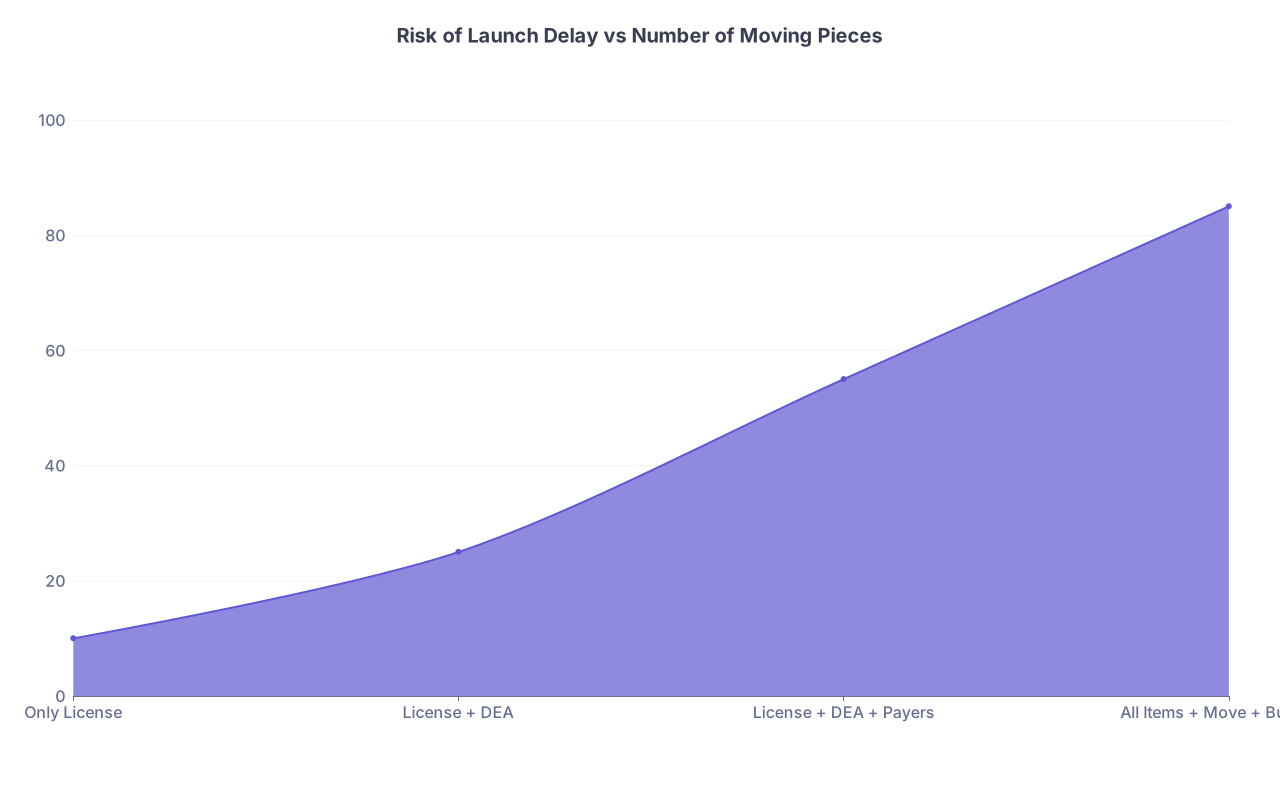
| Category | Value |
|---|---|
| Only License | 10 |
| License + DEA | 25 |
| License + DEA + Payers | 55 |
| All Items + Move + Build-out | 85 |
8. A Lean, Realistic Timeline You Can Actually Use
Let’s put it all together into a clean scenario you can adapt. Assume:
- Residency ends: June 30
- Moving to new state: July 10
- Want clinic open: September 15
Here’s a lean but realistic play:
February (while in residency):
- Decide on new state and city.
- Start new state license application.
- Order FCVS if needed.
March–April:
- Respond immediately to board requests.
- Start researching office spaces and local malpractice carriers.
May:
- Form your entity (PC/PLLC/LLC).
- Get EIN.
- Apply for NPI-2.
June:
- Sign office lease with a start date you can afford (often July/August).
- License likely issued late June or early July.
- As soon as license is active, apply for DEA and any state controlled substance registration.
July:
- Move to new state.
- Bind malpractice effective September 15.
- Start payer credentialing (commercial + Medicare/Medicaid as applicable).
- Begin office build-out, IT, EHR, phone systems.
August:
- Continue payer follow-up; fix any missing items.
- Soft marketing: website, Google listing, referrals from local docs.
- Start booking patients for mid-September, with clear messaging about your insurance status.
September:
- Go live September 15.
- You may not be in-network everywhere yet, but some payers should be active or close.
- Fill initial schedule with a mix of cash pay and early in-network plans.

FAQ (Exactly 3 Questions)
1. Should I wait to apply for a license in my new state until I’m 100% sure I’m moving there?
If you’re truly undecided between multiple states, don’t file everywhere. But once you’re 80–90% sure, start the license in your most likely destination. The cost of a “wasted” license is tiny compared with months of lost income if you delay. If you’re down to two states, it’s not insane to start both, especially if both are slow boards.
2. Can I start seeing patients as cash-pay only before I’m credentialed with insurance?
Yes, and many new practices do exactly that. As long as your license, DEA, and malpractice are active, you can see patients and charge cash. You just can’t bill insurers as in-network until your contracts are live. The key is radical transparency with patients about your current insurance status and providing superbills so they can try to get reimbursed out-of-network.
3. Is it ever smart to work as an employed physician first, then open a clinic later?
Yes, especially if you’re moving to a new state and don’t know the market or referral patterns. A 1–2 year employed job can: get you licensed and fully credentialed, build local relationships, stabilize your finances, and buy you time to plan your practice right. The trade-off is less autonomy initially. But from a risk standpoint, it’s often a cleaner ramp than trying to launch solo the day after graduation in a brand-new state.
Key points: treat your new state license as the first and most critical domino, not an afterthought. Overlap license, DEA, malpractice, and payer enrollment so the “dead zone” between moving and earning is as short as possible. And do not let fear of paying a few months of extra license fees cost you a whole season of lost clinic revenue.