
Retaking Step 2 CK after barely passing is usually a bad move for most applicants. But there are a few specific scenarios where it can help. The trick is knowing which side you’re on.
Let’s walk through this like a decision you’d make on rounds: what’s the problem, what’s the data, and what’s the plan?
1. First: How “Bad” Is a Barely Passing Step 2 CK?
Step 2 CK is now the board exam programs care about most. With Step 1 pass/fail, your Step 2 score is the main standardized number they see.
But here’s the nuance no one tells you: programs don’t judge every “low pass” the same way. A 209 and a 220 are both “not great” on paper, but the context matters.
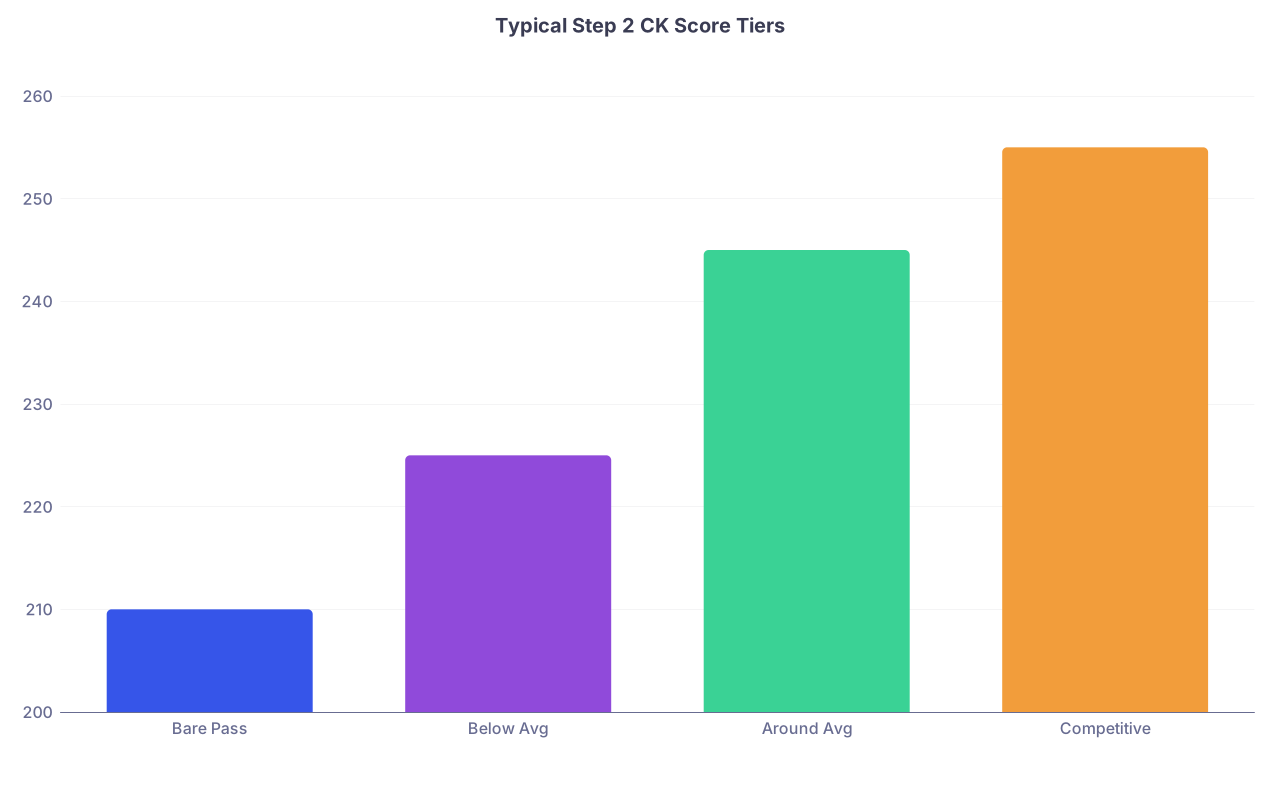
| Category | Value |
|---|---|
| Bare Pass | 210 |
| Below Avg | 225 |
| Around Avg | 245 |
| Competitive | 255 |
Most recent approximate benchmarks (these vary a bit by year, but this is the ballpark):
- Passing: 214
- “Barely passed”: usually in the 214–220 range
- National mean: ~245
- Competitive for strong specialties: 250+
So if you “barely passed,” I’m assuming something like 214–220.
On its own, that’s not an auto-fail for the Match. But it will shape:
- Which specialties are realistic
- Which programs you should target
- How much you need to compensate with everything else (letters, clinical grades, etc.)
The question is not “Is my score bad?” You already know you’re not bragging about it.
The question is: Does retaking Step 2 help me more than it can hurt?
2. The Big Picture: When Retaking Step 2 CK Makes Sense (and When It Doesn’t)
Let me be blunt: retaking Step 2 CK after a pass is uncommon and risky. Most students should not do it.
You should only seriously consider a retake if:
- Your current score is an active barrier to your realistic goals
- You have strong evidence you can significantly improve
- You have the time and support to prep properly
- You understand that a retake is visible to programs and can raise questions
If you passed but are thinking “Maybe I’ll retake to bump a bit,” that’s almost always the wrong move.
3. Pros of Retaking Step 2 CK After a Low Pass
There are some cases where a retake can be strategic. They’re just narrower than most people think.
3.1 You can move from “not viable” to “competitive enough” for your target specialty
If your dream is dermatology and you scored a 216, I’m not going to lie to you: that’s basically a hard stop. Even with a retake and big jump, you’re climbing Everest without oxygen.
But some specialties sit in a middle zone where a better Step 2 actually can change your life:
- Emergency medicine
- Anesthesiology
- OB/GYN
- Psychiatry
- Some internal medicine programs (especially academic ones)
- Transitional year / prelim programs if you’re trying to rehab your application
If your score is so low that a lot of programs will auto-screen you out, a retake with a large improvement (think 30+ points) can:
- Get you past hard cutoffs
- Show you’re not defined by one bad test day
- Counterbalance a weak Step 1 or marginal clerkship grades
Key word: large improvement. A 216 → 225 isn’t changing your destiny. A 216 → 245 might.
3.2 You had clear, fixable reasons you underperformed
If one or more of these apply, you might actually have upside:
- You took Step 2 during a brutal rotation with no dedicated time
- You didn’t finish a QBank or barely did any full-length practice exams
- You had real, documented issues: illness, family crisis, serious life event
- Your practice tests were consistently >10–15 points higher than your actual score
If your NBME/UWSA scores were 235–240 range and you scored a 215 on the real thing, that’s not just “I’m bad at tests.” That’s a test-day problem. Those are sometimes fixable.
3.3 You’re planning a dedicated re-application year anyway
Different situation than “I’m still in school and about to apply.”
If you:
- Failed to match
- Are taking a research / gap year
- Already have to explain a weak application
…then a strong Step 2 retake can be part of a broader “turnaround story.”
It signals: “I took a hit, I regrouped, I worked, and I can perform above average now.”
In that context, the duplicate exam and questions about “Why did you retake?” are easier to answer honestly: you’re already in comeback mode.
4. Cons and Risks of Retaking Step 2 CK After Passing
Here’s the part too many people gloss over: the downside is real, and it’s not just about the new score.
4.1 You can’t hide the fact you took it twice
Programs will see:
- Two exam attempts
- Two scores
- The timeline of both
Some PDs will shrug. Others will immediately ask: “Why?”
If your new score is:
- Lower: you’ve just confirmed their worst suspicion
- Similar: you’ve burned time and money for nothing
- Slightly higher (5–10 points): not impressive enough to justify the retake
- Significantly higher (20–30+ points): finally worth it, but now they’ll wonder why you didn’t perform the first time
So the bar is high. You’re not aiming to “do a bit better.” You’re aiming to rewrite the narrative.
4.2 If you do worse, some programs will interpret that harshly
I’ve heard PDs say this in real meetings:
“If they already passed and chose to retake, and still did poorly, that’s a red flag in judgment.”
Retaking voluntarily sends a message: “I believed I could meaningfully improve.”
If you don’t improve, you’ve just introduced doubt about:
- Your self-awareness
- Your resilience under pressure
- Your use of time and priorities during med school
Brutal? Yes. But that’s how some people think when they have 1,000 applicants to filter.
4.3 Opportunity cost: what you don’t do while studying again
You’re not retaking this in a vacuum. To prep seriously, you’ll:
- Spend weeks to months partially checked out from rotations, research, or life
- Be more stressed, more tired, more likely to underperform clinically
- Possibly miss chances for strong letters, projects, or leadership roles
Here’s the cold truth: for many borderline applicants, a great Sub-I + killer letters + realistic school list is worth more than a 10–15 point score bump.
You can’t do everything well at once. You have to choose.
4.4 Some specialties/programs just won’t care about the retake
For very competitive specialties (derm, ortho, plastics, ENT, neurosurgery), a barely passing Step 2 is often already game-over unless you have elite connections or a unique angle.
A retake here often isn’t “strategic”—it’s denial.
There are always exceptions, but you should plan based on the rule, not the miracle.
5. How Programs Actually Read a Low Pass vs a Retake
Let’s be specific.
| Scenario | Common Interpretation |
|---|---|
| Single low pass (no retake) | Weak test taker, but realistic and moved on |
| Low pass → similar retake | Poor judgment, no real improvement |
| Low pass → lower retake | Major concern, possible instability |
| Low pass → big jump (20–30+) | Shows growth, but raises “why so low first?” |
The least bad scenario if you passed low is often: don’t make it worse, build the rest of your file, and apply smart.
I’ve seen applicants with low 210s match IM, FM, psych, even EM at solid programs because they leaned hard into:
- Strong clinical performance
- Great letters from people who called PDs
- Realistic list of programs and specialties
- A coherent story in the personal statement
Retaking and getting a 223 wouldn’t have improved those outcomes. It might have hurt.
6. A Simple Decision Framework: Should You Retake?
Use this like a checklist. If you don’t hit most of these, don’t retake.
You should strongly consider retaking if:
- Your score: ≤220, and…
- Your target specialty: still reasonably attainable with a big score jump (e.g., EM, anesthesia, OB/GYN, psych, some IM), and…
- Your NBME/UWSA performance before: ≥230–235 consistently, and…
- You have: at least 6–8 solid, protected weeks to restudy properly, and…
- You’re not currently in a cycle where ERAS is already submitted / interviews soon, and…
- You can live with the fact that a second underwhelming score may hurt you
If that’s you, retaking can make sense, especially if you’re reapplying or planning a dedicated improvement year.
You should probably not retake if:
- You already passed and are in the same application cycle
- Your score is low but your specialty target is forgiving (FM, many IM, psych, peds)
- Your practice tests were never much higher than your real score
- You can’t carve out real, dedicated study time
- You’re mainly thinking “I just want to feel better about myself”
In that case, you’re better served by:
- Crushing your remaining rotations and Sub-I
- Getting specific, advocacy-level letters (“take this applicant”)
- Broadening and right-sizing your program list
- Being strategic about geography and community vs academic programs
7. If You Do Decide to Retake: How to Not Wreck Yourself
If after all this you still land on “Yes, I need to retake,” then do it like a professional, not a panicked student.
Step 1: Get brutal data on why you scored low
Not vibes. Data.
- Pull your score report: which content areas were weak?
- Reconstruct your prep: How many questions? Which QBank? How many NBMEs/UWSAs? What were the scores?
- Identify non-academic issues: sleep, health, personal crises, rotation demands
Your retake plan should not look like your first plan with more Anki. It should directly attack the failure points.
Step 2: Set a concrete target
You’re not retaking to “improve.” You’re retaking to hit a specific, program-relevant number.
Example: “I have a 216. I am not retaking unless I can reliably hit 240+ on practice tests.”
If after 4–6 weeks of honest studying your NBMEs/UWSAs are stuck at 225–230, you call it. You don’t sit for the real thing and hope.
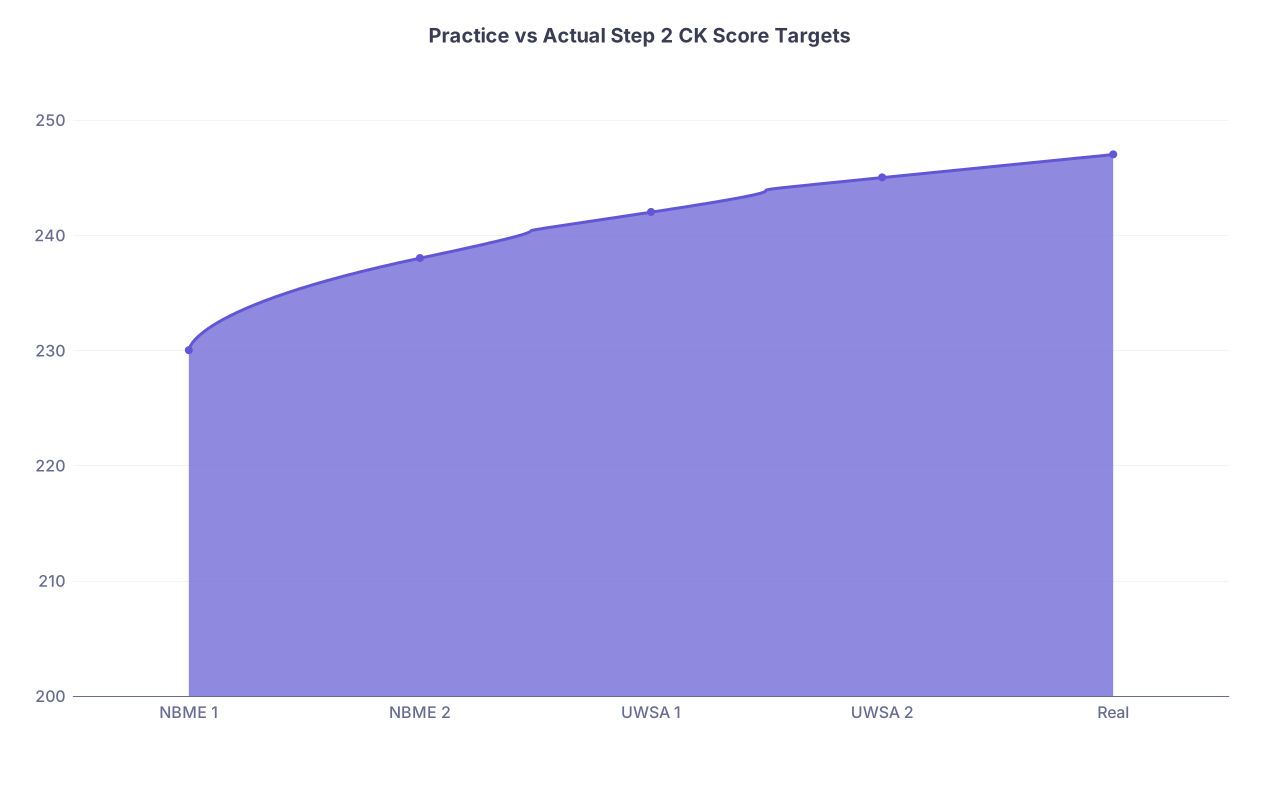
| Category | Value |
|---|---|
| NBME 1 | 230 |
| NBME 2 | 238 |
| UWSA 1 | 242 |
| UWSA 2 | 245 |
| Real | 247 |
Step 3: Build a focused, shorter, smarter study plan
Rough scaffold (about 6–8 weeks):
- 4–6 weeks: High-yield questions daily (UWorld/AMBOSS), 60–120/day, fully reviewed
- 1–2 weeks: NBMEs and UWSAs spaced out, full-length test days, simulate exam conditions
- Daily: Target your weakest systems (OB, peds, neuro, biostats, ethics) deliberately
And yes, you should be tracking scores. No more “I think I’m doing better.” Numbers or nothing.
Step 4: Prepare your explanation
You will get asked in interviews: “I see you took Step 2 twice. Tell me about that.”
You need a 20–30 second, confident, non-defensive answer. Something like:
“I passed on my first attempt, but my score wasn’t representative of my usual performance or my practice exams. I decided to retake it during a dedicated period, approached it more systematically, and I’m proud of the improvement. For me, it was about proving to myself and to programs that I can perform at a higher level when I prepare properly.”
Short. Clear. Takes ownership without oversharing drama.
8. If You Don’t Retake: How to Recover and Still Match
Let’s say you decide not to touch Step 2 again. Good. Now what?
Focus on three things:
Specialty and program selection
Be honest about what’s realistic for your score. Talk to your dean’s office. Ask residents. Look up NRMP Charting Outcomes data.Clinical performance and letters
Sub-I performance matters more than people admit. You want:- “Top 10% of students I’ve worked with” type comments
- Letter writers who know you beyond “hard-working and pleasant”
Application strategy and story
Use your personal statement and interviews to show:- Self-awareness (“I know my score isn’t my strength”)
- Concrete strengths: work ethic, patient care, team contribution
- A clear, grounded reason for your specialty choice
You’re not hiding your score; you’re outweighing it.

| Step | Description |
|---|---|
| Step 1 | Low Pass Step 2 CK |
| Step 2 | Pick Realistic Specialty |
| Step 3 | Crush Sub I |
| Step 4 | Secure Strong Letters |
| Step 5 | Apply Broadly |
| Step 6 | Dedicated Study Block |
| Step 7 | NBMEs Show Big Improvement |
| Step 8 | Retake Step 2 |
| Step 9 | Retake? |



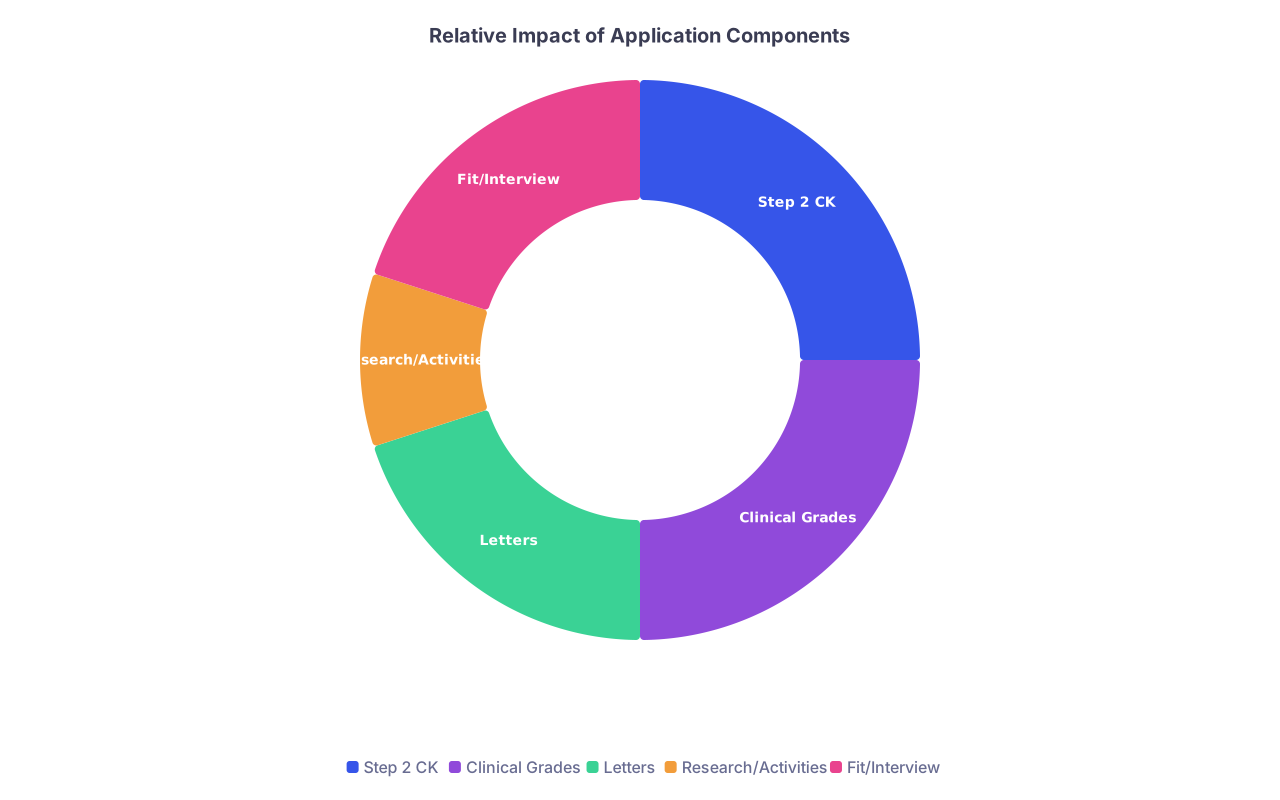
| Category | Value |
|---|---|
| Step 2 CK | 25 |
| Clinical Grades | 25 |
| Letters | 20 |
| Research/Activities | 10 |
| Fit/Interview | 20 |
FAQ: Barely Passed Step 2 CK and Retakes
Is a barely passing Step 2 CK an automatic death sentence for matching?
No. It’s a problem, not a death sentence. It will almost certainly exclude you from the most competitive specialties and some academic programs, but you can still match into many internal medicine, family medicine, psychiatry, pediatrics, and even some EM or community programs if the rest of your application is strong and your list is realistic.Do residency programs care more about a low pass or a failed then passed Step 2?
Both are concerning, but they’re different problems. A fail then solid pass can be spun as “I learned and improved,” especially if the second score is clearly above average. A single low pass says “this is probably your ceiling” unless you prove otherwise elsewhere. Neither is ideal, but programs will absolutely rank applicants with either scenario if the rest of the file is strong and they’re applying to appropriate programs.If I retake and do worse, can I ask programs to ignore the lower score?
No. Programs see every attempt. You don’t get to pick and choose which score “counts.” A worse retake almost always raises more concern than a single low pass. That’s why you should only retake if your practice scores convincingly show you can do much better and you’re prepared to cancel or postpone if you’re not ready.What if my school or dean’s office is pressuring me to retake?
Deans sometimes push retakes because they’re trying to protect the school’s match statistics more than your sanity. Push back with data: show your practice scores, your target specialty, and your timeline. Ask them directly: “For applicants like me with a low pass who did not retake, what specialties and programs did they match into?” Use actual outcomes from your school to guide your decision, not vague worry.If I decide not to retake, should I address my Step 2 score in my personal statement?
Usually no, unless there’s a clear, credible, and brief story that adds value (e.g., serious illness, unique hardship) and you’ve demonstrated strength elsewhere. Most applicants with a low but passing score are better off using the personal statement to highlight fit, motivation, and strengths rather than apologizing for their number. If asked in interviews, have a simple, accountable explanation ready—but don’t center your entire narrative around your score.
Key takeaways:
- Retaking Step 2 CK after a pass is usually a bad trade unless you can realistically jump 20–30+ points and your specialty requires it.
- A single low pass can be managed with smart specialty choice, strong clinical work, great letters, and a broad, realistic program list.
- Whatever you choose, make it a deliberate decision backed by data, not panic—programs can see both your score and your judgment.