
The biggest mistake F-1 IMGs make is thinking “I’ll just take whatever visa the program offers.” That’s how people end up trapped in 2-year home requirements they never meant to accept—or stuck in H‑1B limbo they were never realistically going to win.
You’re already in the U.S. on F‑1. That changes the game. You have more options—and more ways to screw it up—than someone applying from abroad.
Let’s walk through this like I would with a real applicant sitting in front of me with a spreadsheet of programs and a USMLE score report open.
Step 1: Be Brutally Clear About Your End Goal
Before you even say “H‑1B” or “J‑1,” answer one question honestly:
Do you ultimately want to live and work long-term in the U.S. as a physician? Or are you genuinely okay going back home (or to another country) after training?
Not what you’d say in an interview. The real answer.
Because:
- If your true goal is long-term U.S. practice and eventual green card, you’ll lean differently than:
- If you must return to your home country (family, bonds, contracts, government scholarship obligations)
Your visa decision is not about PGY-1. It’s about what your life looks like 10 years from now.
Here’s how different visa paths line up with common goals:
| Goal | Better Fit | Why |
|---|---|---|
| Long-term U.S. practice, green card | H‑1B | Dual intent, smoother to EB visas |
| Short-term training, then home | J‑1 | Designed for training + home country return |
| Unsure / want flexibility | Slight H‑1B lean | Keeps more doors open |
| Plan to do fellowship(s) | Depends | J‑1 has clear fellowship extension path |
If you’re saying, “I’ll figure it out later,” you’re already making a decision—just a bad, passive one.
Step 2: Understand How Your Current F‑1 Status Actually Matters
Being on F‑1 in the U.S. right now gives you three very specific advantages and one big trap.
The advantages
You’re already here.
No consular delays to start. You can do interviews in person, observerships, research, Step exams, etc. You’ve got U.S. connections. That helps for both H‑1B and J‑1.You probably have or will have OPT.
Post‑completion OPT can cover a gap year: research, prelim, or just time while you wait for Match / start date. That flexibility can be critical, especially if your H‑1B timing is tight.You can change status inside the U.S.
You can go: F‑1 → J‑1 (change of status) or F‑1 → H‑1B (change of status) without leaving. Sometimes that’s worth a lot if your home-country consulate is a mess or politically unstable.
The trap
You start believing: “I’m already in the system, so H‑1B will be straightforward.”
Wrong. Residency H‑1Bs are a different lane than corporate H‑1Bs, and your F‑1 history doesn’t magically make you “stronger” for an H‑1B. Programs care about:
- Scores
- How badly they need you
- Whether they’re used to H‑1B filing
- Their cap-exempt status
Your current F‑1 is relevant for logistics and timing, not for how attractive H‑1B is to a hospital.
Step 3: Know the Real Differences that Actually Affect Your Life
You’ve probably read the generic stuff (“J‑1 has 2‑year home requirement,” “H‑1B allows dual intent”). That’s not enough. You need to understand how these play out in actual residency scenarios.
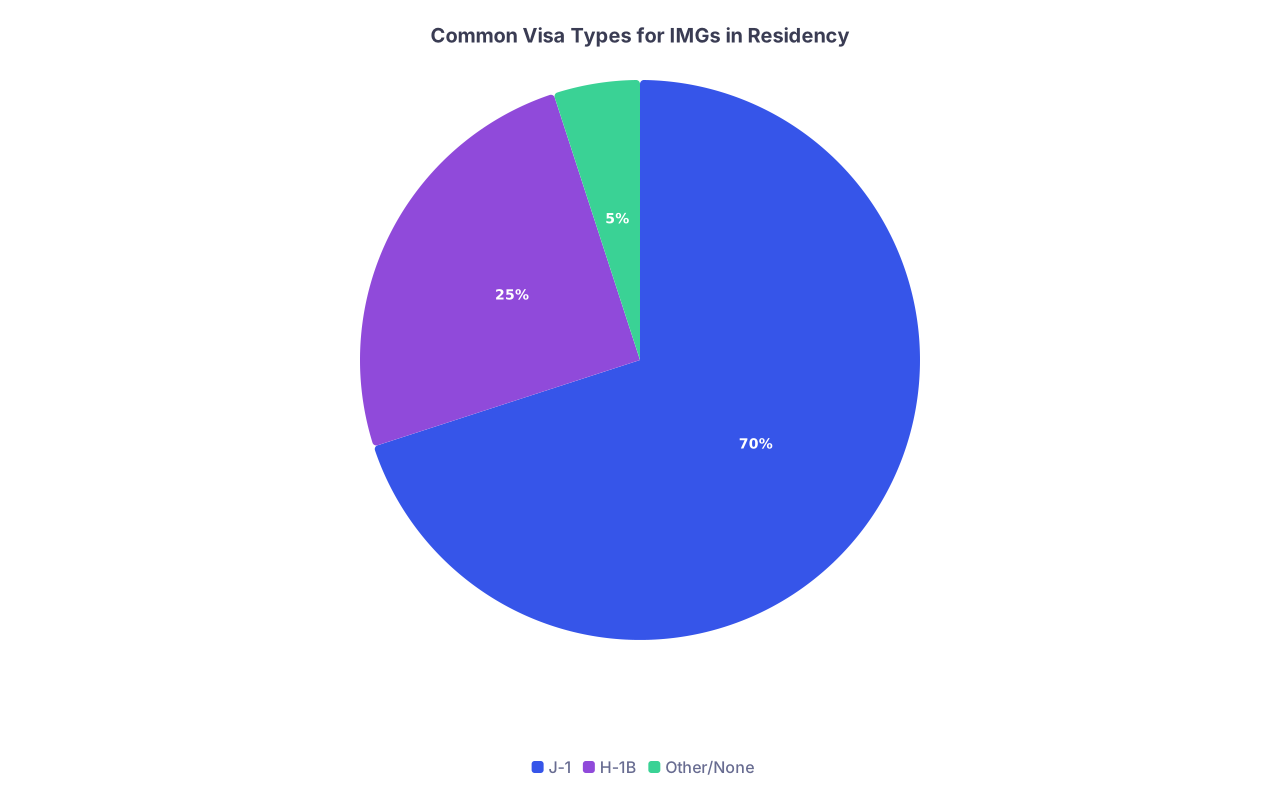
| Category | Value |
|---|---|
| J-1 | 70 |
| H-1B | 25 |
| Other/None | 5 |
Most programs default to J‑1. That’s reality. So if you want H‑1B, you’re already swimming upstream.
J‑1 (ECFMG-sponsored) – what it really means for you
Core facts:
- Sponsored by ECFMG for residency/fellowship training
- You must return to your home country for 2 years after training (all J‑1 training, including fellowships) unless you get a waiver
- You can’t directly jump from J‑1 training to a green card employer in the U.S. without solving the 2-year requirement first
How it feels in real life:
- Match process is easier—far more programs will take you.
- Fellowship (especially in subspecialties) is usually smoother; ECFMG extends your J‑1 each year.
- The 2‑year home rule hangs over every decision: job choices, marriage, where you can live, what visas you can later get.
- You’re playing the “waiver job” game at the end: hunt for Conrad 30, VA, or other waiver spots in specific states, often rural or underserved.
H‑1B (residency/fellowship) – what it really means for you
Core facts:
- Dual intent: you can pursue a green card while in H‑1B.
- No 2‑year home residency requirement tied to it.
- You’re capped at 6 years total (standard), including any previous H‑1B time.
How it feels in real life:
- Much fewer programs are willing/able to sponsor H‑1B for PGY‑1. Outside of IM and maybe neuro/psych at some academic centers, it gets thin quickly.
- There is more paperwork and cost for the program. If they’re not accustomed to it, they’ll simply tell you “We do J‑1 only.”
- You have more clarity about staying: you can line up an employer to file an I‑140 during residency or fellowship, then move to employer H‑1B or even a green card directly.
- Fellowship is trickier: some fellowship programs do H‑1B, many only do J‑1. You can corner yourself if you choose H‑1B residency and then only find J‑1 fellowships in your desired field.
Step 4: Look at Your Profile Honestly and See Which Door Actually Opens
Stop thinking “What do I want?” and start thinking “What can I realistically get?”
Here’s what strongly affects whether H‑1B is even on the table for you:
- USMLE scores (and attempts)
- Specialty competitiveness
- Where you trained / will train (big academic vs small community)
- Graduation year (recent vs >5 years out)
- Visa culture at the program
If your profile is:
- Step 2: 255+
- Graduated within last 3 years
- Strong U.S. experience, LORs from academic centers
- Aiming for Internal Medicine or Psych
You might realistically keep H‑1B as a major priority.
If your profile is:
- Step 2: 220–230
- No U.S. clinical experience beyond observerships
- Applying broadly to community FM, IM, peds
- You’re a few years out from graduation
J‑1 is not “bad”; it’s your actual pathway. I’ve seen people with profiles like this filter out J‑1-only programs and end up unmatched—twice.
Step 5: Use Data, Not Vibes, to Decide Program-by-Program
This is where being on F‑1 in the U.S. actually helps—you can email coordinators, call GME offices during daytime U.S. hours, and attend open houses.
You need a visa column in your program spreadsheet with three simple categories:
- H‑1B routinely
- J‑1 only
- Case-by-case / rare H‑1B
| Program Type | Likely Policy | Your Strategy |
|---|---|---|
| Big-name academic IM (e.g. Mayo) | Often H‑1B friendly | Push for H‑1B if your profile is strong |
| Community IM in Midwest | Mostly J‑1 only | Accept J‑1 if you want the spot |
| University Neuro/Psych | Mixed H‑1B/J‑1 | Ask early, tailor expectations |
You should:
Email the program coordinator or check the website: “Do you sponsor H‑1B for categorical residents?”
Not “Do you sponsor visas?” That’s too vague.Ask at open houses / info sessions:
“For IMGs currently on F‑1 in the U.S., do you typically support H‑1B for residents, or is J‑1 your standard?”
If a program is:
- Your dream training location
- Strong in education
- Known, stable J‑1 user
You’d be foolish to drop them just because you prefer H‑1B on paper.
Step 6: Factor in Your Home Country and Waiver Reality
Here’s what everyone underestimates: the J‑1 home residency requirement is not theoretical. It can block you from:
- H‑1B outside the U.S. that then tries to bring you back
- K visas
- Some immigrant visas
Unless you:
- Actually go home and live there for 2 years, or
- Get a waiver (Conrad 30, VA, hardship, persecution grounds, etc.)
So ask yourself:
- Does my home country actually have meaningful physician employment for me for 2 years that fits my specialty?
- Do I come from a country that routinely cooperates with U.S. consulates and J‑1 rules (most do, some complicate)?
- Am I willing to work in a rural / underserved U.S. area for my first job for a J‑1 waiver?
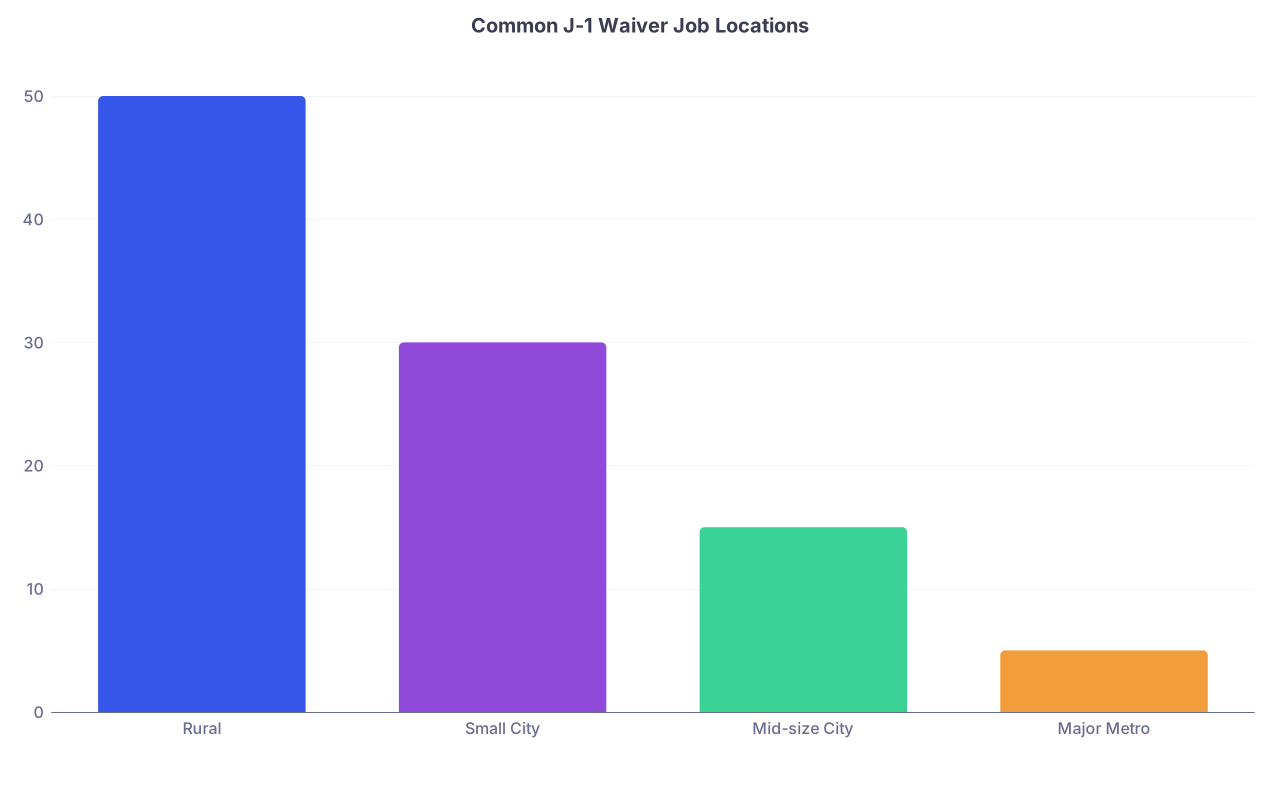
| Category | Value |
|---|---|
| Rural | 50 |
| Small City | 30 |
| Mid-size City | 15 |
| Major Metro | 5 |
If you’re from a country in political turmoil, with consular delays, or you’re part of a minority that might later claim hardship/persecution—your calculus is different. In some cases, hardship/persecution-based waivers are plausible. In others, they’re fantasy.
Step 7: Think Ahead: Residency + Fellowship + First Job
You are not choosing a visa for just residency. You’re picking a path through three phases:
- Residency
- Fellowship (if any)
- First attending job / green card stage
Scenario A: You want IM → Cardiology → U.S. academic job
- J‑1 residency + J‑1 cardiology fellowship is common and smooth.
- Then you need a waiver job (often non-academic, underserved) for a few years.
- H‑1B residency → H‑1B fellowship (if available) → academic H‑1B job → I‑140 during fellowship or early attending. More complex to line up but can be cleaner for long-term green card if you pull it off.
Scenario B: You want FM → practice, no fellowship, ASAP green card
You’re already on F‑1. A very clean route:
- Use F‑1 OPT for a research or prelim gap if needed.
- H‑1B residency in FM at a cap-exempt hospital.
- During PGY‑2 or PGY‑3, line up a permanent job (often rural or community), get them to file PERM + I‑140 while you’re still in residency/fellowship.
- Slide into that job on H‑1B with years left on the 6‑year clock.
J‑1 in this scenario:
- FM J‑1 residency is easy to get.
- But then you need a J‑1 waiver job first before you can do a regular green card path.
- Still doable—lots of J‑1 waiver FM jobs exist—but you’re more constrained.
Step 8: Use Your F‑1/OPT to De-risk H‑1B Timing
Here’s where F‑1 actually wins you something strategic.
The timeline mess:
H‑1B needs to be fully approved by July 1 or whatever your start date is. If there are RFEs, delays, or if the program’s lawyers are slow, you can be in limbo.
If you have 12 months of OPT available and you graduate (or finish your degree) in, say, May:
- You can start working in a research or “clinical research coordinator” role on OPT.
- The hospital can file H‑1B while you’re already there.
- If there’s a slight delay, you’re still legal on OPT, not out of status.
That’s a huge buffer compared to someone sitting abroad waiting on consular H‑1B.
But do not burn your OPT on random retail or unrelated work. Use it strategically: U.S. clinical research, hospital-based positions that make you more attractive to the same institution or similar ones for residency.
Step 9: Watch Out for These Common Bad Decisions
I’ve watched IMGs on F‑1 repeat the same three mistakes over and over.
Filtering out all J‑1 programs in ERAS “because I want H‑1B.”
Unless your application is truly top-tier and you’re applying to a visa-friendly specialty, that’s how you end up unmatched. Remember: you can’t get a green card if you never even get residency.Accepting J‑1 without understanding the 2-year rule.
I’ve had people tell me in PGY‑3: “Wait, I have to go home or do a waiver? Nobody told me that.” They signed the DS‑2019. They just never really read it. That’s on you.Chasing corporate H‑1B myths.
“I’ll just switch to some tech H‑1B job after residency and then come back to medicine.”
No legitimate path does that cleanly. You’re a physician. Your H‑1B classification and licensure/credentialing tie you to that world.
Step 10: Make a Real Plan, Not a Vague Preference
You should leave this with a draft plan that looks something like this.
Example for a strong IM applicant on F‑1 now:
- Goal: Long-term U.S. academic IM + subspecialty.
- Strategy:
- Apply widely, prioritize H‑1B-friendly academic IM programs but do not exclude J‑1-only programs.
- If multiple offers: choose H‑1B program if training quality is comparable.
- During residency: start I‑140 / EB-2 with future employer by PGY‑2 or early PGY‑3.
- For fellowship: aim for H‑1B fellowship at same or similar institution; if only J‑1 fellowships exist, consider whether shifting makes sense given I‑140 timing.
Example for a mid-range FM applicant on F‑1 now:
- Goal: Work in U.S. outpatient primary care, okay with rural.
- Strategy:
- Apply to both H‑1B and J‑1 FM programs; do not be picky if your scores are average.
- If match to J‑1: mentally commit early to doing a J‑1 waiver job. Start networking in PGY‑2.
- If match to H‑1B: during PGY‑2 start green card process with a rural system or FQHC.
You should literally write this plan down. One page. No fluff. It will keep you from making impulsive “I’ll worry later” choices.
A Quick Visual: Decision Flow from F‑1 to Residency Visa

| Step | Description |
|---|---|
| Step 1 | F-1 IMG in U.S. |
| Step 2 | Prioritize H-1B-friendly programs |
| Step 3 | Include all J-1 programs |
| Step 4 | Filter for H-1B but keep some J-1 |
| Step 5 | Apply broadly, accept likely J-1 |
| Step 6 | Plan early for 2-year rule or waiver job |
| Step 7 | Primary goal? |
| Step 8 | Profile strong and specialty H-1B-friendly? |
When You Should Strongly Prefer H‑1B
Given you’re already on F‑1 in the U.S., I’d say H‑1B is worth actively chasing if:
- You are absolutely set on staying in the U.S. long-term.
- Your profile is competitive enough that rejecting some J‑1-only programs will not nuke your match chances.
- You’re in a specialty and target programs where H‑1B is realistically supported (IM, psych, maybe neuro, some surgery at big-name centers).
And you’re willing to:
- Contact programs early about visa policies.
- Potentially do research/OPT-to-H‑1B bridging at a hospital system that might later take you as a resident.
When You Should Be Completely Comfortable with J‑1
J‑1 is perfectly reasonable—and often smartest—if:
Your main priority is simply: “Get U.S. training.”
Your scores are average or below, or your graduation year is older.
You’re okay with:
- Doing a waiver job in an underserved area, or
- Genuinely going back home for 2 years.
You value maximizing your match probability more than optimizing long-term visa neatness.
What I’d Tell You If You Were My Own Friend on F‑1
Stop treating H‑1B vs J‑1 like a status symbol. It’s not a flex. It’s a tool.
If you:
- Have solid scores,
- Are in a visa-friendly specialty,
- And are dead serious about staying in the U.S.,
then push for H‑1B but keep J‑1 in play as a backup. Do not gamble your entire career on one visa type if your application doesn’t justify that level of risk.
If you:
- Are anxious about matching at all,
- Have some weaknesses on your application,
lean into J‑1 as the default and treat any H‑1B offers as an unexpected bonus.
And throughout this, remember: being on F‑1 in the U.S. gives you a massive edge in terms of timing, communication, and flexibility. Use your OPT and your physical presence wisely to build relationships with hospitals that could later be your sponsors—on either visa.

If You Remember Nothing Else
Three takeaways:
- Your current F‑1 helps with timing and logistics, but it does not magically guarantee H‑1B; you still need the right profile and program.
- J‑1 dramatically expands your match options but comes with a very real 2‑year home/waiver requirement that will shape your first job and green card path.
- Do not choose blindly: build a simple written plan that covers residency, fellowship, and first job, then decide where H‑1B vs J‑1 actually helps you—not just what sounds good on Reddit.

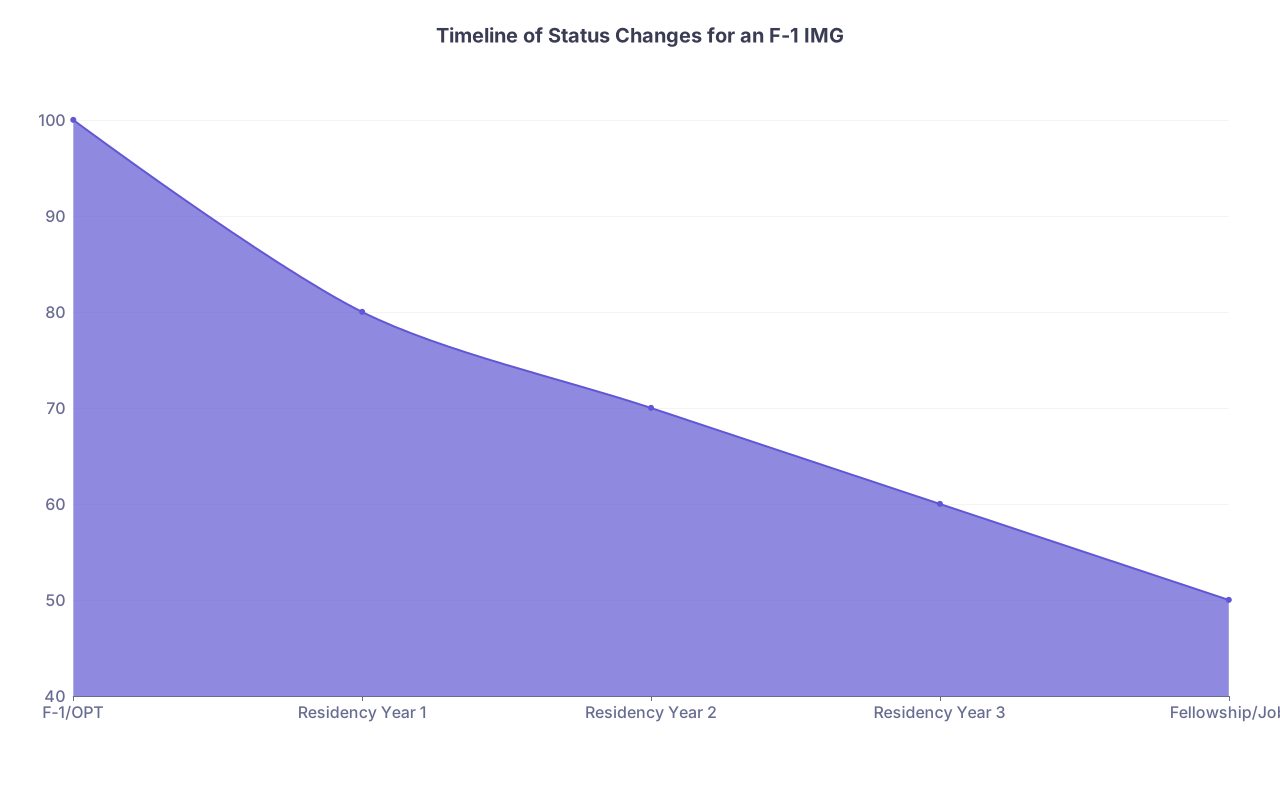
| Category | Value |
|---|---|
| F-1/OPT | 100 |
| Residency Year 1 | 80 |
| Residency Year 2 | 70 |
| Residency Year 3 | 60 |
| Fellowship/Job | 50 |