It’s late at night. You’ve finally decided you’re going to apply for residency in the US. You start reading about visas and see it: J-1. Two-year home residency requirement. Skills list. You search the list and—of course—your country is on it. Suddenly this feels a lot less straightforward.
You’re trying to figure out:
If I train on a J‑1, am I stuck going back for two years? Can I ever do a fellowship? Can I switch to H‑1B later? Is there any way around this?
You’re not looking for theory. You want:
“If I’m from X country, on the skills list, and I do Y residency, what can I actually do with my life after graduation?”
Let’s walk through this like I would with an IMG in my inbox who is about to click “submit” on ERAS.
Step 1: Understand Exactly What the Skills List Does to You
First, no fluff. If your country is on the skills list and J‑1 applies to your specialty, here’s the bottom line:
- You will almost certainly be subject to the two-year home-country physical presence requirement under INA 212(e) if you train on a J‑1.
- That means: after you complete your J‑1 program (residency, or residency + fellowship), you cannot:
- Get an H‑1B visa
- Get an L‑1 visa
- Get a green card (permanent residence)
until you either: - Go home and live there for a cumulative two years, or
- Get the requirement waived.
You can still visit the US on some other visas (like B‑1/B‑2 or maybe F‑1) if a consular officer agrees, but you can’t move your life and work there in H‑1B/green card status without dealing with 212(e).
That “skills list” is what triggers 212(e) in the first place. For medical trainees, it usually applies across the board for that country’s physicians.
So if your country is on the skills list and you do residency on a J‑1, assume you’re 212(e) subject. Plan your career around that assumption unless a qualified immigration attorney tells you otherwise after reviewing your documents.
Step 2: Decide If J‑1 Should Even Be on the Table for You
Here’s the real decision: Do you train on a J‑1 at all, knowing this requirement applies, or do you push hard for H‑1B?
Let’s compare, because this is usually where people mess up.
| Factor | J-1 | H-1B |
|---|---|---|
| Two-year home requirement | Yes (if skills list applies) | No |
| Who sponsors | ECFMG | Individual hospital/program |
| Common in residency? | Very common | Less common |
| Moonlighting | Limited | Often allowed (program-dependent) |
| Fellowship on same status | Yes, J->J | Yes, H->H (if sponsored) |
If your country is on the skills list, J‑1 means:
- You’re almost certainly taking on a real legal barrier to staying in the US after training.
- Any “I’ll just do a waiver later” plan might work, but it also might not. Waiver jobs are not guaranteed and some specialties have very rough markets.
So you ask: When is J‑1 still acceptable, even with the skills list? It can still make sense if:
- Your specialty is underserved and you’re willing to work in rural/underserved America after training (for a waiver job).
- Your long-term plan is actually to go back to your home country, or at least you’re honestly OK with that outcome.
- You don’t have a realistic shot at H‑1B sponsorship (either due to exam timing, program types, or competitiveness).
If, on the other hand, you are dead set on:
- Long-term US practice
- Competitive subspecialties
- Avoiding rural/underserved jobs
then you push aggressively for H‑1B from the beginning and treat J‑1 as a last resort.
Step 3: Know Your Actual Options If You Do Take a J‑1
Let’s say you accept the reality: most programs that like you offer J‑1, your country is on the skills list, and you’ll be subject to the two-year rule. What then?
Your path after residency on J‑1 usually looks like one of these:
- Do a J‑1 waiver job in the US (like a Conrad 30 waiver) → switch to H‑1B → later green card.
- Go home for 2 years → come back later on H‑1B or immigrant visa.
- Attempt another type of waiver (harder: persecution, hardship, etc.).
- Accept that your long-term career may be outside the US.
Most IMGs in your shoes aim for option 1.
The typical “I’ll do a J‑1 waiver job” plan
Here’s what actually happens in practice:
- You finish residency (and maybe fellowship) still on J‑1.
- Before you’re done, you find an employer in the US willing to sponsor you for a waiver position (often in an underserved area).
- They help file a J‑1 waiver application through a state program (e.g., Conrad 30) or a federal program.
- If it’s approved, the two-year home requirement is “waived,” and you transition from J‑1 → H‑1B and work for them for a fixed number of years (commonly 3).
This sounds neat on paper. In real life, it’s:
- Time-sensitive
- Competitive (spots can fill up fast in some states)
- Specialty-dependent (FM, IM, peds, psych do better; derm, rad onc, ophtho… not so much)
- Geography-dependent (rural Midwest vs coastal cities—very different worlds)
If your country is on the skills list and you’re pre-residency right now, you absolutely need to think:
“Would I be willing to go to a smaller or rural place for a few years after training to get my waiver?”
If your honest answer is no, then your long-term US prospects on J‑1 are shaky.
Step 4: Map Your Situation to Realistic Paths
Let’s walk through a few specific scenarios. This is where most people finally “see” it.
Scenario A: You’re Still Applying for Residency (No Visa Yet)
You’re filling ERAS now. No visa status yet. Your country is on the skills list.
Your moves:
Aim for H‑1B where at all possible.
That means:- Have Step 3 done by interview season (or at least before rank list finalization) for programs that require it.
- Explicitly research which programs sponsor H‑1B for PGY‑1 vs only later years.
- In interviews, ask smart, direct questions:
“For non-US IMGs, do you consider H‑1B sponsorship for categorical residents if they’ve passed Step 3?”
Segment your program list:
- Group 1: H‑1B-friendly programs (document these in a spreadsheet with notes).
- Group 2: J‑1 only or “usually J‑1” programs.
- Group 3: No visa sponsorship (waste of time for you).
Decide your personal tolerance for risk.
If you absolutely, truly want to avoid the two-year issue, you may:- Apply more heavily to H‑1B-based university or larger systems known to sponsor.
- Accept that you may have fewer programs and might be increasing your chance of not matching vs matching on J‑1.
I’ve seen applicants who refused J‑1 entirely and matched H‑1B—but with a smaller list and heavy targeting. I’ve also seen others who widened the net to include J‑1 and then spent years stressing about waivers. There’s no free lunch here.
Scenario B: You’re Already in Residency on J‑1
Now you’re PGY‑1 or PGY‑2 on J‑1. You just learned your country is on the skills list and yes, you’re 212(e) subject. The ship has basically sailed on avoiding it. So you shift from prevention to planning.
Here’s what you do:
Confirm your status formally.
Look at:- Your DS‑2019
- Your J‑1 visa stamp (it sometimes says “Bearer is subject to 212(e)…”)
- If needed, consult an immigration attorney or ECFMG.
Clarify your long-term priority:
- Stay in the US long-term if possible
- Or you’re OK going home after training
If staying in the US is the goal:
- Start learning about J‑1 waiver options early (PGY‑2/PGY‑3, not after graduation).
- Talk to senior residents/fellows from your country or neighboring countries who have successfully done waivers. What states? What specialties? What types of jobs?
- Pay attention to where alumni go after graduating—do they get US jobs or vanish back home?
Be strategic with fellowship:
- Another J‑1 for fellowship means: more time delays but same 212(e) requirement.
- Fellowship can sometimes open doors to bigger networks and more waiver job opportunities, especially in IM subspecialties.
- But if your specialty is already niche and location-limited, fellowship may not help much with waiver availability.
You’re not powerless here. You just need to treat “post-J‑1 waiver job” as a core part of your career planning, not an afterthought.
Step 5: Understand the Main J‑1 Waiver Routes (Without Getting Lost in Legalese)
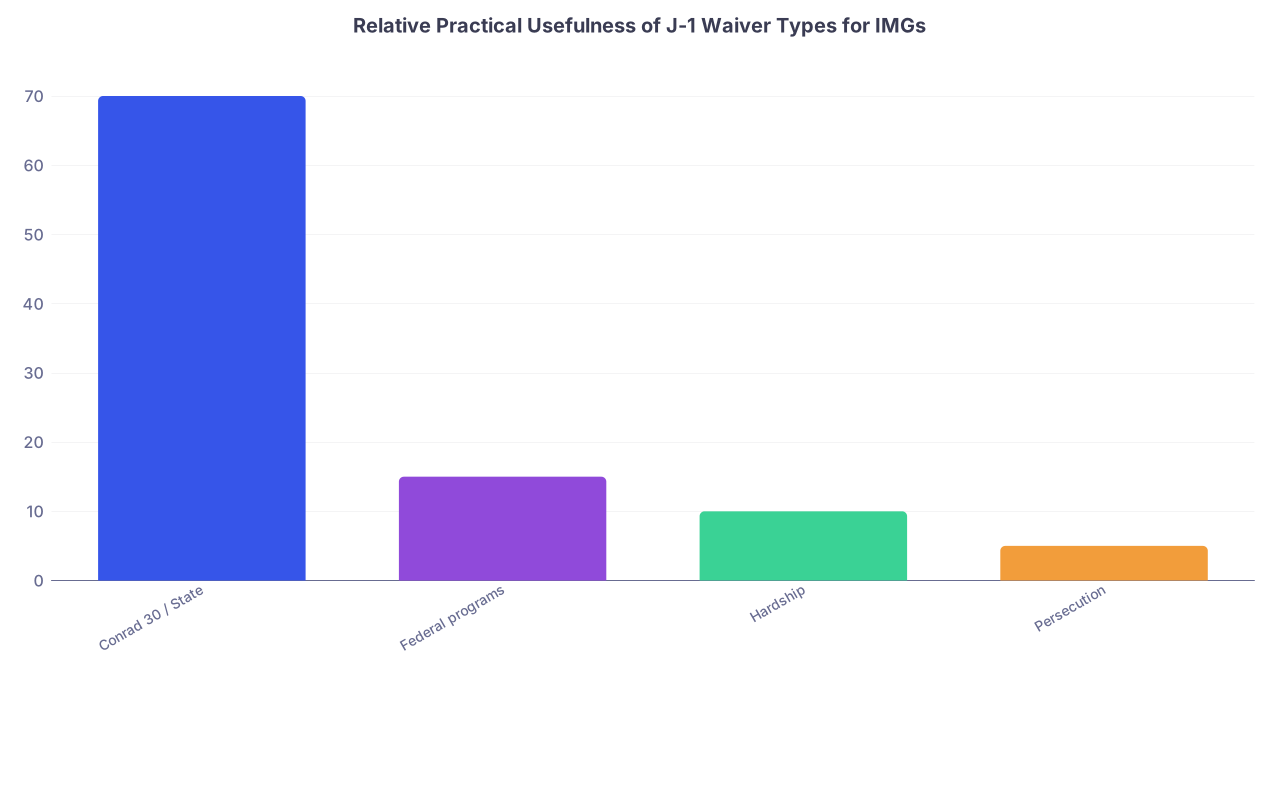
You’ll hear about multiple waiver “types.” Only a few are realistic for most IMGs.
| Category | Value |
|---|---|
| Conrad 30 / State | 70 |
| Federal programs | 15 |
| Hardship | 10 |
| Persecution | 5 |
1. Conrad 30 (State-based)
This is the one you’ll hear about 90% of the time.
- Each US state can sponsor up to 30 J‑1 waivers per year for physicians.
- Most spots are for primary care (IM, FM, peds, psych, OB/GYN) in Health Professional Shortage Areas (HPSAs).
- Some states allow a few specialist slots.
Reality check:
- Highly competitive in some states (coasts, popular cities).
- Easier in others (Midwest, rural, less “sexy” locations).
- Deadlines, paperwork, and employer knowledge vary widely.
If you’re on the skills list and planning J‑1, you should absolutely be aware which states are more IMG/waiver-friendly for your specialty.
2. Federal Programs (VA, HHS, etc.)
A smaller slice of the pie, but important:
- Some federal agencies can sponsor waivers (e.g., VA hospitals, certain HHS programs).
- Often also in underserved areas or with specific patient populations.
You usually find these via job postings or word-of-mouth by residents/fellows ahead of you.
3. Persecution / Hardship
These are borderline for most IMGs:
- Persecution: You’d be persecuted in your home country on protected grounds.
- Hardship: Extreme hardship to a US citizen or permanent resident spouse/child if you had to return.
These are case-specific, legally complex, and slow. They’re not your primary strategy. More like a backup if your life situation and facts strongly support them.
If someone is telling you “Don’t worry, you’ll just get a hardship waiver later” without actually being an experienced immigration lawyer, ignore them.
Step 6: How the Skills List Affects Your Fellowship and Subspecialty Choices
This is where a lot of IMGs on the skills list shoot themselves in the foot: they pick a pathway that is almost impossible to place in a waiver job later.
Be blunt with yourself:
- Are you going into a high-demand, broad, generalist or semi-generalist area (FM, IM, gen peds, psych, some IM subspecialties like cards, pulm/crit, heme/onc)?
- Or a very niche, urban-heavy, academic-heavy field (derm, rad onc, ophtho, pediatric subspecialties, certain surgical subspecialties)?
If your country is on the skills list, J‑1 is your status, and you want to stay in the US without going home for 2 years, then your best odds live in fields where rural and underserved America actually needs you.
Fellowship choices matter:
- An IM resident choosing cardiology or pulm/crit might still find decent waiver options (though often more rural than they imagined).
- Someone doing derm or interventional radiology and hoping for a J‑1 waiver in a big coastal city? Fantasy land.
You don’t have to plan your entire life around immigration, but you also can’t pretend it doesn’t matter. If staying in the US matters to you more than prestige or a specific niche, factor waiver-ability into your subspecialty choice.
Step 7: Pitfalls I See Over and Over (That You Can Avoid)
I’ve watched this movie too many times. Here are the common mistakes for IMGs from skills list countries:
Assuming “I’ll figure out the waiver later.”
Later comes fast. By the time you’re a PGY‑3 or finishing fellowship, it’s too late to change major things like specialty or willingness to relocate.Ignoring visa details when ranking programs.
They fall in love with city or prestige and ignore that the program:- Only does J‑1
- Has terrible track record of graduates finding waiver jobs
- Has zero institutional support for post-training immigration
Not taking Step 3 early, then being shut out of H‑1B-friendly programs.
This one is painful, because it’s fixable if you plan 1–2 years ahead.Believing rumors and WhatsApp group myths over actual attorneys.
“My friend’s cousin got a hardship waiver just by saying it was hard to go back home.”
No. That’s not how this works.Choosing fellowship purely based on interest with zero thought for job market + waiver feasibility.
Passion matters. But passion doesn’t erase immigration law or job availability.
Step 8: Concrete Planning If You’re 1–3 Years Away from Matching
Let’s anchor this to timelines. Suppose you’re in med school or just finished, and residency applications are coming.
Here’s a basic planning flow:

| Step | Description |
|---|---|
| Step 1 | 1-3 Years Before ERAS |
| Step 2 | Confirm if your country is on skills list |
| Step 3 | Decide priority: stay in US vs open to returning |
| Step 4 | Plan Step 3 early for H-1B options |
| Step 5 | Include J-1 programs in target list |
| Step 6 | Research H-1B friendly programs |
| Step 7 | Build ERAS list with visa notes per program |
| Step 8 | During residency: track alumni waiver outcomes |
| Step 9 | Priority = Stay in US |
And if you’re already a resident or fellow, adjust:
- PGY‑1: Learn your visa details; start Step 3 if not already done (for future H‑1B if you change paths).
- PGY‑2: Start researching waiver states, job types, and where alumni go.
- PGY‑3/Fellow: Start contacting potential employers early; understand each state’s waiver timeline; coordinate with an attorney.
Step 9: Accept the Trade-offs and Make a Clear Choice
You’re not going to find a perfect path here. This is a trade-off game.
If your country is on the skills list and you enter on J‑1, your choices usually boil down to:
More control now, less control later
(Take J‑1 easily for residency, no need for Step 3 early, more program options now; later you pay with waiver constraints and/or returning home.)More work and risk now, more control later
(Push for H‑1B, limit programs, stress about Step 3 and sponsorship; if it works, your post-residency life is much more flexible.)
Neither is morally superior. They’re just different paths with different pain points.
What you cannot do, if you’re trying to be rational, is:
- Treat J‑1 vs H‑1B as a minor detail
- Ignore the skills list
- Assume the two-year requirement is “just paperwork”
It isn’t. It shapes your entire post-training geography and job market.
Your Next Concrete Step (Today)
Do one thing right now:
Look up whether your country is on the US Exchange Visitor Skills List and screenshot it.
Then, based on where you are:
- If you haven’t applied yet: open your ERAS program spreadsheet (or start one) and add a column called “Visa & J‑1 Policy.” Start filling it out for 10 programs today.
- If you’re already in residency on J‑1: email one senior resident or fellow (ideally from a similar background) and ask exactly what they’re doing about their J‑1 waiver or post-training plans.
Do not just “read more about visas.” Start a document, start a list, start a conversation that forces you to see your actual path on paper. That’s how you stop this from blindsiding you 5 years from now.