
The biggest mistake IMGs make after matching at a non–cap-exempt hospital is assuming H‑1B is automatic. It is not. If you matched at a community hospital or any non-university program, you’re in a very different H‑1B game than your friends at big academic centers.
Let’s walk through exactly what to do if you matched at a non–cap-exempt hospital and want an H‑1B.
1. First reality check: What “non–cap-exempt” actually means for you
At a high level:
- Cap‑exempt hospitals: University hospitals, hospitals owned by universities, or those with a formal, qualifying affiliation with a university or non-profit research org. They can file H‑1Bs any time, outside the lottery.
- Non–cap-exempt hospitals: Most community hospitals, independent teaching hospitals. They must go through the regular H‑1B cap lottery. No exceptions just because you’re a doctor.
If your program isn’t clearly university‑owned or directly under a major academic institution, assume it’s subject to the cap until proven otherwise. Do not take a coordinator’s “we do H‑1Bs all the time” at face value. Sometimes they mean: “we support H‑1B if you get picked in the lottery,” not “we can file outside the cap.”
Here’s your first move this week: ask your GME office one specific question.
“Is our hospital H‑1B cap‑exempt or subject to the H‑1B cap for residents?”
If they hesitate, they probably don’t know. Push (politely) for a written answer from HR or the hospital’s immigration counsel.
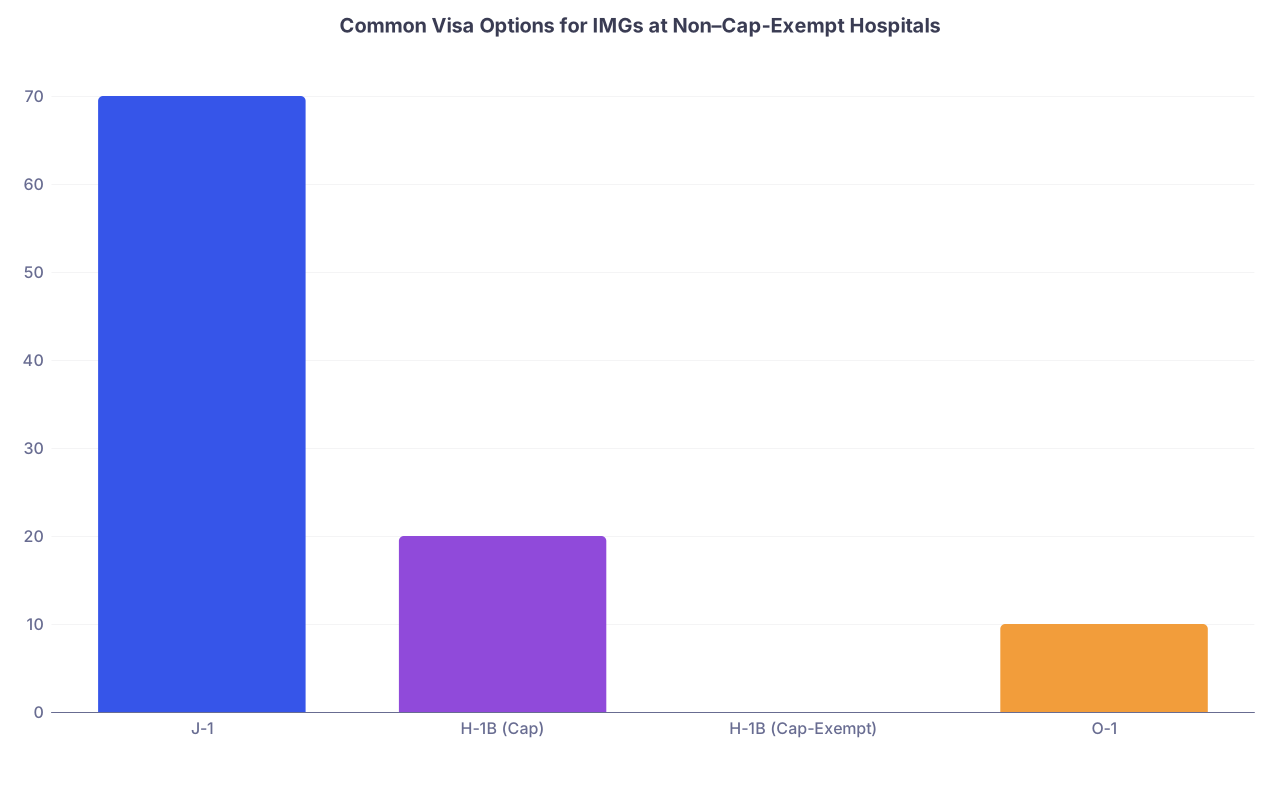
| Category | Value |
|---|---|
| J-1 | 70 |
| H-1B (Cap) | 20 |
| H-1B (Cap-Exempt) | 0 |
| O-1 | 10 |
2. Map your current status: F‑1? J‑1? Outside the U.S.?
You can’t plan H‑1B strategy without knowing your starting line. Here are the common situations for IMGs who matched at non–cap-exempt hospitals:
- You’re on F‑1 with USMLE done, matched into residency.
- You’re on F‑1 with pending graduation and no OPT yet.
- You’re abroad, never in the U.S. on a student visa.
- You’re already on J‑1 doing research or observerships.
- You’re on some other status (H‑4, L‑2, etc.).
Each situation changes what’s realistic for H‑1B.
If you’re currently on F‑1 (especially with OPT/CPT options)
You have some leverage. F‑1 plus OPT lets you stay and work (with restrictions) while you try for the H‑1B lottery.
Strategic questions to answer now:
- When do you graduate?
- Will you have 12 months of OPT available?
- Is your degree STEM (for 24‑month STEM OPT extension)? Usually no for pure MD/MBBS, but some combined programs have wiggle room.
- Can your institution recommend CPT/OPT in time?
If your residency start date is July 1 and you graduate in May, you might have enough OPT to bridge into residency if:
- Your program is willing to take you on under F‑1 OPT as a “clinical trainee” (many won’t).
- Your school’s DSO is willing to issue OPT that aligns with residency work. This is often a fight.
Do not assume you can do residency on OPT. Many programs or DSOs simply say no.
If you’re abroad / never had U.S. status
Your only realistic options for residency start:
- J‑1 (ECFMG-sponsored). Most common for IMGs.
- H‑1B if:
- The program is H‑1B cap‑exempt (doesn’t apply here), or
- You win an H‑1B cap lottery through another cap-subject employer, then transfer.
For a non–cap-exempt hospital straight from abroad? J‑1 will almost always be the only viable visa for PGY‑1 start.
3. Understand the brutal constraint: the H‑1B cap and timing
Here’s the core problem: non–cap-exempt hospitals must enter the H‑1B cap lottery like any other employer.
That lottery:
- Registration: usually early March.
- Lottery results: end of March / early April.
- Earliest start date: October 1 of that year.
Residency start:
- Most programs: late June or July 1.
You see the gap. Even if you win the H‑1B lottery with your hospital, the earliest start is October 1, while they expect you at orientation in June. Most programs will not hold your spot for 3 months while everyone else starts on time.
So the direct path…
Hospital (cap-subject) → files H‑1B cap petition → you start residency July 1 on H‑1B
…usually doesn’t work, purely because of federal dates.
What’s actually on the table:
- Start residency on J‑1 (or, occasionally, F‑1 OPT if already here), then attempt cap H‑1B later.
- Get H‑1B through a different cap‑subject employer, start Oct 1, then transfer H‑1B to the hospital later.
- Start later in the year (rare, requires a program to genuinely want you and be flexible).
I’ve seen one or two programs create a “research fellow” post from July–September while someone waits for an October 1 H‑1B start. That’s the exception, not the rule. You don’t plan around unicorns.
4. Strategy A: Accept J‑1 now but keep H‑1B alive as a downstream goal
For 80–90% of IMGs matched at non–cap-exempt hospitals, this is your most realistic path:
- Start residency on J‑1 visa.
- Later, get H‑1B outside residency or through a cap-exempt setup.
- Use that H‑1B to shift into a long‑term immigration plan.
Here’s how to do this without painting yourself into a corner.
Step 1: Lock in a J‑1 for residency (do not be cute with timing)
If your program sponsors J‑1 and you do not have a rock‑solid H‑1B plan that your program AND an immigration lawyer have signed off on, you secure the J‑1 first.
That means:
- Get your Statement of Need.
- Complete ECFMG paperwork on time.
- Don’t delay J‑1 DS‑2019 issuance “just in case” of H‑1B.
Residency start is the non‑negotiable. Mess that up and nothing else matters.
Step 2: Think about J‑1 waiver strategy early, and how H‑1B fits
J‑1 comes with the 2‑year home residency requirement unless waived.
The classic route:
- Finish residency/fellowship on J‑1.
- Get a J‑1 waiver job in an underserved area (Conrad 30, VA, etc.).
- Move into H‑1B for the waiver job.
- After 3 years, you’re free to change employers.
If you’re at a non–cap-exempt hospital now, your eventual H‑1B pathways after waiver probably look like:
- H‑1B at a cap‑exempt academic or safety‑net hospital.
- H‑1B at a private group that wins you a cap H‑1B (or hires you if you already have one from another employer).
- Possibly O‑1 → then H‑1B later.
The key: treat J‑1 as a temporary training visa, and H‑1B as part of the post‑training, long‑term plan. Don’t try to force H‑1B into PGY‑1 at a cap‑subject hospital unless the timing and institutional support are bulletproof.
5. Strategy B: Use another employer to get a cap H‑1B, then transfer
This is the move almost nobody explains clearly, and it’s how some IMGs at cap‑subject hospitals end up on H‑1B eventually.
Concept:
- A cap‑subject employer files H‑1B for you in the lottery (this could be a university, a research lab, a telemedicine company, etc.).
- Your H‑1B gets selected and approved for October 1.
- Once you’re “counted against the cap” with that employer, you can transfer H‑1B to your hospital (even if it’s also cap‑subject) without going through the lottery again.
The nasty details:
- You must maintain valid status between now and October 1 somehow (F‑1, J‑1, etc.).
- That cap‑subject employer must offer you real, legitimate work that matches your H‑1B specialty.
- The work location, duties, and hours must be consistent with law. You can’t just invent a fake job.
Where this realistically shows up:
- F‑1 student finishing a U.S. master’s or PhD before residency.
- Already working in the U.S. in a research or clinical‑adjacent role (e.g., clinical research associate) who then matches into residency.
- Someone who wins an H‑1B for a non‑clinical role and keeps it alive while training.
This is advanced maneuvering and absolutely requires a competent immigration lawyer who understands physicians, not just generic tech H‑1Bs.
If you read this and think, “I don’t have another employer, no chance,” then this strategy is probably not for you. Don’t torture yourself with it.
6. Strategy C: Leverage or create a cap‑exempt affiliation
This is the sneaky route: sometimes a “non–cap-exempt” hospital can actually file cap‑exempt H‑1Bs if there’s a proper qualifying affiliation with a university or non‑profit research organization.
Key phrase: “affiliated with an institution of higher education through a formal written agreement.”
In practice:
- Some community programs have academic affiliations strong enough to qualify for cap‑exempt H‑1B.
- Others have only “we send residents to do one rotation at University X” agreements. That usually doesn’t cut it.
Your move:
- Ask your program director or GME: “Does our hospital have a cap‑exempt H‑1B affiliation with [local university] for residents? Has your immigration counsel confirmed this?”
- If the answer is, “We don’t know,” suggest they ask the hospital’s immigration attorney. Do not try to interpret this yourself. The legal standard is specific.
- If counsel confirms the hospital IS cap‑exempt through affiliation:
- Then your path to H‑1B is much smoother. No lottery. They can file for a July 1 start.
- You now fight only the usual H‑1B physician issues (USMLE, Step 3, state license/permit, etc.), not the cap.
If the answer is no, or “probably not,” don’t spend months hoping they’ll restructure their entire affiliation just for you. Hospitals move slowly. Immigration restructuring moves even slower.
| Scenario | H-1B Timing | Lottery Required | Typical IMG Visa Choice |
|---|---|---|---|
| University hospital (cap-exempt) | Any time | No | H-1B or J-1 |
| Non–cap-exempt community hospital | Oct 1 only | Yes | Mostly J-1 |
| Non–cap-exempt with solid affiliation | Any time (if qualified) | No | H-1B possible, case-by-case |
7. How to talk to your program now without sounding clueless
You need information from your program, but you also don’t want to sound like you’re demanding they redesign their visa policies around you.
Here’s a script that works better than panicked emails I’ve seen:
Subject line: “Visa options question for [Your Name], matched PGY‑1 IM resident”
Body (shortened):
Dear [Program Coordinator/PD],
I’m very grateful for the opportunity to train at [Hospital]. I wanted to clarify visa options for my situation so I can plan appropriately.
- Is [Hospital] considered H‑1B cap‑exempt or subject to the H‑1B cap for residents?
- For incoming IMGs, does the program typically sponsor J‑1 only, or is H‑1B sometimes supported as well?
- Does the hospital work with a specific immigration attorney or firm for resident visas?
I’m happy to follow whatever is standard for the program; I’d just like to understand what is realistic in my case.
Thank you very much,
[Name], [AAMC/NRMP ID]
You’re not asking them to promise H‑1B. You’re getting the lay of the land.
Once they answer:
- If they say “J‑1 only” → assume H‑1B during residency isn’t happening. Shift all strategy to post‑residency J‑1 waiver + later H‑1B.
- If they say “we sometimes do H‑1B” → ask: “Is the hospital cap‑exempt, or would this be through the lottery? What timeline have you used in past cases?”
- If they’re confused → push gently for them to connect you to HR/immigration counsel.
8. Red flags and common traps you should avoid
I’ve watched IMGs slam into the same walls over and over. Here are the traps:
Banking your residency start on an H‑1B cap lottery win.
The odds are not in your favor. You cannot build your PGY‑1 start around a coin flip.Delaying J‑1 processing because “maybe H‑1B will work out.”
Every year someone misses J‑1 deadlines because they were fantasizing about H‑1B. The result: lost position, scrambling for prelim spots, or sitting out a year.Listening to random hospital HR assurances without attorneys involved.
“We’ve done H‑1Bs before” doesn’t mean “we are cap‑exempt” or “you can start in July.” Get specifics or get legal review.Trying to DIY complex cap‑subject to cap‑exempt maneuvers.
If you’re talking about transfers, concurrent employment, or multi‑employer setups, and there’s no immigration lawyer in the picture, you’re playing with fire.Ignoring USMLE Step 3 and licensing timelines.
Many programs that are open to H‑1B require Step 3 before filing. Non–cap-exempt or not, Step 3 is often your bottleneck. Schedule it as soon as is reasonable.
9. Concrete 12–24 month game plans by situation
Let’s make this painfully practical. Pick the scenario closest to you.
Scenario 1: Abroad IMG, matched at non–cap-exempt community IM program
- Program sponsors J‑1.
- You have no current U.S. status.
Plan:
- Commit to J‑1 for residency.
- Don’t waste energy on PGY‑1 H‑1B fantasies.
- While in residency, build:
- Strong CV, esp. primary care or hospitalist skills.
- Relationships with programs in underserved areas (Conrad 30, VA).
- PGY‑2/3: start scouting J‑1 waiver jobs and examine whether they’re cap‑exempt or cap‑subject H‑1B sponsors.
- H‑1B becomes relevant at J‑1 waiver stage, not now.
Scenario 2: On F‑1 in the U.S. finishing a master’s, matched at non–cap-exempt hospital
- You have potential OPT.
- You might be able to join the H‑1B lottery through your school, lab, or employer.
Plan:
- Immediately meet with your DSO and an immigration lawyer.
- Ask: Can you:
- Use OPT for a research or related job starting after graduation?
- Enter H‑1B lottery via that employer this March?
- Meanwhile, secure J‑1 for residency as backup.
- If you win H‑1B through the cap employer:
- Start that job Oct 1.
- Maintain the H‑1B status while arranging a transfer to a cap‑exempt hospital or to your original program if they can accommodate you later.
- This path is messy. Don’t attempt it without professional guidance.
Scenario 3: Already in U.S. on J‑1 research, matched at non–cap-exempt hospital
- You might already be subject to the 2‑year home rule.
- H‑1B for residency gets even trickier.
Plan:
- Confirm with an attorney whether your current J‑1 triggers the 2‑year requirement.
- If yes, you typically can’t change to H‑1B in the U.S. without a waiver.
- J‑1 for residency → J‑1 waiver job → H‑1B later is still your likeliest path.
- H‑1B directly for residency at a cap‑subject hospital is almost never realistic here.
10. When you should absolutely hire an immigration lawyer
There are times advice articles and forums are not enough. You should get a physician‑focused immigration lawyer if:
- Your hospital is confused about cap‑exempt vs cap‑subject and you’re in the middle.
- You’re trying to use another employer to get a cap H‑1B and then transfer.
- You already have J‑1 exposure and are unsure about the 2‑year rule.
- You’re considering O‑1 as a bridge instead of H‑1B.
Do not cheap out here. A single wrong move can cost you a match year or force you to leave the U.S.
Look for someone who has clearly worked with residents and J‑1 waiver placements, not someone who only does tech H‑1Bs for engineers.
FAQ (exactly 3 questions)
1. I matched at a non–cap-exempt hospital that “sometimes does H‑1B for IMGs.” Should I push for H‑1B instead of J‑1?
You can ask about it, but you should not stake your PGY‑1 start on it unless (a) their immigration attorney confirms the hospital is cap‑exempt or can file cap‑exempt through a valid affiliation, and (b) the timelines work for a July 1 start. If they’re cap‑subject and relying on the lottery, J‑1 is your safety net. Start the J‑1 process on time, then explore H‑1B separately. When in doubt, secure the visa that actually gets you to orientation.
2. Can I start residency on J‑1 and later switch to H‑1B during residency at a non–cap-exempt hospital?
Usually not directly, unless (1) the hospital is actually cap‑exempt (or becomes cap‑exempt through a qualifying affiliation), or (2) you obtain H‑1B status with another cap‑subject employer and then transfer. For most IMGs, the realistic switch from J‑1 to H‑1B happens after residency, at the J‑1 waiver job stage, not mid‑residency at a cap‑subject hospital.
3. Is there any advantage to insisting on H‑1B now instead of just taking J‑1 and planning a waiver later?
There is one big advantage of H‑1B: no 2‑year home residency requirement. If you can land a clean, cap‑exempt H‑1B at a university hospital, that can be a huge long‑term win. But at a non–cap-exempt hospital tied to the lottery and federal October 1 rules, chasing H‑1B can easily jeopardize your ability to start residency at all. For most people in your situation, J‑1 now + strong J‑1 waiver strategy + H‑1B later is the more stable, realistic road.
Open the email account you used for ERAS and draft a short message to your program asking whether your hospital is H‑1B cap‑exempt or cap‑subject and what visas they typically sponsor for IMGs—get that answer in writing before you waste another week planning around assumptions.