
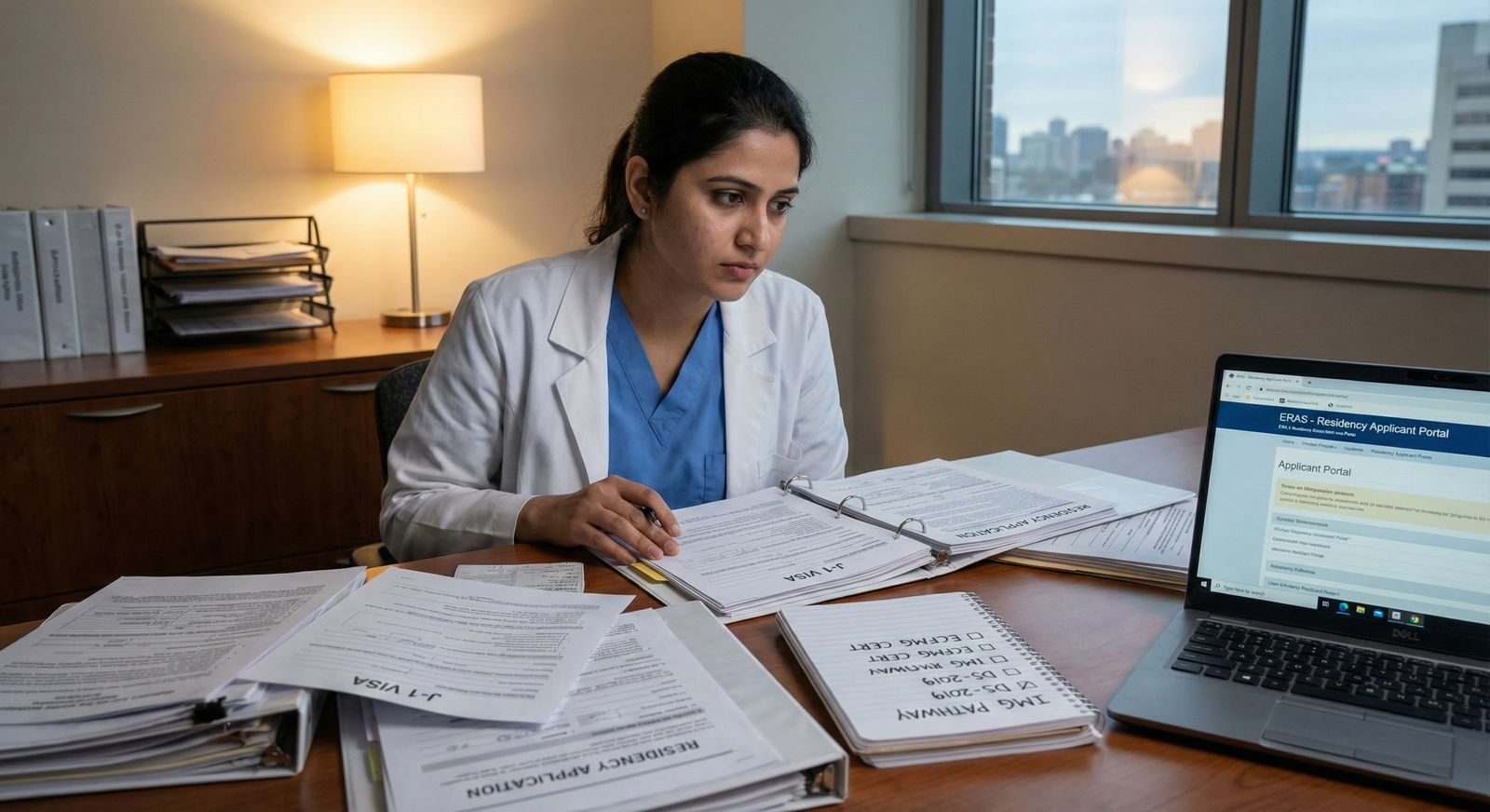
You’re in a research office at 7:30 pm. Everyone else has gone home. You’re still in your white coat from clinic, staring at ERAS on one screen and your DS-2019 on the other. You came to the US on a J-1 research visa (or J-1 “short-term scholar” / “research scholar”), you’ve done good work, maybe published papers, and now you want to apply for residency.
And it just hit you: “Wait. I’m J-1 research. But residency is usually J-1 clinical or H-1B. What actually changes for me? Am I stuck? Will programs avoid me? Do I trigger the 2-year home requirement?”
You’re not alone. I’ve watched multiple IMGs in your exact spot—postdocs, research fellows, “visiting scholars”—get completely blindsided by how different J-1 research and J-1 clinical are when you move into residency territory.
Let’s cut the fluff and walk through what really changes, and what you should do about it, step by step.
1. First Reality Check: J-1 Research vs J-1 Clinical Are Different Animals
If you remember nothing else, remember this: your current J-1 research visa is almost irrelevant for residency. What matters is what comes next.
J-1 research:
- Sponsored by a university or institution directly via a DS-2019.
- Category: “Research Scholar,” “Short-Term Scholar,” maybe “Professor.”
- Does not require ECFMG.
- Doesn’t care that you’re a doctor, per se. It cares that you’re a researcher/academic.
J-1 clinical for residency:
- Sponsored by ECFMG only. Not by your PI, not by your department, not by the hospital alone.
- Category: “Alien Physician.”
- Requires ECFMG certification (Step 1, Step 2 CK, OET, etc. completed).
- Requires a contract with an ACGME-accredited program.
Your shift from research to residency is essentially:
Institution → ECFMG as sponsor.
Research Scholar J-1 → Alien Physician J-1.
No clinical restrictions → Heavily regulated clinical training path.
So yes, “what changes” is basically “everything that matters for practicing medicine.”
2. The Big Question: Are You Subject to the 2-Year Home Residency Requirement?
This is the landmine that can ruin planning if you don’t check it early.
There are two separate 2-year rules in your world:
- The one attached to your J-1 research time.
- The one attached to your future J-1 clinical (residency) time.
They’re related but not identical. Here’s how to approach it.
Step 1: Check your current J-1 research status
Pull out:
- Your current and all prior DS-2019 forms.
- Your J-1 visa stamp in your passport (if you have one).
Look for:
- On DS-2019: a box or annotation about “212(e) Two-Year Home-Country Physical Presence Requirement.”
- On your J-1 visa stamp: language like “Bearer is subject to 212(e) – Two-year rule applies” or “Subject to 212(e): Yes.”
If you see “Subject to 212(e)” on either the DS-2019 or the visa, assume the rule applies.
Why you might be subject from your research J-1:
- Your field was on the skills list for your country.
- You received government funding (home country or US government).
- Some other condition triggered it (less common but happens).
If you’re already subject to 212(e) from your research J-1:
- You cannot change to H-1B or permanent resident from within the US without:
- Completing 2 years in your home country, or
- Getting a waiver of 212(e).
- But you can usually get another J-1 (clinical) and then accumulate a second 2-year rule from residency. Yes, a stack of obligations.
If you are not subject from your research J-1:
- Good. You get one fewer headache.
- But you will almost certainly become subject once you start J-1 clinical residency, because all ECFMG-sponsored J-1 clinical physicians are subject to 212(e) by design.
So either:
- You have 212(e) already and you’ll add more later, or
- You don’t have it yet, but you will once you start residency on J-1.
There’s no world where you do J-1 clinical residency and avoid 212(e). Zero.
3. How Your Current J-1 Affects Your Residency Visa Options
This is where people get confused. Let’s make it concrete.
You’re on J-1 research. You’re now applying for residency starting next July.
You basically have three pathways:
- End research J-1 → leave US → get new J-1 clinical visa abroad → re-enter for residency.
- End research J-1 → try to change status inside the US (J-1 research → J-1 clinical).
- Try to skip J-1 clinical and go directly to H-1B for residency.
Option 1: End J-1 research, get new J-1 clinical abroad
This is the most common, clean path:
- You finish your research appointment (or cut it short).
- Your current J-1 research ends (check grace period dates).
- You go home (or to a third country) for a visa appointment.
- ECFMG issues a new DS-2019 under “Alien Physician.”
- You get a new J-1 clinical visa stamp and re-enter for residency.
What changes:
- Sponsor: institution → ECFMG.
- Category: research → alien physician.
- Goal: academic research line on CV → structured clinical training, board eligibility.
What you must watch:
- Gaps: you can’t stay unlawfully between the end of your research J-1 and start of residency.
- Timing: DS-2019 for residency usually gets issued in late spring / early summer.
- Travel: plan for embassy wait times and potential 221(g) administrative processing.
Option 2: Change of status inside the US
Sometimes possible, often messy.
- A “change of status” is done with USCIS (Form I-539).
- This does not give you a new visa stamp, only a different status inside the US.
- It also doesn’t erase any existing 212(e) obligations.
Issues:
- ECFMG doesn’t love people staying in limbo or cutting it super close.
- Programs are sometimes uncomfortable with complex COS cases.
- If you later leave the US during residency, you’ll still need to get a J-1 clinical visa stamp abroad anyway.
I’ve seen people do it, but if you have the option to just leave, get stamped, and re-enter cleanly, that’s usually safer and simpler.
Option 3: Skip J-1, aim for H-1B
Here’s where your existing J-1 212(e) status matters a lot.
- If you are subject to 212(e) from your research J-1 and you haven’t:
- Completed 2 years in your home country, or
- Secured a waiver…
…you cannot change from J-1 → H-1B in the US, and you also can’t get an H-1B stamp abroad. 212(e) blocks H-1B and permanent residency until resolved.
So:
- If 212(e) applies from your research J-1 and you haven’t cleared it, H-1B for residency is basically off the table for now.
- If 212(e) does not apply from your research J-1, you might do H-1B for residency, but:
- Many programs won’t sponsor H-1B at all.
- Those that do often require Step 3 and ECFMG certification before starting.
- It complicates your match strategy.
Bottom line: J-1 research + 212(e) = you’re almost certainly heading for J-1 clinical, not H-1B.
4. What Changes in How Programs See You
You’re not just an IMG now. You’re an IMG already in the US on a J-1 doing research.
This cuts both ways.
Advantages you now have
- You’re physically here. Programs like that. Less visa risk perception.
- You have US research experience, maybe US letters, possibly some clinical exposure through observational roles.
- You probably know the system better—EMR, academic culture, expectations.
Talk to PDs and faculty and you’ll hear the same phrases:
- “They’ve already proven they can function in the US academic environment.”
- “Less adjustment time.”
- “Good for our publications.”
That matters.
Red flags programs worry about
Programs also think:
- “Will their visa be a mess?”
- “Are they subject to 212(e) already?”
- “Will they be able to do a waiver later if they want to stay?”
Your job is to make yourself low-risk in their eyes.
On your ERAS and in interviews, you want to project:
- Clear understanding of your visa path.
- Realistic expectations (you’re not demanding H-1B if it’s impossible).
- A simple story: “I’m on J-1 research now, will switch to J-1 clinical with ECFMG sponsorship for residency, and I understand the 2-year home requirement / waiver process later.”
If you look confused about your own visa situation, PDs get nervous. They don’t want surprises at onboarding.
5. The Administrative Switch: Research DS-2019 → ECFMG DS-2019
Let’s talk logistics. At some point if you match on J-1, here’s how the gears move.
The basic flow
- You match into a J-1 accepting program.
- Program’s GME office requests J-1 sponsorship from ECFMG.
- ECFMG verifies:
- Your ECFMG certification is complete.
- You meet all USMLE/English requirements.
- The program is ACGME-accredited and approved for J-1.
- ECFMG issues a new DS-2019 as “Alien Physician.”
- You:
- Use that DS-2019 to get a new J-1 clinical visa abroad, or
- If a change of status is pursued, use it in the COS application.
What changes for you:
- You’re no longer tied to your PI/department or research project.
- Your status is tightly linked to your residency participation and ECFMG rules (duty hours, rotations, moonlighting restrictions, etc.).
- Any side gigs or research outside your program now need very careful handling to avoid unauthorized employment.
You go from flexible academic researcher → regulated trainee whose immigration status is chained to one specific training program.
6. Strategic Changes in Your Match and Application Plan
Because you’re on J-1 research now, your match strategy can’t look exactly like someone totally abroad or on F-1.
Here’s how I’d adjust if I were in your place.
1. Decide your likely visa target before you submit ERAS
- If you’re 212(e) from research J-1 and not waived, assume J-1 clinical is your only realistic path for residency.
- Target programs that:
- Explicitly say they sponsor J-1 (check FREIDA, program websites).
- Have a track record of ECFMG J-1 residents.
- Do not waste energy on places that only do H-1B unless something about your case is unusual (e.g., you already have a 212(e) waiver in hand).
2. Use your research to your advantage
Programs see a thousand applications with “one-month observership in New York.” They don’t care.
But multi-year research? They care.
Spell out:
- Continuous US experience.
- Letters from respected US attendings/PIs.
- Publications, posters, specific projects (preferably connected to your target specialty).
Make it obvious that you’re not just “some IMG.” You’re already embedded in US academic medicine.
3. Be brutally honest with yourself on timing
If:
- Your J-1 research expires in, say, April, and
- Residency starts in late June/early July…
You must:
- Know your J-1 grace period end date.
- Make a clean plan: Will you leave and re-enter? Where will you stay? Any gap?
Do not assume “they’ll fix it for me.” They won’t.
7. Waivers, Long-Term Plans, and What Your Research J-1 Does to the Future
You’re probably thinking beyond residency too, even if you won’t admit it out loud. Fair.
Here’s how your research J-1 time plays with future plans.
If you do residency on J-1 clinical
At the end of residency/fellowship, you will:
- Be subject to 212(e) from your clinical J-1, even if you weren’t from research.
- Have to either:
- Do 2 years back home, or
- Get a waiver (e.g., Conrad 30, hardship, persecution, interested government agency).
Your prior research J-1 doesn’t directly give you or deny you a waiver. It just might mean you already had a 212(e) requirement that merges into or stacks with your new one.
The real “change” is conceptual: you’re building a life in the US over years of J-1 time (research + residency). The deeper those roots, the more emotionally painful 212(e) or a mandatory home return can feel. Plan for that reality early.
If you somehow get H-1B for residency
If you avoid 212(e) on your research J-1 and land an H-1B residency spot:
- Your research J-1 still isn’t a big deal long-term.
- You’re not subject to 212(e) from residency.
- Your path to future H-1B jobs or permanent residency is cleaner.
But again, this scenario requires:
- No 212(e) from research J-1, and
- A program willing to do H-1B, and
- You meeting Step 3 and timing requirements.
Most IMGs in your shoes end up on J-1 clinical, not H-1B.
8. Concrete To-Do List for You Right Now
Let’s get out of theory. Here’s what I’d do this week if I were you.
Confirm your 212(e) status from your current J-1.
Check every DS-2019 and your visa stamp. If unclear, you can do a “J-1 Advisory Opinion” with the Department of State—but that takes time. At least have your best reading now.Email your current institution’s international office.
Ask directly:- “Am I subject to 212(e) on my current J-1 research status?”
- “When exactly does my current J-1 end, and what is my grace period?”
- “Are there any bars (e.g., 12-month or 24-month bars) that would affect a future J-1 category change to Alien Physician?”
Clarify your target visa type for residency.
If you’re subject to 212(e) and don’t have a waiver in progress: mentally commit to J-1 clinical as your plan A. Stop fantasizing about H-1B at programs that don’t even offer it.Map your timeline.
Draw this on paper:- Current research J-1 end date.
- Planned residency start date.
- Likely interview season travel windows. Then mark when you’d need to leave the US, get a J-1 clinical stamp, and re-enter.
Adjust your ERAS program list accordingly.
Prefer programs that:- Explicitly say “J-1 accepted” or “ECFMG sponsored J-1 welcome.”
- Have a history of IMGs on J-1 (FREIDA, current residents section, etc.).
Prepare a simple, clear “visa story” for interviews.
One or two sentences:- “I’m currently here on a J-1 research scholar visa sponsored by [Institution]. For residency I’ll switch to an ECFMG-sponsored J-1 clinical visa as an Alien Physician; I understand that carries a 2-year home residency requirement that I’ll address after training through [home return/waiver options].”
You don’t need to sound like an immigration lawyer. You just need to not sound lost.
9. Quick Comparison: Before vs After You Decide to Apply for Residency
| Feature | J-1 Research Scholar | J-1 Clinical (Alien Physician) |
|---|---|---|
| Sponsor | University/Institution | ECFMG only |
| Primary Purpose | Research/Academia | Clinical training (residency) |
| ECFMG Involvement | None | Central sponsor and regulator |
| 212(e) Status | Maybe | Always yes |
| Typical Path Next | More research / home | Practice via waiver or home |
FAQ (Exactly 4 Questions)
1. I’m on a J-1 research visa and want to start residency next July. Do I have to leave the US to switch to J-1 clinical?
Not always, but it’s often the cleanest path. You might be able to do a change of status inside the US, depending on timing, your program, and ECFMG guidance. But many IMGs in your situation finish their research J-1, leave the US, get a new J-1 clinical visa stamp abroad with the ECFMG DS-2019, and re-enter before residency. Talk to your international office and the GME office at programs that interview you to see what they prefer. If there’s any doubt, expect you’ll need to travel.
2. My DS-2019 for research says I’m subject to 212(e). Does that stop me from getting J-1 clinical for residency?
No. 212(e) does not block you from getting more J-1 time. It blocks H-1B and green cards until you do 2 years at home or get a waiver. You can still move from J-1 research to J-1 clinical (and you’ll pick up an additional 212(e) obligation from your clinical training). It makes H-1B residency very difficult, but it doesn’t prevent J-1 residency.
3. Do residency programs dislike applicants who are already on J-1 research visas?
Generally, no. Many actually like you more because you’ve already proven you can function in US academic medicine. The concern is not “you’re on J-1 research,” it’s “does this person understand their visa situation, and will there be any onboarding problems?” If you can clearly explain your plan to move to ECFMG-sponsored J-1 clinical and you’re otherwise a strong candidate, being on J-1 research is usually a net positive, not a negative.
4. Should I try to get a 212(e) waiver from my research J-1 before applying to residency?
Only if it fits your realistic long-term plan and your home country/government funding situation allows it. A waiver now could make H-1B residency or future H-1B jobs more accessible, but pursuing it can be politically sensitive (especially if you had home-government funding) and takes time. Many IMGs simply accept that they’ll do residency on J-1 clinical, then deal with a waiver after residency through Conrad 30 or other programs. If you even think you might chase a waiver early, talk to a real immigration attorney before you start anything.
Close your laptop for a second and pull out your latest DS-2019. Today, physically circle the lines about 212(e) and write in the margin: “J-1 research → J-1 clinical plan.” That is your north star. Everything else—ERAS, personal statements, program list—has to line up with that reality.