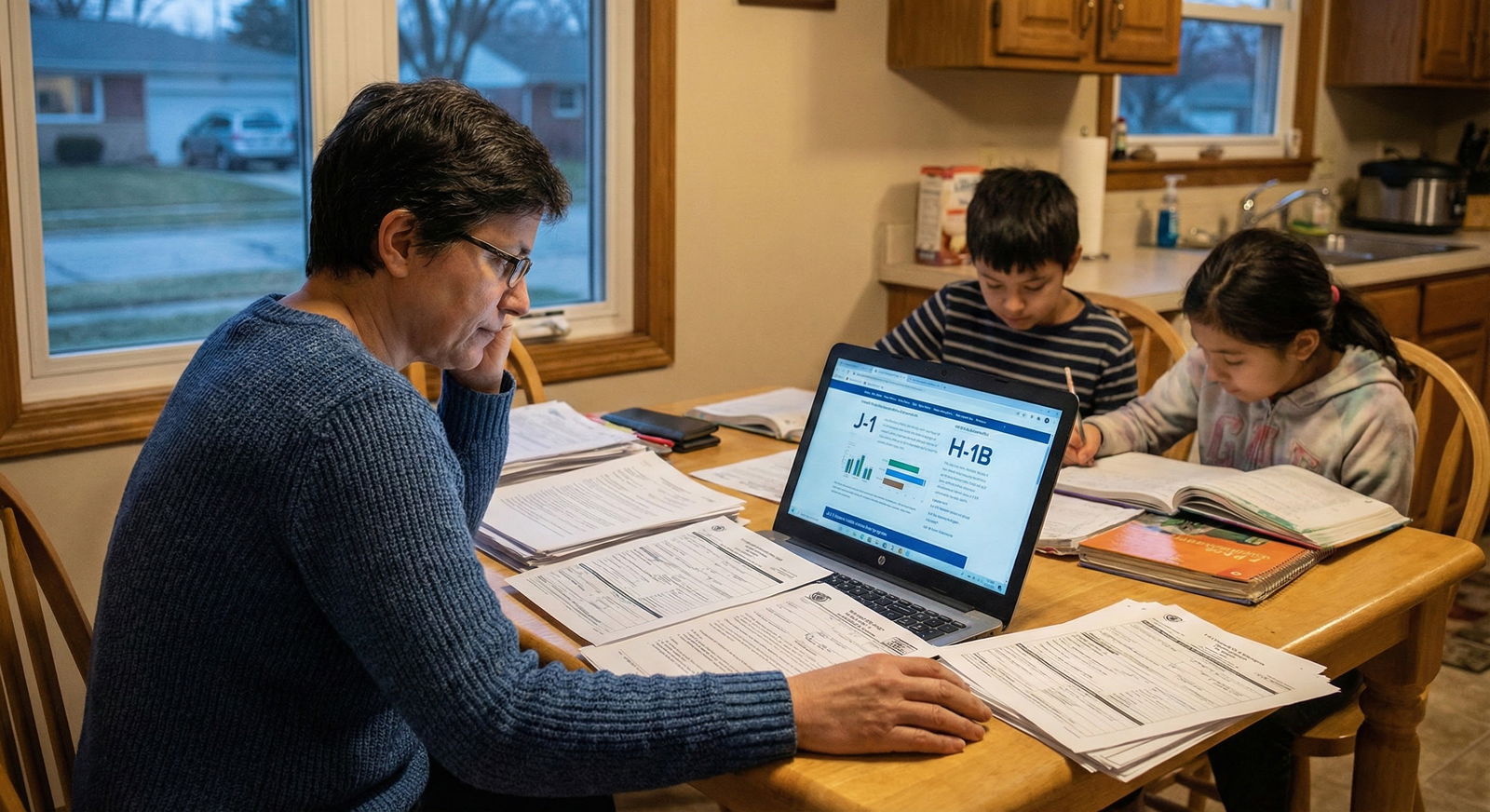
Older IMG With Kids in School: Balancing H-1B vs. J-1 Family Priorities
What do you do when the “best training program” wants you on a J‑1, but your 12‑year‑old has finally stopped crying at night because they’re just starting to feel settled in school?
That’s the real question. Not “What’s the difference between H‑1B and J‑1?” You can Google that. You’re here because you’re an older IMG, you’ve got actual children with actual lives, and you can’t afford to play visa roulette.
Let me walk you through how this really plays out on the ground. Not the brochure version. The version with school calendars, two‑year home rules, and aging parents back home.
First, your situation: what actually matters for you (not in theory)
If you’re an older IMG with kids already in school (or about to be), here’s what usually describes your reality:
- You’re mid‑30s to mid‑40s.
- You may have a spouse who either:
- Also trained medically and might want to work, or
- Has a non‑medical career and doesn’t want to be stuck at home forever.
- Your kids:
- Are in primary/middle school, learning the language, and just starting to form real friendships.
- Need stability more than adventure.
- You’re not just thinking about “matching somewhere.” You’re thinking: “Where is my family 10 years from now?”
If that’s you, then H‑1B vs. J‑1 is not an academic comparison. It’s a decade‑long family decision.
So let’s frame it the way you actually experience it:
- Can my spouse work?
- What happens to my kids and their schooling?
- Where will we physically live in 5–10 years?
- What if I need to return home for aging parents or emergencies?
- How much risk are we taking that everything falls apart after residency?
We’ll hit each of those, but first, you do need the stripped‑down visa basics in practical terms.
The real-world differences: H‑1B vs. J‑1 for an IMG with kids
I’m not going to list every regulation; I’ll break down what you actually feel day‑to‑day.
| Factor | H-1B (Physician) | J-1 (ECFMG) |
|---|---|---|
| Who is the visa for? | Worker-focused | Training-focused |
| Spouse work rights | H-4 (usually no work during residency) | J-2 can get work permit |
| Kids’ status | H-4, can attend school | J-2, can attend school |
| After residency | Need job + H-1B transfer; no automatic home return | 2-year home requirement unless waiver |
| Typical sponsor | Fewer programs; some specialties limited | Most academic programs; very common |
Now what that actually means for a family.
H‑1B – how it feels with children
Pros that matter to a parent:
- You’re on a “real worker” visa, not just a trainee.
- No automatic 2‑year home country requirement at the end.
- Transition to long‑term US life is cleaner: H‑1B → green card is a straight story.
- If you stay in the US, your kids can be in one school system for years.
Cons you will feel:
- Spouse on H‑4 usually cannot work unless:
- You later get an approved employment‑based immigrant petition (I‑140) and hit specific rules, or
- They independently qualify for another status (F‑1, their own H‑1B, etc.).
- Fewer programs sponsor H‑1B, especially for first‑year residents (PGY‑1).
- Some programs use H‑1B only for later years or fellowship.
- You must have passed USMLE Step 3 before H‑1B petition (this delays things for some).
J‑1 – how it feels with children
Pros that matter:
- Spouse (J‑2) can apply for a work permit and legally work at almost any job.
- Kids can enroll in school easily and there’s no problem while you’re in training.
- Many more programs are familiar with J‑1; less back‑and‑forth about visa logistics.
- You don’t need Step 3 before residency start.
Cons that hit hard for families:
- The 2‑year home residency requirement after all training. This is not just fine print:
- You, your spouse, and kids on J‑2 are all tied to this.
- To stay in the US after training, you must:
- Get a J‑1 waiver job (usually underserved area)
- Or leave the US for 2 years
- Or prove hardship/persecution (rare, messy, slow).
- Kids who’ve adapted to US schools now get uprooted:
- Either to your home country for 2 years or
- To some remote US town you take just for the waiver.
- Spouse work authorization ends when your J‑1 ends.
So the tradeoff is harsh:
J‑1 is easier now, harder later.
H‑1B is harder now, easier later.
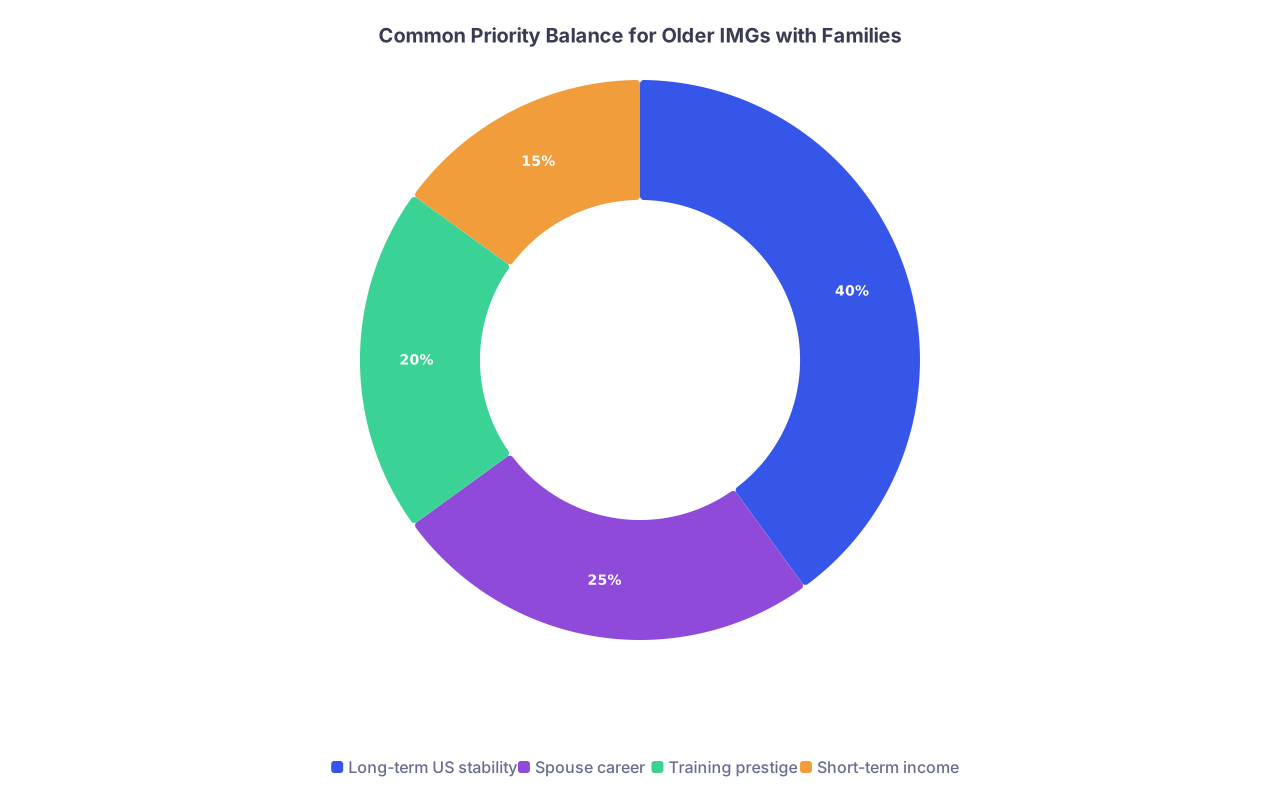
| Category | Value |
|---|---|
| Long-term US stability | 40 |
| Spouse career | 25 |
| Training prestige | 20 |
| Short-term income | 15 |
Specific scenarios: how to choose in your situation
Let me walk you through the common setups I see over and over with older IMGs and kids.
Scenario 1: You are 38–45, kids are 8–14, spouse wants or needs to work
This is probably the most common scary one.
Reality check:
If you take an H‑1B:
- Your spouse is on H‑4, usually not working during your entire residency.
- Financial load is on you.
- But your long‑term US path is cleaner, and the kids can likely stay in the US continuously.
If you take a J‑1:
- Your spouse can work. Huge relief in the short term.
- But you are making a bet: “We’ll deal with the 2‑year rule later.”
- That “later” usually hits right when your oldest is in high school or close to it.
How I’d think through it bluntly:
You choose J‑1 if:
- You absolutely need the spouse income just to survive.
- Or your spouse’s career sanity is non‑negotiable (e.g., they would deeply resent being stuck for 3+ years).
You push hard for H‑1B if:
- You can live on your resident income + maybe part‑time remote work from spouse abroad or independent contract work.
- You are committed to keeping your kids in one educational system as much as possible.
- You want the option of green card and long‑term US practice without begging for a waiver job later.
If you’re on the line, I personally lean toward H‑1B in this age/kid bracket, because pulling a 12‑year‑old out of 7th grade to move them “back home for 2 years” has a cost that people massively underestimate.
Scenario 2: You’re older (late 30s/40s), kids are very young (0–5), spouse indifferent about work for now
This is a more flexible case.
- Kids at this age adapt faster to new languages, new school systems, new countries.
- If you had to do the 2‑year home requirement after residency, they’d still be in early primary school.
Here, a J‑1 is less catastrophic if:
- You’re open to returning home for a few years.
- Or your home country job market can absorb you decently for 2 years.
- Or you seriously plan to pursue a waiver job in a rural/underserved US area. And you mean it, not just “we’ll see.”
H‑1B still wins for long‑term stability, but J‑1 isn’t as dangerous for family disruption at this stage. I’ve seen families do J‑1 with toddlers, then go back home for 2–3 years, then return later on another visa or through a different path—and the kids were okay.
Different story when kids are teenagers.
Scenario 3: You already know you want to stay in the US long term
If you’re honest with yourself and the plan in your head is:
“I want to settle in the US, get a green card, my kids graduate from US high schools.”
Then J‑1 is like taking out a high‑interest loan. You might pull it off, but you’re stacking risk.
On J‑1, to stay in the US long term, you’re usually doing one of these:
Waiver job route (most common):
- Finish residency/fellowship → get a waiver job in an underserved/rural area → work there 3+ years → then maybe move somewhere else if the market allows.
- Your kids may end up in a very different school environment than the city where you trained.
Hardship/persecution waiver:
- Very specific circumstances, heavy documentation, legal fees, and not guaranteed.
- This is not a plan; it’s a hope.
Go home 2 years:
- Kids now leave all their US friends and stability.
- Spouse career probably disrupted again.
If your inner voice already knows, “We want to stay in the US,” then you do everything in your power to get H‑1B, even if:
- It means ranking only H‑1B‑friendly programs first.
- It means delaying a year to pass Step 3 and strengthen your application.
- It means choosing a slightly less “famous” program that will actually sponsor H‑1B.
I’ve watched people chase prestige and take a J‑1 at a big‑name place, only to end up stuck later, years behind where they could have been, because of the waiver/home requirement. Your kids do not care if your residency program was top‑10. They care whether they have to leave their school and friends.

| Step | Description |
|---|---|
| Step 1 | Older IMG with school-age kids |
| Step 2 | Long-term US stability |
| Step 3 | Immediate spouse income |
| Step 4 | Open to living back home |
| Step 5 | Prioritize H-1B programs |
| Step 6 | Consider J-1 but plan waiver early |
| Step 7 | J-1 acceptable, plan 2-year return |
| Step 8 | Main priority? |
Practical constraints: what programs actually do
You’re not choosing in a vacuum. Programs have their own rules.
Common patterns I see:
- Many community programs:
- Will consider H‑1B, especially in IM, FM, psych, neurology.
- Big-name academic programs:
- Default to J‑1.
- Some explicitly say “J‑1 only” for categorical positions.
- Some will:
- Start you as J‑1 and only consider H‑1B for fellowship or later transfers.
- Surgical specialties:
- Often more J‑1 heavy, but exceptions exist.
You should not be guessing this. Before ranking programs (ideally before applying widely), you:
- Check each program website for “Visa sponsorship” section.
- Email/coordinators politely with a very specific question:
- “Do you sponsor H‑1B for categorical PGY‑1 IMGs who have USMLE Step 3 passed before start date?”
- Watch their exact wording.
- “We usually sponsor J‑1, H‑1B considered case‑by‑case.” = can work, if you’re strong.
- “We only sponsor J‑1.” = believe them.
How each visa actually shapes your kids’ lives
Forget theory. Here’s what your kids will notice, year by year.
On H‑1B
School continuity:
They enroll in one district, maybe move once if you change jobs, but no forced 2‑year exile.Language & friends:
They get to build fluency and peer groups without the “we might disappear in a few years” cloud hanging over the family.Stability of narrative:
When they ask, “Are we staying here?” you can more honestly say, “We’re trying to make this our long-term home.”Downside:
They see one parent (often the non‑physician spouse) stuck professionally during residency years. Financial stress is visible. You may say “no” to more activities and extras.
On J‑1
Short-term normal:
During residency, life can look similar: school, friends, parent(s) working.But the countdown exists: Even if you don’t say it out loud, kids feel when there is a big uncertain “after residency” event coming.
If you leave for 2 years:
They restart: new system, new language nuances, then potentially return again. More resilient kids can handle it; others struggle hard.If you do a waiver job in a rural area:
The school, peer culture, and environment might be very different from your training city. Sometimes better. Sometimes worse. But it is not entirely your choice; it’s driven by where you can find a waiver.
This is where your parenting style and your particular kids matter. Some families are very mobile and handle big moves well. Others really don’t.
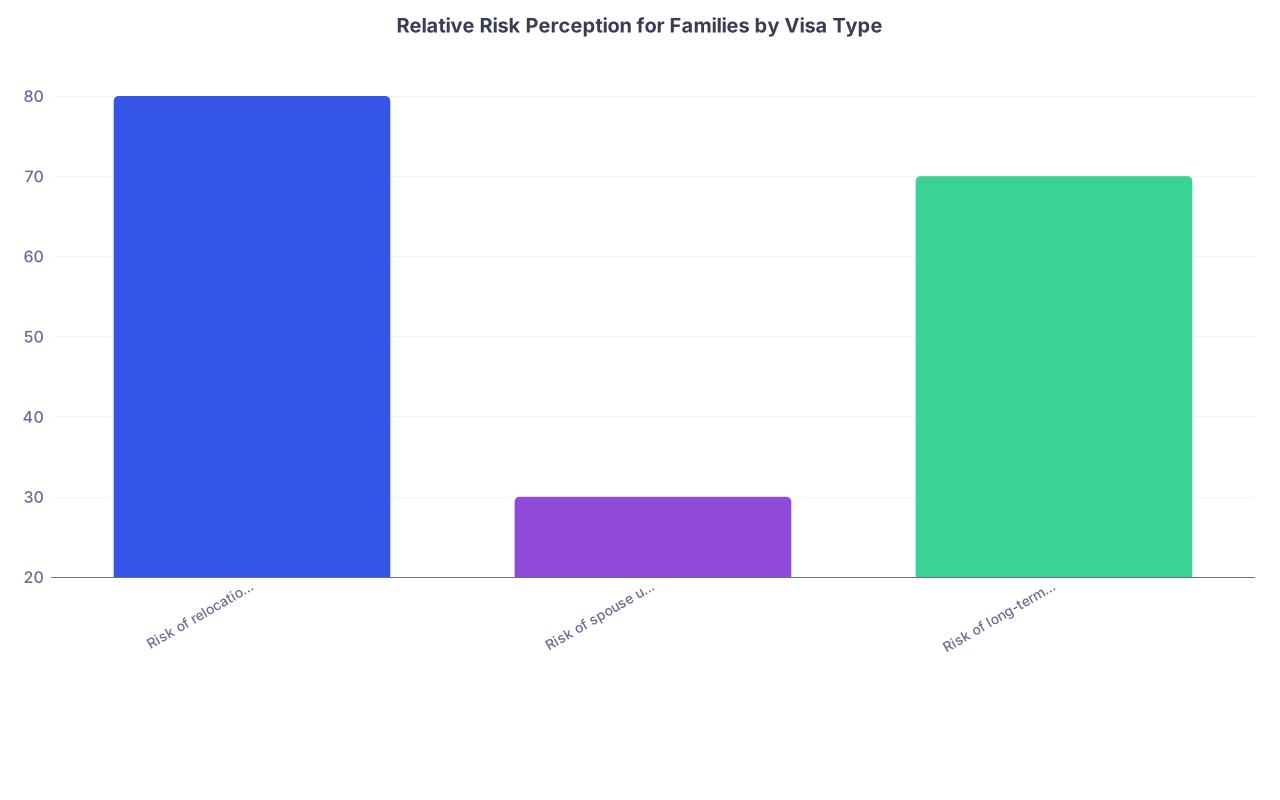
| Category | Value |
|---|---|
| Risk of relocation after residency | 80 |
| Risk of spouse underemployment | 30 |
| Risk of long-term US plans failing | 70 |
(Higher numbers = higher perceived risk on J‑1 compared to H‑1B)
Money, time, and aging parents: the invisible pressure points
You’re older. You’re not 25 with infinite time to “see how it goes.”
Three things tie into this:
Financial runway
On J‑1 with a working J‑2 spouse, those extra dollars might:- Let you live in a safer neighborhood
- Pay for better childcare
- Avoid high‑interest debt
On H‑1B, you may tighten your belt for several years. But if it sets up a clean path to a long‑term job and green card, those years might be worth the pain.
Your own aging parents back home
With J‑1 and a 2‑year home requirement, you could theoretically:- Spend those two years closer to your aging parents and help them,
- While your kids learn your home culture and language more deeply.
That is one of the few upsides of the 2‑year rule that people ignore.
On H‑1B, you’ll probably be in the US continuously, flying back only for emergencies and brief visits.Your own age at the end of all this
If you’re 40 starting residency:- 3 years IM → 43
- 2–3 years fellowship → 45–46
- Then add 2 years home requirement? Now you’re almost 50 before stable attending income.
That’s a long game. H‑1B shortens that by removing the forced 2‑year detour.
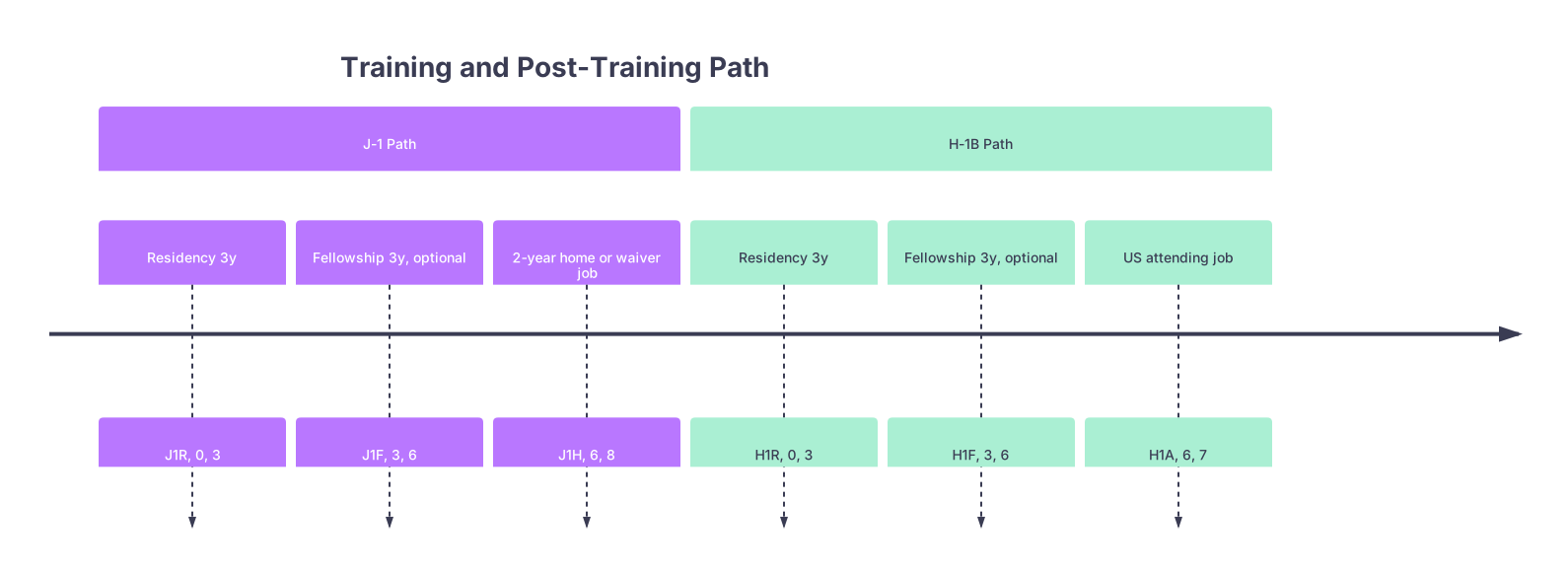
| Period | Event |
|---|---|
| J-1 Path - Residency 3y | J1R, 0, 3 |
| J-1 Path - Fellowship 3y, optional | J1F, 3, 6 |
| J-1 Path - 2-year home or waiver job | J1H, 6, 8 |
| H-1B Path - Residency 3y | H1R, 0, 3 |
| H-1B Path - Fellowship 3y, optional | H1F, 3, 6 |
| H-1B Path - US attending job | H1A, 6, 7 |
Concrete steps: what to actually do this season
Enough theory. Here’s how you behave if you’re currently in the match/apply phase.
1. Decide your red lines before rank lists
Write them out. Literally.
Examples:
- “We will not knowingly choose a path that forces our child to change national school systems twice after age 10.”
- “We cannot afford 3+ years on a single income; spouse must be able to work.”
- “We are okay returning home for 2 years if needed.”
- “Long-term US settlement is our top priority.”
When you’ve written these, visa choice becomes clearer. You stop being hypnotized by program prestige.
2. Build a target list of H‑1B‑friendly programs (if long-term US is priority)
Do this even if you’re still open to J‑1. Examples:
- Community internal medicine programs in medium-sized cities.
- Some university‑affiliated programs that explicitly say “H‑1B considered.”
Email them early. Ask exactly:
“For IMGs with USMLE Step 3 passed, do you sponsor H‑1B visas for categorical PGY‑1 residents?”
Save replies. Use them to filter.
3. Do not lie or hide your situation
I’ve seen people try to “slide in” on a J‑1 and tell themselves they’ll solve it later. It’s understandable. But at least be fully honest with yourself: you are trading short‑term ease for long‑term volatility.
Talk to your spouse like this is a business decision. Because it is.
4. If you end up with only J‑1 options: plan J‑1 properly, not passively
If all realistic offers you get are J‑1, it’s not the end of the world. But then you:
- Start understanding J‑1 waiver options from PGY‑1, not PGY‑3.
- Network with people in your specialty who actually did J‑1 waivers.
- Mentally prepare kids and spouse that “post‑residency might mean a move to a smaller city/town” or “we may return home for a bit.”
Passive J‑1 planning is where families get burned. Active J‑1 planning can still work.

A few blunt opinions people don’t say out loud
Let me just say the quiet parts:
Prestige is overrated when you have kids. A “less famous” H‑1B program that keeps your family stable is often better than a top‑10 J‑1 mill that spits you out into waiver chaos later.
For older IMGs with school-age kids who want to stay in the US, J‑1 is usually a bad long-term bet, unless you are very strategic about waivers or genuinely open to leaving.
For couples where the spouse’s mental health depends on being able to work and avoid complete dependence, J‑1 might be the only survivable choice. A miserable, trapped spouse can damage your family more than a 2‑year home requirement.
Kids are more resilient than we fear but less flexible than immigration law assumes. Two major school‑system moves in adolescence? That can absolutely wreck their academic trajectory.
You’re not choosing a visa. You’re choosing which pain you can live with.
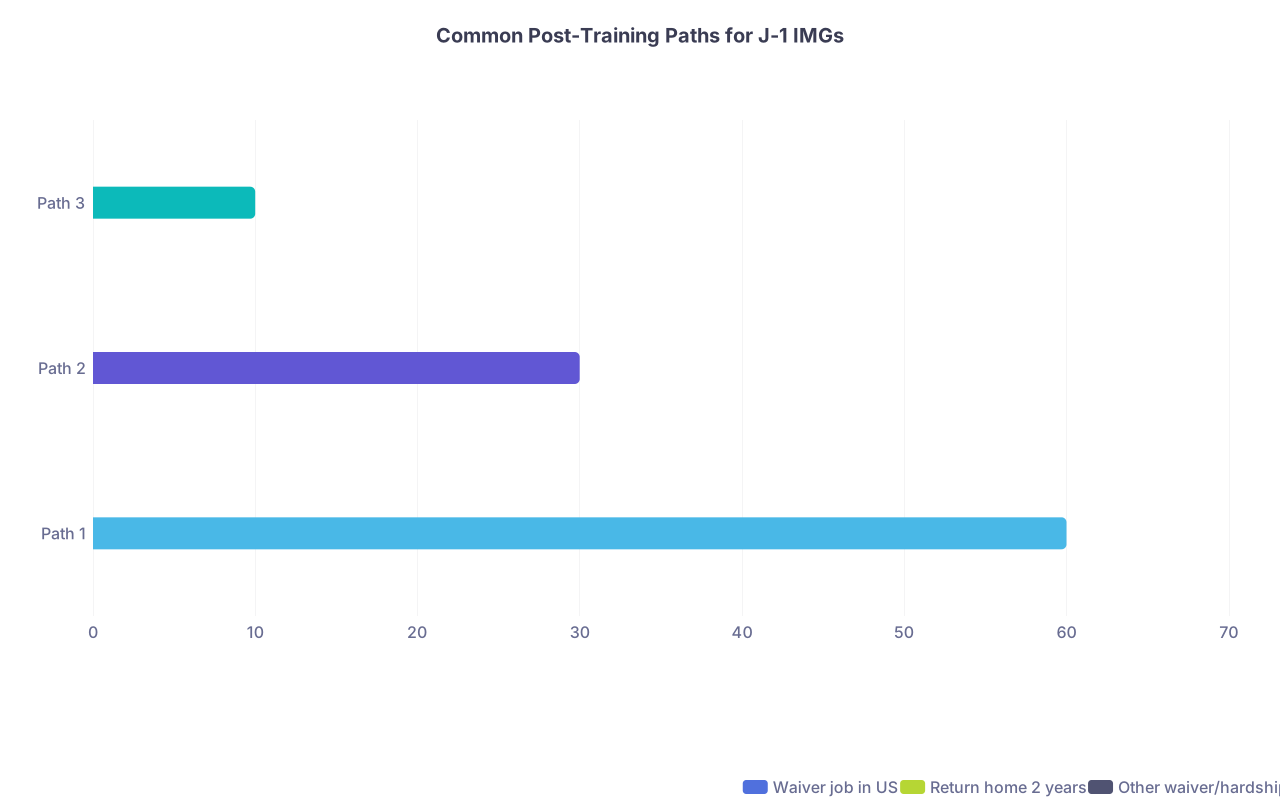
| Category | Waiver job in US | Return home 2 years | Other waiver/hardship |
|---|---|---|---|
| Path 1 | 60 | 0 | 0 |
| Path 2 | 0 | 30 | 0 |
| Path 3 | 0 | 0 | 10 |
(Illustrative, not precise statistics—but it matches what I’ve seen anecdotally.)
Where this leaves you
You’re not going to solve this in one evening. But you can do three things this week:
- Sit down with your spouse and write out your top three non‑negotiables for the next 10 years.
- Make an honest list of which programs on your radar even offer the visa that fits those priorities.
- Decide now whether you’re willing to delay a year or shift specialty if that’s what it takes to align visa and family.
Your kids are not in the Zoom interviews. They’re not reading contract fine print. But they’re the ones who will live with the ripple effects of this choice long after you’ve forgotten which attending at which institution asked you about your research project.
Handle the visa choice like you’re planning their lives, not just your CV.
With that frame in place, you’re not just “chasing any match.” You’re building a training path that doesn’t blow up your family five years down the line. Once that’s settled, then it makes sense to talk about rank lists, specialty competitiveness, and interview strategy—but that’s the next chapter.