
Your embassy refusing a No-Objection Statement is not the end of your U.S. career. It just means you’re now in the harder, more realistic lane most IMGs end up in.
Let me be blunt: for almost all physicians on J‑1 for residency or fellowship, the “No Objection” waiver was never really your path. Your path was always going to be a service‑based waiver (Hardship, Persecution, or Conrad 30 / other physician shortage waivers). The shock comes when you first hear “We don’t issue No‑Objection letters for doctors” from your embassy and realize you have to rethink everything.
Here’s how to do that, step by step, without blowing up your timeline or your career.
1. First: Face the Reality of Your J‑1 Two‑Year Rule
If your country won’t issue a No‑Objection Statement (NOS), you’re in one of three buckets:
- You are currently in J‑1 residency or fellowship and trying to plan what happens after graduation.
- You are about to start a J‑1 program and just discovered the NOS is not available.
- You’ve finished training, are back home or stuck on J‑1, and trying to figure out how to ever come back.
The underlying law is the same for all of you.
What the two‑year rule actually means
You are “subject to 212(e)” (the two‑year home residency requirement) if at least one of these is true:
- Your J‑1 was funded by your government or the U.S. government
- Your specialty appears on the Skills List for your country
- You did graduate medical education (ECFMG‑sponsored J‑1 for residency/fellowship)
You’ll typically see this on:
- Your J‑1 visa stamp annotation
- Your DS‑2019
- Or a formal advisory opinion from the Department of State (if there’s confusion)
If subject to 212(e):
- You cannot change status in the U.S. to H‑1B, L‑1, or permanent residence (green card)
- You cannot get an H‑1B or immigrant visa at a consulate
- Until you either:
- Complete an aggregate of 2 years physically in your home country, or
- Get an approved waiver of the requirement
If your embassy will not give a NOS, that just kills one of the five waiver bases. The others are still alive:
| Waiver Type | Needs NOS? | Common for IMGs? | Based On |
|---|---|---|---|
| No-Objection | Yes | Rarely useful | Home govt consent |
| Persecution | No | Rare | Fear of persecution |
| Hardship | No | Occasionally | Extreme hardship to USC/LPR spouse/child |
| Conrad 30/State | No | Very common | Service in underserved area |
| Federal Agency | No | Less common | VA, ARC, HHS, DRA, etc. |
So your real question is not “What do I do without a NOS?”
Your real question is: Which of the remaining four can I actually pull off?
That’s where we go next.
2. If You’re Still in Residency/Fellowship on J‑1
This is the group with the most options if they don’t freeze up.
Step 1: Stop chasing a No‑Objection fantasy
If your country has a known policy of refusing NOS for physicians (India, Pakistan, many Middle Eastern countries, etc.), do not waste a year:
- Writing nice letters to the embassy
- Asking relatives to “pull strings”
- Waiting to see if “policy changes”
Assume the NES (No‑Embassy‑Support) scenario and plan for a waiver‑job‑plus‑H‑1B path.
Step 2: Know your actual realistic paths
You basically have three possible lanes after residency/fellowship:
- Conrad 30 / State Health Department waiver
- Federal agency waiver (VA, ARC, HHS, etc.)
- Hardship / Persecution waiver (highly case‑dependent)
If you’re a typical IMG in Internal Medicine, Family Med, Pediatrics, Psychiatry, OB/GYN, or some hospital‑based subspecialties, you’re mostly looking at:
- Conrad 30 or
- Another physician shortage waiver (like ARC or HHS)
Persecution / hardship are niche, complex, and not your Plan A unless your personal life clearly fits.
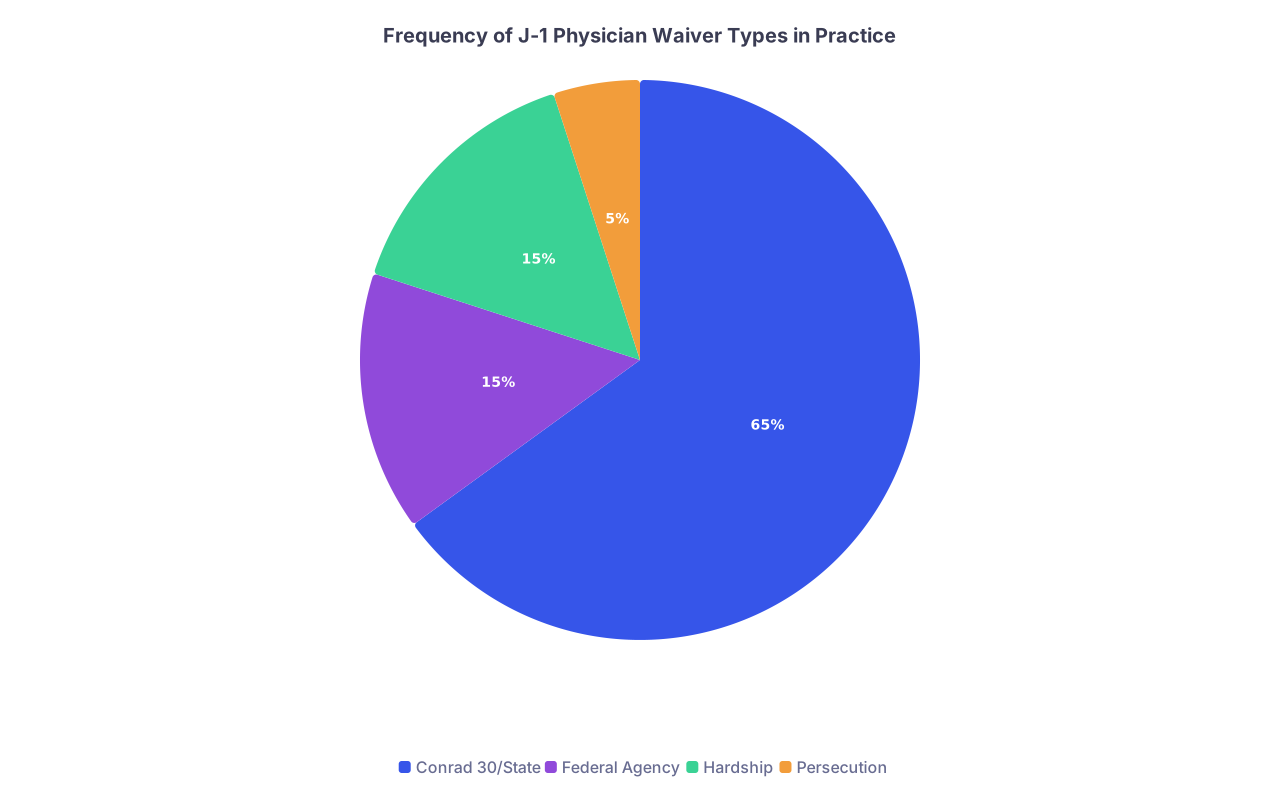
| Category | Value |
|---|---|
| Conrad 30/State | 65 |
| Federal Agency | 15 |
| Hardship | 15 |
| Persecution | 5 |
Step 3: Timeline pressure you’re up against
Typical J‑1 physician timeline:
- Final year of training: Find waiver‑sponsoring job (often 9–18 months before graduation)
- Late summer/fall before graduation: Employer files waiver application (Conrad 30 or federal)
- Once waiver approved: USCIS files H‑1B petition so you can start working July 1 (or as close as possible)
If you wake up to the “no NOS” situation in PGY‑3 of IM or PGY‑6 of surgery and haven’t thought about Conrad 30, you’re late but not dead.
Your priority now:
- Secure a waiver‑sponsoring job in a location and specialty that qualifies
- Work with an attorney who knows this space (not your cousin who does real estate closings)
3. The Real Workhorse: Conrad 30 and State Waivers
Conrad 30 is the default path for J‑1 physicians whose home countries refuse NOS. If you’re in a common IMG specialty, assume this is your main route unless you have a compelling hardship/persecution case.
What is Conrad 30, in actual human terms?
Each U.S. state can recommend up to 30 waivers per year for J‑1 physicians who agree to:
- Work full‑time (at least 40 hours/week)
- In a Health Professional Shortage Area (HPSA) or Medically Underserved Area / Population (MUA/P), or under a “flex” slot where only a portion of patients are underserved
- For 3 years in H‑1B status
- Often with some in‑person, not purely telemedicine
State requirements vary a lot in:
- How early they accept applications
- How strict they are on HPSA/MUA
- Whether they allow hospitalist / subspecialist positions or only primary care
- How competitive their 30 slots are
You don’t get a magical waiver by existing. You get it by locking down a job in an eligible setting and having that employer sponsor your waiver.
Basic flow of a Conrad 30 case
Here’s what the sequence commonly looks like:

| Step | Description |
|---|---|
| Step 1 | Find qualifying job |
| Step 2 | Sign contract with waiver clause |
| Step 3 | Employer prepares state waiver packet |
| Step 4 | State reviews and recommends waiver |
| Step 5 | State sends to DOS |
| Step 6 | DOS issues favorable recommendation |
| Step 7 | USCIS approves J-1 waiver |
| Step 8 | Employer files H-1B |
| Step 9 | Start work in H-1B status |
Key practical points:
- You stay on J‑1 through the rest of residency/fellowship
- The waiver process runs before your J‑1 expires
- H‑1B kicks in right as your J‑1 ends (ideally July 1 after training)
How to approach job hunting for waivers
Stop thinking like a prestige‑chasing resident. Start thinking like someone who needs a ticket out of 212(e).
Strong moves:
- Target states that historically don’t fill all 30 slots
- Look at rural community hospitals, FQHCs, small private practices in HPSAs
- Be flexible geographically (you are buying your ability to stay in the U.S.)
Questions you ask employers up front:
- “Do you have experience sponsoring J‑1 waiver positions?”
- “Do you work with an immigration attorney for J‑1/H‑1B?”
- “Is this location in a HPSA or MUA/P? Do you know the score?”
- “Are you planning to use a Conrad 30 slot or a federal program like ARC/HHS?”
If they stare blankly when you say “Conrad 30,” you either:
- Walk away, or
- Accept you’ll be educating them with your own lawyer
4. Federal Agency Waivers: VA, ARC, HHS and Friends
If your home country will not issue NOS, federal agency waivers are equally valid and sometimes more flexible.
Common physician‑relevant agencies:
- VA (Department of Veterans Affairs) – for VA hospitals/clinics
- ARC (Appalachian Regional Commission) – for certain Appalachian counties
- DRA (Delta Regional Authority) – for parts of the Mississippi Delta region
- HHS (Health and Human Services) – mostly primary care or certain mental health settings
These share a core idea:
- You take a job in a specific geographic and/or clinical area that the agency cares about
- The agency agrees to sponsor your J‑1 waiver based on service
- Requirements and processes are different for each agency
Sometimes federal waivers open doors when state Conrad slots are gone or your job doesn’t fit a state’s exact rulebook.
5. Hardship and Persecution Waivers: Only If You Actually Have a Case
If you’re hoping hardship/persecution is an easy NOS substitute: it isn’t.
You need one of these:
- A U.S. citizen or green card holding spouse or child for hardship
- A credible, specific fear of persecution in your home country based on protected grounds (race, religion, nationality, political opinion, social group) for persecution waivers
And you need:
- Detailed, consistent documentation
- A very well‑built legal argument
- Usually a seasoned immigration attorney experienced in J‑1 waivers, not just asylum or marriage green cards
Use these if:
- Your child has a significant medical or developmental issue that cannot be adequately treated in your home country
- You’re in an interfaith/interethnic marriage that would genuinely be unsafe or socially impossible back home
- You’re a dissident, activist, or part of a targeted group in your country and would be at risk if forced to live there 2 years
Do not expect these to be quick. And do not assume your story is “obvious” without serious legal work.
6. “Can I Just Switch to Another Visa and Bypass 212(e)?”
Short answer: No. Not for H‑1B or a green card.
If you’re subject to 212(e), you cannot:
- Change status to H‑1B or L‑1 while inside the U.S.
- Get an H‑1B or immigrant visa at a consulate
Even if you marry a U.S. citizen. Even if your employer loves you. 212(e) is a hard wall.
The few things you can still get while subject to 212(e):
- O‑1 in some cases (but this is nuanced and you need a very strong profile and legal advice)
- F‑1 sometimes (for non‑immigrant study), but it does not erase the 2‑year rule
- Tourist visas, maybe, but that’s irrelevant to your career
Bottom line: if your embassy will not issue NOS, your way through the wall is a waiver based on service or personal circumstances, not a side door visa.
7. If You’ve Already Left the U.S. or Are Back Home
Different reality, different playbook.
You still technically have two paths:
- Satisfy the 2‑year requirement by actually living in your home country
- Waive the 2‑year requirement even while abroad (service or hardship/persecution)
Satisfying the 2‑year requirement
The rule is aggregate time physically in your home country, not continuous.
Key points:
- Short trips abroad don’t usually break anything, but they also don’t count toward your 2 years
- You need to be able to document your physical presence (entry/exit stamps, job contracts, housing, etc.)
- Once you hit the 2‑year mark, you’re free of 212(e) and can pursue H‑1B or immigrant visas like anyone else
If you’re early‑career and there is no realistic waiver for your specialty/location right now, doing your time at home and coming back later is not insanity. Many IMGs do exactly this, then come back for fellowships, hospitalist gigs, or even academic posts.
Waiver from abroad
If you find:
- A U.S. employer in an underserved area willing to sponsor you for a J‑1 waiver position, and
- A state or federal agency ready to back the waiver
You can still:
- Get the J‑1 waiver approved
- Get an H‑1B petition approved
- Then return to the U.S. on H‑1B
The dot you must connect: even from abroad, you need that waiver‑sponsoring job. That’s your linchpin.
8. If You Haven’t Started J‑1 Yet and Just Discovered the NOS Problem
You actually have the most strategic flexibility.
Three decisions to think through:
Should you still use J‑1 for residency?
- If you can qualify for H‑1B for residency (USMLE Step 3 done, program willing to sponsor), that’s often better.
- Many community and some university programs will not do H‑1B for residents. That limits you.
If you do go J‑1, do it with open eyes
- Assume you’ll need a Conrad 30 or federal waiver job after training.
- Plan your specialty and fellowship choices with that in mind (some subspecialties have terrible waiver prospects).
Align your long‑term goals
- If you want ultra‑competitive urban academic positions with no underserved component, J‑1 is usually the wrong visa.
- If you’re open to rural, small city, underserved practice for at least 3 years, J‑1 + waiver can still be a solid route.
Think career chess, not checkers. One visa choice at the start of residency can cost or save you 3–6 years later.
9. Strategy: How to Plan Your Next 3–6 Years
Let’s strip this down to practical moves depending on where you are.
If you’re PGY‑2 or early fellowship on J‑1
- Confirm you are in fact subject to 212(e) (check DS‑2019/visa; get DOS advisory opinion if unclear).
- Accept that NOS is off the table if your embassy has a consistent policy.
- Map out states and federal programs that sponsor waivers in your specialty.
- Start networking and job hunting earlier than your peers (12–18 months ahead).
- Budget for at least one good immigration attorney consult; do not cheap out on this.
If you’re in your final year and behind
- Immediately talk to your GME office about any institutional connections with waiver‑sponsoring employers.
- Cast a wide geographic net: Midwest, South, rural areas, places U.S. grads avoid.
- Be honest with employers about your J‑1 and 212(e) situation; see who’s willing to sponsor.
- Have an attorney rapidly evaluate whether any hardship/persecution angle exists as a back‑up.
If you’re already home country–based post‑J‑1
- Decide: are you going to run out the 2 years or actively seek a waiver job from abroad?
- Keep your CV active: clinical work, publications, U.S. networking if possible.
- Track your physical presence days; ensure you can later prove you completed the 2 years if you go that route.
- If pursuing a waiver job, be realistic: many U.S. employers want you physically in the U.S., so you may need to stand out more.
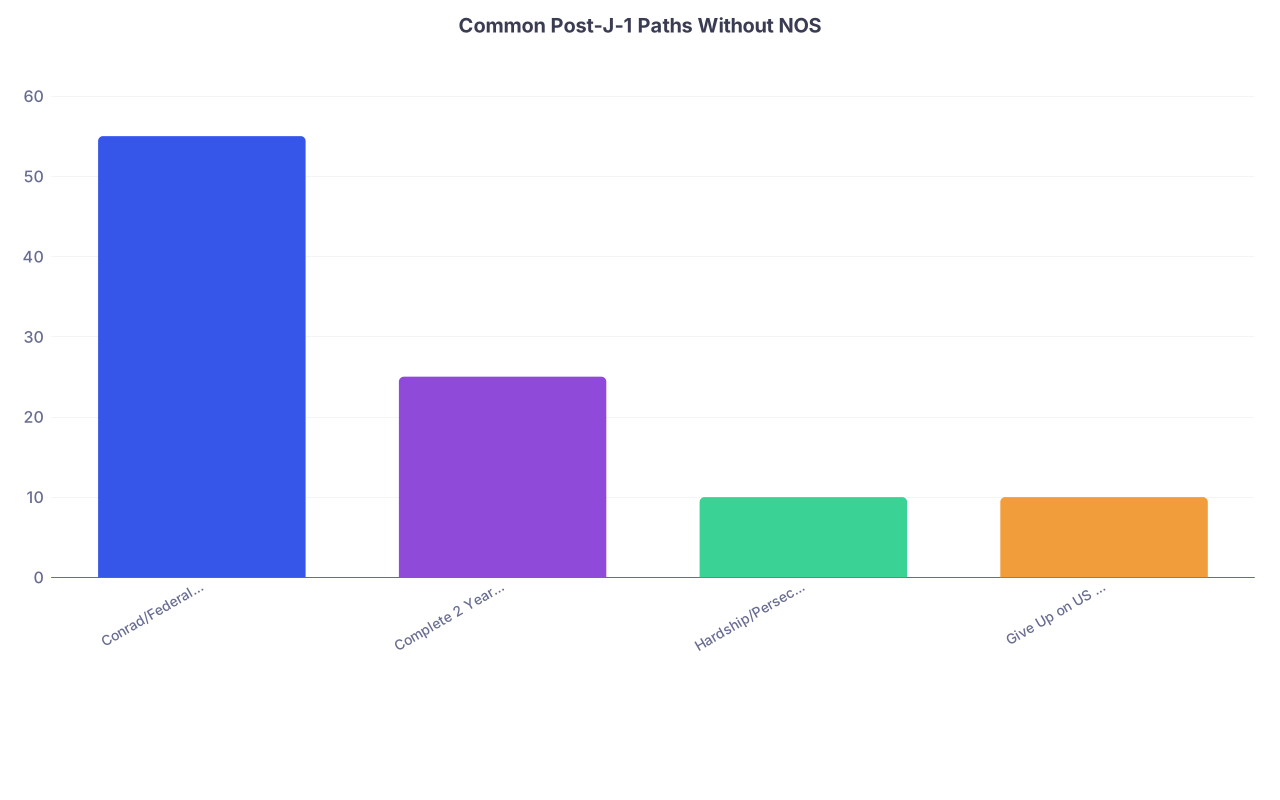
| Category | Value |
|---|---|
| Conrad/Federal Waiver Job | 55 |
| Complete 2 Years at Home | 25 |
| Hardship/Persecution Waiver | 10 |
| Give Up on US Career | 10 |
10. Red Flags and Common Mistakes IMGs Make Here
I see the same self‑inflicted wounds over and over:
- Waiting too long in training to face the waiver issue
- Assuming marriage to a U.S. citizen cancels 212(e) (it doesn’t)
- Trusting random WhatsApp group “immigration experts” over real attorneys
- Signing job contracts without a clear waiver/H‑1B plan
- Refusing rural/underserved offers as “beneath them,” then crying when they’re forced to leave the country
You can fix ignorance. You cannot fix time once you’ve wasted it.
FAQ (Exactly 5 Questions)
1. My home country absolutely refuses No-Objection Statements for physicians. Does that mean I must go home for 2 years?
No. It means your waiver options narrow to the other four bases: Conrad 30 / state, federal agency waivers, hardship, and persecution. For most IMGs in common specialties, the realistic path is a Conrad 30 or similar underserved‑area job with H‑1B sponsorship. You only have to do the physical 2 years at home if you cannot secure a waiver‑sponsoring job or don’t qualify for hardship/persecution.
2. Can I marry a U.S. citizen and get a green card without dealing with the two-year rule?
Not if you’re subject to 212(e) and haven’t satisfied or waived it. Marriage lets you apply for a green card, but 212(e) is a separate barrier. USCIS will not approve your green card until you either:
- complete the 2 years in your home country, or
- get a J‑1 waiver (hardship or persecution are the only marriage‑connected routes). So marriage helps in some ways, but it does not magically erase 212(e).
3. Is Conrad 30 possible for subspecialists (e.g., cardiology, GI, heme/onc) or only for primary care?
It depends heavily on the state. Some states reserve most or all of their 30 slots for primary care (FM, IM, peds, psych, OB/GYN). Others routinely approve hospitalists and a decent number of subspecialists if there is real local need. You have to check state‑by‑state rules and recent practice; this is where a lawyer or your program’s GME office can give real‑world intel beyond what’s written on a website.
4. If I’ve already gone back home, can I still get a J‑1 waiver and return to the U.S. without finishing the full 2 years?
Yes, if you secure a waiver‑sponsoring job (Conrad 30 or federal agency) and that waiver is approved. You can be abroad during the entire waiver process. Once the J‑1 waiver and H‑1B are approved, you’d go to a consulate, get your H‑1B visa, and re‑enter to start the job. Time you’ve already spent at home will still count toward the 2‑year rule if, for some reason, the waiver fails and you need to complete it.
5. Is it ever smarter to avoid J‑1 entirely if my home country doesn’t issue NOS?
Sometimes, yes. If you have a realistic shot at an H‑1B for residency (Step 3 done, supportive program) and your long‑term goals don’t align with 3+ years in an underserved setting, then J‑1 might paint you into a corner. But H‑1B comes with its own headaches (caps, portability, some programs refusing to sponsor). The correct move is to look at your specialty, target programs, and long‑term career goals, then choose the lesser evil with your eyes open. For many IMGs, J‑1 + Conrad 30 is still a solid, predictable path—just not a glamorous one.
Key points to walk away with:
- A blocked No‑Objection route is normal for J‑1 physicians, not a personal catastrophe.
- Your real lifeline is a waiver‑sponsoring job in an underserved area plus solid legal guidance.
- Time is your scarcest resource—face 212(e) early, plan around it, and stop waiting for your embassy to save you.