
Last week I got an email from a PGY-1 in internal medicine: an IMG on a J-1 visa, married to a U.S. citizen, panicking because her co-intern said, “Why are you still on J-1? Just get a green card” like it was a Starbucks order. She’d already started orientation, DS‑2019 issued, and now she was wondering if she’d just made a terrible mistake.
If you’re an IMG, married to a U.S. citizen, starting or applying for residency, you’re sitting on one of the most powerful immigration advantages in the system—and I’ve watched people waste it or complicate it because no one explained the timing and trade-offs. Let’s fix that.
Step 1: Get Your Situation Straight (Before You Pick a Visa)
You can’t pick the right visa until you’re brutally honest about your situation. Here’s what I need to know from you:
Where are you physically right now?
- Outside the U.S.?
- In the U.S. on F‑1, J‑1, B1/B2, or something else?
- Already on J‑1 or H‑1B from a previous position?
Your residency status:
- Just applying / in Match season
- Matched but not started
- Already in residency (PGY‑1+)
Your spouse’s situation:
- U.S. citizen (not just green card holder)
- Income / job stability (for I‑864 financial sponsorship)
- Willing to move for future jobs/waiver?
Your long-term goal:
- Stay in the U.S. permanently?
- Open to working in underserved/rural setting?
- Want maximum specialty flexibility (e.g., competitive fellowships)?
Once you’re clear on those, you have three main paths:
- J‑1 (with U.S. citizen spouse)
- H‑1B (with U.S. citizen spouse)
- Go straight to green card (CR‑1/IR‑1 or adjustment of status)
And the “right” answer absolutely depends on timing.
Step 2: The Big Picture – Your Main Options Compared
Here’s the 30,000‑foot view before we dive into scenarios.
| Option | Pros | Cons |
|---|---|---|
| J-1 + waiver later | Easiest for programs, many IMGs use it | 2-year home rule, waiver hassle, restricted first jobs |
| H-1B for residency | No 2-year rule, dual intent | Not all programs sponsor, more paperwork, Step 3 often required |
| Marriage green card (CR-1/IR-1) | Direct path to permanent residence | Timing sensitive, consular delays or AOS complexity |
Now let’s go situation by situation, because that’s where people get tripped up.
Scenario A: You’re Abroad, Applying or Just Matched – Spouse Is a U.S. Citizen
This is the cleanest moment to use your marriage advantage intelligently. You basically choose: J‑1, H‑1B, or immigrant visa (CR‑1/IR‑1) before entry.
Option 1: Just Take the J‑1 (Most Common… Not Always Smart)
You:
- Are outside the U.S.
- Got an ECFMG-sponsored J‑1 offer from the program
- Need to start this July
What J‑1 gives you:
- Fastest set-up for most programs
- Programs are very comfortable with this route
- You get to start on time with minimal friction
What’s bad about it:
- You trigger the J‑1 “2-year home residency requirement” (212(e))
- That means:
- You cannot get H‑1B, L‑1, or a green card until:
- You either return home for 2 years, OR
- You get a J‑1 waiver (Hardship, Persecution, or Conrad‑30/state program)
- You cannot get H‑1B, L‑1, or a green card until:
Being married to a U.S. citizen does not automatically erase that 2‑year rule. I’ve watched people assume, “I’ll just adjust status during residency” and then realize too late that 212(e) blocks them.
When is J‑1 still reasonable for you?
- You’re okay with:
- Working in an underserved/rural area for 3 years after residency/fellowship
- Navigating a waiver job (Conrad‑30 or similar)
- Your specialty is waiver‑friendly:
- Internal Medicine, Family Med, Pediatrics, Psychiatry, some OB/GYN, some hospitalist roles
- Your spouse is flexible to move states for your waiver job
If this is you and you’re close to the start date, J‑1 is probably fine—but you should plan your waiver strategy during residency, not after.
Option 2: Push for H‑1B for Residency
This is usually the “power move” if you can get it.
You:
- Want to avoid the J‑1 2‑year rule
- Want maximum future flexibility for green card timing
- Are married to a U.S. citizen who can later sponsor your green card
Advantages of H‑1B for you:
- No 2‑year home rule
- Dual intent: You can pursue a green card while on H‑1B
- Your U.S. citizen spouse can file an I‑130/I‑485 when you’re ready
- Easier transition to attending jobs (especially if you’re not interested in underserved areas)
Constraints:
- Not all programs sponsor H‑1B. Many community hospitals simply refuse because:
- Cost
- Legal complexity
- Preference for J‑1
- Step 3 is usually required for H‑1B
- Timing: Step 3, job offer, and petition all have to align with July 1 start
If you’re pre‑Match:
- Rank programs that explicitly support H‑1B higher.
- Email programs before rank lists and ask, directly:
- “I’m married to a U.S. citizen and wish to avoid the J‑1 2-year rule for long-term planning. Do you sponsor H‑1B for categorical residents if Step 3 is completed?”
If you’ve already matched:
- Ask your GME office immediately if they will convert you to H‑1B instead of J‑1.
- If they say no and you’ve not yet started J‑1 processing, you still might have leverage—but it’s limited.
Option 3: Enter on a Marriage-Based Immigrant Visa (CR‑1/IR‑1)
This is the “big swing,” but when it works, it’s beautiful.
You:
- Are abroad
- Are legally married to a U.S. citizen
- Have some time (9–14 months) before needing to be in the U.S. physically
Your spouse can file:
- I‑130 (Petition for Alien Relative)
- Process through consular processing
- You enter the U.S. with a CR‑1 or IR‑1 immigrant visa = you arrive as a permanent resident
Upsides:
- You skip the whole J‑1/H‑1B drama.
- No 2‑year rule.
- You can work anywhere and change employers more easily.
- Programs are usually delighted you don’t need visa sponsorship.
Downsides:
- Timeline can be longer than you think. For many couples it’s ~10–14 months total.
- If your residency start is in 6 months, this might not complete in time.
- You need clean documentation of the relationship; consulates can be picky.
How to know if this path is viable:
- Check current I‑130 and consular processing times for your country.
- If your target residency start is >12–18 months away (for example you’re still a med student), start the I‑130 now. You can still apply to programs while the petition is pending.
Scenario B: You’re Already in the U.S. on Some Other Status (F‑1, B1/B2, etc.)
Very common setup:
- You’re an IMG taking Step exams in the U.S. on B1/B2 or F‑1 from an MPH or research program.
- You marry a U.S. citizen.
- You’re planning to apply for residency in the next 1–2 cycles.
Here’s your fork in the road.
Path 1: Adjust Status Now, Then Apply as a Green Card Holder
Your U.S. citizen spouse files:
- I‑130 (family petition)
- I‑485 (adjustment of status)
- Plus EAD (I‑765) and AP (I‑131)
If your last entry to the U.S. was lawful (inspected or paroled), even if your visa expired, you can often still adjust.
Once the I‑485 is pending, you eventually get:
- EAD: work authorization
- Advance parole: travel permission
- Then green card
Why this can be great for residency:
- By the time you start residency, you may already be a permanent resident.
- Programs treat you like any U.S. grad for visa purposes.
- No J‑1, no H‑1B sponsorship required.
Catch:
- Travel gets tricky while AOS is pending unless you have AP.
- You have to be careful about intent if you recently entered on a visitor visa and then rapidly filed for AOS (this is where a good lawyer actually matters).
This route is usually strongest if:
- You’re at least 1–1.5 years out from potential residency start.
- Your marriage is well documented and bona fide.
- You entered the U.S. properly (no EWI).
Path 2: Use a Training Visa First (J‑1 or H‑1B), Adjust Later
Sometimes timing just does not work. Maybe:
- You matched unexpectedly.
- Your AOS case is too tight to be done before July.
- Your program insists on a specific visa type.
If you’re still free of the J‑1 2‑year rule (meaning you haven’t been on J‑1 yet), you have more flexibility:
If program allows H‑1B:
- Go H‑1B for residency.
- Your U.S. citizen spouse can file I‑130/I‑485 at almost any point afterward.
- H‑1B’s dual intent makes this boring and straightforward.
If program only allows J‑1:
- Now we have a real issue.
- Once you go on ECFMG J‑1 for residency and become subject to 212(e), you cannot just “adjust status through marriage” unless you:
- Finish 2 years back home, OR
- Get a J‑1 waiver (Conrad‑30 or hardship/persecution)
So if you’re in the U.S., married to a U.S. citizen, and about to step into your first J‑1—pause and talk to an attorney before you let that DS‑2019 be issued. I mean it.
Scenario C: You’re Already a J‑1 Resident Married to a U.S. Citizen
This is where a lot of people write to me panicked.
Facts:
- You’re already on J‑1 sponsored by ECFMG.
- You are now subject to the 2‑year home residency requirement (212(e)).
- Marriage to a U.S. citizen does not cancel 212(e).
Your options simplify to:
- Get a J‑1 waiver and then do green card.
- Fulfill 2 years at home (almost no one in your situation wants this).
- Try hardship/persecution waiver based on your spouse (real, but not trivial).
Path 1: Conrad‑30 or Similar Service Waivers
Most common path:
- Finish residency (and fellowship, if any) on J‑1.
- Apply for a J‑1 waiver job:
- Conrad‑30 in a state (job in underserved area, 3 years full-time)
- Federal programs (VA, HHS, etc. depending on specialty)
Once waiver is approved:
- You switch from J‑1 to H‑1B for that job.
- After your 3-year service commitment, you’re free of the 2‑year requirement.
- Meanwhile, because you’re married to a U.S. citizen, you can usually file:
- I‑130 + I‑485 while in H‑1B status (no 212(e) anymore)
- Or consular process an immigrant visa
Key point:
You do not have to wait until you finish the 3 years to start green card processing. The employer often files during those years, or your spouse can.
Path 2: Hardship or Persecution Waiver Based on the Marriage
This is for specific tough situations, not routine use:
Hardship waiver:
- You argue that your U.S. citizen spouse (and/or U.S. citizen children) would suffer exceptional hardship if:
- You returned home for 2 years, or
- They had to accompany you.
- You argue that your U.S. citizen spouse (and/or U.S. citizen children) would suffer exceptional hardship if:
Persecution waiver:
- You show you’ll likely face persecution at home.
Marrying a U.S. citizen + “we’ll be sad and financially strained” is usually not enough for hardship. These cases require:
- Serious medical issues
- Country conditions
- Security risks
- Or other documented, compelling factors
If you’re thinking about this path, do not DIY it. This is where an immigration lawyer who does physician J‑1 waivers constantly is worth every dollar.
Scenario D: You’re on H‑1B for Residency, Married to a U.S. Citizen
You’re in the cleanest position of all.
You:
- Matched at an H‑1B-friendly program
- Are legally married to a U.S. citizen
- Have no J‑1 background with 212(e)
What you should do:
- Decide timing of your green card with your spouse and maybe a lawyer.
- Your spouse can file I‑130 + I‑485 whenever:
- You’re ready to commit to staying in the U.S.
- You’re comfortable with some travel restrictions during AOS, or you’re fine using Advance Parole.
Why some H‑1B residents delay:
- They want to finish residency or fellowship first.
- They don’t want to fuss with I‑485 while changing programs/fellowships across states.
- They plan to file through employer later instead (less ideal for you, more control for them).
From a pure immigration-security standpoint, if your marriage is legit and stable, I think filing earlier is better. You get:
- Stability if you change jobs
- Freedom from visa renewals
- Less anxiety with each status extension
Visual: Typical Pathways When Married to a U.S. Citizen

| Step | Description |
|---|---|
| Step 1 | Outside US, Married to US Citizen |
| Step 2 | Consider CR-1/IR-1 Green Card |
| Step 3 | Use H-1B for Residency |
| Step 4 | Likely J-1 for Residency |
| Step 5 | J-1 Waiver (Conrad-30 / Hardship) |
| Step 6 | H-1B Job After Waiver |
| Step 7 | Marriage-Based Green Card |
| Step 8 | Residency Start in < 12 months? |
| Step 9 | Program Offers H-1B? |
When Should You Talk to an Immigration Lawyer?
Here’s my blunt opinion:
If you’re married to a U.S. citizen and an IMG, and anyone is about to issue you a DS‑2019 for J‑1 or an H‑1B petition, you should at least have a one‑hour consult with a physician‑immigration lawyer.
Specific red-flag moments:
- You’re switching from:
- F‑1/B1/B2 to J‑1 or H‑1B while married to a U.S. citizen.
- You’re about to renew J‑1 for another year and thinking about green card.
- You already have some scar tissue in your record:
- Overstays
- Unauthorized work
- Prior J‑1 statuses
- Prior visa denials
Do not rely on:
- Random WhatsApp groups
- That one senior who “did marriage and it was fine”
- Hospital HR giving you legal advice (they aren’t your lawyer)
Quick Comparison: Which Path Fits You?
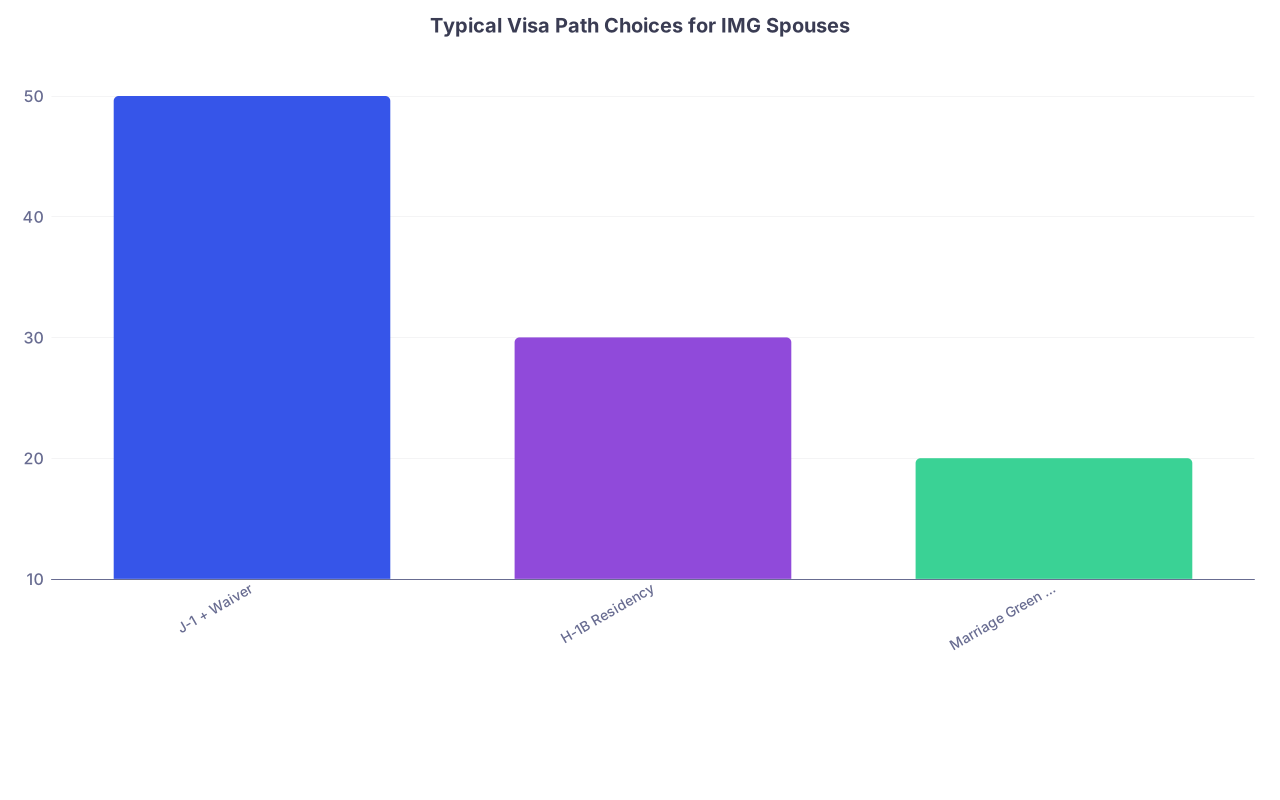
| Category | Value |
|---|---|
| J-1 + Waiver | 50 |
| H-1B Residency | 30 |
| Marriage Green Card First | 20 |
That rough split is what I actually see in practice among IMGs married to U.S. citizens. Half sleepwalk into J‑1, a chunk get H‑1B, and a smaller but very happy group front‑load the green card.
Another way to think about it—look at what you care about most:

Rough decision rule of thumb:
- If you want maximum geographic/specialty freedom and your program will cooperate → push hard for H‑1B or do the marriage-based green card earlier.
- If you’re okay with rural/underserved work after training and your program only does J‑1 → J‑1 + waiver is fine, just plan early.
- If you’re still abroad with time before residency → strongly consider starting the CR‑1/IR‑1 process now.
Tactical To‑Do Lists By Phase
If You’re Pre‑Match (Still Applying)
Have a visa strategy talk with your spouse now. Decide:
- Do we want green card first?
- H‑1B focus?
- Or okay with J‑1 + waiver?
Filter programs:
- Check if they sponsor H‑1B.
- Ask current residents (especially IMGs) what they actually see, not just what’s on paper.
If aiming for H‑1B:
- Schedule Step 3 early.
- Signal clearly to programs that you’ll be ready for H‑1B.
If aiming for green card first:
- Start the I‑130/CR‑1 process. Yesterday.
If You Just Matched
As soon as you get your welcome packet:
- Find out exactly what visa they plan to put you on.
- J‑1 planned? You married to a U.S. citizen? Pause and ask questions.
If H‑1B is an option:
- Confirm Step 3 timing.
- Confirm program’s immigration attorney is on it.
If J‑1 is the only option:
- Accept it, but meet with an immigration lawyer early PGY‑1 to map the waiver + marriage green card timeline.
If You’re Already a Resident
On J‑1:
- Identify your likely waiver states by PGY‑2.
- Talk with your spouse about where they’re realistically willing to move.
- Decide if hardship/persecution waiver is even worth considering.
On H‑1B:
- Decide when to file marriage-based AOS.
- Coordinate around big life events (board exams, childbirth, fellowship interviews).
One Thing You Should Not Do
Do not casually:
- Enter the U.S. on B1/B2 “to visit,” while secretly planning to marry and file adjustment in a few weeks, and definitely not right after a J‑1 refusal, then ask later, “Is this okay?”
Can some people get away with sloppy intent issues? Yes. Do you want your entire career riding on it? No.
If you’re going to use your marriage to a U.S. citizen as your primary immigration path (which is smart), do it cleanly and strategically.
FAQ (Exactly 5 Questions)
1. If I’m already on a J‑1 in residency and marry a U.S. citizen now, can I just file for a green card?
No, not if you’re subject to the J‑1 2‑year home residency requirement (212(e)), which almost all ECFMG-sponsored J‑1 residents are. Marriage to a U.S. citizen does not cancel that requirement. You must either complete 2 years in your home country or get a J‑1 waiver first. After the waiver is approved and you move into H‑1B (or another non‑restricted status), then you can proceed with marriage-based adjustment or consular processing.
2. My program says they “don’t do H‑1B for residents.” Should I push harder or accept J‑1?
If they’ve been consistent for years (all IMGs are J‑1), you won’t move that mountain as a PGY‑1. At that point you treat it as a J‑1 reality and plan: waiver + post‑waiver green card through your spouse. If they occasionally do H‑1B, you can absolutely push politely: mention your marriage to a U.S. citizen and long-term retention interest. But don’t threaten or posture; it backfires. If you’re still in the Match process, rank H‑1B-friendly programs higher next time.
3. Is it better to get my green card through my spouse or through an employer later?
For you, married to a U.S. citizen, spouse-based is usually better. It gives you control, not an employer. It’s typically faster, doesn’t tie you to one job, and isn’t dependent on PERM labor certification. Employer-based green cards are useful if you’re single or married to a non‑citizen. In your case, if the marriage is stable and bona fide, I’d prioritize spouse-based and treat employer sponsorship as a backup.
4. Can I apply for a marriage-based green card while on H‑1B during residency or fellowship?
Yes, and this is exactly what many smart IMG spouses do. H‑1B allows dual intent, so filing I‑130/I‑485 while on H‑1B is routine. You just need to coordinate travel (you generally use Advance Parole once your I‑485 is filed unless you keep valid H‑1B and follow the rules). The timing choice is practical: when do you want to deal with USCIS forms, possible interviews, and some limitations on travel?
5. I’m abroad, engaged to a U.S. citizen, but not married yet. Should we rush the marriage for immigration timing?
If your primary goal is to be a permanent resident before or early in residency, then yes, earlier legal marriage lets your spouse file the I‑130 sooner, which can be crucial for timing. If you’re a couple of years out from residency and want to live in the U.S. together long-term, I’d rather see you marry and start the CR‑1/IR‑1 pipeline now than scramble last-minute with J‑1/H‑1B. If you’re only a few months from residency start, rushing a marriage now probably will not make the immigrant visa process finish in time, so you’d still need a training visa first.
You’re not just any IMG. You have a U.S. citizen spouse, which reshapes your ceiling and your risk profile completely. Once you stop thinking in “what do most IMGs do?” and start thinking in “what makes sense for us long-term?”, your choices get clearer—and a lot more powerful.
Get your plan straight now; the next big decision point is coming fast: that contract you sign for your first attending job, waiver or not, green card started or still a distant future problem. That’s where this groundwork pays off.