The couples match is hard. The couples match when you are both IMGs with different visa needs can be brutal if you do not plan it with military-level precision.
You cannot treat visas as an afterthought. If you do, you will either:
- block each other from good programs,
- end up hundreds of miles apart, or
- match to a “visa safe” program that is a terrible fit academically.
Let’s walk through how to handle this like adults who want to end up in the same city, both in training, and not in immigration limbo.
Step 1: Get Real About Your Actual Visa Profiles
Before you open ERAS or the NRMP couples screen, you need one conversation: “What am I actually eligible for right now and over the next 1–2 years?”
There are a few common couple configurations. I’m going to assume internal medicine (IM) focused, but the logic holds for other specialties.
Typical combo situations:
| Partner A Status | Partner B Status | Main Complexity |
|---|---|---|
| Needs J-1 | Needs H-1B | Sponsor mismatch |
| Needs J-1 | US Citizen/GC | J-1 rules for both lives |
| Needs H-1B | US Citizen/GC | Limited H-1B programs |
| Needs J-1 | Any status | Waiver + hardship later |
| Both Need H-1B | Both Need H-1B | Very few programs, high risk |
You and your partner should each write down:
- Do I need a visa, or do I just prefer one type?
- Am I ECFMG certified before rank order list time?
- Step 3: Done, booked, or impossible this year?
- Any current nonimmigrant status (F-1, F-2, H-4, etc.) I’m already on?
Now, translate that into visa flexibility tiers. This is how I think about it in real-world planning:
- Tier 1 (Most Flexible): US citizen or green card. No visa ask.
- Tier 2: IMG who can take either J-1 or H-1B (Step 3 done, timing reasonable).
- Tier 3: IMG who can realistically get only J-1 (no Step 3, tight timeline, or programs in states that hate H-1B for residents).
- Tier 4 (Least Flexible): IMG insisting on H-1B only, with just-barely-enough time for Step 3 and very narrow geography.
If one of you is Tier 1 or 2 and the other is Tier 3 or 4, the inflexible person’s situation will drive your entire couples strategy. That’s not “fair,” but it is real.
Step 2: Understand How Your Visa Needs Interact
You’re not planning visas in a vacuum. You’re planning two visas in one geographic reality.
Here are the three big visa interactions I see couples mess up.
1. J-1 + J-1 (or J-1 + US citizen/GC)
Everyone underestimates this combination because J-1 is “easy to get.” Yes, most IM programs sponsor J-1. But the pain is not at entry. The pain is at exit.
If one or both of you are on J-1:
- You each trigger an independent 2‑year home-residency requirement (212(e)), unless you both get waivers later.
- Waivers are usually job-based (e.g., underserved/waiver jobs after residency). Getting two waiver jobs in the same region, same year, same specialty? Doable, but tight.
- I’ve seen couples where one gets a fantastic J-1 waiver hospital in a city. The other can find nothing but a low-quality outpatient job 3 hours away and ends up commuting or living apart.
So, for a J-1 couple, the strategy isn’t just “match together”; it’s “match in a region where post-residency underserved jobs exist for both of you.” That means you choose residency locations with an eye on waiver-rich states (often in the Midwest, South, some Northeast states).
2. J-1 + H-1B Preference
This is the classic difficult combo. One partner would strongly prefer H-1B (maybe for long-term immigration reasons, or because they already started a green card elsewhere). The other is more open, or can only realistically get J-1.
What happens in real life:
- H-1B partner filters too aggressively, cuts out 70% of IM programs.
- J-1 partner has plenty of options, but your overlap shrinks to almost nothing, especially if you also want to be in the same city.
- You start rationalizing: “We’ll apply broad, something will work out.” That’s not a plan. That’s roulette.
The practical approach: you decide early whether the H-1B ask is a preference or a non‑negotiable.
- If it’s a preference: drop it. Act like a J-1-accepting IMG, especially for couples match.
- If it’s non-negotiable: accept that
- many couples match pairs in your shoes spend PGY-1 apart, or
- you may not match at all this cycle if you’re picky on geography + H-1B.
3. Dual H-1B Hopefuls
Two IMGs, both insisting on H-1B, both in couples match. I’ve seen this exact pairing apply only to “H-1B friendly” IM programs in Boston/NYC where both need visas and then act surprised they barely got interviews.
I’m blunt here: if you’re both H-1B only, and not absolute rockstar applicants (high Steps, US experience, strong letters) in a less competitive specialty, you’re playing on ultra‑hard mode in couples match.
You need:
- Ridiculously broad application list (80–120+ programs each).
- Real flexibility in geography (Midwest, South, smaller cities).
- Acceptance you may not end up together PGY‑1.
Step 3: Build Two Program Lists, Then Slice the Overlap
Do not start from “What are good programs?” Start from “What programs can actually sponsor us, individually and together?”
You and your partner each build three internal lists:
- List A: All programs I’m theoretically competitive for
(Based on scores, YOG, US clinical experience, etc.) - List B: Programs from A that meet my visa needs
(J-1 only? J-1 + H-1B? Need H-1B sponsorship history?) - List C: Programs from B in acceptable locations for couples
(Same city, or pairs of cities where commuting is realistic—e.g., Philly–Camden, Dallas–Fort Worth, SF–Oakland.)
Then you sit down, put them side by side, and find:
- Core overlap set: Programs where both of you are eligible and the location works.
- Solo-safe set: Programs where only one of you is clearly viable.
The core overlap set is your couples match foundation.
To make this manageable, use a simple table.
| Program | City | Visa Type | Sponsor History | Both Eligible? |
|---|---|---|---|---|
| Program X IM | Buffalo | J-1 only | 5+ years consistent | Yes |
| Program Y IM | Dallas | J-1 + H-1B | Occasional H-1B | Yes (if Step 3 done) |
| Program Z IM | NYC | J-1 only | Stable | Only Partner A |
Two key things you need to actually do:
- Email or call coordinators for ambiguous programs. Some list “J-1 only” but make H-1 exceptions for outstanding candidates. Others say “J-1/H-1B” but haven’t sponsored H-1B in 7 years. Get real answers.
- Track everything. Spreadsheet, color codes, notes like “Coordinator said H-1B only if Step 3 passed by January and high scores.”
Step 4: Use the Couples Match Algorithm the Right Way
Most couples do not use the couples match power correctly. They either underuse it or overcomplicate it.
You’re not just ranking programs; you’re ranking pairs of outcomes.
If you’re in the situation:
- Partner A: IMG, J-1 or H-1B possible, Step 3 done
- Partner B: IMG, J-1 only this year
Then your pairing categories should look like this:
Top Tier Pairings: Both in same program or same city
Example:- (Program X – Partner A, Program X – Partner B)
- (Program A – Partner A, Program B – Partner B) if they’re in the same metro.
Second Tier: Same region, realistic commute (<60–90 minutes)
Think Houston metro, Chicago metro, North Jersey + NYC boroughs.Third Tier: One matches, the other in a nearby but not perfect zone, or prelim-only + categorical for the other
You use this tier if being together geographically is higher priority than visa type perfection.Bottom but still acceptable: One matches somewhere decent, the other unmatched
These are your “nonzero match” fallbacks. Painful, but better than double unmatched if one has a stronger profile.
The trick with different sponsorship needs:
- If one partner needs H-1B and the other is fine with J-1, push pairs where the H-1B possible program is for that partner. Do not accidentally put the J-1-only partner at the limited H-1B-friendly place and waste that H-1B slot.
Also: don’t be too proud to include mismatched visa pairs like:
- (Partner A – J-1 at solid community IM; Partner B – H-1B at more academic IM)
in the same city.
It looks weird on paper. But in real life, being in the same city with different visas is often better than “both on the same visa 600 miles apart.”
Step 5: Decide How Much You’ll Trade Visa Preference for Proximity
This is the uncomfortable part. You cannot escape tradeoffs.
You and your partner need to answer these, honestly:
Would we rather:
- Be in the same city on “less ideal” visas, or
- Have one partner in a perfect visa/academic situation and the other scrambling in SOAP or unmatched, but with a cleaner immigration path?
For the H-1B preferring partner:
- Is H-1B “ideal,” or is it truly non-negotiable?
- Would you take a J-1 if it meant being in the same city and both matching?
For the J-1 inevitable partner:
- Are you mentally ready for the waiver grind later? That affects where you should match now.
I’ve seen strong couples do this:
- Year 1: Both match J-1 in a region with lots of underserved hospitals (e.g., Midwest).
- PGY-3: Both hunt waiver jobs in the same state, aggressively and early.
- Years 4–6: They do their J-1 waiver time together and start green cards.
And I’ve seen this:
- Partner A insists on H-1B only, in big coastal cities.
- Partner B takes any IM J-1 to avoid being unmatched.
- Result: 3 years long-distance, then waiver mess.
There’s no universally correct answer. But pretending you don’t have to choose is the worst option.
Step 6: Special Cases and How to Handle Them
Case 1: One Partner Is Much Stronger on Paper
Example:
- Partner A: 250+ on Steps, strong US LORs, research, broad specialty (IM).
- Partner B: 220s, gaps, minimal USCE.
If the weaker partner needs J-1 anyway, the smarter move is:
- Let the strong partner be flexible on visa (accept J‑1 if needed).
- Focus your couples list on J-1 heavy regions where community IM programs are plentiful.
- Use the strong partner’s profile to open doors in slightly more competitive programs where program leadership might take both of you as a “package” (yes, that happens).
If you try to leverage the strong partner for H-1B in a top coastal academic center while the weaker partner chases J-1 spots, the overlap shrinks and you risk separating.
Case 2: One Has an Existing US Status (F-1, H-4, etc.)
If one of you is already in the US on F-1 (research, MPH) or H‑4, you may have some extra options:
- That partner might not need a visa for the first year if they can stay on their existing status while transitioning. But most programs still prefer clean J-1/H-1B sponsorship to avoid confusion.
- Sometimes the spouse on H-4 wants H-1B residency so they can work independently and start their own green card process.
Do not assume your current status solves everything. It mainly buys time and slightly more comfort. Residency programs still have to be willing and able to sponsor.
Case 3: You’re Open to Being Apart for PGY‑1 Only
This is the “controlled separation” strategy:
- You rank together for as many reasonable pairs as possible.
- You also allow outcomes where one matches and the other doesn’t, or both match in different cities, but you commit to:
- The unmatched partner doing a research year or observerships near the matched partner’s city.
- Both applying again next season with that new geography + US experience advantage.
If you go this route with different sponsorship needs:
- The one with more rigid visa constraints should aim to match first in a visa-accommodating program.
- The more flexible partner then targets that same city/region and visa type in the next cycle.
It’s not romantic. It is rational.
Step 7: On-the-Ground Tactics During Application Season
Here’s where couples with complex visa combos separate themselves from the chaos.
Do the following, deliberately:
Tailor your ERAS “Visa” section like a surgeon.
Don’t just check random boxes. If you’re open to J-1 but prefer H-1B, say so in a short, clear sentence in your personal statement or supplemental, not in a confusing checkbox that makes you look high-maintenance.Use emails strategically.
Example wording to coordinators for a borderline H‑1B program:“I’m an IMG applying to your internal medicine program. I’m ECFMG certified, have passed Step 3, and I’m in the couples match with my fiancé(e), who is eligible for J-1. I saw your site lists J-1 and occasional H-1B. Could you please confirm whether H-1B sponsorship might be possible for a strong candidate this cycle?”
Coordinators will often give you a straight yes/no/maybe based on your profile.
At interviews, read the room on visa questions.
Some PDs love H-1B because residents stay longer; others avoid it like plague because of legal cost. Ask one clear question at the end, not a ten-minute immigration seminar:“For IMGs in recent years, have you typically sponsored J‑1, H‑1B, or both?”
Adjust mid-season.
If by December the H-1B preferring partner has almost no interviews at H-1B programs but several J‑1 offers, that’s your answer. Don’t cling to a fantasy. Start mentally and rank-order-wise pivoting to J-1 viability.
Step 8: Be Honest With Each Other About Risk Tolerance
The last piece is not technical. It’s relational.
Different visa needs amplify stress and can bring out the worst in couples during match season. One person might quietly resent “having to give up” H-1B dreams for the relationship. The other might feel like a burden.
Talk this through before rank list certification:
- What’s the worst acceptable outcome this year that we can live with?
- Are we okay with being apart if that’s the only way one of us gets H-1B?
- If we both end up J-1, are we on the same page about targeting waiver jobs together later, even if that means less glamorous cities?
If you skip this and just “see how it goes,” resentment tends to appear the day NRMP emails go out.
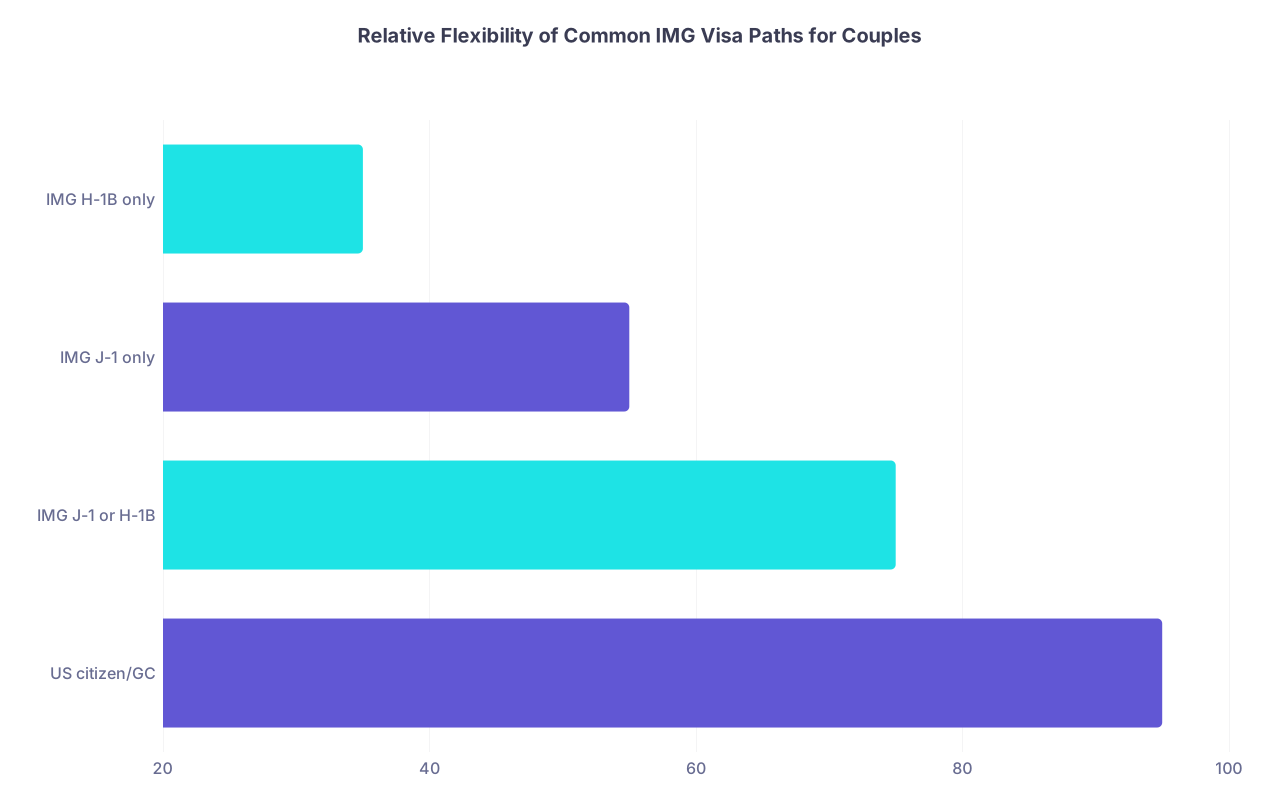
| Category | Value |
|---|---|
| US citizen/GC | 95 |
| IMG J-1 or H-1B | 75 |
| IMG J-1 only | 55 |
| IMG H-1B only | 35 |

| Step | Description |
|---|---|
| Step 1 | Start: Two IMGs in Couples Match |
| Step 2 | Plan as J-1 capable couple |
| Step 3 | Build list of strong H-1B programs |
| Step 4 | Identify J-1 heavy overlap regions |
| Step 5 | Create couples rank list prioritizing same city |
| Step 6 | Decide acceptable fallback: separate vs unmatched |
| Step 7 | Does either partner need H-1B only? |
| Step 8 | Is H-1B truly non-negotiable? |
You’re not just applying for residency. You’re laying down the immigration and career blueprint for the next decade of your lives—two lives, intertwined.
If you treat visas like fine print, the system will chew you up. If you treat them as a central design constraint from day one, you can make the couples match work even with mismatched sponsorship needs.
You now know the playbook: map your visa flexibility, build overlap lists, decide your real priorities, and use the couples algorithm to codify those decisions—brutally honestly.
With that squared away, your next move isn’t just refreshing emails. It’s using every interview, every coordinator conversation, and every program impression to refine a rank list that serves both your careers and your lives together. And once that Match email lands, the game shifts again—to waivers, green cards, and long-term planning—but that’s another battle for another day.