

It is June. You matched. You told your family. You ordered the white coat.
And then HR emails you: “After further review, our institution will not be able to proceed with H‑1B sponsorship at this time. We can only support J‑1 visas.”
Your stomach drops.
You planned your entire future around that H‑1B. Maybe you are on OPT and the clock is ticking. Maybe you have a spouse and kids whose status depends on you. Maybe you turned down other options because this program promised “We do H‑1B all the time.”
Now they are backing out.
You are not the first IMG in this mess. And you are not out of options yet.
What you need now is a recovery plan, not panic.
I am going to walk you through it step by step.
1. First 72 Hours: Stop the Bleeding
The worst mistakes happen in the first few days. People lash out, threaten to quit, or send angry emails that kill any remaining leverage. Do not do that.
Step 1: Get the facts in writing
You need clarity, not vague HR language.
Send a short, calm email to your GME office and HR:
- Ask:
- Is this a final policy decision or is there any exception process?
- Is the program willing to sponsor J‑1?
- Is any other visa classification possible (O‑1, cap‑exempt H‑1B through affiliated university, etc.)?
- What deadline are they working with for visa documents?
Something like:
“Thank you for the update. For planning purposes, can you please confirm in writing:
- Whether the institution is completely unable to sponsor H‑1B visas for incoming residents this year, or whether exceptions can be considered;
- Whether sponsorship for J‑1 is available for my position;
- Any other visa categories the institution is able to support for residency positions; and
- The internal deadlines for finalizing visa documentation.
I remain committed to joining the program if a viable visa option can be arranged.”
No emotion. No threats. Just facts.
Step 2: Pull your original documentation
Find every document where H‑1B was mentioned:
- Interview emails
- Offer letter / match letter
- Any visa policy PDF they sent
- Notes from phone calls (reconstruct them now while you remember)
You are looking for:
- Clear promises: “We will sponsor your H‑1B.”
- Conditional statements: “We anticipate being able to sponsor H‑1B pending institutional approval.”
- Disclaimers: “Visa sponsorship is not guaranteed.”
Why? Because your leverage, and any legal route, depends heavily on what they actually promised versus what you assumed.
Step 3: Do a quick reality check on your status
Do not guess. Know your numbers:
- Where are you physically right now? (US or abroad)
- Current status: F‑1, OPT, H‑4, J‑1, B‑1/B‑2, etc.
- When does that status or work authorization end?
- Have you ever held J‑1 before? With or without 212(e) home residency requirement?
Write it down. You will need these details for every serious conversation from this point on.
2. Understand the Real Problem: Policy vs Capability vs Willingness
Not all “we cannot do H‑1B” situations are the same. You need to classify which one you are facing.
Scenario A: Institution-wide policy change
You may see wording like:
- “Our legal department has decided we will no longer sponsor H‑1B for trainees.”
- “GME has moved to J‑1 only for all new residents.”
This is the hardest to fight. HR is not singling you out; this is a political/financial decision.
Recovery strategy here:
- Treat J‑1 as your primary immediate option.
- Start a parallel track exploring O‑1 or future H‑1B at fellowship/attending level.
- Focus on compliance and speed, not trying to reverse the policy. Odds are low.
Scenario B: They can do H‑1B, but not for you (or not now)
Typical excuses:
- “We cannot file in time for July 1.”
- “Your Step 3 is pending; we only do H‑1B for residents who have Step 3.”
- “Your prior immigration history complicates H‑1B.”
Here, you have more room to negotiate.
Options might include:
- Delayed start date with H‑1B filing
- Exception request
- Temporary J‑1 for PGY‑1, plan H‑1B from PGY‑2
- Exploring if an affiliated university can file a cap‑exempt H‑1B
Scenario C: One person in HR is wrong or lazy
I have seen this more than once:
- Program director says, “We always do H‑1B.”
- HR generalist says, “We only do J‑1.”
- Immigration counsel says quietly, “We can do it, but it is more paperwork.”
Your job is to figure out if this is:
- True institutional policy, or
- One person talking out of convenience or ignorance.
How?
- Ask your program director (PD): “Do you currently have any residents on H‑1B?”
- Ask current residents anonymously (Whatsapp, FB groups, IMG forums): “Anyone at [Hospital Name] on H‑1B right now?”
- Look up old NRMP / institutional visa pages on the Wayback Machine. Many programs proudly say: “We sponsor J‑1 and H‑1B.”
If there are current H‑1B residents, and suddenly you are being told “we do not do H‑1B,” that is a red flag. You push harder here.
3. Core Decision: Are You Willing to Take a J‑1?
Time for blunt truth:
For most IMGs in residency, J‑1 is the standard path. H‑1B for residency is the exception.
If your employer is willing to sponsor J‑1, your residency is likely still safe. Your long-term path just changes.
You need to answer one question fast:
If H‑1B is off the table for residency, will I accept J‑1?
Let us walk it out.
Pros of taking J‑1 now
- Keeps your match and training intact.
- DS‑2019 processing through ECFMG is usually faster and more predictable than H‑1B.
- Almost every academic center knows how to handle J‑1s. Fewer institutional roadblocks.
- You preserve the relationship with the program instead of starting over.
Cons / complications
- 2‑year home residency requirement (212(e)) in most cases.
- To stay in the US after training, you usually need:
- J‑1 waiver job (Conrad 30, VA, or federal program), then
- Transfer to H‑1B with that employer.
- Some fellowships and academic jobs are less flexible with J‑1 backgrounds, though this is often overstated.
The real risk: If you have strong reasons you cannot or will not return home or do a waiver job (family safety, political risk, no waiver programs from your country, etc.), then J‑1 may be much more problematic.
But if your main issue with J‑1 is “I heard it is bad online,” you are overreacting. Thousands of IMGs train J‑1 → waive → H‑1B → green card every year.
4. Tactical Conversations: PD vs GME vs Lawyer
You now need three parallel conversations. And you cannot bumble through them.
1) With your Program Director (PD)
Objective: Turn your PD into an ally, not a bystander.
How to approach:
- Request a short Zoom or phone call.
- Be direct, not emotional.
Key points to hit:
- You are committed to joining the program.
- The sudden withdrawal of H‑1B sponsorship creates specific immigration problems for you (give 1‑2 concrete details, not a rant).
- Ask:
- “Do you currently have or have you previously had residents on H‑1B?”
- “Is there any possibility of an exception in my case?”
- “Would you be willing to support an appeal to GME or HR?”
PD leverage:
- They can push GME to review exceptions.
- They can vouch that you are a key candidate and worth extra effort.
- In some systems, they can involve institutional immigration counsel directly.
You want your PD emailing GME with:
“We want this candidate; H‑1B is essential; what can we do?”
2) With GME / HR
Different tone here. You are not appealing emotionally; you are problem-solving.
Ask very pointed questions:
- “Does the institution support cap‑exempt H‑1B for any trainees through an affiliated university?”
- “Can you connect me directly with your immigration counsel to evaluate my specific case?”
- “Are there documented criteria under which H‑1B is permitted for residents?”
- “If J‑1 is the only supported category, what are your internal deadlines for DS‑2019 paperwork?”
You are trying to:
- Surface any exceptions or alternate structures.
- Get connected to the actual lawyers instead of middlemen.
3) With an independent immigration attorney
Not the hospital’s lawyer. Your lawyer.
You want someone who has:
- Real experience with physician visas, not generic H‑1B for tech workers.
- Familiarity with ECFMG, J‑1 waivers, Conrad 30, O‑1.
Bring:
- Your full immigration history
- Copy of match letter / offer
- All emails about visa sponsorship
- Your exam status (USMLEs, ECFMG cert, Step 3 Y/N)
Ask very direct questions:
- “If this residency is J‑1 only, what are my realistic options to stay in the US long term?”
- “Is there any viable path to H‑1B for this residency (cap‑exempt, dual appointment, university sponsor)?”
- “Given my situation (country, family, prior status), is J‑1 a terrible idea or an acceptable compromise?”
You pay them to be blunt. If they just say “it depends” for 45 minutes, find a different lawyer.
5. Alternative Paths If H‑1B is Truly Gone
Let us assume worst case: the institution will not do H‑1B for you. Period.
Your realistic paths then look like this:
Path 1: Accept J‑1 and plan your waiver early
If J‑1 is available and you can live with 212(e), this is often the most rational move.
Core steps:
- Confirm program will sponsor J‑1 through ECFMG.
- Get DS‑2019 process started immediately. Missing those deadlines is how people actually lose their spot.
- During PGY‑1/2, start learning about:
- Conrad 30 programs in states you like
- VA / HHS / ARC / DRA waiver options
- Which specialties and locations have the best waiver job markets
Once you accept J‑1, the game shifts: your main job becomes securing a J‑1 waiver job post‑residency that will sponsor H‑1B → green card. That is a separate problem, but it is solvable.
Path 2: Cap‑exempt H‑1B via university or affiliate
Some hospitals:
- Cannot or will not sponsor H‑1B directly for residents
- But are affiliated with a university or non-profit that can file cap‑exempt H‑1B petitions
This sometimes looks like:
- You hold a university H‑1B appointment as “Clinical Instructor” or similar
- You function day‑to‑day as a resident at the hospital
- GME pretends nothing is unusual; legal does the heavy lift
You cannot force this, but you can:
- Ask if the hospital is university-affiliated
- Ask if any trainees are on cap‑exempt H‑1B through the university
- Have your attorney suggest a joint appointment structure
Not every institution will bother. But some will, especially big academic centers.
Path 3: O‑1 as a residency workaround
Is O‑1 for residents realistic? Sometimes.
You need:
- Strong research profile (first‑author papers, serious citations)
- National/international awards
- Evidence that you are “extraordinary” by regulatory standards
If you are a typical IMG, O‑1 is a stretch. If you were already on O‑1 for research at a US institution and you are transitioning into residency, this deserves a hard look.
Downside: O‑1 is complex, more expensive, and some HR departments refuse to touch it for trainees.
Path 4: Change residency program (rare, ugly, but sometimes possible)
If:
- The program misrepresented H‑1B sponsorship in a really clear way, and
- You absolutely cannot accept J‑1, and
- You are early in the cycle (pre‑start, pre‑visa),
then you can explore:
- Talking to NRMP about misrepresentation (if applicable)
- Quietly networking for off‑cycle PGY‑1/PGY‑2 positions at H‑1B‑friendly programs
I will be blunt:
This path is high risk. You can easily end up with no position at all. Only consider it if:
- You have powerful connections
- Or your current country / home residency situation makes J‑1 genuinely untenable
- Or your attorney strongly recommends you do not accept J‑1 under any circumstance
6. When the Employer Truly Misled You: Leverage and Legal Options
If your offer letter explicitly states “H‑1B sponsorship will be provided,” and they reverse late in the game, you may have some leverage.
Realistic expectations:
- You are not going to sue your way into an H‑1B. Courts will not force an employer to sponsor.
- You might have a case for reliance damages (money lost because you relied on their promise) in some jurisdictions.
- NRMP / institutional GME may push them to offer extra support or alternatives if misrepresentation is clear.
What you can practically aim for:
- Extra efforts to explore cap‑exempt structures / exceptions
- Extended onboarding or later start date to allow time for alternative filings
- In rare cases, assistance with finding another residency slot if they genuinely cannot sponsor any visa you can accept
Again, this is where an attorney who understands both contracts and immigration is worth the fee.
7. Time and Logistics: Do Not Miss Hard Deadlines
While you are negotiating strategy, the clock is running. You cannot lose track of the immigration timeline.
Here is what typically matters most for incoming residents:
| Stage | Approx Timing (US Start July 1) |
|---|---|
| Program sends visa instructions | Jan–Mar |
| Final decision on visa type | Mar–Apr |
| J‑1 DS‑2019 processing | Apr–Jun |
| H‑1B petition filing for July | Mar–May |
| Consular visa appointments | 2–12 weeks before travel |
If you are already in May/June and still have no clear path, your priority is:
- Lock some viable visa route (J‑1 or alternative) to preserve your position.
- Work with your attorney on medium‑term strategy (waivers, transfers, O‑1 later).
Do not sacrifice your slot by focusing only on the perfect visa while letting all realistic options expire.
8. Emotional Management and Communication Strategy
People blow up their careers here not because of immigration law, but because of how they react.
Do not:
- Threaten the program with lawsuits in your first email
- CC half the institution on angry messages
- Post identifiable rants about your program on public social media
These things do not help your visa. They just make everyone less willing to lift a finger for you.
Do:
- Keep every communication professional and documented.
- Use the phrase “I remain committed to joining the program if a viable visa option can be arranged.” It signals you are reasonable.
- Vent somewhere safe: friends, therapist, private groups, not in official channels.
You are asking a large bureaucracy to do something extra for you. Make it as easy as possible for them to say yes.
9. If You Are Still Abroad vs Already in the US
Your risk profile changes depending on where you are sitting right now.
If you are outside the US
Your main issues:
- Getting a visa issued in time
- Travel restrictions / consular delays
- Having no “backup” lawful status inside the US
Practical focus:
- Choose the path (J‑1 vs fight for H‑1B) that gets you into the country and into training reliably.
- Missing your first day of residency because of visa drama is a much bigger red flag than being on J‑1 instead of H‑1B.
If you are already in the US (F‑1, OPT, H‑4, etc.)
You have more variables:
- Possible change of status vs consular stamping
- Bridges between your current status and residency start
- Dependent family who may be tied to your status
This is where a good immigration lawyer can sometimes get creative:
- F‑1 → J‑1 vs F‑1 → H‑1B change of status
- H‑4 → J‑1 where H‑1B is blocked
- Time‑limited status bridging (e.g., cap‑gap periods, short‑term B‑2 fixes, etc. — but these are sensitive)
You cannot run these plays on your own with Google. Get counsel.
10. A Simple Recovery Protocol (Condensed)
If you are overwhelmed, use this as your checklist.

| Step | Description |
|---|---|
| Step 1 | Employer Backs Out on H-1B |
| Step 2 | Get Facts in Writing |
| Step 3 | Review Prior Promises |
| Step 4 | Assess Your Current Status |
| Step 5 | Confirm J-1 Support and Deadlines |
| Step 6 | Start DS-2019 Process |
| Step 7 | Engage PD and GME for Exceptions |
| Step 8 | Consult Independent Immigration Lawyer |
| Step 9 | Implement Alternative Filing Strategy |
| Step 10 | Re-evaluate J-1 vs Program Change |
| Step 11 | Make Hard Decision with Counsel |
| Step 12 | Is J-1 Acceptable? |
| Step 13 | Any Viable H-1B/O-1 Structure? |
And underneath that:
Priority order
- Preserve a seat in accredited training (even if under less-than-ideal visa conditions).
- Avoid unlawful presence or status gaps.
- Optimize visa category within what is realistically on the table.
- Plan long-term workaround strategies early (J‑1 waiver, future H‑1B, O‑1, etc.).
11. Reality Check: What Is Actually “Game Over”?
People love to dramatize. “If you don’t get H‑1B for residency, your US career is dead.”
Nonsense.
Actual “game over” scenarios look more like:
- You lose your residency spot and cannot secure another ACGME position.
- You fall out of status and trigger 3‑/10‑year bars.
- You accumulate multiple visa denials based on misrepresentation or fraud.
Not “you had to train on J‑1 instead of H‑1B.” That is fixable.
If you manage to:
- Start and complete ACGME training
- Stay in lawful status
- Keep your record clean
then you still have a path. Maybe less direct. Maybe more service in an underserved area. But still a path.
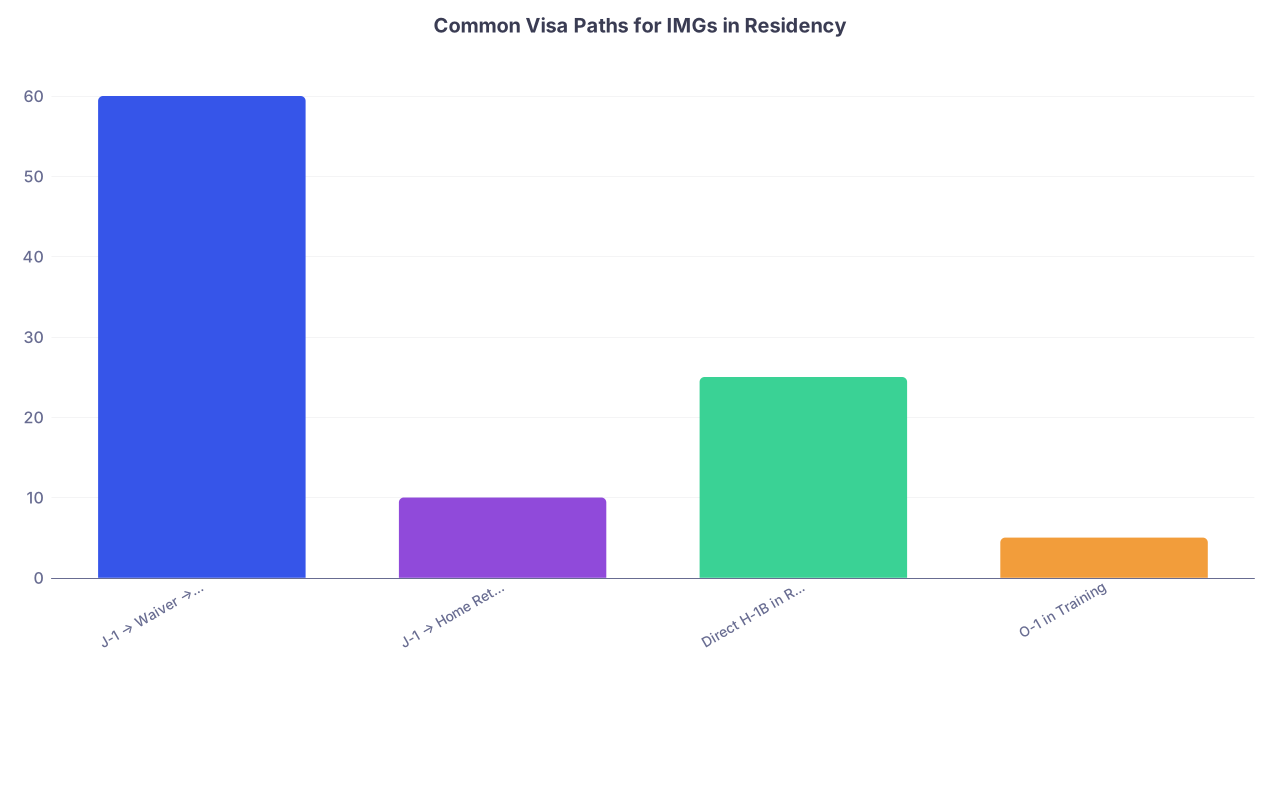
| Category | Value |
|---|---|
| J-1 → Waiver → H-1B | 60 |
| J-1 → Home Return → H-1B | 10 |
| Direct H-1B in Residency | 25 |
| O-1 in Training | 5 |
The majority do not get direct H‑1B for residency. They still end up as attendings in the US.
FAQ (Exactly 2 Questions)
1. My program promised H‑1B during interviews but never put it in writing. Do I have any leverage?
You have some leverage, but it is weaker without documentation. If multiple witnesses (faculty, residents) can confirm that the program explicitly represented itself as “H‑1B friendly,” you can raise this with your PD and GME as a miscommunication affecting your match decision. It may push them to look for exceptions or alternative structures (like cap‑exempt H‑1B through a university). Legally, though, oral promises are far harder to enforce, and you are unlikely to compel an institution to file an H‑1B. Treat it as pressure for internal advocacy, not as a guaranteed legal weapon.
2. If I switch to J‑1 now, am I stuck with the 2‑year home requirement forever?
The 2‑year requirement (212(e)) attaches to you because of your J‑1 program, not your entire life. You either:
- Fulfill it by spending a cumulative 2 years physically in your home country after J‑1, or
- Get it waived through a Conrad 30 job, federal waiver, hardship/persecution claim, or other designated waiver process.
Once the requirement is either fulfilled or formally waived, you are no longer “stuck” with it for future status changes (like H‑1B) or immigrant visas. The key is that you cannot change to certain statuses (H‑1B, L‑1, permanent residency) until that 212(e) obligation is dealt with. Planning that waiver strategy early during residency is how you prevent it from becoming a permanent roadblock.
Key takeaways:
- Do not let the perfect visa (H‑1B) cost you the essential outcome (an accredited residency spot and lawful status).
- Treat J‑1 as a tool, not a death sentence, and if you must accept it, start your waiver strategy early.
- Use your PD, GME, and a real immigration lawyer aggressively but professionally to explore exceptions, alternatives, and long‑term fixes.


