

Visa dependence absolutely affects your Match odds—but not in the simplistic, fatalistic way people repeat on forums.
The lazy version of the myth goes like this: “If you need a visa, your chances are basically zero unless you’re perfect.” That is wrong. And it leads a lot of smart IMGs to make dumb decisions—overapplying, under-targeting, or worse, self-eliminating from reasonable specialties.
Let’s tear this apart with data, not vibes.
The Big Picture: What the Data Actually Shows
You cannot talk about visa-dependent IMGs without talking about numbers. Feelings do not match outcomes.
From recent NRMP Charting Outcomes and annual Match data (patterns have been stable for years):
- Non–US citizen IMGs match less often than US citizen IMGs. True.
- But thousands of non–US citizen IMGs match every year—many on visas.
- The gap is real, but it’s not the cliff people dramatize.
The more accurate statement is:
Being visa-dependent is a negative but modifiable factor—roughly on the same order as having slightly lower scores, weaker clinical experience, or a less polished application strategy. It’s not a death sentence. It’s a tax.
And here’s the part people miss: that “visa tax” is not uniform.
Some programs are:
- Hyper-visa-friendly (sponsor routinely, have a system, prefer IMGs)
- Visa-neutral (will sponsor, but not going to jump through extra hoops)
- Visa-averse (avoid it unless applicant is unbelievably strong)
- Visa-closed (do not sponsor, full stop)
If you treat all programs as equal just because they’re on ERAS, you’re throwing away your leverage.
Myth 1: “Needing a Visa Automatically Puts You at the Bottom of the Pile”
No. But it does move you down some piles and up others.
Programs don’t sit there saying “We hate visas.” They say things like:
- “We don’t have the institutional backing to do H‑1Bs.”
- “Our GME office only allows J‑1.”
- “We’ve had good experience with IMGs before; our chief is an IMG.”
- “We got burned on a visa delay once; we’re wary now.”
Those are structural, not emotional, decisions.
In practical terms:
- At some university programs with big institutional support, your visa status is a minor logistical checkbox.
- At some small community programs without strong GME admin, your visa is a deal-breaker no matter how good you are.
- At IMG-heavy programs with prior visa residents, your visa need is basically normalized.
Here’s the key: you’re not “less” everywhere; you’re “less” in some places and “normal” in others. Your job is to stop wasting emotional energy and application money on the wrong bucket.
| Program Type | Typical Visa Stance | Your Leverage If Visa-Dependent |
|---|---|---|
| Big university (IMG-heavy) | J‑1 yes, H‑1B sometimes | Medium–High |
| Big university (US‑grad focused) | J‑1 maybe, H‑1B rare | Low |
| Mid-size community with many IMGs | J‑1 routine, H‑1B variable | High |
| Small community, few/no IMGs | Often no sponsorship | Near zero |
| Highly competitive academic (Derm, Ortho, etc.) | Sponsorship technically possible | Basically none unless unicorn-tier |
If you spray 200 applications without mapping this out, you’re not “working hard.” You’re gambling blind.
Myth 2: “If You’re Visa-Dependent, You Must Have Perfect Scores”
Another over-simplified fantasy. Programs do not need “perfect.” They need confidence.
Confidence in what?
- You can pass boards on first attempt.
- You can function clinically Day 1.
- You’ll actually be allowed to start (visa approved on time).
- You won’t be an administrative headache.
Visa dependence makes admins slightly nervous. Strong metrics and experience calm them down. That does not mean 270+ Step scores or nothing. It means no red flags and clear strengths.
For a visa-dependent IMG, the “comfort zone” looks like:
- USMLE/Step 2 CK: above the mean for matched IMGs in your specialty.
- No failed attempts. A single fail is bad for everyone; it’s worse for you because it stacks with visa risk.
- Recent graduation (ideally within 5–7 years), unless you have substantial, continuous clinical work.
- Real US clinical experience (not just observer-only, not just one random month).
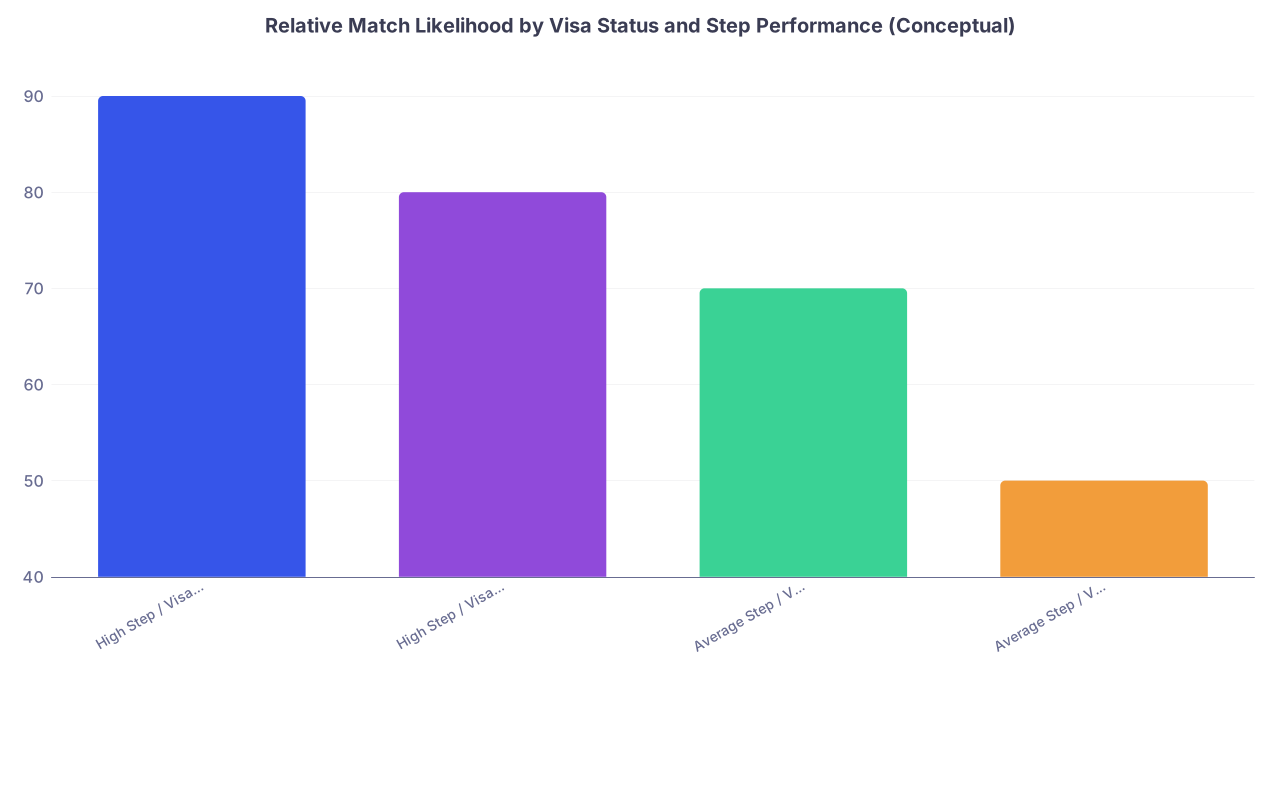
| Category | Value |
|---|---|
| High Step / Visa-Free | 90 |
| High Step / Visa-Dependent | 80 |
| Average Step / Visa-Free | 70 |
| Average Step / Visa-Dependent | 50 |
That chart is not an official NRMP graph; it’s how PDs actually behave when you listen to them off the record. Scores help. Visa hurts a bit. The combination matters more than any single factor.
You do not need to be perfect. You need to be reassuring.
Myth 3: “J‑1 vs H‑1B Is Just a Preference—Programs Don’t Care”
They care a lot. Just not for the reasons you think.
Here’s the breakdown:
- J‑1: ECFMG-sponsored. Centralized, relatively standardized, familiar to GME offices. Requires return-to-home-country or waiver after training.
- H‑1B: Employer-sponsored. More paperwork for the institution, more fees, more coordination, more legal risk. But allows potential direct transition to fellowship or employment without the J‑1 two-year rule.
Programs who’ve been burned by H‑1B complexities tend to default to: “We do J‑1 only.” You’ll literally see that stamped on their website.
So does asking for H‑1B “hurt” your chances? It depends:
- Programs that routinely sponsor H‑1B:
- They’ve already decided the overhead is worth it.
- Asking for H‑1B is normal; it doesn’t hurt you.
- Programs that only sponsor J‑1:
- Insisting on H‑1B is pointless. You’re auto-excluded before anyone even opens your PDF.
- Programs that are vague:
- Admissions might say “case-by-case.” Translation: “We don’t want to promise anything; if you’re spectacular we might consider it, but we’d rather not.”
| Website Language | Real Meaning for You |
|---|---|
| "J‑1 only" | Do not mention H‑1B; accept J‑1 or move on |
| "J‑1 and H‑1B supported" | H‑1B is possible for strong candidates |
| "Visa sponsorship possible" | Very program-dependent, usually J‑1 default |
| "No visa sponsorship" | Do not apply, do not email, move on |
If you email a “J‑1 only” program arguing for H‑1B, you’re not being assertive. You’re telling them you don’t understand the system.
Myth 4: “Programs Avoid Visa-Dependent IMGs Because They’re Anti-IMG”
The image of residency programs as cartoon villains who “hate foreigners” is comforting in a twisted way. It gives you a simple enemy. Reality is less dramatic and more bureaucratic.
The usual reasons programs hesitate with visas:
- Past visa delays causing late starts or training disruption
- Weak GME admin infrastructure (one overworked coordinator doing everything)
- Institutional rules from legal/compliance above the program director’s head
- Funding or billing issues tied to visa categories
- Pure convenience: US grads with no visa needs are easier to onboard
Yes, there is occasional bias. But more often what I’ve heard from PDs sounds like:
- “I’d love to rank this candidate, but our GME office stopped H‑1Bs after a legal review last year.”
- “We got burned with late visa approval; my chair told me to avoid sponsorship unless necessary.”
So no, your biggest enemy is rarely bigotry. It’s risk aversion and paperwork fatigue.
And that matters because:
- You cannot argue someone out of racism in an email.
- But you also cannot argue admin logistics into existence where they do not exist.
You need to stop trying to “convince” closed-door programs and instead triple down on the ones where the system is already friendly to you.
Myth 5: “If I Apply Broadly Enough, Visa Status Won’t Matter”
This is the classic “200-application delusion.”
More applications do not linearly translate into more interviews once you hit a certain threshold—especially for visa-dependent IMGs.
Here’s what actually happens:
- You apply to 200 programs.
- Maybe 50 of them literally don’t sponsor any visas.
- Another 50 “technically” sponsor but haven’t actually taken a visa-dependent IMG in 5+ years.
- 30 are hyper-competitive academic programs where even US MDs with AOA are sweating.
- Now you’re shocked you only got 4 interviews and think it’s “because of visa.”
No. It’s because you did not actually apply broadly. You applied blindly.
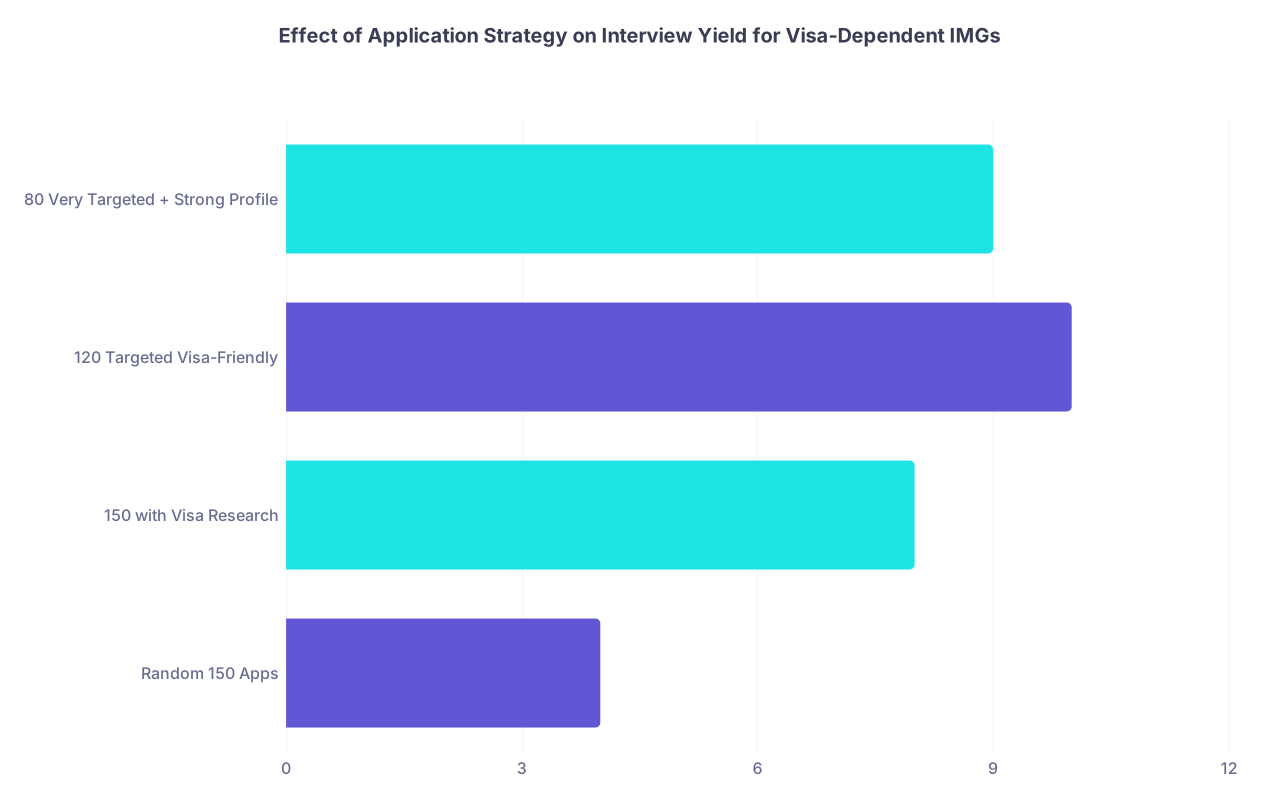
| Category | Value |
|---|---|
| Random 150 Apps | 4 |
| 150 with Visa Research | 8 |
| 120 Targeted Visa-Friendly | 10 |
| 80 Very Targeted + Strong Profile | 9 |
Fewer, smarter applications often beat massive, undifferentiated ones.
What works better:
- Build a list where every single program either:
- Explicitly sponsors your visa type, or
- Has recent graduates with your visa.
- Aggressively prioritize:
- Community and mid-size university programs with heavy IMG representation.
- States and regions historically friendlier to IMGs and visas (think NY, NJ, MI, IL, TX in many specialties—not exclusively, but often).
- Cut programs that:
- State “no visa sponsorship.”
- Haven’t matched a non–US citizen IMG in years.
“Broad” for you means “broad within the subset of visa-tolerant programs,” not “every green dot on ERAS.”
Myth 6: “If I Don’t Mention Visa in Emails, I Can At Least Get Looked At”
I’ve seen this move: people hide their visa need in early contact, hoping to “get in the door” and then sort it out later.
It backfires more often than not.
Program coordinators and PDs are not discovering your visa status at the interview table. It’s on your ERAS. It’s obvious the moment they actually review your file. If your outreach email doesn’t align with your application reality, it looks evasive.
Better approach:
- If you are doing cold outreach:
- Be upfront but concise. “I am a non–US citizen IMG requiring J‑1 sponsorship.”
- Don’t ask, “Can you sponsor?” if the website says “no visas.” That just marks you as someone who doesn’t read.
- If you already know they sponsor:
- You do not need a long visa essay.
- Just be clear in your application: you’re eligible, you understand the process, and you’ve passed the necessary exams.

| Step | Description |
|---|---|
| Step 1 | Identify Program |
| Step 2 | Do not apply or email |
| Step 3 | Apply if OK with J-1 |
| Step 4 | Apply and mention visa need briefly |
| Step 5 | Research grads & FREIDA |
| Step 6 | Low yield - apply only if strong fit |
| Step 7 | Website clear on visas? |
You’re not hiding anything. You’re signaling that you live in reality and understand the system. PDs respect that.
Myth 7: “Visa Dependence Matters More Than Everything Else”
This is the most dangerous myth because it becomes an excuse. People use it to rationalize bad outcomes that actually had multiple causes.
Visa status is one factor. Here’s the harsh ranking from real-world PD behavior:
- Red flags: failed Step attempts, major professionalism issues, big unexplained gaps.
- Core strength: exam performance, clinical letters, US experience, communication.
- Fit and specialty choice: applying to hyper-competitive specialties with a weak profile.
- Graduation year and recency of training.
- Visa status.
Yes, being visa-dependent knocks you down somewhat within any given tier. But I have watched:
- Visa-dependent IMGs with solid 230s–240s, strong US rotations, and coherent PS match internal medicine and family med very reliably.
- Visa-free IMGs with multiple Step failures or no USCE go unmatched despite an “easier” status.
- Visa-dependent IMGs match into pathology, psychiatry, even occasional radiology, because they were strategic and rock-solid on paper.
If you fixate on visa as The Enemy, you’ll ignore the stuff you actually control: your Step 2 CK score, your letters, how you present your story, what specialties you choose, and how you build your program list.
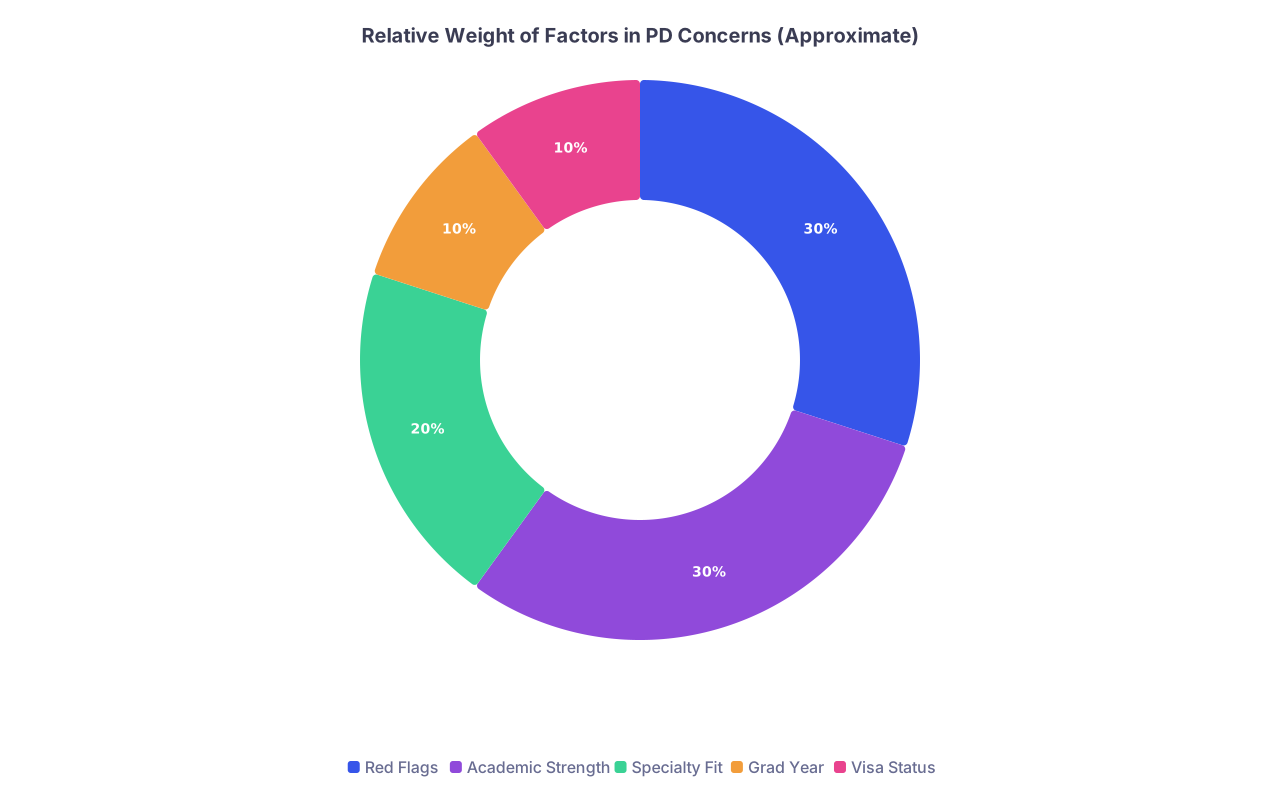
| Category | Value |
|---|---|
| Red Flags | 30 |
| Academic Strength | 30 |
| Specialty Fit | 20 |
| Grad Year | 10 |
| Visa Status | 10 |
Again, that’s conceptual, but it reflects what I’ve heard in PD meetings more accurately than the “visa is everything” narrative.
So, Does Being Visa-Dependent Hurt Your Match Chances?
Yes. But not in the simplistic “you’re doomed” way.
Here’s the reality stripped of drama:
- It narrows the subset of programs for which you’re viable.
- It mildly lowers your odds within that subset if all else is equal.
- It raises the bar for how clean and strong the rest of your file must be.
- It forces you to be more strategic, more informed, and frankly, more disciplined than many US grads ever have to be.
You do not beat that by complaining. You beat it by out-planning them.
Key Takeaways
- Visa dependence is a real but bounded disadvantage—significant enough that you must adapt, not so big that you should give up.
- Your success depends far more on targeting visa-friendly programs and building a strong, clean application than on obsessing over J‑1 vs H‑1B in theory.
- The IMGs who match with visas are not magical; they are ruthlessly realistic about where they apply, what they can offer, and how the system actually works.


