

What actually happens when a cardiology or GI PD likes you, but then hears you’re on a J-1 waiver in a small town or on an H‑1B that can’t be transferred easily?
Let me answer the core question first and clearly:
Yes, your visa type can absolutely limit your chances at competitive fellowships as an IMG.
But it doesn’t kill your chances. It just changes which doors are open, how hard you have to knock, and the order you do things.
Let’s unpack this in a way that actually matches how programs think and how the system works.
1. The blunt truth: how much does visa type matter?
Here’s the hierarchy most competitive fellowship programs informally operate with, from their point of view:
- US citizens / green card holders – easiest
- J‑1 residents – very common, manageable
- H‑1B residents – more complex, more expensive, more risk
- Any “complicated” or unusual status – usually a hard no
Your visa type is not the first thing that gets you filtered. Programs still look at:
- Where you trained (US vs abroad, university vs community)
- Letters of recommendation (big names vs generic)
- Research output (first-author, PubMed, respected journals)
- Exams and clinical performance
But once you’re in the serious consideration bucket, visa type suddenly matters. A lot.
Here’s the key nuance:
For less competitive fellowships (endocrine, geriatrics, heme-path, nephrology in many places):
Visa type often matters less. If they like you, they’ll usually work with what you have.For highly competitive fellowships (cards, GI, heme/onc, some critical care, certain interventional tracks):
Visa type becomes a real constraint. Some programs simply don’t want to touch H‑1B at all. Others are J‑1 only. And a smaller subset are flexible and sophisticated.
So yes, your visa can limit your options. But that’s different from saying “you have no chance.”
2. J‑1 vs H‑1B for residency: which is better for fellowship?
Let me be concrete.
J‑1 for residency
J‑1 is the standard training visa for IMGs in US GME. Programs are used to it.
Pros for fellowship:
- Almost all fellowships are used to sponsoring J‑1.
- ECFMG handles a lot of the logistics – PDs and GME offices are familiar with the process.
- Many big-name academic fellowships (cards, GI, heme/onc) routinely take J‑1s.
Cons for fellowship and career:
- You accumulate a two-year home-country physical presence requirement after finishing all training on J‑1 (residency + fellowship).
- To stay in the US and work after fellowship, you usually need a J‑1 waiver job (often rural/underserved, HPSA, VA, etc.).
- Some programs quietly prefer H‑1B because they think it’s “better” for long‑term academic retention, but that’s not universal.
Bottom line:
For getting into fellowship, J‑1 is usually easier than H‑1B.
H‑1B for residency
This is where people get misled by forum advice.
Pros for fellowship (theoretical):
- No J‑1 two‑year home return requirement.
- Easier path to stay in academics long-term if you secure continuous H‑1B and eventually a green card.
- A minority of programs do value that you’re “easier to keep” after fellowship.
Cons (this is where people get burned):
- Many fellowship programs either:
- Don’t sponsor H‑1B at all, or
- Sponsor it only for highly exceptional candidates and only when institutionally easy
- Cap issues: if your H‑1B is cap‑subject and you’ve not been counted in the cap already, you’re in a tougher position
- Costs and paperwork are higher for the institution
- Timing can be tight; H‑1B start dates and fellowship start dates need to align
If you’re on H‑1B in internal medicine and aiming for very competitive fellowships, your pool of programs is smaller than if you were on J‑1.
So the short answer:
- J‑1 = easier access to a wider range of fellowships, with more post-training pain
- H‑1B = potentially nicer long‑term pathway, but more limited fellowship options and more program resistance
3. How competitive fellowships actually think about visa types
Let’s talk about real behavior, not policy documents.

Category 1: “J‑1 only” programs
Common in large university systems and some community‑based academic programs.
These programs:
- Have a standard relationship with ECFMG
- Don’t want H‑1B legal costs, cap issues, or compliance headaches
- Often explicitly state “J‑1 visa only” in their ERAS listing
If you’re H‑1B, you’re functionally ineligible here, no matter how strong you are.
Category 2: “J‑1 preferred, rare H‑1B exceptions”
This is most big‑name academic fellowships.
They will:
- Happily take strong J‑1 applicants
- Consider H‑1B, but only for:
- Exceptional candidates (serious research, strong letters, US med grads who are noncitizens, etc.)
- Situations where the institution already has easy H‑1B processes
I’ve seen this scenario:
Program loves an IMG on H‑1B. Then GME says, “We can do it, but it’s expensive, and we only want to do 1–2 per year.” That applicant becomes the one H‑1B exception, and everyone else on H‑1B gets screened out.
Category 3: “Visa‑friendly” and flexible programs
Usually:
- Large academic centers with robust legal teams
- Institutions used to handling many foreign nationals (think major cities and research powerhouses)
These are your best bet if you’re on H‑1B, or if your current situation is messy (J‑1 waiver job, etc.). But they’re also the ones everyone else is applying to.
4. Specific problem scenarios IMGs face
Let’s go through a few that keep coming up.
Scenario A: J‑1 resident → wants competitive fellowship
Your main issues:
- Competition level, not visa type
- You’re in the “normal” pathway that lots of J‑1 IMGs successfully navigate every year
Your real levers:
- Get into the strongest residency environment you can (especially for your chosen specialty)
- Do serious research (not just case reports) in your target field
- Work with letters writers who are known in that fellowship world
For cards/GI/hem-onc: J‑1 is not your main limitation. Your CV and home program prestige are.
Scenario B: H‑1B internal medicine resident → wants cards/GI/hem‑onc
Here’s the ugly version:
- Some programs will auto‑filter you out.
- Others will put your application in a “maybe if we run out of J‑1/GC” pile.
- A small group will genuinely not care as long as you’re excellent.
What you need to do:
- Build a targeted list of programs that have historically taken H‑1B fellows.
- Talk to current fellows (especially IMGs) and ask what visas are in their cohort.
- In applications, be transparent but not apologetic about visa — just matter‑of‑fact.
- Over‑apply. You’re playing with a smaller pool, so volume matters.
| Program Type | J-1 Sponsorship | H-1B Sponsorship | Notes |
|---|---|---|---|
| Large university (top 20) | Yes | Sometimes | Often J-1 preferred |
| Mid-sized academic | Yes | Variable | Policy can change yearly |
| Community fellowship | Yes | Rare | Often avoid H-1B entirely |
| VA-based programs | Yes | Sometimes | Federal rules apply |
Scenario C: J‑1 waiver job attending → wants fellowship later
This is one of the toughest.
You did:
- J‑1 residency
- J‑1 waiver job (often rural or underserved) on H‑1B
- Now you want to go back to do a fellowship
Problems:
- Many fellowship programs:
- Prefer applicants straight out of residency
- Don’t want to mess with a physician mid‑waiver or complex H‑1B history
- Your academic CV may have “gone cold” during waiver work
It’s not impossible, but your chances at top‑tier competitive fellowships drop sharply. You’re more likely to match into less competitive subspecialties or in less sought‑after locations.
If you’re currently J‑1 in residency and know you want a competitive fellowship, it’s usually better to do fellowship first, then waiver, not waiver then fellowship.
5. Strategy: how to play the visa–fellowship game intelligently
You can’t control US immigration policy. You can control how you plan.
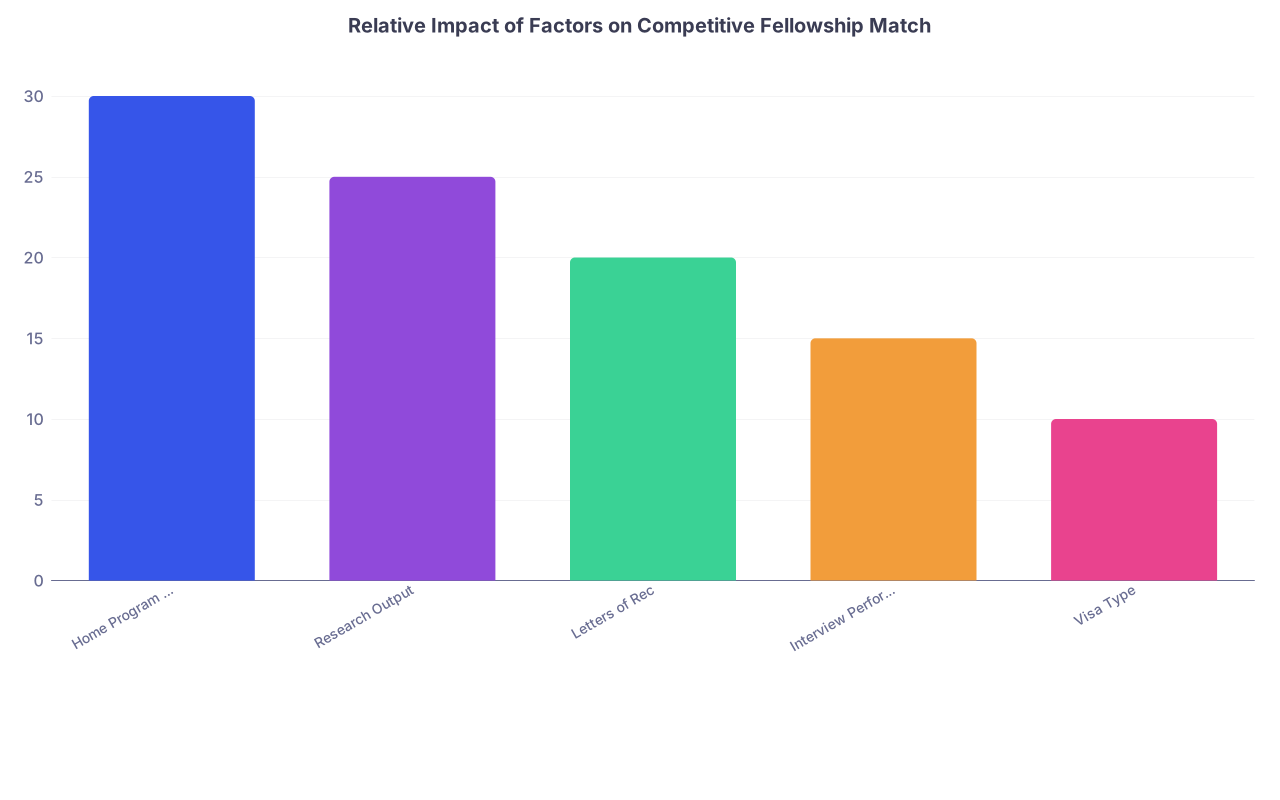
| Category | Value |
|---|---|
| Home Program Reputation | 30 |
| Research Output | 25 |
| Letters of Rec | 20 |
| Interview Performance | 15 |
| Visa Type | 10 |
Step 1: Decide what matters more to you — fellowship now, or long‑term immigration flexibility
If your absolute priority is a competitive fellowship (cards/GI/hem‑onc) and you’re choosing between J‑1 and H‑1B for residency:
- I’d lean J‑1 in many cases because it keeps more fellowship doors open.
If your absolute priority is long‑term US stay with least immigration friction and you’re okay with some risk to fellowship competitiveness:
- H‑1B can make sense, especially if you’re in a strong academic IM program that’s known for placing H‑1B residents into fellowships.
There’s no universal right answer. But pretending visa type doesn’t affect fellowship odds? That’s just wrong.
Step 2: Research actual program behavior, not just stated policy
Don’t trust websites alone. Do this:
- Look at current and recent fellows on program websites
- Find IMGs and check their backgrounds (LinkedIn, PubMed, institutional pages)
- Note their visa types when visible (H‑1B academia vs community, J‑1 waiver jobs, etc.)
- Email or message current fellows (short, specific questions) about visa sponsorship patterns
Patterns you see in current fellows are way more reliable than generic “we sponsor J‑1 and H‑1B” blurbs.
Step 3: Be realistic about competitiveness
If you’re:
Community IM, low‑research background, on H‑1B, aiming for GI at top‑10 institutions
→ That’s almost certainly not happening.University IM, solid research, on J‑1, aiming for cards at mid to high‑tier academic centers
→ Very realistic if your file is strong.
Aim for matchable targets first, then add “reach” programs.
Step 4: Use your PD and GME office early
Your program director and GME office often know:
- Which fellowships reliably sponsor which visas
- Which ones balked in prior years
- If your own institution will sponsor you for fellowship and what visa they’ll do
Have a blunt conversation early in PGY‑2:
- “I’m on J‑1/H‑1B. I’m aiming for [field]. Which programs have taken fellows with my visa status in the past?”
This isn’t a theoretical discussion. They usually have names and examples.
6. Timeline and planning for IMGs thinking about fellowship
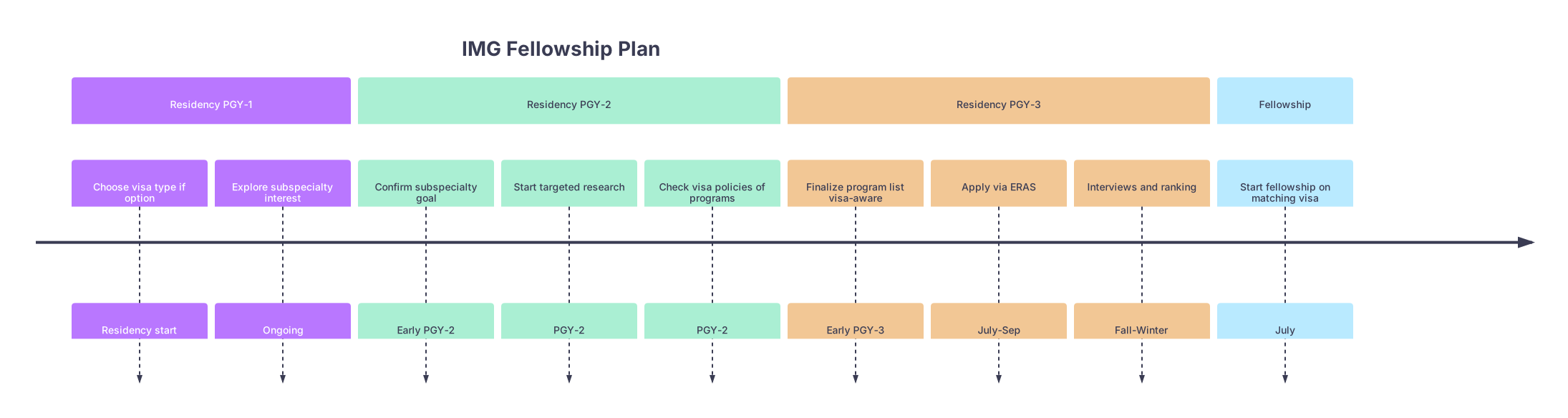
| Period | Event |
|---|---|
| Residency PGY-1 - Choose visa type if option | Residency start |
| Residency PGY-1 - Explore subspecialty interest | Ongoing |
| Residency PGY-2 - Confirm subspecialty goal | Early PGY-2 |
| Residency PGY-2 - Start targeted research | PGY-2 |
| Residency PGY-2 - Check visa policies of programs | PGY-2 |
| Residency PGY-3 - Finalize program list visa-aware | Early PGY-3 |
| Residency PGY-3 - Apply via ERAS | July-Sep |
| Residency PGY-3 - Interviews and ranking | Fall-Winter |
| Fellowship - Start fellowship on matching visa | July |
The earlier you know your target field, the more you can line up:
- Right mentors
- Right research
- Right letters
- Right program list matched to your visa status
7. Common myths you should ignore

“H‑1B is always better for career”
Not if it quietly blocks you from 30–50% of competitive fellowship programs.“J‑1 means you can’t get top fellowships”
Totally false. Plenty of J‑1 IMGs match GI, cards, heme/onc at big-name places every year.“Programs will change visa policy just for me if I’m strong enough”
Occasionally true at very flexible places. Mostly false elsewhere.“Once you have a waiver job, you can always go back for fellowship later”
Sometimes yes. Often your odds at competitive fellowships are much lower after years away from academia.
8. Practical moves you can make right now
- Clarify your priority: fellowship competitiveness vs long‑term immigration stability
- If you’re still pre‑residency and have a choice, think hard before reflexively choosing H‑1B “because it’s better”
- Map programs in your desired subspecialty by:
- Visa types they’ve historically taken
- How many IMGs they have
- Academic vs community orientation
- Talk to real humans: current fellows with similar backgrounds/visas
- Build the strongest CV you can; a stellar profile can overcome some visa hesitation, though not all
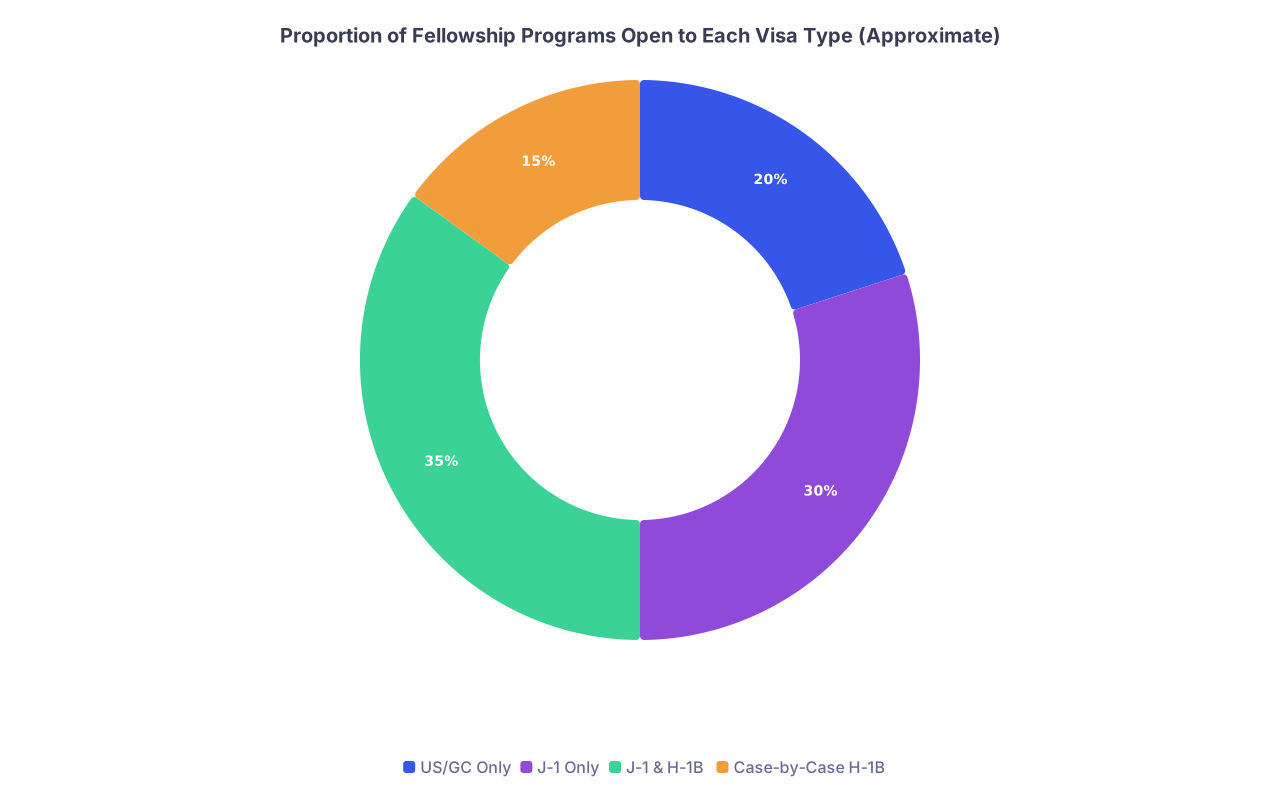
| Category | Value |
|---|---|
| US/GC Only | 20 |
| J-1 Only | 30 |
| J-1 & H-1B | 35 |
| Case-by-Case H-1B | 15 |
FAQ (exactly 7 questions)
1. Does being on a J‑1 visa significantly reduce my chances at competitive fellowships?
Not by itself. J‑1 is the standard training visa for IMGs and widely accepted for competitive fellowships. Your program reputation, research, and letters matter more. The real hit with J‑1 comes later: the two‑year home requirement or need for a waiver job after you finish all your training.
2. I’m on H‑1B for residency. Should I be worried about matching into cards or GI?
You should be strategic, not panicked. Your pool is smaller because some programs won’t touch H‑1B or do it only rarely. That means you need a more targeted, larger application list that focuses on institutions known to sponsor H‑1B for fellows, and your CV needs to be strong enough that a program is willing to take on the extra hassle.
3. If I can choose between J‑1 and H‑1B for residency, which is better for fellowship?
For pure fellowship access, especially in highly competitive fields, J‑1 is usually safer because more programs routinely accept it. If your long‑term life plan revolves around staying in the US with less immigration friction and you’re willing to accept a narrower fellowship pool, H‑1B can make sense. You’re trading fellowship openness for long‑term immigration convenience.
4. Can programs switch me from J‑1 to H‑1B for fellowship later?
Sometimes, but don’t count on it as a plan. Many institutions have strict policies: J‑1 only, or J‑1 preferred with rare H‑1B exceptions. Switching from J‑1 in residency to H‑1B in fellowship is possible in some places, especially if they’re very motivated to keep you and have strong institutional support, but it’s the exception, not the rule.
5. I’m in a J‑1 waiver job now. Is it realistic to go back for a competitive fellowship later?
Realistic? Yes. Likely at top‑tier competitive programs? Usually no. After a few years in a waiver job (often community/rural, low research output), your academic profile tends to cool off. Some fellowships, especially less competitive ones or in less desired locations, may still consider you. But your chances at high‑end GI/cards/hem‑onc drop significantly compared to going straight from residency.
6. How can I find out if a specific fellowship will sponsor my visa type?
Don’t rely only on their website. Do three things:
- Check the current fellows and see how many IMGs there are and where they came from.
- Email or message current IMG fellows and ask directly what visas are in the program and whether H‑1B/J‑1 is actually supported.
- Ask your PD or GME office if they’ve had residents match there and what visas they used. Historical behavior is far more accurate than vague “we sponsor visas” statements.
7. Can an outstanding application completely override visa concerns?
It can overcome some of them, not all. If a program institutionally doesn’t sponsor H‑1B, your brilliance won’t change that. If they “prefer J‑1 but can do H‑1B for the right person,” then yes, a truly exceptional profile (strong US research, big‑name letters, clear fit with their program) can push them to make an exception. Visa type is one variable. A strong CV gives you leverage, but it doesn’t rewrite institutional policy.
Key takeaways:
- Visa type absolutely affects your fellowship options, especially in competitive fields, but doesn’t decide your fate alone.
- J‑1 tends to be easier for fellowship access; H‑1B can be better for long‑term stay but shrinks your program pool.
- The smartest thing you can do is match your visa reality with a carefully researched, targeted fellowship strategy instead of pretending visa doesn’t matter.


