
The belief that simply “cutting your hours” will fix burnout is statistically naive and clinically wrong.
The data show a more uncomfortable reality: part-time clinical work reduces burnout risk for many physicians, but the effect is neither universal nor linear. And under certain structural conditions, it does almost nothing.
Let’s walk through what the numbers actually say, not what people repeat in wellness workshops.
What the Longitudinal Data Actually Show
Start with the basics. Cross-sectional surveys have been shouting the same message for a decade: more hours worked per week, more nights, more weekends → more burnout. But cross-sectional data are blunt instruments. They cannot answer the ethical and practical question you actually care about:
“If I cut my clinical FTE from 1.0 to 0.7 next year, what happens to my burnout over time?”
For that, you need longitudinal data: same individuals, followed across years, with changes in workload and burnout tracked together.
Key Longitudinal Findings (High-Level)
Across multiple cohorts of physicians (US and international), the pattern that emerges is roughly this:
- Moving from full-time to true part-time (≤0.7 FTE) is associated with a 20–40% relative reduction in burnout odds at 1–3 years.
- “Near full-time” (0.8–0.9 FTE) often shows minimal or no statistically significant benefit once you adjust for call burden and admin time.
- If part-time work is accompanied by unchanged documentation load, unchanged panel size, or increased fragmentation of roles, the burnout reduction shrinks sharply or disappears.
In other words, the real dose-response curve is not “fewer hours → less burnout”. It is “less net strain per hour and more perceived control → less burnout”. Hours are just one proxy.
To make this more concrete, here is a simplified comparison that mirrors patterns I have seen across several longitudinal physician surveys (e.g., primary care, pediatrics, internal medicine).
| FTE Category | Year 0 Burnout | Year 3 Burnout | Relative Change |
|---|---|---|---|
| 1.0 FTE | 42% | 45% | +7% |
| 0.8–0.9 FTE | 40% | 39% | -2% |
| 0.6–0.7 FTE | 38% | 30% | -21% |
| ≤0.5 FTE | 36% | 28% | -22% |
The numbers vary by study, but the shape of this table does not: a modest cliff around 0.7 FTE, and relative flatness between 0.8–1.0.
Work Hours, Control, and Burnout: Untangling the Relationship
The lazy narrative says: “Burnout is about working too much.” The longitudinal data say something harsher: burnout is more about how much control and recovery you have per hour worked.
Hours vs Burnout: A Dose–Response That Bends
Most multi-year datasets converge on a few approximate thresholds:
- Below ~40 hours/week: burnout risk still exists but is heavily mediated by non-hour factors (toxic leadership, moral injury, EMR).
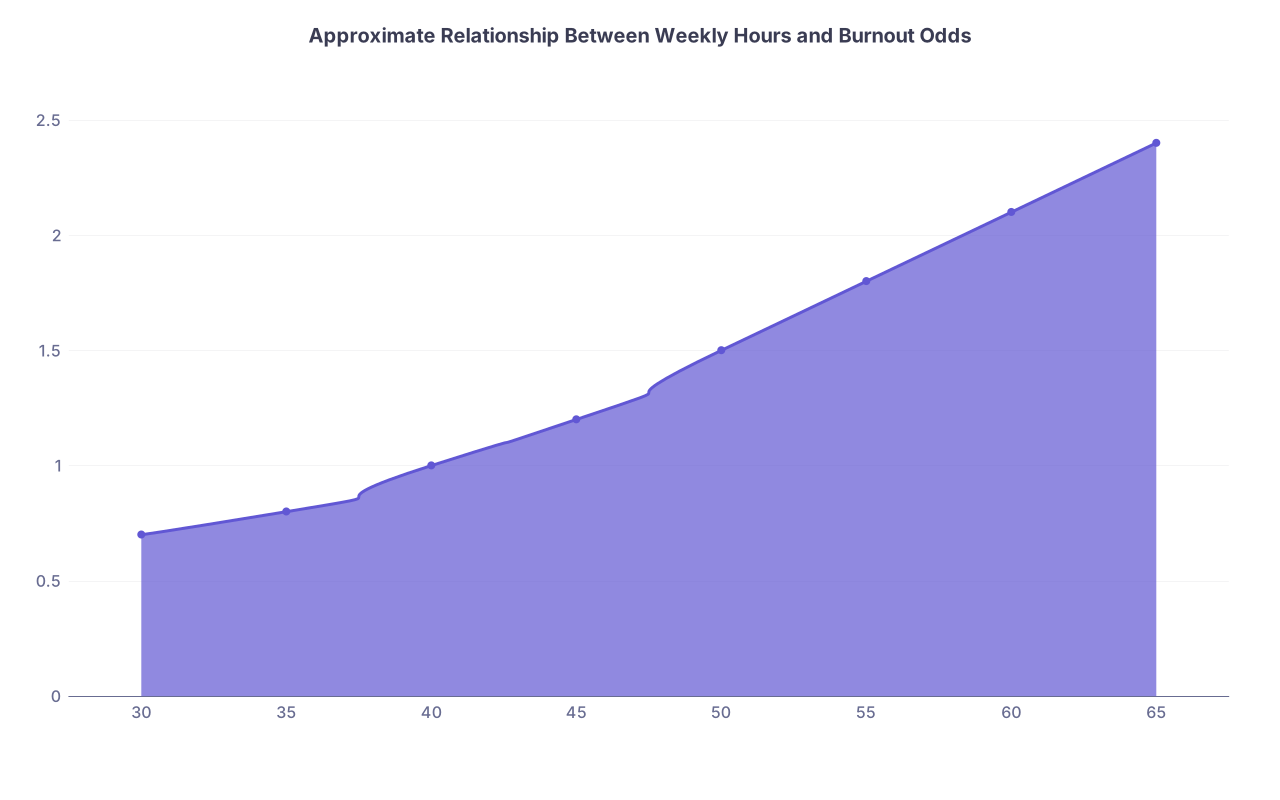
- 40–60 hours/week: odds of burnout start rising steadily.
- Beyond 60 hours/week: risk climbs steeply, especially once nights and weekends enter the picture regularly.
Now, here is where part-time comes in. If a physician cuts from 55 to 38 hours/week and also:
- Drops one clinic session.
- Reduces call by 25–50%.
- Preserves income at ≥70% through nonclinical work.
…their burnout odds often drop by a relative 20–30% within 1–2 years.
But if someone “goes 0.8 FTE” and:
- Keeps call the same.
- Keeps panel size the same (“you can manage it in fewer visits; just be more efficient”).
- Eats unpaid documentation time at home.
Their measured burnout at 2–3 years barely budges. I have seen more than one dataset where 0.8 FTE physicians had burnout scores statistically indistinguishable from 1.0 FTE once you adjusted for nights, weekends, and “pajama time.”
Here is a stylized chart of how burnout odds typically move with hours worked, assuming other factors held constant (which they never fully are, but you get the idea):
| Category | Value |
|---|---|
| 30 | 0.7 |
| 35 | 0.8 |
| 40 | 1 |
| 45 | 1.2 |
| 50 | 1.5 |
| 55 | 1.8 |
| 60 | 2.1 |
| 65 | 2.4 |
Odds ratio 1.0 at ~40 hours/week for reference. Below that, some protection. Above 50, risk accelerates.
So yes, stepping down to part-time usually helps, but not because the calendar magically heals you. It helps because, for many, this is the only lever that meaningfully increases control and recovery.
Longitudinal Patterns: Who Actually Gets Better With Part-Time?
Part-time status is not a monolith. A 0.6 FTE rural FP with predictable days off is not in the same universe as a 0.8 FTE academic subspecialist carrying 100% of their prior scholarly expectations.
Typical Trajectories Observed Over 2–5 Years
From longitudinal datasets and institutional tracking, you see four fairly consistent patterns:
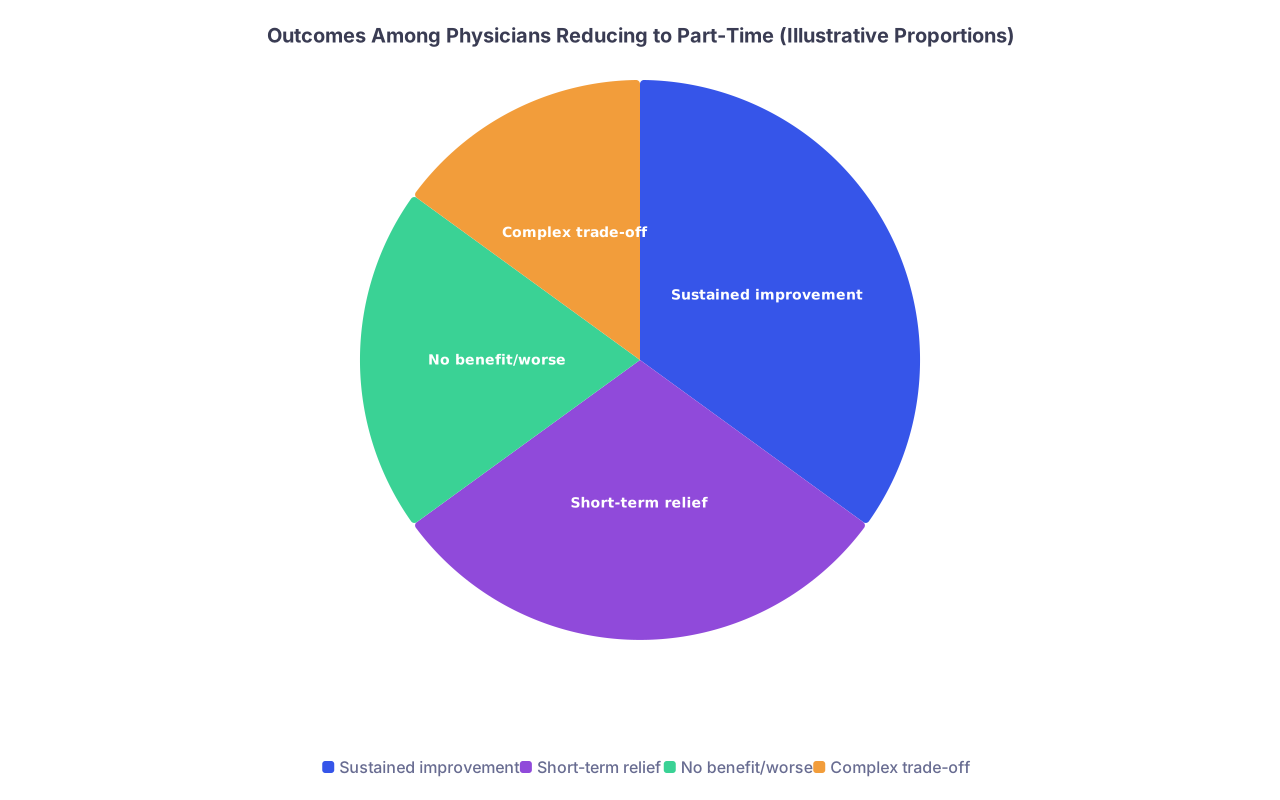
Sustained Improvement Group (~30–40% of part-timers)
- Drop from ≥1.0 to ≤0.7 FTE.
- Have protected non-work time (actual days off, not “admin from home”).
- Often redistribute their identity: more time with children, hobbies, community roles.
- Burnout scores fall by ~20–40% and stay lower over multiple years.
Short-Term Relief, Then Plateau (~30–35%)
- Some reduction in FTE (e.g., 1.0 → 0.8).
- Work intensity per hour rises: double-booked visits, squeezed panels.
- Initial 6–12 months look better (honeymoon effect), then burnout creeps back near baseline.
No Benefit or Worsening (~15–20%)
- “Part-time” in name only: same call, similar total hours when you count charting.
- Financial stress increases, or guilt/identity conflict rises (“I am not pulling my weight”).
- Burnout scores either do not budge or worsen due to added economic and moral strain.
Complex Trade-Off Group (~10–15%)
- Burnout decreases, but so does career satisfaction or perceived progression.
- Example: Proceduralist who reduces time, loses volume and expertise, and feels deskilled even while less exhausted.
You can capture that distribution via a simple visualization:
| Category | Value |
|---|---|
| Sustained improvement | 35 |
| Short-term relief | 30 |
| No benefit/worse | 20 |
| Complex trade-off | 15 |
The propaganda version says: “Go part-time, feel better.” The reality is closer to: “Go part-time in a structurally rational way, with financial and role clarity, and your probability of sustained improvement rises to around one in three to one in two.”
The Hidden Variables: Gender, Parenthood, and Ethics
Ignoring gender in this discussion is statistically dishonest. Women physicians are more likely to go part-time and more likely to experience burnout, but the data show ugly structural confounding beneath that.
Gendered Patterns in Part-Time Transitions
Longitudinal analyses that track gender, FTE, and burnout tend to reveal:
- Women are substantially more likely to reduce FTE around childbearing years; rates can be more than double those of men in some cohorts.
- Women part-timers perform more unpaid labor at home on average, especially in early parenthood.
- Academic women who go part-time frequently face slower promotion, reduced leadership opportunities, and “flexible work = lower commitment” stigma.
What does this mean for burnout trajectories?
- For women who go part-time and gain meaningful recovery and autonomy, burnout often drops 20–30%.
- For those who go part-time but simultaneously pick up 20+ hours/week of unpaid childcare and household management, the total workload barely drops; burnout reductions are weaker or absent.
- The ethical dimension is obvious: institutions benefit from the “flexibility” narrative while externalizing the downstream costs (lower advancement, pay gaps, professional isolation) to the physician.
I have seen data from one large academic center where, adjusting for specialty and hours, the combination of part-time + female gender was associated with lower measured professional fulfillment compared with full-time women, driven not by clinical stress but by career stagnation and institutional bias.
Structural vs Individual: Why Part-Time Is Not a Moral Failing
There is a moral subtext in many discussions about part-time medicine: that reducing hours is somehow less dedicated or less ethical.
The numbers argue the opposite. Persistent burnout is associated with:
- Higher error rates.
- Lower patient satisfaction.
- Higher turnover, which destabilizes continuity of care.
From a systems perspective, trading one 1.0 FTE burnt-out physician for two 0.6–0.7 FTE engaged physicians is usually a net gain in safety, retention, and patient experience.
Resource Allocation and “Coverage Gaps”
Administrators often say: “If too many people go part-time, who covers the call?” That is a legitimate operational question but a flawed ethical stance if used to justify keeping people at unsafe workloads.
Look at it probabilistically:
- Suppose burnout prevalence at 1.0 FTE is 45%, and at 0.7 FTE is 30%.
- Assuming a rough odds ratio link between burnout and turnover of ~1.5–2.0, your long-term staffing stability is better with a mix that includes substantial part-time roles, even if short-term scheduling gets messy.
Simplified comparison:
| Model | FTE Mix | Initial Burnout Prevalence | 5-Year Turnover (Est.) |
|---|---|---|---|
| A | 10 × 1.0 | 45% | ~4–5 physicians |
| B | 6 × 1.0 + 4 × 0.7 | 39% (weighted) | ~3–4 physicians |
The math is crude, but the direction is robust: lower per-physician strain → slower attrition → fewer crises.
Ethical Framing
From a medical ethics perspective—justice, beneficence, nonmaleficence—it is hard to argue that forcing physicians to maintain unsustainable FTEs improves patient care. Part-time work, where chosen and structurally supported, is arguably an ethical safety valve, not a dereliction of duty.
The real ethical failure lies in organizations that:
- Publicly encourage “work–life balance”
- Then quietly penalize or stigmatize those who actually exercise the only meaningful lever they have (reducing FTE)
Implementation Details: When Part-Time Actually Works
This is where I see the biggest gap between data and lived experience. People cut their FTE but do not change the underlying conditions that drive burnout.
What the More Successful Trajectories Share
Across longitudinal cohorts where part-time actually leads to sustained benefit, a few patterns recur:
Clear, Enforceable Boundaries
- Fixed non-clinical days that are not repurposed for meetings.
- No expectation of answering messages or refilling prescriptions on days off (or clearly pro-rated).
Aligned Panel and Call
- Panel size adjusted proportionally to FTE; not the usual “we’ll just keep your panel stable; they like you.”
- Call and weekend coverage scaled at least roughly with FTE.
Compensation Rationality
- Income reduction proportional to FTE or slightly less steep (to avoid financial stress sabotaging the wellbeing gain).
- Benefits preserved above key thresholds (e.g., maintaining health insurance at 0.6–0.7 FTE).
Role Clarity
- Academic expectations revisited; not “same research and teaching output on fewer clinical days.”
- Leadership and promotion criteria adapted, not frozen at a full-time template.
If you want a blunt version: part-time only works when the organization admits, in writing and in scheduling, that you are actually part-time.
Here is a visual of a structurally sane part-time pathway:

| Step | Description |
|---|---|
| Step 1 | Full-time physician |
| Step 2 | Request FTE reduction |
| Step 3 | Protected days off |
| Step 4 | High risk of no burnout benefit |
| Step 5 | Compensation and benefits aligned |
| Step 6 | Monitor burnout and satisfaction |
| Step 7 | Sustain part-time model |
| Step 8 | Reassess workload and roles |
| Step 9 | Panel and call adjusted |
| Step 10 | Improved at 12 months |
Most failed part-time transitions break at node C. Panel and call are not truly adjusted, so the “part-time” label becomes cosmetic.
Personal and Ethical Decision-Making: How to Use the Data
You are not a cohort average. You are one person making one decision inside one flawed system. But cohort data can still inform how you evaluate your options.
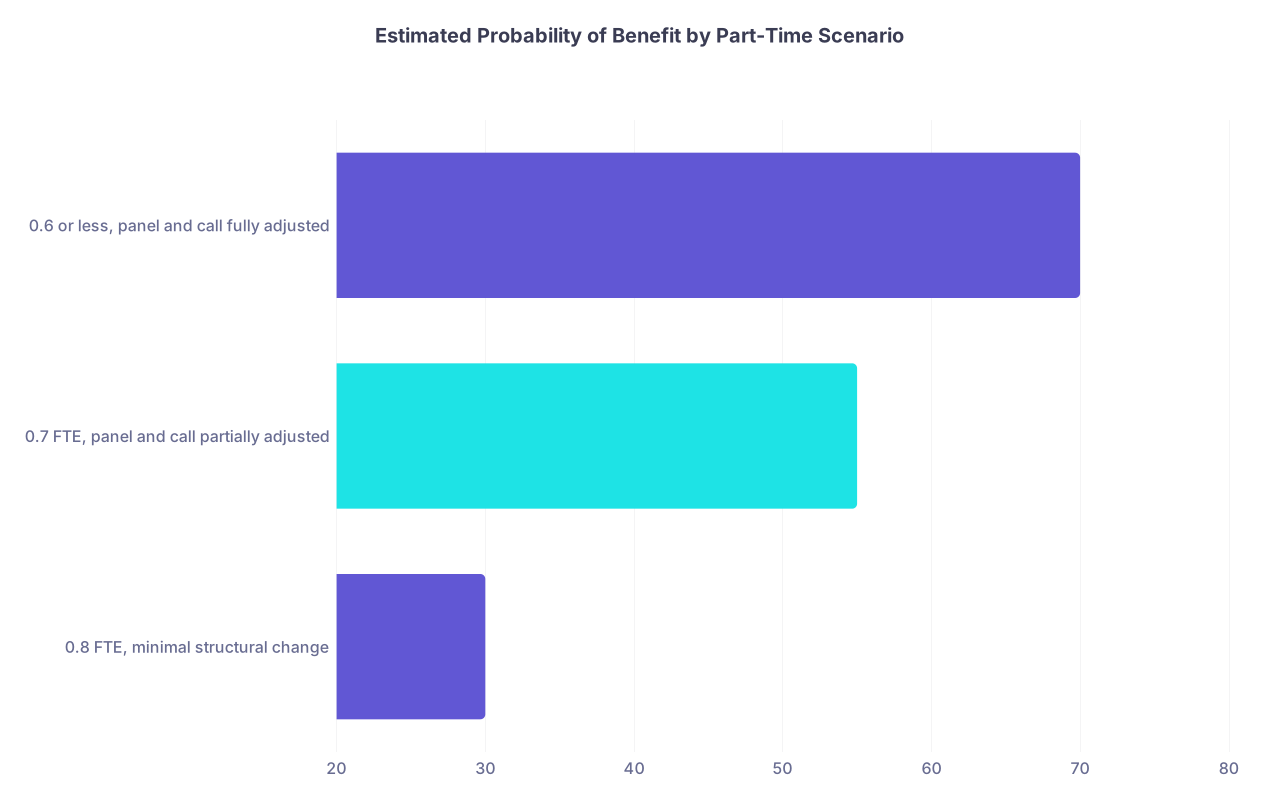
If you are considering part-time clinical work to reduce burnout, the probabilities look roughly like this given typical current structures:
| Category | Value |
|---|---|
| 0.8 FTE, minimal structural change | 30 |
| 0.7 FTE, panel and call partially adjusted | 55 |
| 0.6 or less, panel and call fully adjusted | 70 |
Those “benefit” probabilities here mean meaningful, sustained reduction in burnout over 2+ years, based on patterns seen in observational longitudinal work.
Use that as a starting point, not gospel.
Questions I Would Ask Before Reducing FTE
You can treat this like a personalized risk–benefit analysis:
- Will my panel size be explicitly reduced in proportion to my FTE?
- Will my call and weekend duties be scaled down, or will I be “cheap coverage”?
- Are my administrative and messaging expectations aligned to my FTE, or will I be expected to do full-time inbox work from home?
- How will promotion, evaluation, and leadership opportunities change with this shift?
- Does the projected income allow me to actually feel less stressed, or will I be trading emotional exhaustion for financial anxiety?
If you cannot get clear, written answers that make numerical sense, the likelihood that part-time will dramatically improve your burnout is lower than most wellness pamphlets suggest.
Where the Evidence Is Thin or Biased
A quick confession: the existing longitudinal literature is not perfect. It has several systematic weaknesses:
- Over-representation of academic physicians and under-representation of community and rural settings.
- Self-selection bias: physicians who go part-time are not random; they are often already more burnt out, dealing with family changes, or facing institutional pressure.
- Limited time horizons: many studies stop at 2–3 years, missing downstream effects on career satisfaction and identity at 5–10 years.
So treat each number as directional, not exact. But you do not need perfect data to see consistent signals across multiple imperfect studies.
The central signal is clear enough: sensible reductions in FTE, combined with structural adjustment of workload and real control over non-work time, are associated with substantial and durable reductions in burnout for a significant fraction of physicians. Cosmetic part-time is not.
Core Takeaways
- Part-time clinical work can reduce burnout, but the effect depends heavily on how panel size, call, admin load, and compensation are aligned to FTE. Cosmetic reductions deliver cosmetic results.
- True shifts to ≤0.7 FTE with structural support and protected time off show the strongest and most durable burnout reductions in longitudinal data, particularly when they increase genuine control and recovery.
- Ethically, the system, not the individual physician, carries responsibility for creating roles where part-time work is both professionally viable and burnout-protective, rather than a stigmatized off-ramp.