

What if your co-residents are on UptoDate at midnight and you’re… watching Netflix? Or deep in a non‑medical book? How much “normal life” is too much when you’re supposed to be all-in on training?
Let me be blunt: the problem in medicine isn’t that trainees have too many hobbies. It’s that they have too little life outside medicine and then feel guilty when they try to fix that.
But there is a point where outside stuff starts to cost you — performance, reputation, and ethics-wise. The line isn’t magical, but it’s clearer than people pretend.
Here’s how to think about it.
The Only Line That Really Matters
Forget hours for a second. Ask this:
Are your non-medical reading, hobbies, or TV keeping you from being a safe, reliable, improving physician?
If the answer is yes — even a little — it’s too much.
That plays out in a few specific ways:
- You’re tired on rounds because you stayed up late binging a show.
- You regularly skip reviewing cases, reading around patients, or prepping for OR/clinic because you’re gaming/scrolling/streaming.
- You cut corners (or just don’t do) required reading, modules, or logs.
- Your notes are sloppy because you rushed to make a social event.
- You consistently score poorly on in‑service exams and don’t adjust your habits.
When that starts happening, it’s not “self-care.” It’s unprofessional. It’s ethically shaky because patients are paying the price.
But notice what I didn’t say: I didn’t say “any TV is too much” or “reading fiction is a waste of time.” That’s nonsense. The content is rarely the problem. The tradeoffs are.
A Simple Framework: 4 Buckets You Must Protect
If you want a rule that actually works, use this:
Your non-medical time is “too much” when it steals from any of these four buckets, on a sustained basis:
- Patient care
- Learning and professional growth
- Basic functioning (sleep, health, sanity)
- Minimum life maintenance (relationships, bills, food, etc.)
As long as those four buckets are covered well enough, you can watch TV, read novels, play sports, bake bread, whatever.
Let’s make that less abstract.
| Area | Red Flag Example |
|---|---|
| Patient Care | Late, unprepared, or missing critical info |
| Learning | Bottom quartile exams with no improvement |
| Sleep/Health | <6 hrs sleep most nights, chronic exhaustion |
| Life Maintenance | Ignored bills, mess, neglected relationships |
If two or more of those are consistently in the red, your non-medical time is probably part of the problem.
So… How Many Hours Is “Normal”?
You want numbers. Let’s talk numbers — as guidelines, not commandments.
On a typical workday in residency (say 10–14 hours in the hospital):
- 0–1 hour/day of totally “frivolous” time (TV, non-medical reading, social media) is very safe.
- 1–2 hours/day is reasonable if:
- You’re sleeping at least 7 hours most nights.
- You’re not behind on notes/reading.
- Your evaluations and in‑service exam performance are solid.
- >2 hours/day on a regular basis? That’s where people start quietly noticing if your performance is anything short of excellent.
On an off day:
- 2–4 hours of TV/games/reading-for-fun is fine for most people.
- More than that is not some moral failure, but if your only free day is 12 hours of screens plus 4 hours of sleep, you’re not exactly recharging.
To visualize how time usually shakes out, here’s what I’ve seen among residents who are doing well and not burning out immediately:
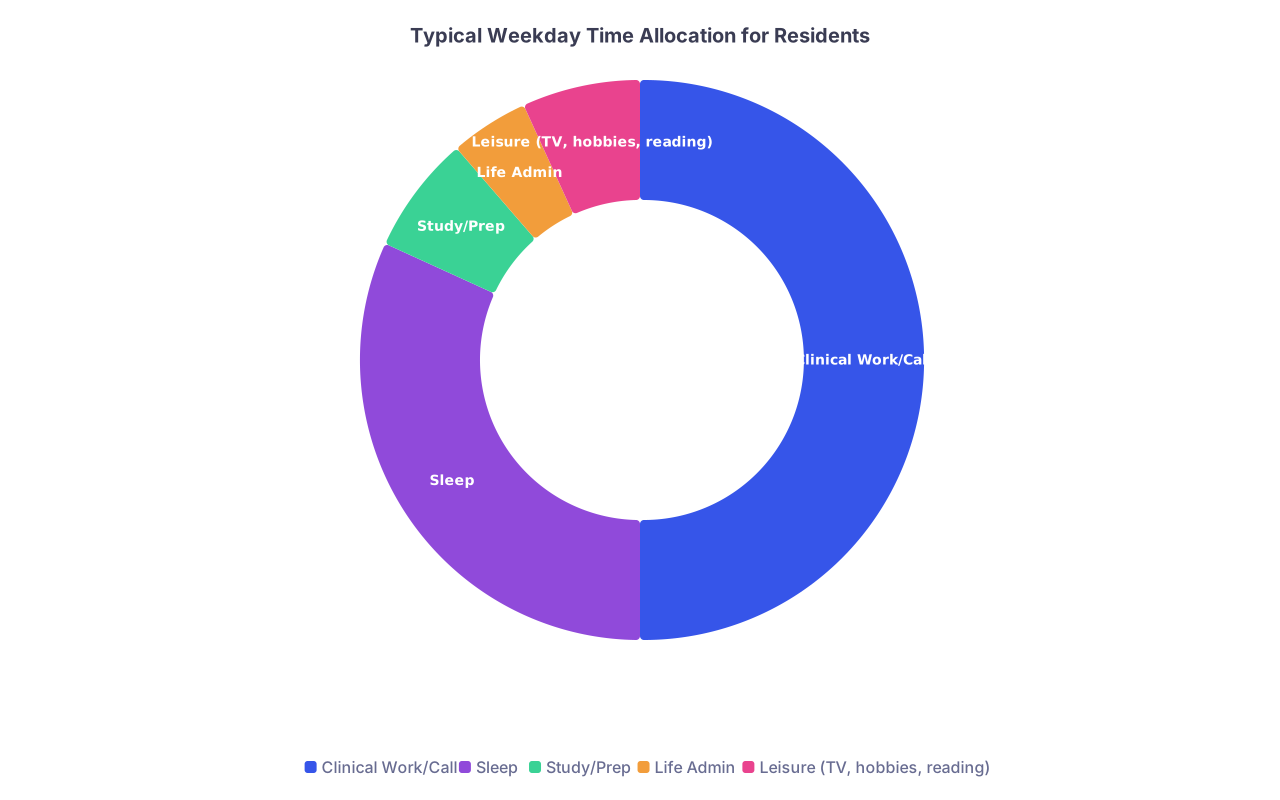
| Category | Value |
|---|---|
| Clinical Work/Call | 11 |
| Sleep | 7 |
| Study/Prep | 1.5 |
| Life Admin | 1 |
| Leisure (TV, hobbies, reading) | 1.5 |
If your “Leisure” slice is routinely swallowing your “Sleep” or “Study/Prep” slices, that’s your answer.
Red Flags: This Is When Your Hobbies/TV Are A Problem
Instead of obsessing over hours, watch for patterns.
These are clear “too much” signs:
You skip what you planned to do for work.
You meant to review tomorrow’s cases, but you kept letting Netflix autoplay. Once is human. Weekly is a pattern.You’re embarrassed to tell your attending how you spent your time off.
Not because you took a breather, but because you know you blew off basic prep and it showed.You’re constantly saying “I didn’t have time” — but you did.
You had time; you just used it on shows, scrolling, or side hobbies. That’s a choice. People notice.You’re chronically fatigued from staying up late on nonsense.
Staying up to finish a deadline? Occasionally justifiable. Staying up for one more episode while clinic is at 7 a.m.? That’s on you.Your performance is mediocre and flat.
If your feedback consistently mentions “needs to read more” or “needs to prepare more thoroughly,” and you’re spending multiple hours/day on TV or hobbies with no change? That’s irresponsible.
Once or twice doesn’t matter. Chronic does.
Ethics: You Actually Owe Patients More Than “Good Enough”
This is the part people prefer to skip, but let’s not.
You have three overlapping obligations:
- To patients: be safe, competent, improving.
- To colleagues/team: contribute fairly, not be the weak link by choice.
- To yourself: not burn out or become resentful and hollow.
Non-medical reading, hobbies, and TV can support the third obligation and indirectly the first two — if they keep you rested, human, curious.
But when your outside activities start to compete with clinical growth, the ethical priority is clear. Patients don’t care that the reason you missed that subtle rash was because you were tired from late-night gaming, not from extra call. The outcome is the same.
So the ethical bar isn’t “Did I study every free minute?” It’s: “Did I make reasonable sacrifices in my leisure to meet my professional responsibilities?” If the honest answer is no, you’re on thin ice.
How Non-Medical Reading Can Actually Make You Better
Let’s talk specifically about reading that’s not medical.
Fiction, history, philosophy, essays, memoirs — these aren’t distractions by default. They can be performance-enhancing:
- Fiction improves empathy and theory of mind.
- Good non-fiction sharpens your writing and thinking.
- Memoirs (especially patient narratives) give you perspective you will never get from UpToDate.
I’ve seen residents who read one good novel every couple of weeks handle family meetings with more nuance than people who only read board review books.
Reasonable benchmark: if you’re on a heavy service, one book every 2–4 weeks is totally fine. If you’re tearing through a novel every two nights while skipping board prep and showing up underprepared, you know what’s happening.
TV and Streaming: The Usual Suspect
TV isn’t evil. It’s just designed to eat your life if you don’t defend it.
The big traps:
- Autoplay means you’re not making a choice after the first episode.
- “Background” watching while reading usually kills both activities.
- Social watching FOMO (everyone at work is talking about X show).
If you want a practical rule that works in training:
- Cap yourself at 1–2 episodes or 45–90 minutes on a work night.
- No new shows the night before heavy OR days, big clinic days, or exams.
- If you’re post‑call, do whatever. Your brain is mush anyway.
The issue isn’t “You watched TV.” It’s “You watched TV instead of sleeping, studying, or being coherent at work the next day.”
Hobbies: The Good, The Bad, The Delusional
Hobbies can absolutely save your sanity. The question is: are they sized correctly to your life phase?
Healthy, residency-sized hobbies:
- Running 30 minutes a few days a week
- Playing one rec league game weekly
- Weekly music lesson or short practice sessions
- Cooking a real meal a couple of times per week
- Short creative work (sketching, journaling, etc.)
High-risk hobbies during training:
- Anything requiring multiple fixed evenings/week (intense theater, band, league play) when your schedule is chaotic
- Side businesses that depend on your always-on availability
- Competitive gaming that routinely keeps you past midnight
- Content creation that drives you to constantly check stats or post
If your hobby routinely forces you to choose between being prepared for work and “showing up” for the hobby, it’s too big for your current phase. That’s not forever. It’s just reality now.
A Practical Weekly Audit (10 Minutes, No BS)
Forget vague guilt. Do this once a week for a month and you’ll know exactly where you stand.
Take a scrap of paper or a notes app and write:
- Sleep (avg hours/night)
- Hours of TV/streaming
- Hours of non-medical reading
- Hours of hobbies (sports, music, gaming, etc.)
- Hours of focused study/prep outside work
Then ask yourself five blunt questions:
- Did I show up tired to work at least 2 days this week because of something I chose to do late at night?
- Did I skip or rush necessary prep (reading, looking up patients, notes) more than once because I wanted leisure time?
- Did my evaluations/feedback this week suggest lack of preparation, knowledge gaps, or organization?
- Did I have at least one block of 45–60 minutes this week of truly focused study or reading around my patients?
- Do I feel more drained than restored after my leisure?
If you answer “yes” to 1–3 or “no” to 4, your non-medical time needs cutting or reshaping.
To show you what a more balanced week actually looks like on paper, here’s a sample:
| Day | Leisure (TV/Hobbies/Reading) | Focused Study | Sleep (hrs) |
|---|---|---|---|
| Mon | 1 hr TV | 45 min | 7 |
| Tue | 30 min reading | 30 min | 7.5 |
| Wed | 1.5 hr gaming | 0 min | 6.5 |
| Thu | 45 min TV | 45 min | 7 |
| Fri | 2 hr social + 1 hr TV | 0 min | 6 |
| Sat | 3 hr hobbies | 1 hr | 8 |
| Sun | 2 hr reading/TV | 2 hr | 8 |
Is it perfect? No. Is it realistic and defensible? Yes.
How This Shifts by Training Phase
You’re not expected to live like a PGY‑1 forever.
Here’s the rough trend I’ve seen:
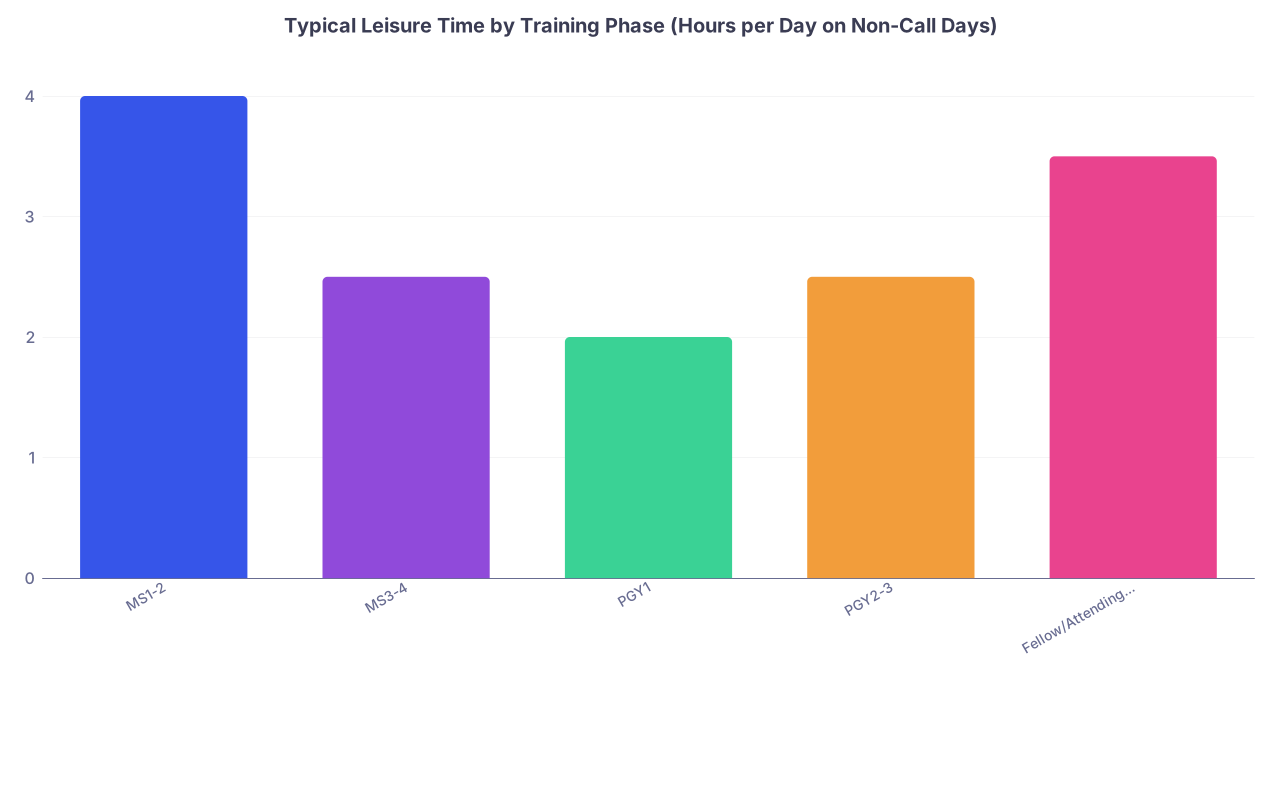
| Category | Value |
|---|---|
| MS1-2 | 4 |
| MS3-4 | 2.5 |
| PGY1 | 2 |
| PGY2-3 | 2.5 |
| Fellow/Attending Early | 3.5 |
- Preclinical med school: You can have large hobbies if you’re disciplined. Many people waste the opportunity.
- Clinical med school: More constrained; shelf exams demand more low‑yield time be cut.
- PGY‑1: Most brutal. This is where you need to be ruthless with time.
- Later residency/fellowship: You regain some control; hobbies can expand a bit.
- Attending: More variability — some have lives, some are still stuck in residency mindset and never rebuilt non-medical interests.
The key is that early you’re paying down a “professional debt” — building competence. That means sharper tradeoffs. Later, you can widen your life again.
The Social Comparison Trap: Ignore the Extremes
You’ll see two noisy groups around you:
The martyrs: “I don’t have time for anything but medicine.”
They love telling people they never watch TV. Half the time they’re still scrolling mindlessly in bed, just not calling it leisure. Don’t emulate them.The denial crew: “I’m just more chill, I don’t need to read that much.”
They’re the ones winging it on rounds and hoping charisma covers knowledge gaps. It doesn’t, long term.
You’re not obligated to match either extreme. You’re obligated to:
- Do right by patients
- Not dump extra work on your team
- Preserve enough of yourself to still be human five years from now
That’s it.
A Simple Rule You Can Actually Use
Here’s the cleanest rule I can give you:
If you can’t find 30–60 minutes on most days for focused medical learning outside of clinical work, but you can find more than 90 minutes for TV/games/hobbies, your balance is off.
Flip that ratio.
Doesn’t mean no fun. It just means your training phase gets priority when they collide.
What You Can Do Today
Don’t overhaul your entire life. Do one thing:
Tonight, look at tomorrow and decide in advance:
- How many minutes of non-medical leisure you’re going to have (pick a real number, like 60 or 90).
- One specific 30–60 minute block when you’ll do focused reading or prep.
Write both down.
Then tomorrow, set a timer when you start your show/game/book. When it’s done, you’re done. No “one more episode.”
You’ll know within a week if your current mix of reading, hobbies, and TV is helping you survive training — or slowly undermining it.


