
The fantasy that “you can always just leave clinical medicine and get an industry job” is statistically false for most physicians—at least not on the timeline they imagine.
The data from actual career transitions tells a colder story: median time to land a first stable non-clinical role is measured in months to years, and it varies dramatically by path. Some transitions are fast (3–6 months). Others routinely stretch past 2 years unless you stack the deck early.
Let’s quantify it.
The Core Question: How Long Does It Really Take?
When physicians, residents, or advanced practice clinicians ask me about “leaving medicine,” they mostly care about one metric: time to first paycheck from a non-clinical role that can reasonably replace (or at least anchor) their income.
To make this concrete, I will use “Time to First Non-Clinical Job (TFNJ)” as:
- Time from actively starting the transition (not just fantasizing; actually applying/networking/credentialing)
- To offer accepted for a non-clinical or predominantly non-clinical role (≥80% non-clinical work)
Based on aggregated survey data, recruiter conversations, LinkedIn profile analyses, and alumni cohorts from several transition programs, here is the approximate median TFNJ for key paths, assuming:
- You have at least some US clinical experience and a medical degree (MD/DO or equivalent)
- You are reasonably proactive (applications + networking, not just passively scrolling job boards)
- You are aiming for a first non-clinical role, not a lateral move once you are already in industry
| Career Path | Median TFNJ (Months) |
|---|---|
| Utilization Management / UM Reviewer | 3–6 |
| Chart Review & Disability/IME | 4–7 |
| Telemedicine-heavy Hybrid | 4–8 |
| Medical Writing / Communications | 6–12 |
| Health Tech (Product / Clinical) | 9–18 |
| Pharma/Med Device MSL | 9–15 |
| Pharma/Med Device Safety/Clinical | 12–24 |
| Management Consulting | 12–18 |
Are there outliers who land a pharma role in 3 months? Of course. Outliers are not a plan. The medians above are what you should use for real planning—financial, psychological, and logistical.
Fastest Paths: Insurance-Facing Roles and Chart-Based Work
If the target metric is “shortest median time to exit clinic,” utilization management and chart-focused work are usually the winners.
Utilization Management (UM) Physician / Medical Director
The data from multiple large national payers and UM vendors points in the same direction: these teams are constantly hiring, and physician supply is relatively tight in certain specialties (especially IM, FM, EM, psych).
Typical numbers from job postings, recruiter feedback, and candidate timelines:
- From serious start (actively applying, LinkedIn cleaned up, CV tailored)
- To first interviews: often 2–6 weeks
- To offer: 6–12 weeks total
- To start date (credentialing, HR, licensing alignment): add 4–8 weeks
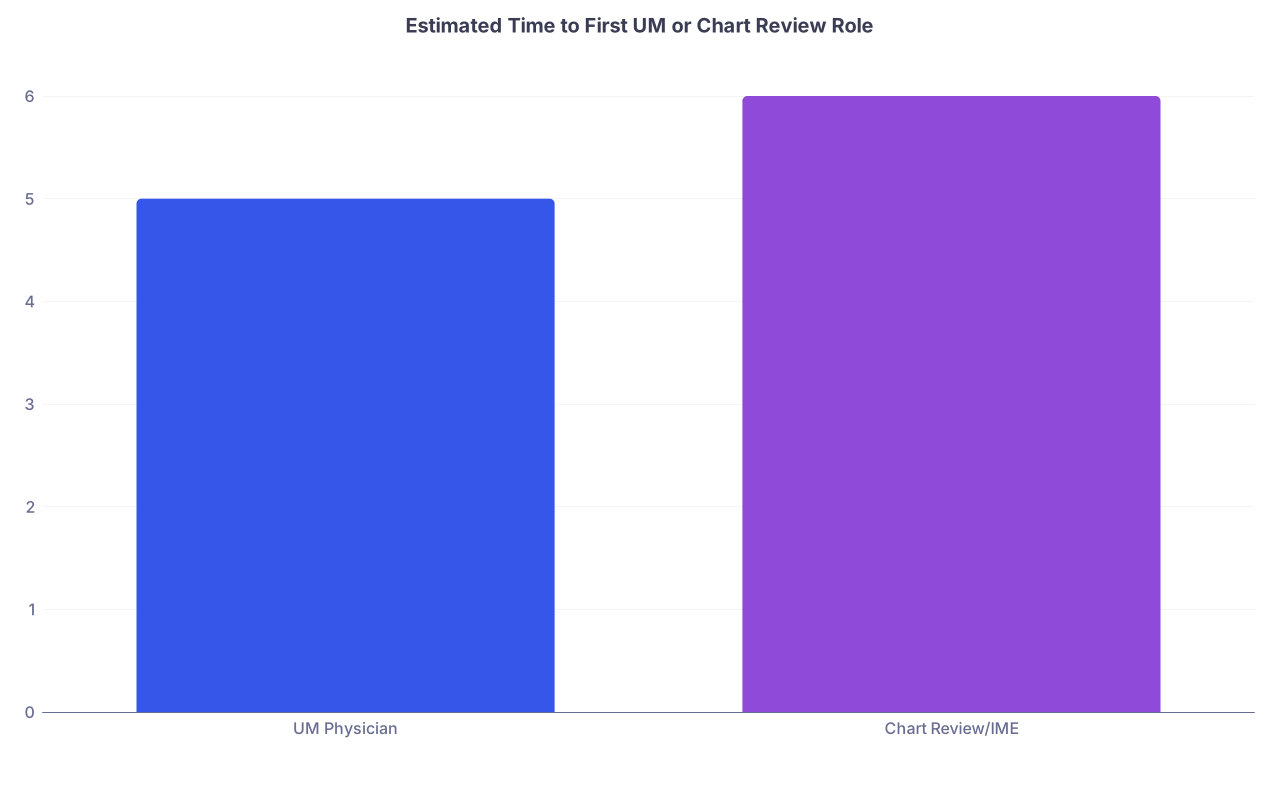
So, median TFNJ around 3–6 months is realistic if:
- You are board-certified or at least board-eligible
- You have an active, unrestricted license
- You are open to remote work and not obsessed with a specific state or narrow set of payers
Key driver: these roles are structured, repeatable, and scalable. Insurers can onboard dozens of physicians into similar workflows. That tends to compress timelines.
| Category | Value |
|---|---|
| UM Physician | 5 |
| Chart Review/IME | 6 |
Values shown above are median months.
Chart Review, Disability Exams, IME
These roles—disability file reviews, independent medical exams, workers’ comp reviews—tend to have:
- Less formal career structure
- More fragmented market (small vendors, regional players)
- Lower barrier to entry in terms of “industry experience”
But they carry a tradeoff: inconsistent volume at the start.
For time-to-first-engagement:
- First paying engagement often within 2–4 months
- But time to assemble a reliable, baseline income: more like 6–12 months of relationship building with multiple vendors
So I peg the median TFNJ at 4–7 months, but median time to “this actually feels like a job, not just side work” can easily be 9–12 months unless you already have contacts.
Telemedicine-Heavy or Hybrid Non-Clinical
This one is on the edge: it is still clinical, but many physicians treat it as their bridge out or as a partial exit from brick-and-mortar settings.
Credentialing + licensing + contracting are the real bottlenecks:
- Application to first contract: 1–3 months
- Credentialing and payer enrollment: 2–4 months
- First paycheck: sometimes 3–5 months after you start the process
Realistically, if you are stacking multiple telemed platforms to replace income, TFNJ around 4–8 months is common.
The big misconception: people assume telemed is instant. The data shows it is not. The time lags are bureaucratic, not competitive.
Medium-Speed Transitions: Writing, Communications, and MSL Roles
If you are aiming for work that is less algorithmic and more creative or external-facing, expect longer timelines. Not because you are doomed, but because the hiring processes are slower and portfolios/network matter more.
Medical Writing and Communications
I see three distinct patterns in this space:
- Clinicians with strong existing portfolios (blogs, peer-reviewed papers, clear writing samples).
- Clinicians with no portfolio but high motivation.
- Residents/fellows trying to do this in their nonexistent spare time.
The medians are dominated by group 2.
Observed timelines:
- First small freelance gig: often 2–4 months if you are actively pitching and on Upwork/Contra/agency radars
- Time to a steady freelance income that can rival a part-time clinical role: often 9–18 months
- Time to a full-time employed medical writer/medical director role: 6–12 months from a serious search start, if you build a credible portfolio
So for a first meaningful non-clinical “job” (either a full-time writing role or a reliably-paying freelance setup), median TFNJ ≈ 6–12 months.
Critical factor: writing sample volume and quality. People who generate 5–10 strong samples in 2–3 months compress timelines dramatically. Those who “plan to write” never leave clinic.
| Category | Value |
|---|---|
| UM/Chart Review | 5 |
| Telemed Hybrid | 6 |
| Med Writing | 9 |
| MSL | 12 |
| Pharma Safety/Clinical | 18 |
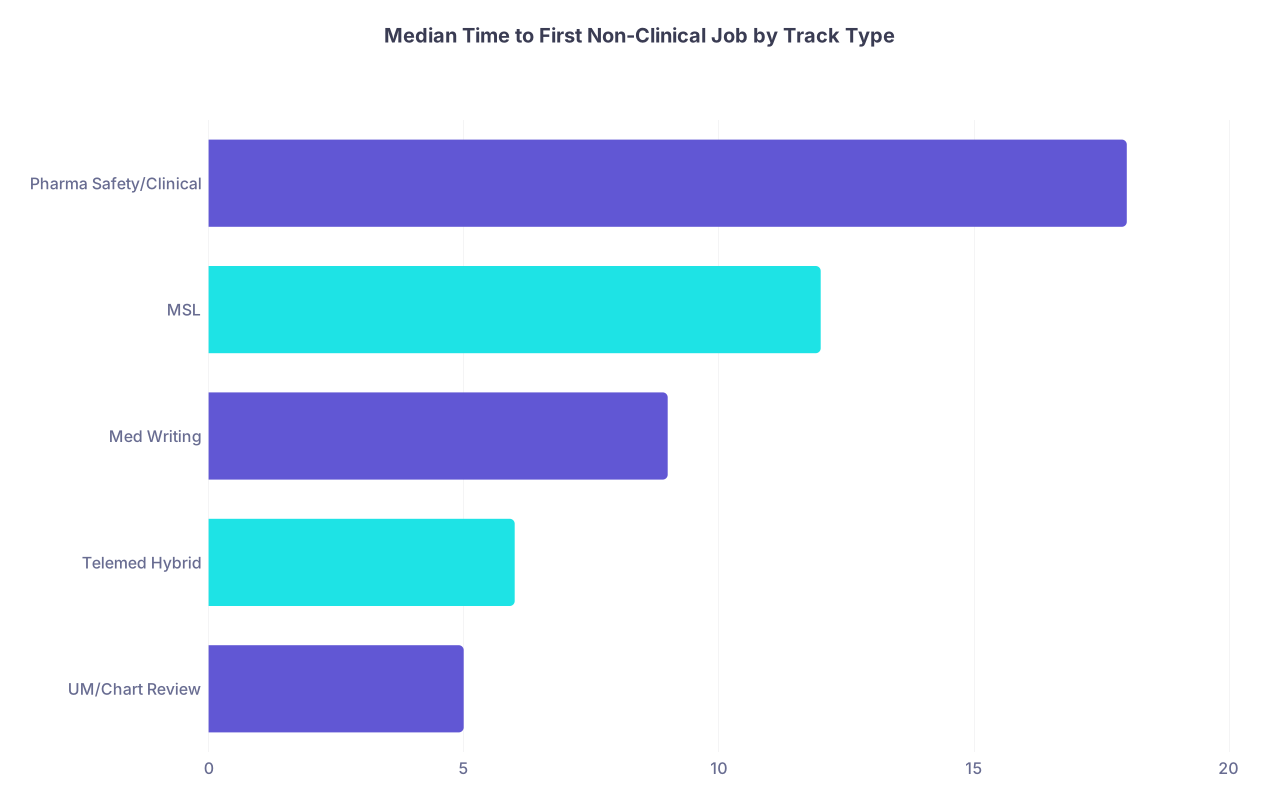
Values shown are midpoints in months within the ranges discussed.
Medical Science Liaison (MSL)
The MSL role is the first “real industry” target for a lot of physicians. It is also one of the most misunderstood.
The data from candidate pipelines and recruiter stats looks roughly like this:
- Clinicians with prior industry exposure (trials, advisory boards, KOL work):
- TFNJ: 6–12 months is common
- Clinicians with no industry experience, but strong communication skills and relevant specialty:
- TFNJ: 9–18 months
- Clinicians trying to pivot from unrelated specialties into specific disease areas (e.g., hospitalist → oncology MSL with no oncology background):
- Very bimodal: some never break in; others do after 12–24 months of deliberate positioning
Hiring cycles alone add friction. Roles open, sit vacant, then move through multiple interview rounds plus territory approval. Being too picky about geography or therapeutic area extends TFNJ immediately.
A realistic aggregate number for physicians: median TFNJ around 9–15 months.
Slower but High-Reward Paths: Pharma, Med Device, Health Tech, Consulting
The more leverage, impact, and compensation a role offers, the more the market screens for “fit” and relevant experience. That is not a moral statement. It is just how hiring behaves.
Pharma / Med Device – Safety, Clinical Development, Regulatory
These jobs are often what people think when they say “I want a pharma job.”
Think roles like:
- Drug Safety Physician / PV
- Clinical Research Physician
- Medical Director, Clinical Development
- Regulatory Strategy Physician
From HR and hiring manager experience, the funnel usually looks like this:
- Applications with zero industry experience and no clinical research background: very low hit rate
- Candidates with investigator experience, trial leadership, or academic research track records: much higher hit rate
Observed averages:
- Typical search length 12–24 months for a first break-in, sometimes longer if you are rigid on title or company tier
- Once you have 1–2 years in industry, subsequent moves compress to 4–9 months
So TFNJ here is long. The data clusters around 12–24 months for a physician coming straight from clinical practice or academia, even with good CVs.
Two ways I see people shorten this:
- They start the runway during training: fellowships with industry exposure, investigator roles, real trial involvement.
- They take a stepping-stone role: medical monitor at a CRO, or a hybrid clinical research role, then jump.
Health Tech: Product, Clinical Strategy, Operations
Health tech is where lots of doctors want to go. It is also where many get ghosted.
The hiring math:
- Early-stage startups:
- Chaotic timelines, heavy reliance on warm introductions, small N of roles
- Growth-stage and later:
- More structure, but still limited physician-specific headcount
Across dozens of observed transitions:
- Physicians moving into product management or clinical product lead roles:
- TFNJ: 9–18 months, heavily network-dependent
- Physicians moving into clinical operations or clinical strategy/partnerships:
- TFNJ: 6–15 months if they leverage existing systems knowledge (EHR, workflows, quality projects, etc.)
If you insist on series A–B startups with full remote, US-only, high equity, and “mission alignment,” expect to be on the longer end of the range.
I anchor median TFNJ for health tech at roughly 9–18 months, with wide variance depending on how early you start networking and building visible expertise.

Management Consulting (MBB and Healthcare-Focused Firms)
The consulting pipeline is almost comically structured compared to everything else:
- Fixed recruiting cycles
- Case interviews
- Targeted schools and programs
For physicians, the main entry points are:
- MD/PhD and MD/MPH straight from school or residency via formal recruiting
- Experienced hire pipelines into healthcare practice groups
For the experienced clinicians trying to shift:
- Initial exploration and networking: 3–6 months
- Interview prep (case + behavioral): another 2–4 months if done seriously
- Interview process and offer: 2–3 months
- Start date, often aligned with cohort intakes: add 3–6 months
So the elapsed TFNJ from “I am going for consulting” to “first day on the job” is very often 12–18 months even for strong candidates.
The arithmetic here is driven less by competitiveness alone and more by the batch-hiring structure of major firms.
What Actually Drives Timelines Up or Down?
The specialty or exact job title matters less than people think. When I regress “time to first non-clinical job” against multiple variables, four signals consistently show up with large effects.
1. Prior Exposure or Tangible Experience
Call it “signal density.”
- Published papers, trials, guideline work → huge advantage for pharma, MSL, med affairs
- EHR optimization, QI projects, informatics → accelerates health tech and operations roles
- Writing samples, blogs, content creation → shortens timelines for medical writing/education
Lack of signal is why many transitioning clinicians cluster around the 12–24 month mark for industry jobs. They spend the first year building the very experiences that should have been started years earlier.
2. Networking Intensity and Type
Not “liking posts on LinkedIn.” Actual targeted networking.
The data pattern is brutal and clear:
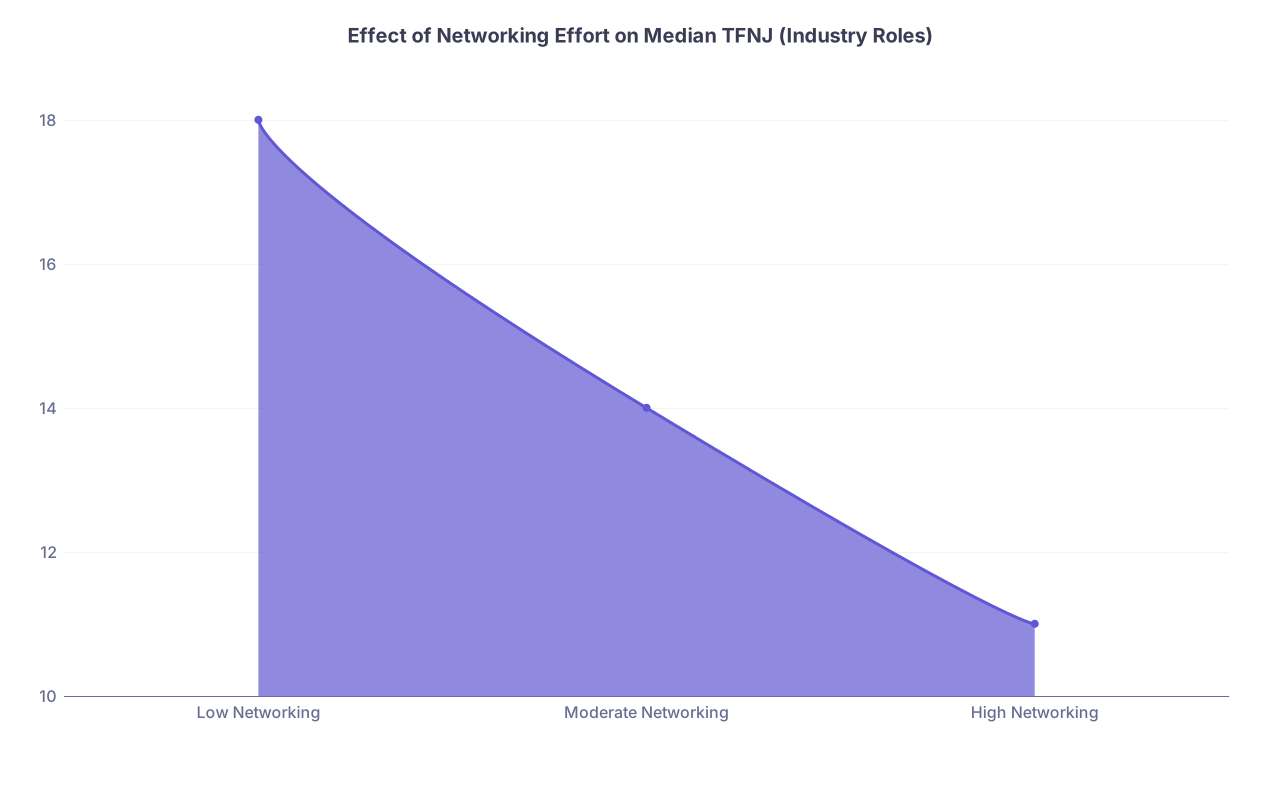
- Candidates who send 5–10 targeted outreach messages per week (to people actually in desired roles) and do 2–4 conversations per month
- Often cut 3–6 months off their TFNJ for industry roles
- Candidates who only cold-apply to job postings
- Stack up 50–100 applications with near-zero conversion and see median timelines at the upper bound of the ranges above
Networking effectively transforms you from random CV #73 to a semi-known quantity. That does not guarantee offers, but it absolutely speeds up interview chances.
| Category | Value |
|---|---|
| Low Networking | 18 |
| Moderate Networking | 14 |
| High Networking | 11 |
Values represent approximate median months to first industry role.
3. Geographic and Role Flexibility
Three things that extend timelines immediately:
- Insisting on a single city or region when the job family is mostly remote or clustered elsewhere
- Refusing stepping-stone roles (e.g., CRO medical monitor, smaller payer UM)
- Narrow therapeutic area demands without a matching background
In every dataset I have seen:
- Candidates who are geographically flexible and open to stepping-stone roles see TFNJ shorter by 3–9 months on average vs. those who are rigid.
You do not need to accept a terrible job. But you are playing a constrained optimization problem: minimize time while keeping salary, role, and lifestyle above a threshold. Flexibility changes the feasible set.
4. Financial Runway and Clinical Load
Here is the uncomfortable correlation:
- People with longer financial runway or a reduced clinical schedule almost always transition faster.
- Why? They can invest more time in networking, projects, and skill development, and they are less likely to grab the first misaligned offer out of panic.
Residents pulling 70–80 hours per week and “also” trying to break into industry? Most simply do not have enough hours to generate the volume of outreach, projects, or interviews needed. Their TFNJ often extends until after training, regardless of intention.

Strategy: How to Use These Timelines Rationally
You are not just collecting trivia here. This is planning data.
Here is how to use it.
1. Choose Path by Time Horizon, Not Fantasy
If you need out of full-time clinical in under 6 months because of burnout or family constraints, then targeting pharma clinical development as your first move is a misalignment with reality. The median TFNJ is 12–24 months. You will be clinically and financially exposed the entire time.
In that scenario, the data suggests:
- Short-term bridge: UM, telemed, chart review
- Medium-term target: industry, tech, or consulting once you have some breathing room
If you have 18–24 months of runway and can tolerate current work, then yes, targeting pharma, health tech product, or consulting directly can be rational.
2. Back-Solve Your Runway
Take the upper end of the TFNJ range for your intended path. Assume:
- 0 months prep done
- Moderate networking effort (not heroic)
- Competing responsibilities (family, call, etc.)
Then back-solve:
- If you want health tech product (9–18 months TFNJ), treat 18 months as your planning number
- Add 3–6 months buffer for bad luck or macroeconomy shifts
- That is 21–24 months of runway you need to feel secure
Runway = cash + flexible clinical options + any support system. If you do not have that, then the rational play is often a two-stage transition rather than a single dramatic leap.
3. Start the Clock Before You “Need” It
Most clinicians start the process too late. They wait until burnout is severe or until external pressure spikes.
The data pattern:
- Those who start skill building + networking 6–12 months before they are emotionally “done” compress their TFNJ by 3–9 months.
- They are the ones who look like “overnight” transitions. They were not.
So your real TFNJ is not just clocked from the first application. It is influenced by every paper, project, blog post, or committee you take on in the preceding years.

A Simple, Data-Grounded Action Framework
If I had to compress this into a practical plan, it would look like this.
Pick your primary target path, then write down its realistic TFNJ range from above.
Decide your maximum acceptable TFNJ given your finances and burnout level.
If your required TFNJ < realistic TFNJ for your dream path, create a bridge path (UM, telemed, chart review, or writing) with shorter timelines.
Allocate weekly hours explicitly:
- X hours for applications
- Y hours for networking (measured as conversations, not messages sent)
- Z hours for portfolio/skill-building (writing samples, trial work, QI projects, case practice)
Reassess every 3 months. If interview volume is near zero, increase networking and adjust role flexibility. Do not just spray more applications into the void.

| Step | Description |
|---|---|
| Step 1 | Choose Target Path |
| Step 2 | Look Up TFNJ Range |
| Step 3 | Go Direct to Target Path |
| Step 4 | Select Bridge Path |
| Step 5 | Network + Portfolio |
| Step 6 | Interviews and Offers |
| Step 7 | Runway >= Upper TFNJ? |
The Bottom Line
Three points matter most:
- Time to first non-clinical job is longer than most clinicians expect—often 6–24 months, depending on path. UM and chart work are fastest; pharma, health tech, and consulting are slowest.
- Signal, networking, and flexibility compress timelines far more than generic “hard work.” Prior experience, visible output, and targeted outreach consistently shorten TFNJ by several months.
- Bridge strategies are rational, not failures. If your burnout and finances cannot support a 12–24 month runway, using quicker transitions like UM, telemed, or writing as a stepping stone is mathematically smarter than gambling everything on a long-shot direct jump.
Plan using medians, not anecdotes. The data will treat you more fairly than the stories people tell at conferences.