
The fear that programs will think you’re hiding something isn’t paranoid. It’s exactly how your brain works when you’re applying for residency and one key evaluation is late.
You see that one missing medicine clerkship evaluation and your mind immediately goes: “They’ll think I failed. They’ll think I’m unprofessional. They’ll think I’m gaming the system. They’ll toss my application before even reading my personal statement.”
Let me say this bluntly: a late internal medicine clerkship evaluation is not the career-ending red flag you’re imagining. But how you handle it? That part actually matters.
Let’s unpack this like someone who’s been sitting in the call room refreshing ERAS at 2 a.m. wondering if their world is over.
What Programs Actually See When An Evaluation Is Late
Here’s the part your anxiety won’t let you believe: most program directors are not memorizing your school’s eval release dates or hunting for missing comments like detectives.
They usually see:
- Your transcript
- Your MSPE (Dean’s Letter)
- Your core clerkship grades
- Sometimes a narrative summary of your performance
What they don’t usually see is: “This medicine eval was completed 3 weeks later than all the others, therefore this student is probably a liar.”
The key question is: does the medicine grade show up on your transcript/MSPE on time, or is the entire thing “pending”?
To make it less abstract:
| Scenario | How It Usually Looks To Programs |
|---|---|
| Grade posted, comments delayed | Normal, barely noticed |
| Grade delayed, “In Progress” on transcript | Mild question, not fatal |
| Rotation finished very late in cycle | Not suspicious; timeline issue |
| Pattern of many late/missing grades | Bigger concern about professionalism |
Most of the time, they see the grade once your school posts it. The actual internal comment submission time? They’re not tracking that like you are.
What actually raises an eyebrow is when:
- Your medicine clerkship is listed as “In Progress” or “Pending” while everything else is done
- Or your MSPE is missing a medicine summary entirely
Even then, the first thought isn’t, “This student is hiding something.” It’s more like, “Their school is slow / scheduling is weird / timelines didn’t line up.”
But your brain, of course, fills in the worst-case scenario.
Common Worst-Case Thoughts (And What’s Actually Real)
Let’s drag your internal monologue into the light and go through the big three fears.
1. “They’ll assume I failed or did horribly and I’m hiding it.”
No. Programs don’t default to “you failed.” They default to “this school has its own weird administrative timeline.”
I’ve seen:
- Schools where medicine grades aren’t finalized until months after clerkships end
- Evaluations that get stuck with one attending who’s on vacation for three weeks
- Systems where a whole block is held up because the clerkship director won’t sign off till every single preceptor finishes
Programs know this because they see the same schools every year. They know School X always has late medicine evals and School Y always posts surgery grades in clumsy batches.
If you actually failed the clerkship, it almost never just “disappears.” It has to be remediated, and that remediation shows up somewhere: transcript, MSPE, or an explanation.
2. “They’ll think I’m strategically delaying a bad evaluation until after interview invites.”
Here’s the unromantic truth: programs don’t have time to track micro-timelines like that. They’re not comparing your end-of-block date to the timestamp on your evaluation.
What they do care about:
- Big delays that affect whether they know your grade at all
- Missing core clerkship information in your MSPE
They’re not thinking like: “Hm, this medicine eval came in on October 14, that must be a student trying to outrun a bad comment.” They’re thinking: “Do I see the medicine grade? Yes? Okay, moving on.”
3. “If I say nothing, they’ll assume the worst.”
This depends on the situation:
- If the grade is already in and it’s visible on transcript/MSPE = you usually don’t need some dramatic explanation.
- If the grade is not in and will be delayed past when apps open or MSPE is released = you might want a simple, calm explanation ready.
Not a novel. Not an apology tour. Just enough so that if they ask, you don’t look caught off guard or evasive.
When A Late Medicine Evaluation Actually Matters
There are moments when timing becomes a real issue. Not catastrophic, but not nothing.
Case 1: Your Medicine Core Ended Late In The Year
Say your medicine clerkship ran August–September, and ERAS opened in September. So your application goes in before the evaluation fully processes.
This is common. Not suspicious. Programs know some students have late cores based on lottery/scheduling.
Big question: does your MSPE end up including the medicine summary and grade?
If:
- Your medicine grade makes it into the official MSPE released on October 1 → you’re fine. That’s what they use.
- It doesn’t show up until after → some programs may see “In Progress” or have less narrative info to go on.
Does that hurt? Slightly. But not because they think you’re hiding it—because they have less data to compare you with other students.
Case 2: Your School Is Just Slow With Evaluations
You finish medicine in June. It’s September. Still no evaluation. You email. They say, “We’re working on it.” You want to throw your laptop.
Programs usually blame the school, not you. They know some places are chronically behind grading. But this can impact:
- How confident programs feel ranking you high if there’s no internal medicine performance data at all
- How much they must rely on Step scores, narrative from other rotations, or letters
Case 3: There Is A Real Underlying Problem
If:
- You had professionalism issues on the rotation
- You failed part of it
- You had complaints or needed remediation
Then yes, the content of the evaluation matters. But in that scenario, the issue isn’t that the evaluation is late. It’s what’s actually in it.
And again, that usually shows up in some structured way, not just as a ghost eval that vanishes into the ether.
What You Should Actually Do (Instead Of Spiraling)
Let me be specific, because vague “advocate for yourself” advice is useless when you’re freaking out.
Step 1: Know Exactly What’s Missing
Pull up:
- Your unofficial transcript
- Any clerkship grade portal your school uses
- The draft MSPE (if your school lets you preview it)
Figure out:
- Do you have a medicine grade posted?
- Is there a narrative written anywhere?
- What does the MSPE say (or not say) about medicine?
Be concrete. “I don’t see anything about medicine in my MSPE” is different from “The grade is there but the narrative is short.”
Step 2: Ask Your School The Boring Admin Questions
Email your clerkship coordinator or student affairs with something calm like:
“Hi [Name],
I completed my internal medicine clerkship on [date], but I don’t see the final evaluation/grade posted yet. I’m in the middle of working on my residency application and wanted to check if there is an estimated time when this will be finalized, and whether it will appear in my MSPE.
Thanks very much,
[Your Name]”
No drama. No accusations. You’re just asking for a timeline.
You want to know:
- Will this be in the MSPE?
- When will the grade be official?
- Is this delay normal for this clerkship?
Step 3: Decide If You Need To Mention It In ERAS
Most of the time, you do not need to write some long explanation in your application. That just draws attention to something they might not have even worried about.
You might consider a brief explanation if:
- Medicine will be “In Progress” on MSPE/transcript at the time of submission
- It’s unusually late compared to everything else
- You’re applying to highly competitive specialties where every data point matters
Even then, it should be one calm line in the “Additional Information” section, if at all. Something like:
“My internal medicine clerkship concluded later in the academic year due to scheduling; the final evaluation and grade will be added to my transcript/MSPE once processed by my school.”
That’s it. No self-flagellation. No “I’m so sorry about this terrible issue.” Just a straightforward explanation.
Step 4: Be Ready To Address It On Interviews (If Asked)
Most will never bring it up.
If they do, you don’t go into panic mode. You say:
“Yes, my internal medicine clerkship was later in the year, and my school processes those evaluations on a slightly delayed timeline. The grade was finalized as [Honors/High Pass/Pass], and I enjoyed the rotation a lot. I had strong feedback on [X, Y], which I’ve tried to carry into later rotations.”
Answer the question and then shift to what they really care about: how you performed and what you learned.
How Much Does A Medicine Clerkship Actually Matter For Match?
For most core specialties (internal med, FM, peds, etc.), your medicine clerkship is a big deal in the sense that:
- It’s a major part of your third-year narrative
- It often feeds into letters of recommendation
- It shows how you function on busy inpatient teams
But “big deal” doesn’t equal “one administrative delay will ruin everything.”
To put this in perspective:
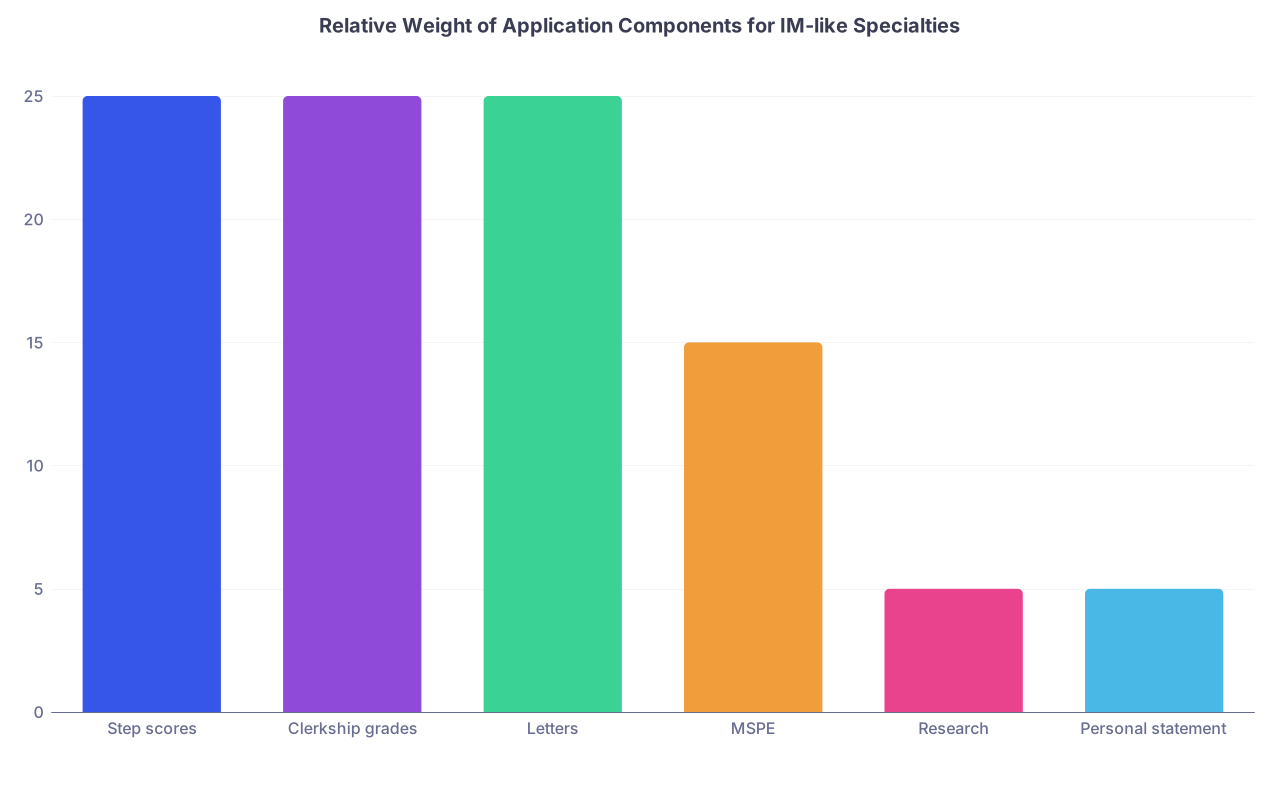
| Category | Value |
|---|---|
| Step scores | 25 |
| Clerkship grades | 25 |
| Letters | 25 |
| MSPE | 15 |
| Research | 5 |
| Personal statement | 5 |
Do they care about medicine performance? Yes. Do they need it on Day 1 of ERAS to ever consider you? No.
Programs make early decisions on:
- Step/COMLEX scores
- Overall pattern of clerkship grades
- MSPE summary
- School reputation/context
Medicine is part of that pattern, but not the sole pillar.
The “Hiding It” Fear Vs What Programs Actually Think
Your brain: “Single missing thing = I look dishonest.”
Program brain: “I have 1500 applications. I am looking for consistent patterns, big problems, or clear standouts. I do not have time to build conspiracy theories around one late eval.”
Where programs really get suspicious:
- You “forget” to report a failed course or exam
- There is a documented professionalism issue that isn’t mentioned anywhere and only shows up in a weird way
- Information in your application doesn’t match what’s in your MSPE or transcript
A delayed medicine evaluation, with your school confirming it’s an admin backlog or normal timeline? That’s not in the same category.
If there were real concerns, they’d usually show up as:
- A lower grade (Pass instead of Honors, etc.)
- Narrative comments hinting at reliability / teamwork issues
- Rarely, a professionalism notation in MSPE
Programs can work with that. They’ve seen it before. They don’t need to invent a scandal around a late document.
How To Keep It From Hurting You More Than It Has To
Here’s the honest, non-sugar-coated version of how this plays out.
If:
- Your medicine grade is eventually good/solid
- Your other clerkships are strong
- Your letters (especially from medicine or similar fields) are supportive
Then the effect of a slightly late evaluation is:
- Annoying to you
- Background noise to them
If your entire application is fragile (borderline scores, mixed grades, weak letters), then the late eval feels like the thing that will break everything. But it’s not. It’s just one more small uncertainty in a pile of them.
What helps more than anything:
- Getting a strong letter from a medicine attending who knows you well
- Doing well on sub-I / acting internship in a related field
- Having your school advocate for you if timing creates gaps
Those things speak louder than a timestamp on an evaluation form.
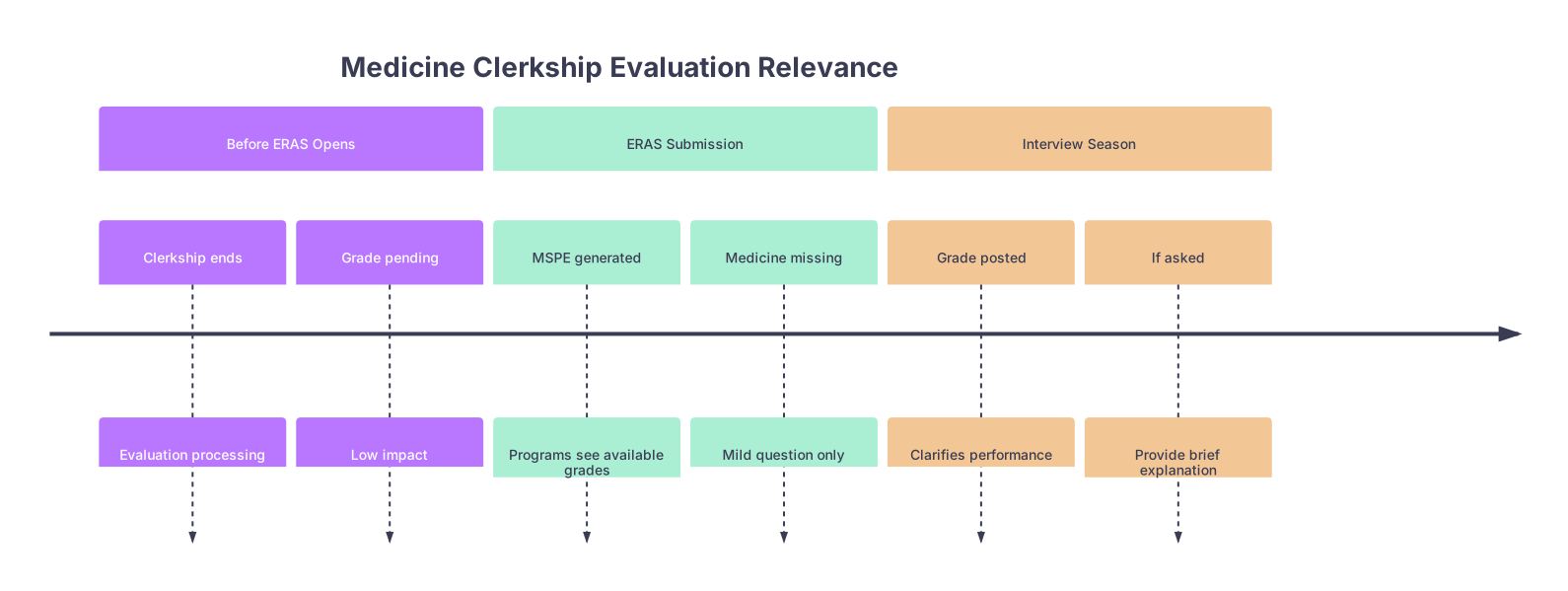
| Period | Event |
|---|---|
| Before ERAS Opens - Clerkship ends | Evaluation processing |
| Before ERAS Opens - Grade pending | Low impact |
| ERAS Submission - MSPE generated | Programs see available grades |
| ERAS Submission - Medicine missing | Mild question only |
| Interview Season - Grade posted | Clarifies performance |
| Interview Season - If asked | Provide brief explanation |
FAQ (Exactly The Stuff You’re Afraid To Ask Out Loud)
1. Will programs think I’m hiding a bad evaluation if my medicine clerkship isn’t in my MSPE?
They might notice it’s missing, but the default assumption is usually “timing/school issue,” not “this student is hiding something.” Especially if other clerkship info looks complete and there are no other red flags. If they care enough, they’ll ask. That’s your chance to calmly explain the timing and, if known, your eventual grade.
2. Should I delay submitting ERAS until my medicine evaluation is finalized?
Almost never. Submitting significantly later just to wait for one eval is more likely to hurt you, because interview spots start filling as soon as applications open. Get your application in early. Let the evaluation catch up. Programs are used to some information trickling in after submission.
3. My medicine grade is “Pass,” and it came in late. Does that scream “bad performance”?
No. It screams “average performance,” which a huge proportion of residents had in at least one core rotation. Programs don’t mentally pair “Pass + late” into a disaster story. They look at overall patterns. If everything else is good—or improving—they move on.
4. Do I need my internal medicine attending to write in their letter that the evaluation delay wasn’t my fault?
Not necessary and honestly kind of weird. It draws attention to something they probably didn’t care about. What you want from that letter is: concrete, specific examples of you functioning well on the team, thinking clinically, and acting like an intern. Not an administrative defense.
5. Can I ask my Dean’s office to mention the delay explanation in my MSPE?
You can ask, but don’t force it. A short neutral line like, “The internal medicine clerkship occurred later in the academic year; the evaluation was processed after the initial MSPE release,” is fine. But a long apology paragraph makes it sound more dramatic than it is. Keep it boring. Boring is good.
6. Honestly, how many programs will even notice this?
Far fewer than your anxiety tells you. The people who might notice are: super detail-oriented reviewers at competitive programs, or those who already have your file on the bubble and are looking closely. Even then, most will either ignore it, assume school timing, or ask you once in an interview. No one is building their rank list primarily around “one late eval from third year.” They care a lot more about how you seem now, as a near-intern.
Key points, stripped down:
- A late medicine clerkship evaluation is annoying, not fatal; programs usually blame timing/schools, not “you’re hiding something.”
- Make sure you know what’s actually missing, get a timeline from your school, and only give short, boring explanations if needed.
- Focus your energy on strong letters, solid performance on later rotations/sub-Is, and a complete, early ERAS submission—those matter far more than one delayed evaluation.