
The summer before MS4 is where students quietly win or lose the residency match. Not Step 2. Not the personal statement. The sub‑internship schedule.
If you want high‑yield sub‑Is that actually move the needle for interviews and letters, you cannot “see how things shake out.” By the time most of your class gets serious, the best slots are gone, the top services are full, and you are left auditioning in November when rank lists are basically written.
Let me walk you through exactly what you should be doing month‑by‑month, then week‑by‑week, from late MS3 through the summer before MS4 to lock in the sub‑Is that matter.
Big Picture: What You Must Lock In (and When)
Before we zoom in on the calendar, you need to know the non‑negotiables. For competitive specialties and programs, the real game happens between July and October of MS4. Your summer before MS4 is when you reserve those months.
You are trying to book:
Home institution sub‑I(s)
- On the service that feeds your target residency (e.g., cardiology‑heavy medicine team, trauma or ACS for surgery, L&D for OB).
- Often July–September slots are highest yield for letters and “known quantity” status.
Away sub‑internships / audition rotations
- At 1–3 realistic target programs where:
- Your metrics are in range.
- They historically take home‑grown or visiting students.
- Usually August–October are the prime audition months.
- At 1–3 realistic target programs where:
Buffer time for ERAS and Step 2
- 1–2 lighter blocks to:
- Finish Step 2 CK (if not already done).
- Write ERAS, personal statement, and letters packet.
- Interview later in fall/winter.
- 1–2 lighter blocks to:
Here is how the time pressure actually looks:
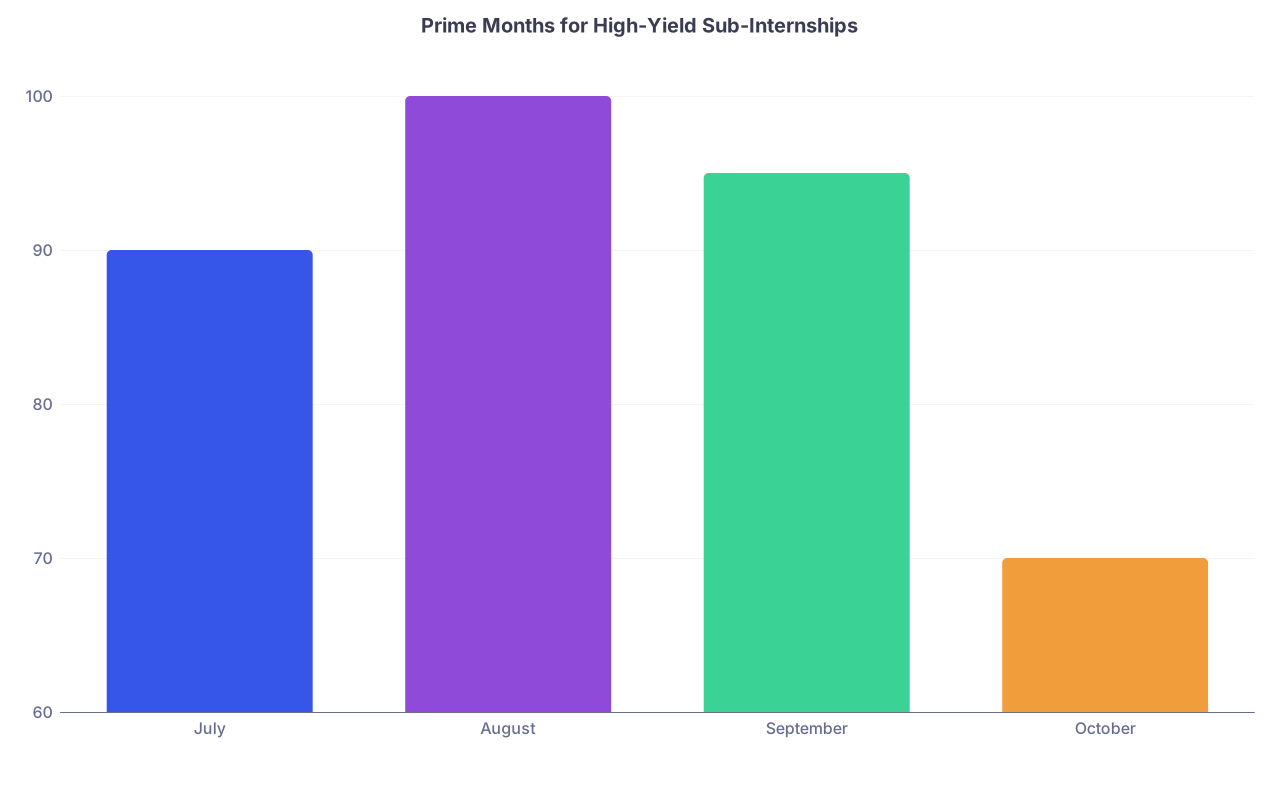
| Category | Value |
|---|---|
| July | 90 |
| August | 100 |
| September | 95 |
| October | 70 |
Those relative values are not exact percentages, but they capture the reality: August and September auditions matter more than some late November away at a place that has already decided its rank list core.
March–April of MS3: Quiet Planning Phase (You Are Already Behind if You Ignore This)
At this point you should not be “thinking broadly” about residency. You should be making a first‑pass map of your sub‑I needs.
Weeks 1–2: Define Your Specialty Path
By early spring of MS3, you should:
- Narrow to 1 primary specialty (maybe 1 backup).
- Get honest signal from faculty about competitiveness:
- Ask: “If I apply to [X specialty], what tier of programs is realistic for me?”
- Have your Step 1 pass, clerkship comments, and shelf scores ready.
At this point you should decide:
- How many medicine‑type vs surgical‑type vs specialty‑specific sub‑Is you need.
- Your tentative graduation date and whether you need to compress or extend MS4.
Weeks 3–4: Learn Your School’s Rules and Deadlines
Every school has annoying, idiosyncratic rules. Ignore them and you lose prime months.
At this point you should:
Check the MS4 curriculum/registrar pages for:
- Earliest date you can start MS4 rotations.
- Required MS4 rotations (sub‑I, ICU, EM, electives, etc.).
- Max number of away rotations allowed.
- Required “capstone,” boot camp, or OSCE blocks.
Talk to:
- One recent grad who matched in your specialty.
- One current MS4 from your school doing the path you want.
Ask them:
- “Which months do you regret not using for away rotations?”
- “Which services were actually high‑yield for letters?”
May of MS3: Sub‑I Blueprint and VSLO Prep
By May, the people who match well next year are already behaving differently. They have a draft sub‑I calendar. You should, too.
Week 1: Build a Draft 12‑Month Calendar
Take a blank July–June MS4 calendar and block it:
- Choose 2–3 audition months (usually Aug–Oct).
- Choose 1–2 home sub‑I months (July–September).
- Protect 1 light month for ERAS launch (September is common).
- Mark exams, required courses, and any personal events (weddings, etc.).
Example for an internal medicine applicant:
| Month | Block Focus |
|---|---|
| July | Home IM Sub‑I |
| August | Away IM #1 |
| September | Away IM #2 + ERAS |
| October | ICU at home |
| November | Elective (research) |
| December | Interviews |
You will move blocks around later. But you cannot book anything intelligently until you see the whole year on one page.
Week 2: Identify 8–12 Target Away Sites
At this point you should begin a focused list, not a fantasy list.
Criteria:
- Programs in your competitive range (based on Step scores, clerkship grades).
- Mix of:
- 2–4 reach / aspirational
- 4–6 realistic / target
- 2–3 safer programs where you would actually rank and attend
Sources:
- Residency Explorer.
- Program websites (check if they explicitly value away rotations).
- Your school’s match list (where your seniors actually matched).
Week 3: VSLO / Visiting Student Portal Setup
If your school uses VSLO (or another portal), the setup can lag and cost you an entire block.
At this point you should:
- Confirm VSLO (or equivalent) access date from your school.
- Upload:
- Immunization records.
- BLS/ACLS certifications.
- Mask fit test / TB test.
- OSHA and HIPAA modules.
- Background check / drug screen if required.
You want these done BEFORE your top programs open applications. I have seen students lose dream programs because titers were “pending” for weeks.
Week 4: Map Application Open/Deadline Dates
Now you build your program‑specific deadline sheet. Many sites open and close applications early.
Create a simple sheet with:
- Program name
- Application platform (VSLO or program‑specific)
- Earliest app date
- Latest app date
- Required documents (LORs, transcript, Step scores)
- Preferred months (they sometimes state this)
You can sketch it like this:
| Program | App Opens | App Deadline | Prime Months |
|---|---|---|---|
| Big City IM | May 15 | June 15 | Aug–Sep |
| Regional IM | May 1 | July 1 | Sep–Oct |
| University IM | April 30 | Rolling | Jul–Sep |
June of MS3: Aggressive Booking Month
June is where people either secure prime slots or accept leftovers. There is not much in between.
Week 1: Submit Early VSLO Applications
At this point you should be submitting applications to your highest‑priority away sites for your top two months.
- Rank your desired blocks:
- First choice: August
- Second: September
- Third: October
- Submit to enough programs that you realistically fill at least 1–2 away slots.
Do not play games with “I’ll just apply to my one dream institution first.” Programs fill. They do not cry about your feelings.
Week 2: Lock In Home Institution Sub‑Is
While you are staring at away calendars, your classmates are booking the prime home sub‑I months. Do not let them.
At this point you should:
- Meet with your clerkship or sub‑I coordinator.
- Request:
- 1 early home sub‑I on a strong service (July or August).
- Avoid overlapping with planned away months.
For high‑yield home sub‑Is:
- Internal medicine: pick teaching services where residents actually write detailed letters.
- Surgery: trauma, ACS, or a big general service where attendings know the PD.
- OB/GYN: busy L&D.
- EM: a core EM month at your top‑tier EM site, ideally right before SLOE deadlines.
Week 3: Start LOR Conversations for Sub‑I Focus
Letters matter more than you think. The sub‑I schedule is built backwards from who you want letters from.
At this point you should:
- Identify 2–3 potential letter writers at your home institution.
- Ask them:
- “If I do a sub‑I on your service in [month], would that give you enough time to know me and write a strong letter by September?”
Then align your home sub‑I month so their answer is “yes.” Doing a November sub‑I with your dream letter writer for an early‑match field (like some integrated programs) is classic self‑sabotage.
Week 4: Build Follow‑Up and Backup Plans
Not hearing back from away programs is normal. Doing nothing about it is what sinks people.
At this point you should:
- Track responses weekly from each program.
- Have a “Plan B” away list for:
- Less competitive but still respectable programs.
- Later months (October) if August/September do not work out.
July: Finalize and Fix — The Summer Before MS4 Begins
This is the last month where you can still meaningfully rearrange things before MS4 launches.
Week 1: Confirm All Booked Rotations in Writing
You should have:
- Email confirmations for:
- Home sub‑I dates.
- Away rotation dates and services.
- Documentation saved in a single folder (screenshots, PDFs).
If something is still “verbal” or “pending,” push it:
- Email coordinator: “Just confirming my sub‑internship on [service] from [dates]. Please let me know if any additional paperwork is needed.”
Week 2: Resolve Conflicts and Redundancies
At this point you might discover:
- Two away rotations accidentally overlapping.
- A required MS4 course scheduled in your planned audition month.
- An EM SLOE timing issue.
Fix it now:
- Swap blocks with classmates if allowed.
- Ask your dean’s office about rearranging non‑critical rotations to later in the year.
- Prioritize:
- Required rotations that must be done before graduation.
- Sub‑Is that drive letters and interviews.
- Electives can move to winter or spring.
Week 3: Calibrate Step 2 CK and ERAS Around Sub‑Is
Sub‑Is are exhausting. You do not want to be deep in UWorld while doing 12–14‑hour days trying to impress every attending.
At this point you should:
- Decide:
- Pre‑sub‑I Step 2 (ideal for many) OR
- Step 2 in a lighter block adjacent to auditions.
- Protect 2–3 weeks of lower‑acuity time around the test.
If you are taking Step 2 during summer:
- Avoid scheduling your main audition sub‑I in the same month.
- Use an easier elective or research block around the exam.
August–October MS4: Doing the Work on High‑Yield Sub‑Is
You used the summer before MS4 to book the rotations. Now you need to convert them into letters and interview offers. Briefly:
On Each High‑Yield Sub‑I, By Week
Week 1 of the rotation:
- Introduce yourself to:
- Senior residents.
- Key attendings (especially PD or APD).
- Say clearly (without being obnoxious):
- “I am applying to [specialty] this year and very interested in your program.”
Week 2:
- Ask a trusted senior resident:
- “How do students here stand out in a good way? What do the attendings care about most?”
- Fix any early feedback quickly.
Week 3:
- Ask your main attending:
- “I have really appreciated working with you. Would you feel comfortable writing a strong letter for my residency applications?”
- Confirm:
- Timing (they need your ERAS deadlines).
- Logistics (do they want your CV, draft personal statement, or clerkship summary).
Week 4:
- Cement relationships with residents and fellows.
- Make sure your performance is consistent through the very end; people remember the last week more than the third day.
Visualizing the Whole Lead‑Up: Late MS3 Through Early MS4
Here is how the overall planning timeline flows:
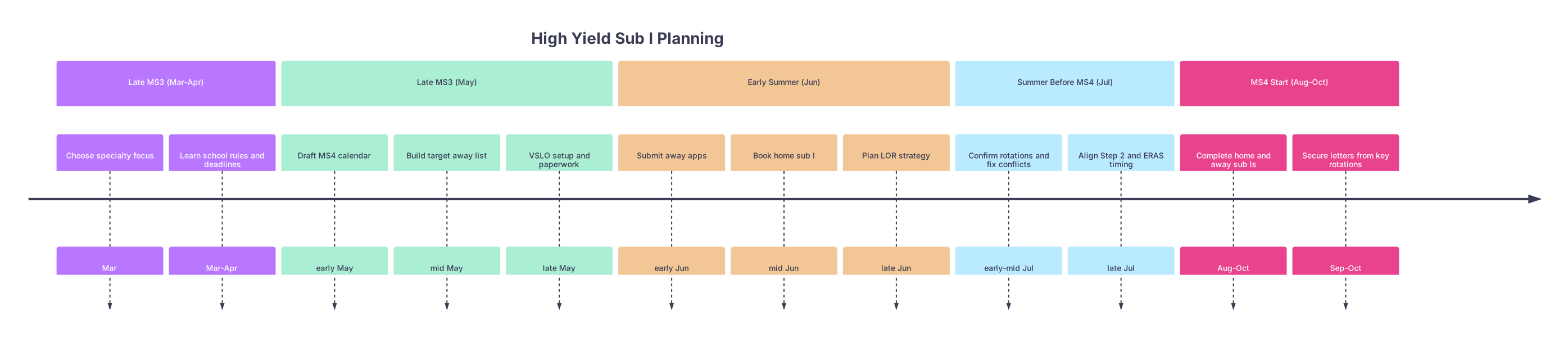
| Period | Event |
|---|---|
| Late MS3 (Mar-Apr) - Choose specialty focus | Mar |
| Late MS3 (Mar-Apr) - Learn school rules and deadlines | Mar-Apr |
| Late MS3 (May) - Draft MS4 calendar | early May |
| Late MS3 (May) - Build target away list | mid May |
| Late MS3 (May) - VSLO setup and paperwork | late May |
| Early Summer (Jun) - Submit away apps | early Jun |
| Early Summer (Jun) - Book home sub I | mid Jun |
| Early Summer (Jun) - Plan LOR strategy | late Jun |
| Summer Before MS4 (Jul) - Confirm rotations and fix conflicts | early-mid Jul |
| Summer Before MS4 (Jul) - Align Step 2 and ERAS timing | late Jul |
| MS4 Start (Aug-Oct) - Complete home and away sub Is | Aug-Oct |
| MS4 Start (Aug-Oct) - Secure letters from key rotations | Sep-Oct |
Quick Snapshot: Month‑by‑Month Checklist
Use this as a reality check against your current status.
| Time Period | At This Point You Should... |
|---|---|
| Mar–Apr (MS3) | Pick specialty, know school rules, talk to mentors |
| May (MS3) | Draft MS4 year, shortlist away sites, prep VSLO |
| June (MS3) | Submit away apps, book home sub‑Is, plan LORs |
| July (Before MS4) | Confirm dates, resolve conflicts, schedule Step 2 |
| Aug–Oct (MS4) | Crush home and away sub‑Is, secure letters |
Final Thoughts: What Actually Matters
Three points, and then you can go build the calendar.
- The calendar is strategy. If your audition months are late, scattered, or on weak services, your Step score and personal statement will not save you.
- Deadlines are not suggestions. Away spots and prime home sub‑Is are gone quickly. If you are not applying in May–June, you are competing for leftovers.
- Letters drive interviews. Book your most important sub‑Is early enough that faculty can write letters before ERAS deadlines, and choose services where attendings actually see your work.
Get those three right in the summer before MS4, and you walk into application season already ahead of half your class.