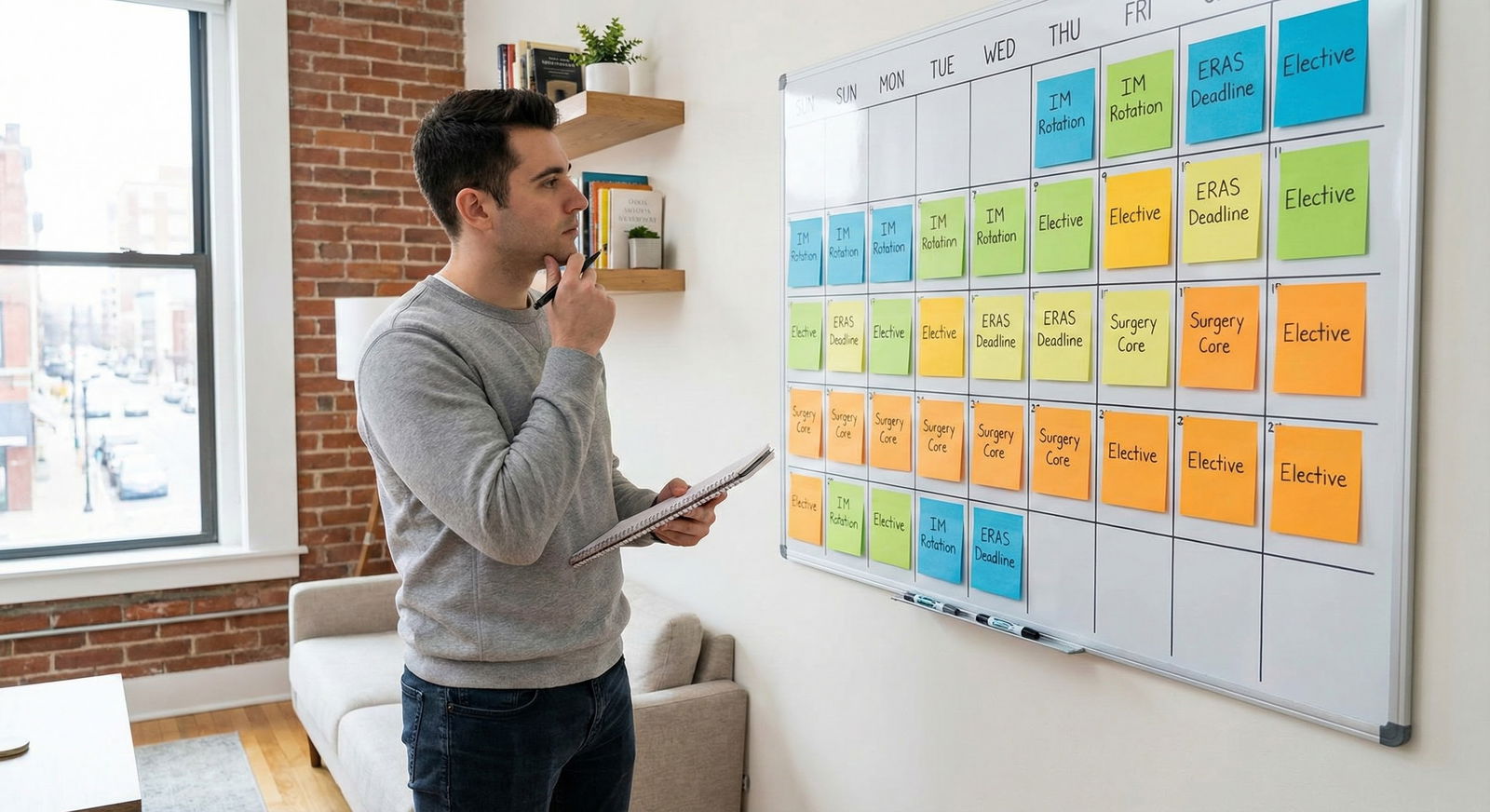
The last 90 days before ERAS submission are not “just more rotations.” They’re a live audition and a timed logistics puzzle. If you treat this stretch like any other block, you’re wasting the best leverage you have.
Here’s how to run those 90 days like someone who wants to match, not just graduate.
Big-Picture Timeline: Your 90-Day Runway
At this point you should be inside the 3‑month window before your ERAS opens for submission (usually mid‑September). I’m going to assume:
- You’re M4 (or equivalent) or a reapplicant doing audition rotations.
- You have at least one rotation in your chosen specialty in this 90‑day window, or you’re trying to line one up.
First, see the whole arc before we zoom into weeks and days.
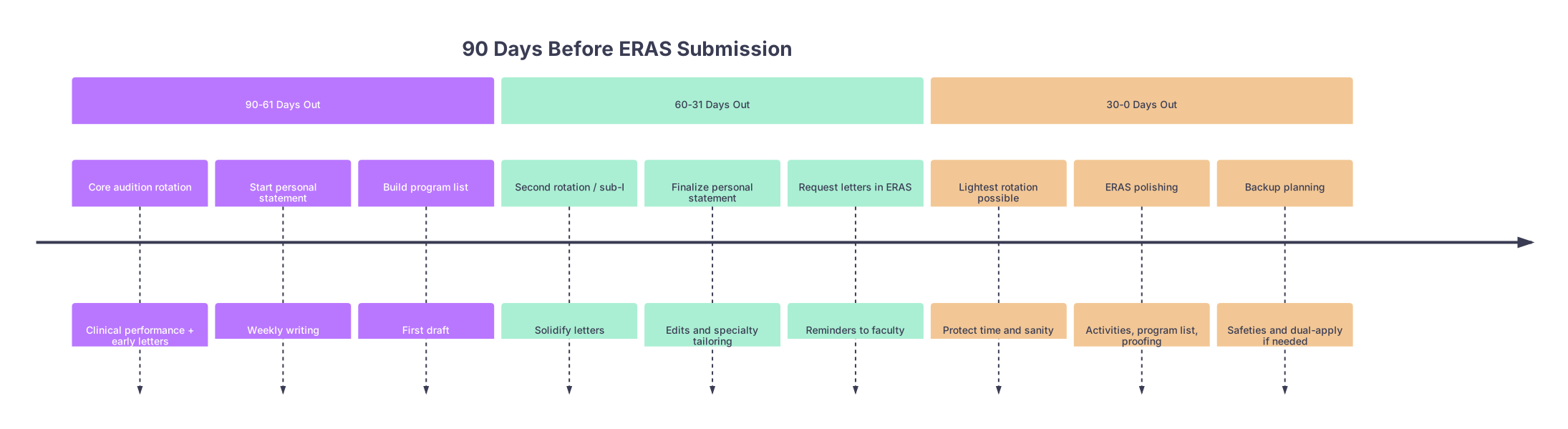
| Period | Event |
|---|---|
| 90-61 Days Out - Core audition rotation | Clinical performance + early letters |
| 90-61 Days Out - Start personal statement | Weekly writing |
| 90-61 Days Out - Build program list | First draft |
| 60-31 Days Out - Second rotation / sub-I | Solidify letters |
| 60-31 Days Out - Finalize personal statement | Edits and specialty tailoring |
| 60-31 Days Out - Request letters in ERAS | Reminders to faculty |
| 30-0 Days Out - Lightest rotation possible | Protect time and sanity |
| 30-0 Days Out - ERAS polishing | Activities, program list, proofing |
| 30-0 Days Out - Backup planning | Safeties and dual-apply if needed |
Now we break it down.
Days 90–61 Before ERAS: Performance + Positioning
At this point you should be on a rotation that matters. Ideally:
- A sub‑I / acting internship in your desired specialty
- Or a high‑yield medicine/surgery sub‑I if your specialty is competitive and expects it
- Or an away rotation at a realistic target program
The priority in this first 30‑day block: become a memorable, easy-to-recommend student while quietly building your application skeleton.
Clinical Priorities (On the Floor)
Your daily checklist on rotation:
Pre‑round like you’re the intern.
- Know every lab, imaging result, overnight event on your patients before your resident does.
- Walk in with a one‑liner and a plan, not just “vitals are stable.”
Have a clear 24‑hour plan for every patient. On prerounds, you should be able to say:
- “Today I want to: advance diet, transition from IV to PO meds, and push PT/OT to evaluate for discharge.”
- Residents remember students who think in “what’s next” language.
Speak up once, not constantly.
- One thoughtful question on rounds > ten obvious questions that derail workflow.
- Ask: “Can I present the next patient?” early in the block. Then deliver clean, structured presentations.
Own 2–4 patients deeply.
- Know their social situation, barriers to discharge, last three creatinines, consultant notes.
- When staff ask, “What’s the latest echo say?” you should answer without scrolling for two minutes.
Be visibly helpful between cases.
- Discharge summaries started.
- Notes prepped.
- Family updated (with permission).
- Find the pager, the consent form, the missing chart – not Instagram.
This is how you generate the phrases you need in letters: “functioned at an intern level,” “took primary ownership,” “consistently anticipated team needs.”
Strategic Priorities (After Hours – 4–6 hours/week)
Even on a brutal sub‑I you can carve out 30–45 minutes most days. Use them intentionally.
At this point you should:
Draft a rough personal statement. Week 1–2 of this 30‑day block:
- Get a full ugly draft down. No editing yet.
- Focus: why this specialty, 1–2 real clinical stories (not fake inspirational fluff), and what you bring to a residency team.
Build your ERAS experiences list (scratch version).
- Open a document and list every activity, job, leadership, research.
- Under each, draft 2–3 bullet points in ERAS-style language:
- Action verb + scope + impact.
- “Led weekly 12‑person case-based teaching sessions for M2 students, resulting in improved quiz scores (class average 82%→89%).”
Sketch a first-pass program list.
- Use your Step scores, class rank, home program strength, and specialty competitiveness.
- Sort into three columns: Stretch / Realistic / Safety.
| Tier | Example Program Type |
|---|---|
| Stretch | Big-name university IM |
| Realistic | Mid-tier university / strong community |
| Safety | Community-heavy, IMG-friendly |
- Identify your letter-writers on this rotation.
By the end of week 2:
- Target: 1 attending and maybe 1 senior resident (if your specialty allows it) who have seen you work closely.
- Start laying the groundwork: ask for feedback, request to present, volunteer for challenging tasks.
You’re building two parallel tracks: clinical reputation and application infrastructure. Do not let either lag.
Days 60–31 Before ERAS: Lock Letters + Solidify Narrative
At this point you should have:
- One anchor rotation in your specialty (or close to it) either completed or almost done.
- A working personal statement draft.
- A bloated list of programs you might apply to.
The second 30‑day block is about securing letters, tightening your story, and avoiding letter-writer slippage.
Clinical Priorities
You may be on:
- A second sub‑I (home or away) in your specialty
- A related specialty that still counts (e.g., ICU for EM, heme/onc for IM, trauma for surgery)
- A lighter elective that frees time for application work
Whatever it is, at this point you should:
Ask for letters before you disappear. Ideal timing: end of week 2 to mid‑week 3 of a 4‑week rotation.
Script (in person, not over email if at all possible):
- “Dr. X, I’ve really valued working with you. I’m applying to [specialty] this cycle. Do you feel you know my work well enough to write a strong letter of recommendation for my residency applications?”
If they hesitate, thank them and move on. A lukewarm letter costs interviews.
Give them a “letter packet” within 24 hours:
- Updated CV
- Draft personal statement (even if imperfect)
- ERAS experiences list (or at least a polished CV-style version)
- Short paragraph: “Here are the strengths I hope come through in my application…”
- Any required forms or ERAS letter request PDFs
Keep performing after asking for the letter.
- The last week of the rotation is often when they actually write it.
- This is not the time to “coast;” it’s when you over-prepare, show up early, stay late when needed.
Diversify letters if specialty demands it. Example:
- EM: 2–3 SLOEs from different programs.
- Surgery: 1–2 from surgeons, plus 1 from medicine sub‑I if you were stellar there.
- IM: at least one letter clearly stating “ready for residency” on a busy service.
Application Priorities
Now we get serious about paper (and electronic) application polish.
Weeks 60–45 Days Out
At this point you should:
Refine your personal statement.
- Do 1–2 serious edit passes.
- Cut generic “I have always wanted to help people.”
- Replace with 1–2 vivid, specific patient encounters or rotation snapshots that show why this specialty fits your brain and temperament.
- Get feedback from:
- One resident or fellow in your specialty
- One non‑medical reader for clarity and cliché detection
Tighten ERAS experiences.
- Prioritize “top 10” experiences that really define you.
- For each, make sure at least one bullet shows:
- Leadership or initiative
- Ownership/responsibility
- Impact (numbers, change, outcome)
Check your research story.
- If you have projects but no publications, line up:
- Updated abstracts/posters
- Clear explanation: “Retrospective chart review presented at [meeting], manuscript in preparation.”
- Make sure you actually know your own methods, results, and limitations cold. Interviewers will grill you on this if they’re bored.
- If you have projects but no publications, line up:
Weeks 44–31 Days Out
This is the follow‑up and enforcement period.
At this point you should:
- Track your letters like a project manager.
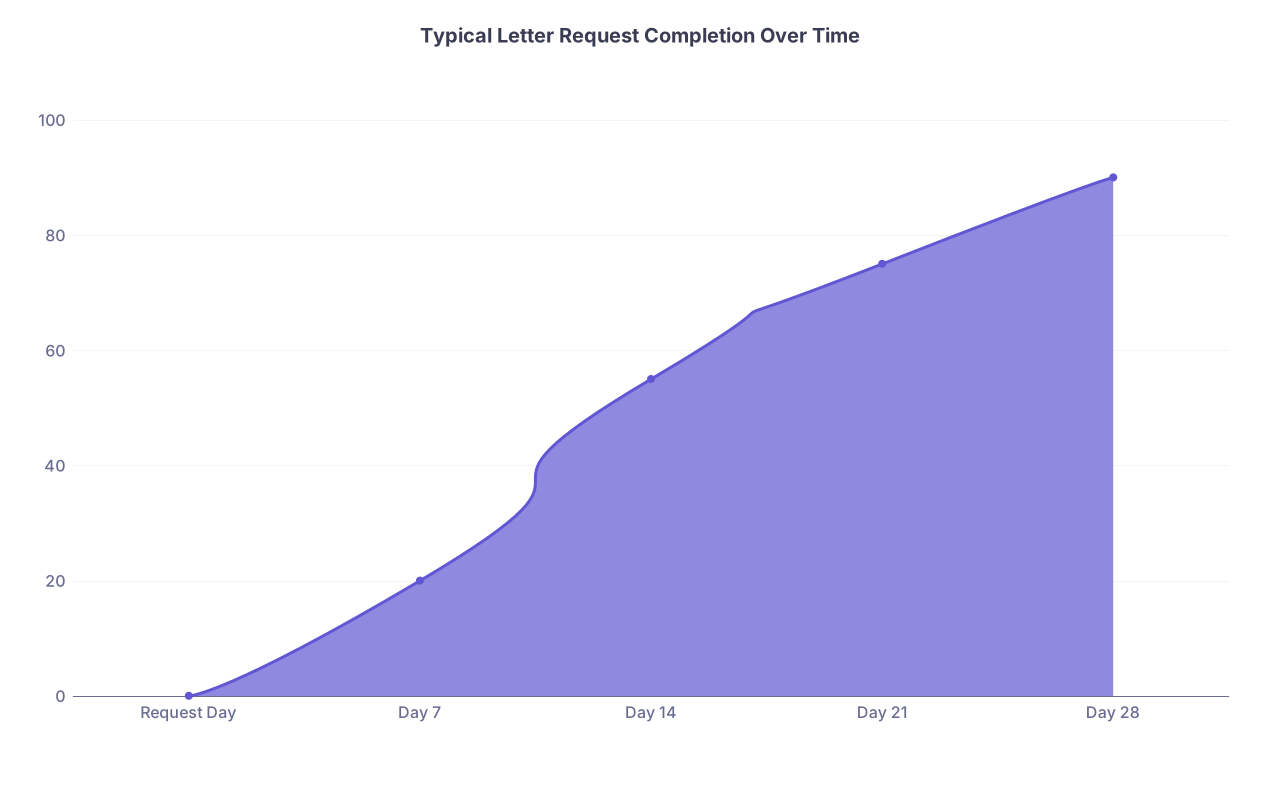
| Category | Value |
|---|---|
| Request Day | 0 |
| Day 7 | 20 |
| Day 14 | 55 |
| Day 21 | 75 |
| Day 28 | 90 |
That curve only happens if you:
- Send one polite reminder at 1 week if no ERAS upload yet.
- Another at 3 weeks if still nothing, asking whether they need more information.
- Have 1–2 backup letter-writers in mind if someone ghosts you.
Right-size your program list. Based on your metrics and specialty, calibrate:
- Overly competitive specialty (e.g., derm, plastics, ENT): probably 60–80+ programs.
- Moderately competitive: 40–60.
- Less competitive: 25–40, depending on geography restrictions.
Cut clearly unrealistic programs unless you have a real connection (research, geographic tie, home med school). Save the money.
Plan your September rotation strategically. That’s the 30‑day window leading into ERAS submission. You want:
- Lighter rotation: outpatient, consults, or elective with predictable hours.
- Or, if you still don’t have a strong letter in your specialty: one more high-yield audition, but accept that the letter may arrive later.
Days 30–0 Before ERAS: Protect Time, Polish, and Final Checks
This last block is where people either close strong or fall apart. At this point you should:
- Already have most letters requested (and many received).
- Have a nearly final personal statement.
- Have a mostly cleaned ERAS experiences section.
Now the focus shifts: avoid last-minute disasters while putting a shine on everything.
Clinical Priorities
Rotation choice here matters. If you can:
- Avoid brutal inpatient sub‑Is.
- Avoid night float.
- Avoid heavy call schedules.
You want enough breathing room to do 1–2 focused hours on ERAS several days a week without burning out or making clinical mistakes.
On rotation, your goals this month:
Stay competent and safe.
- This is not the month to chase “rock star” comments by risking burnout.
- Hit your responsibilities, avoid errors, show up, be kind, and go home when you can.
Collect any last-minute advocates.
- If you pleasantly surprise an attending, ask for a short “phone call” advocate, not a full letter.
- E.g., “If I end up applying to your program, would it be alright if I let them know you’d be willing to say a few words about my work here?”
- Some PDs will place serious weight on a trusted colleague’s 2‑minute phone endorsement.
- If you pleasantly surprise an attending, ask for a short “phone call” advocate, not a full letter.
Application Priorities – Week-by-Week
30–21 Days Before ERAS Submission
At this point you should:
Lock your personal statement.
- Final proofread (out loud).
- Check specialty wording (if you plan to use slightly different versions for different program types, label files clearly: “IM academic,” “IM community,” etc.).
- Freeze it. Stop tinkering unless there is a true red flag.
Finalize experiences.
- Verify dates, titles, contact names.
- Remove fluff; residents and PDs can smell it instantly.
- Make sure your three “most meaningful” (if your specialty cares) or top entries clearly align with the traits your specialty values: teamwork, reliability, technical curiosity, whatever fits.
Clean up any professionalism issues online.
- Quick scan of your social media for anything that could be screenshotted in a PD meeting. You know what I mean.
20–11 Days Before ERAS Submission
This is your quality-control window.
At this point you should:
Print your entire ERAS application as a PDF.
- Step scores correct?
- Clerkship grades entered correctly?
- No “lorem ipsum” placeholders left in descriptions? (I’ve seen it. More than once.)
Have 1–2 trusted people proof everything.
- One person in your specialty (for content): resident, chief, mentor.
- One non‑specialist (for clarity and typos): friend, partner, school advisor.
Confirm letters in ERAS.
- Do you have:
- The minimum number?
- At least one from your specialty?
- Any “big names” correctly assigned to the programs they matter most for?
- If anything is missing, this is the last realistic moment to send a “just checking in” email to a letter-writer.
- Do you have:
Calibrate your program list one last time.
- Based on:
- Any new grades or Step 2 scores.
- Feedback from advisors or residents.
- Lock the number. Stop playing “maybe I’ll add five more” every night.
- Based on:
10–0 Days Before ERAS Submission
Now you’re in the red zone.
Daily or near-daily micro-checklist:
10–7 days out:
- Final pass on:
- Demographics and contact information.
- Medical school name entered correctly (yes, this gets messed up).
- Honors, awards, AOA/Gold Humanism status.
- Final pass on:
7–4 days out:
- Double-check every program entry:
- Right specialty?
- Right track (prelim vs categorical vs advanced)?
- Any special instructions (supplemental applications, Altus/CASPer, etc.) noted?
- Double-check every program entry:
3–2 days out:
- Stop editing unless it’s a clear error.
- Sleep like a sane human. You’ll make better decisions if you’re not cross-eyed.
1 day before submission:
- Quick check of:
- Letters received.
- Personal statement attached to each program correctly.
- USMLE/COMLEX scores authorized for release.
- Quick check of:
On submission day:
- Sit down when you’re awake and calm, not after call or a 14‑hour shift.
- Re-open your ERAS, do a final single pass, then submit. No drama.
What NOT to Prioritize in These 90 Days
You also need to know what’s low-yield or outright harmful in this window.
In the final 90 days before ERAS, do NOT over-prioritize:
- Random new research projects that can’t possibly produce a poster or submission before applications.
- Extra away rotations at ultra‑reach programs where you’ll be invisible and exhausted.
- Constant personal statement rewrites that change your voice every week.
- Perfecting obscure procedural skills at the expense of basic reliability and teamwork.
Programs want:
- Clean, competent, safe junior residents.
- Reliable team players.
- People whose letters say, “I would absolutely take this student in my own program.”
Everything you do in these 90 days should point toward that.
Final Snapshot: If You Remember Nothing Else
By the time you hit ERAS submission, you want three things to be true:
On rotations, you behaved like an intern.
Owned patients, anticipated needs, and made yourself easy to recommend.Your letters and application tell one coherent story.
The same strengths show up in your attendings’ comments, your experiences section, and your personal statement.You protected time in the final 30 days to polish, not panic.
Light-enough rotation, no all‑night editing marathons, and a clean, error-free ERAS submitted on time.
Run the 90 days this way, and your rotations stop being “just requirements” and start being what they actually are: the strongest leverage you have in the residency match.