

It’s 1:37 a.m. Your laptop screen is the only light in the room.
You’ve got three tabs open:
- A UK NHS job board
- An Australian recruitment agency email
- A WhatsApp message from a friend who just matched in the US
You stare at the contracts. Visa details. Salary tables. Training pathways.
And your brain is just looping:
“What if I pick the wrong country and ruin my career?”
You picture yourself five years from now, stuck. Underpaid. Burned out. Watching everyone else on Instagram living your “Plan B” life in some other country you almost chose.
I know that mental spiral way too well. Let’s go straight at the stuff you’re actually scared of, not the polished brochure version people give on Reddit.
The Core Fear: What If I Lock Myself Into the Wrong Life?
Let me put words to the monster under the bed:
- “If I choose Country A and hate it, I’ll never get into Country B later.”
- “I’ll fall behind my classmates in training and never catch up.”
- “I’ll be trapped by visas, debt, exams, and my own ego.”
- “Everyone else will move forward while I restart… again.”
Underneath all of this is one brutal idea:
There’s one correct path and I only get one shot.
That’s the lie that’s tormenting you.
Reality is uglier and kinder at the same time: no country is perfect, no path is clean, and almost everyone has at least one moment of “Did I screw this up?” a few years in.
You just happen to be asking it before signing the contract instead of after.
How “Wrong” Can a Country Choice Actually Be?
Let’s be blunt: yes, there are choices that make your life harder. Some are recoverable. Some are expensive. A few are genuinely brutal.
But “wrong” isn’t binary. It’s more like:
- Annoying but fixable
- Costly and slow to fix
- This was a disaster, but still not career-ending
Here’s how it usually plays out when people feel they chose “wrong”:
| Regret Type | How Bad It Really Is |
|---|---|
| Training not recognized elsewhere | Often fixable with extra exams/years |
| Lower pay than expected | Negotiable or solvable by moving later |
| Burnout/work conditions | Common everywhere, not country-specific only |
| Visa/immigration stress | Painful but usually not permanent |
| Feeling stuck socially/family away | Hard, but not a professional death sentence |
1. “My training won’t transfer anywhere”
Worst fear: You do 5–7 years in one country and later realize you have to redo big chunks to move.
This does happen. Example:
- A doctor does residency-equivalent training in India or some Middle Eastern countries, then tries to move to the UK or Canada. They’re told they’ll lose years of seniority or have to redo big pieces.
- Or someone trains as a GP in the UK, then decides at 35 they want to move to the US and suddenly they’re back taking USMLE and reapplying like a fresh grad.
Is that painful? Yes.
Is it career-ending? No.
It usually means:
- 1–3 extra years of training or exams
- Some financial hit (lost seniority, lower salary for a while)
- A hit to your ego watching peers advance faster
But you’re not unemployable. You’re not banned.
2. “What if I pick a ‘poor’ country financially?”
Another spiral: “If I go to X (e.g., UK, New Zealand, some European countries), I’ll earn less than in the US or Australia and regret it forever.”
Let’s reduce the drama.
You can think of countries in rough clusters for pay vs life quality (oversimplified, but your brain needs something to hold onto):
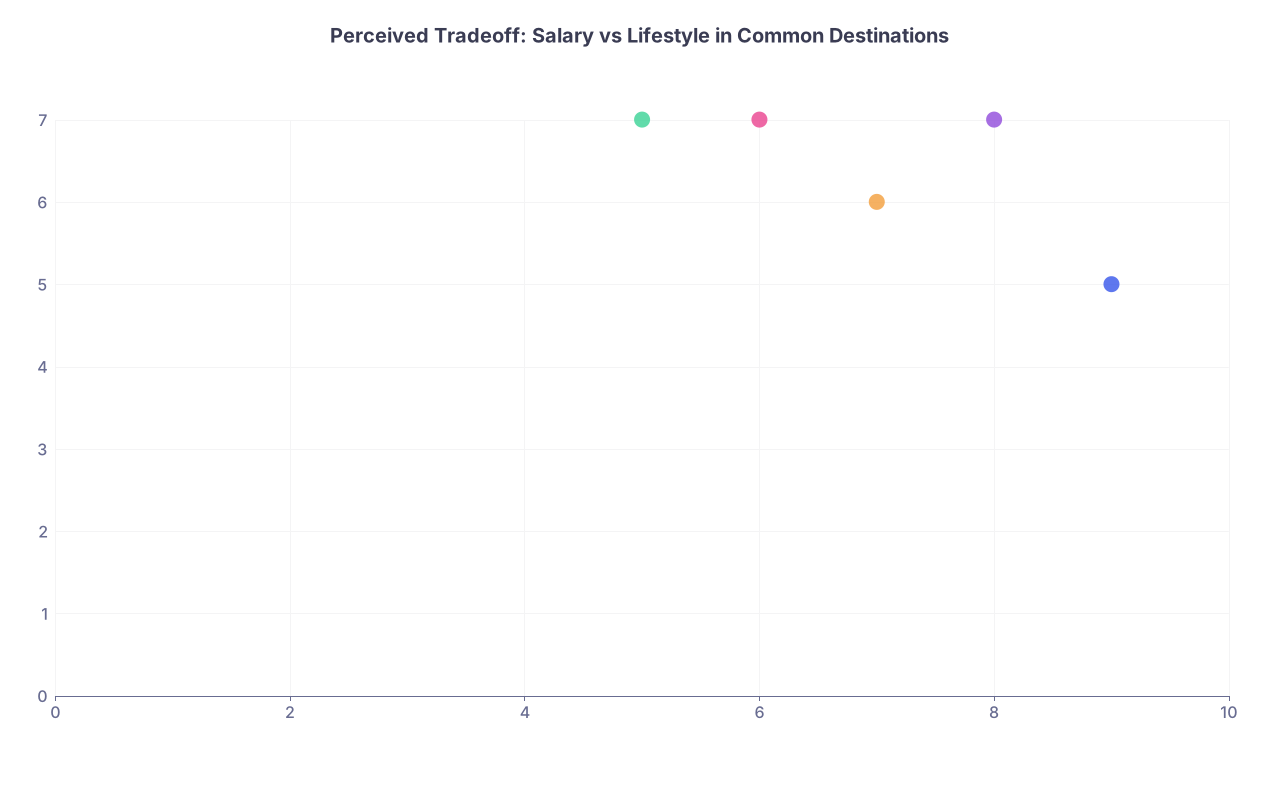
| Category | Value |
|---|---|
| US | 9,5 |
| Australia | 8,7 |
| UK | 5,7 |
| Canada | 7,6 |
| Germany | 6,7 |
Where x = money/earning potential, y = lifestyle/work-life balance (approximate, perception-based, not gospel).
Point is: no single country crushes it on all fronts.
You “pay” in different currencies:
- Money
- Time in training
- Stress
- Distance from family
- Bureaucracy/visa nonsense
You can’t win every category. You will trade something. That’s not failure. That’s adulthood.
3. “What if burnout is worse where I go?”
Here’s the actually depressing part: burnout is everywhere.
- UK: rota gaps, NHS pressure, constant underfunding talk
- US: RVUs, billing, malpractice anxiety, crazy debt
- Australia: good pay but rural pressure, isolation in some regions
- Canada: access issues, long waits, some provinces messy with billing caps
- Europe: language barriers, bureaucracy, pay caps
I’m not saying “everything sucks, so just choose randomly.”
I’m saying: don’t imagine there’s a magical country where all the systemic pain vanishes.
You’re not choosing between “burnout” and “no burnout.”
You’re choosing what kind of stress you can live with and what support you’ll have outside of work.
What Actually Is Hard to Reverse?
Let’s separate the stuff you can reasonably change later from the stuff that really locks you in for a while.
Harder-to-reverse choices
- Going very deep in a niche that doesn’t translate well
Example: hyper-niche fellowship that only exists in one system, then trying to move to a country that barely recognizes that niche.
- Starting in a country with zero or weak pathway back to your “dream” country
Example:
You know you want the US eventually, but you:
- Skip USMLE
- Go into a non-ACGME recognized training path abroad
- Build a CV that doesn’t line up with what US programs expect
Does it completely block you? No. But you’re intentionally taking the more uphill road.
- Immigration status decisions
Getting permanent residency or citizenship in one place can make you mentally and practically anchored. Not because you literally can’t move. But because:
- You’ve invested tons of time and money
- Partner/kids/jobs get tied there
- You’re less willing to reset somewhere else
Again: not irreversible. But heavier to undo.
You’re Overestimating How “Final” This First Move Is
Let me give you something concrete: most doctors I’ve seen with “country regret” did some version of this:
- Spent 2–5 years in Country A
- Realized specific things they couldn’t tolerate (money, training structure, distance from family, language barrier)
- Took 1–3 years to pivot to Country B
- Lost some seniority, some money, some ego
- Ended up mostly ok by their late 30s / early 40s
Is it ideal? No.
Is it a “wasted decade”? Also no.
That decade bought them:
- Clinical experience
- Financial stability compared to being a perpetual student
- Clarity about what they actually value instead of what they thought they valued at 24
You will waste some time somewhere. You just want to waste it on something you can live with.
How to Reduce the Odds of Real Regret (Without Needing Psychic Powers)
Since you can’t guarantee “right,” focus on avoiding obviously-bad-for-you fits.
Step 1: Get brutally honest about your non-negotiables
Not “what sounds good on paper.” What you actually care about daily.
Ask yourself:
- Do I care more about money or about predictability/time off?
- How important is being near family in the next 5–10 years, not just “someday”?
- Can I really tolerate living where I don’t speak the native language fluently?
- How much do exams drain me? Am I ready for USMLE/PLAB/MCCQE/AMC etc. or do I want fewer hoops?
Write these down. Not in your head—physically.
Then map them against each country. Not perfectly, just honestly.
| Priority | Better Fit Examples | Potentially Worse Fit Examples |
|---|---|---|
| Max income | US, Australia | Some EU countries, UK early years |
| Shorter training | Some EU countries, UK GP | US subspecialties |
| Near family (Asia/Middle East) | Gulf, Singapore | Remote rural posts far away |
| Minimal exams | Staying home, some local pathways | US, multiple-country hopping |
This isn’t “right answer vs wrong answer.” It’s “where am I least likely to hate my life at 3 a.m. on call?”
Step 2: Talk to specific people, not Reddit abstractions
You need:
- Someone 2–5 years ahead of you in each country you’re seriously considering
- Preferably from your background (IMG vs AMG, visa-dependent vs citizen, etc.)
Ask them:
- “What’s one thing you wish you’d known before committing here?”
- “If you had to leave this country tomorrow and start over elsewhere, what would be hardest to replace?”
- “On your worst weeks, what makes you think ‘I should’ve gone somewhere else’?”
This will cut through the sugar-coating.
Step 3: Keep one door slightly open
If your dream country is X but you’re going to Y first, don’t slam X shut out of exhaustion.
Examples:
- If US is dream but you start in UK: maybe still take USMLE Step 1 and 2 within a realistic window, or at least keep the option technically possible.
- If you think you might go to Australia later: be aware of their recognition list and training equivalence before you pick a super-obscure training route elsewhere.
You don’t need to chase 4 continents at once. Just don’t make it mathematically impossible to pivot later.
The FOMO Problem: You Only Hear the Highlight Reels
Your friend who moved to Australia:
- Sends beach photos.
- Talks about “amazing pay” and “great work-life balance.”
- Doesn’t post about the night shifts, the isolation away from family, or the 18-month wait for certain visas.
Your colleague in the US:
- Posts about a new car.
- Flexes salary screenshots.
- Doesn’t post about prior-authorization hell, RVU quotas, or the constant fear of malpractice suits.
You’re comparing your complete reality to their edited highlight reel.
That’s why every choice feels wrong: whichever country you don’t choose will exist in your head as the fantasy version only.
You’ll never meet the real alternative—the version where:
- Your visa got delayed
- You hated the city you thought you’d love
- Your spouse couldn’t find a job
- You landed on a toxic team
You’re afraid of missing out on an imaginary life that never actually existed.
A More Honest Way to Think About It
Here’s how I’d reframe it if I were sitting next to you right now:
You’re not choosing “perfect vs disaster.”
You’re choosing which set of problems you’d rather deal with first.You will regret parts of any decision.
That doesn’t mean it was wrong. Regret is baked into adulthood.You can probably switch countries once or even twice.
It’ll cost time, money, and pride. But it’s usually doable.The real “wrong” country is the one that clashes with your core values:
- If you’re deeply family-oriented, a super-remote posting far from them will hurt.
- If you’re hyper-driven for academic prestige, a small rural system may suffocate you.
- If you hate grinding exams, countries with exam-heavy entry points will chew you up.
The job is not to find the mythical perfect country.
It’s to pick a place where you can grow, save some money, not lose your mind, and keep a few doors open.
A Simple Sanity Check Before You Decide
If you’re on the verge of signing something and your chest gets tight, run this quick check:

| Step | Description |
|---|---|
| Step 1 | Considering Country |
| Step 2 | Reconsider options |
| Step 3 | Accept but know tradeoffs |
| Step 4 | Probably safe enough to try |
| Step 5 | Fits top 3 life priorities? |
| Step 6 | Any hard deal breakers? |
| Step 7 | Keeps at least 1 other door open? |
If you can honestly say:
- It matches your top 2–3 priorities reasonably well
- There are no glaring deal-breakers you’re ignoring
- You’re not permanently sealing every other path
…then it’s not a “wrong” country. It’s a good-enough first move.
And that’s usually the best any of us get.
Final Thoughts (Before You Spiral Again at 2 a.m.)
Let me be really clear.
You will second-guess yourself no matter what you choose. The FOMO doesn’t vanish with a visa stamp. It just shifts shape.
So:
- There is no single “right” country that guarantees happiness.
- Your first choice of country is important, but usually not permanent.
- A “wrong” choice is more often “a rough phase you learn from” than “career apocalypse.”
If you can treat this as your first chapter, not your one and only shot, the fear loosens its grip a bit. Not completely. But enough that you can sign something, move forward, and allow future-you some power to course-correct.
You’re not choosing your forever-life.
You’re choosing your next 3–7 years.
That’s big. But it’s survivable. And fixable.


