
23% of SOAP-eligible applicants who go unmatched never fix the single biggest problem in their SOAP materials: they are too long and too generic to be read in a 30‑second skim.
You do not have time. Programs do not have time. SOAP is a speed round, not a literature contest. So your SOAP portfolio—personal statement (PS), CV, and emails—must be:
- Brief enough to be skimmed in under 30 seconds
- Specific enough to differentiate you from 50 similar unmatched applicants
- Structured enough that a tired APD can find what they care about instantly
Let me break this down specifically.
The SOAP Reality: How Your Documents Are Actually Read
During SOAP, most program coordinators and APDs are doing some version of this:
- Filtering hundreds of ERAS files for a few simple criteria (citizenship, exam status, YOG, red flags)
- Opening documents in tiny ERAS windows while on call, in clinic, or between cases
- Making 10–20 second decisions: “Call / Maybe / No”
They are not:
- Reading your 1‑page narrative line by line
- Studying your full 6‑page CV
- Analyzing your email like an English professor
So your goal is not “tell my story fully.” Your goal is “signal value and reduce risk instantly.”
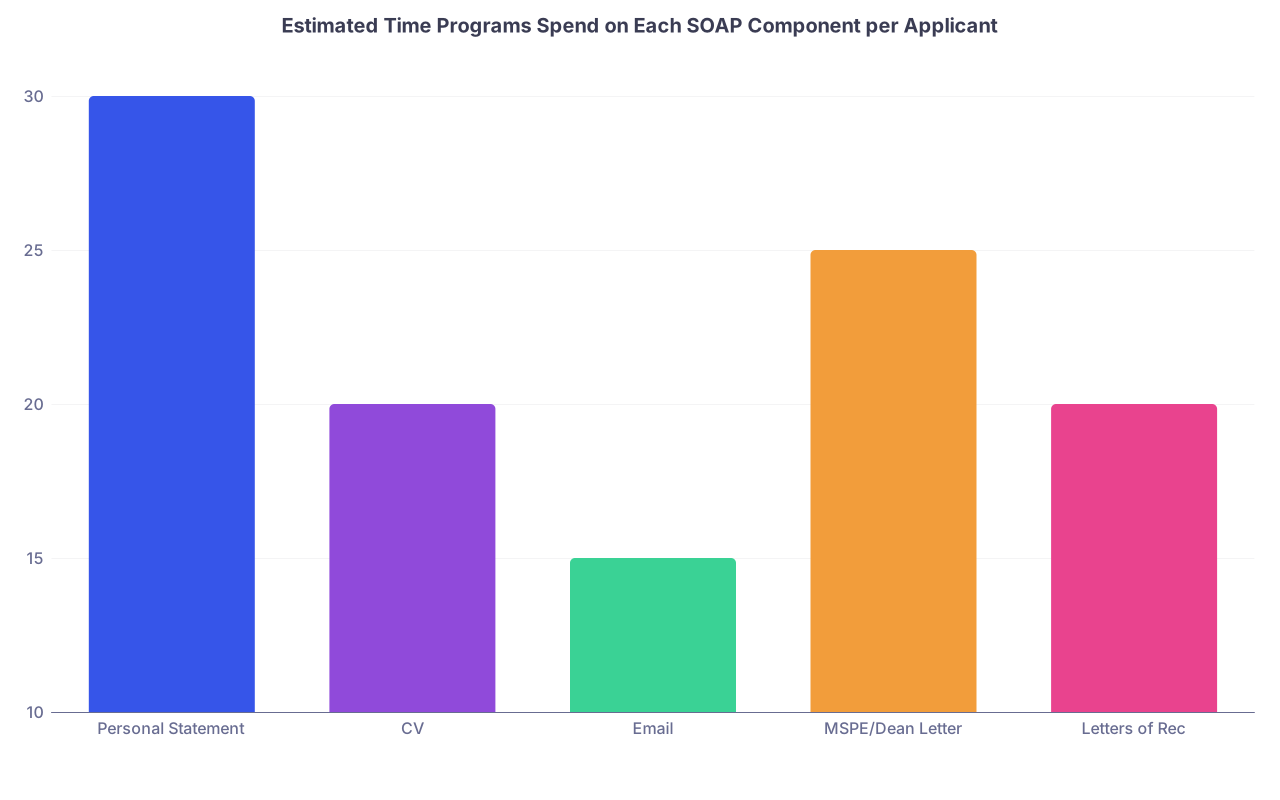
| Category | Value |
|---|---|
| Personal Statement | 30 |
| CV | 20 |
| 15 | |
| MSPE/Dean Letter | 25 |
| Letters of Rec | 20 |
That is why “brief but powerful” is not a style preference; it is a survival strategy.
Core Strategy: One Clear Angle, Repeated Three Ways
If there is one mistake I see repeatedly, it is this: applicants present three different versions of themselves across PS, CV, and emails.
- PS: “I love underserved care and global health.”
- CV: Heavy on research and publications.
- Email: “I will do anything for your program, any specialty, anywhere.”
That reads scattered. Or worse—desperate.
You need one dominant professional angle, tailored to the specialty, that comes through in all three components:
- Who you are clinically (e.g., strong inpatient worker, great with procedures, solid team player)
- How you fit the specialty (specific exposure, track record, or pivot explanation)
- Why you are safe to rank (no loose ends around exams, professionalism, or gaps)
Think of it this way:
- Personal Statement = 1‑paragraph narrative + 1‑paragraph reassurance
- CV = the receipts that back up that narrative
- Emails = a fast, respectful “highlight reel + fit statement”
If those three sing the same tune, your file feels coherent and low‑risk.
Building a SOAP‑Focused Personal Statement (400–500 Words Max)
For SOAP, you are not writing a full-bloom “why medicine” essay. Anything beyond ~500 words is usually a liability. Many PDs skim only the first half anyway.
The SOAP PS has one job: make you look like a competent, realistic, low‑maintenance resident who fits this specialty.
Structure That Works in SOAP
Aim for 4 short paragraphs, 3–5 sentences each:
- Hook + current status
- Clinical evidence + skills
- Address red flags / career pivot (if any)
- Fit + clear, grounded goals
Paragraph 1: Hook + Where You Are Now
Open with the present, not your childhood.
Example (Internal Medicine SOAP):
I am a 2024 graduate of Ross University who completed all core and elective rotations in the United States, with the strongest evaluations on my inpatient internal medicine rotations. After going unmatched in the main Match, I am seeking a categorical internal medicine position where I can contribute immediately as a reliable, hardworking intern focused on high‑quality patient care.
Why this works:
- One sentence gives YOG, school, and setting.
- You acknowledge the unmatched status without drama.
- You explicitly state the role you want: categorical IM, not vague “residency opportunity.”
Paragraph 2: Show You Can Actually Do the Work
This is where many SOAP PSs fail. They talk values, not evidence.
You need 2–3 concrete signals:
- Rotation types and settings
- Specific feedback or roles you held
- Measurable or clearly observable behaviors
Example:
Across three internal medicine clerkships and two subinternships, I consistently received comments on my work ethic, ability to synthesize complex histories, and reliability with follow‑through. On my subinternship at [Hospital Name], the team entrusted me with pre‑rounding on up to nine patients, presenting independently, and drafting initial assessment and plan notes for attending review. I am comfortable managing common inpatient conditions such as decompensated heart failure, COPD exacerbations, and diabetic emergencies under supervision, and I take pride in clear, concise communication with nurses and consultants.
This paragraph tells a rushed reader:
- You have repeated IM exposure.
- Teams trusted you with more responsibility.
- You have a clue how inpatient medicine actually functions.
Paragraph 3: Red Flags or Pivot—State It Once, Calmly
SOAP evaluators are looking for problems. Do the work for them. Name it, fix it, move on.
Common issues:
- Failed Step 1 or 2
- Gap year(s)
- Specialty switch (e.g., from surgery to FM)
Bad way: emotional, defensive, long explanation.
Good way: short, accountable, problem solved.
Example (Step failure):
I did experience a setback with an initial failure on Step 1, which resulted from poor exam strategy rather than knowledge gaps. I adjusted by completing a dedicated question‑based curriculum, working closely with my academic advisor, and ultimately passed Step 1 and Step 2 CK on subsequent attempts. That experience sharpened my study discipline and time management, which I now apply consistently on rotations.
Two sentences, three signals:
- You own it.
- You show a corrective plan.
- You demonstrate improved behavior.
Do not write an autobiography about your test anxiety.
Paragraph 4: Fit + Grounded Goals
End with pragmatic alignment, not grand mission statements.
Example (FM SOAP):
I am seeking a family medicine program with strong inpatient training and continuity clinic exposure, particularly in communities with high burdens of chronic disease. My long‑term goal is to practice as a community‑based primary care physician in a medically underserved area, with a focus on hypertension and diabetes management. I bring a track record of reliability, team orientation, and comfort working with diverse patient populations, and I am ready to contribute fully from the first day of internship.
Short, clear, and believable. That is enough.
CV for SOAP: Compress, Front‑Load, Make It Skimmable
Your ERAS profile already houses your official CV. But many programs still look at your uploaded “resume/CV” PDF during SOAP because:
- It is faster to open
- It is easier to share internally
- It sometimes gets emailed around before interviews
This PDF must be short and brutal: 1–2 pages, no filler.
| Profile Type | Max Pages | Notes |
|---|---|---|
| Recent Graduate (≤2 years) | 1 | You do not need 3 pages |
| Older Grad (3–5 years) | 1–2 | Only include relevant work |
| Career Change / Prior Work | 2 | Compress nonclinical roles |
| Research‑Heavy Applicant | 2 | Group publications by type |
SOAP CV Structure That Works
- Header
- Snapshot / Profile (2–3 lines)
- Education
- Exams & Licensure
- Clinical Experience (core + electives, brief)
- Work & Leadership (only if meaningfully relevant)
- Publications / Presentations (if you have them)
- Skills (1–2 lines max)
No objective statement. No soft‑skills laundry list.
Header: Make Contact Easy
You would be amazed how many SOAP CVs bury contact info.
- Full name (exactly as in ERAS)
- Phone (the one you will actually answer)
- City, State (enough for time zone)
Snapshot / Profile: 2–3 Lines of Pure Signal
Example (Pediatrics SOAP):
2023 graduate of American University of the Caribbean with all core rotations in the United States and two pediatrics subinternships. Strong clinical evaluations highlight thoroughness, compassion with families, and attention to detail in documentation. Seeking a categorical pediatrics position with robust inpatient and newborn care exposure.
This is basically your PS in miniature.
Education: One Line Each
- Medical school, city, country, graduation year
- Undergrad only if relevant or recent
Avoid long lists of coursework. Useless.
Exams & Licensure: Clarity Over Spin
List:
- USMLE/COMLEX with scores or Pass, and number of attempts if required by region
- Step 3 if taken
- ECFMG status (for IMGs)
Example:
USMLE Step 1 – Pass (second attempt)
USMLE Step 2 CK – 234 (first attempt)
Step 3 – Scheduled April 2026
ECFMG Certified – November 2024
This immediately answers the PD’s first filter questions.
Clinical Experience: Group and Compress
You do not need full paragraph descriptions. Use clean, minimal entries:
Internal Medicine – Core Clerkship, 8 weeks
[Hospital Name], [City, State], 2023
Inpatient and outpatient general internal medicine; responsible for 4–6 patient presentations daily, initial note drafting, and follow‑up communication with consultants.
For SOAP, emphasize:
- US clinical experience
- Sub‑Is / Acting Internships
- Rotations in the target specialty
Group related rotations (e.g., “Surgery‑related electives”) if you are over length.
Work & Leadership: Only What Helps
Three test questions:
- Does this show responsibility, reliability, or leadership at an adult level?
- Does it connect to medicine, teamwork, or service in a clear way?
- Would an overworked PD care even slightly?
If not, cut it.
Good: “Full‑time medical assistant,” “ICU scribe,” “EMS volunteer supervisor.”
Bad: “Treasurer of Chess Club,” “Campus tour guide.”
Publications / Presentations: Clean and Grouped
Do not paste full AMA citations with 6 lines each.
Group:
Peer‑reviewed publications (3)
- Co‑author, retrospective study on readmission predictors in heart failure patients, Journal of Hospital Medicine, 2023
- Co‑author, case report on atypical Kawasaki disease, Pediatric Annals, 2022
- Second author, quality improvement project on medication reconciliation, BMJ Open Quality, 2021
Make it obvious where the research fits specialty‑wise (IM, peds, surgery, etc.).
Skills: One Micro‑Section
1–2 lines:
Languages: English (fluent), Spanish (conversational)
Technical: EPIC, Cerner, basic SPSS
If you are writing more than 3 lines in “Skills,” you are padding.
SOAP Emails: Short, Specific, and Not Pathetic
The SOAP email is not a personal statement. It is a broadcast ping that says:
- “I exist.”
- “I am serious about your program.”
- “Here is why I might be worth your scarce interview slot.”
Programs receive hundreds. The average quality is terrible—walls of text, emotional begging, zero specifics.
A good SOAP email is ruthlessly edited.
Core Rules for SOAP Outreach Emails
- Max length: 150–200 words.
- One clear subject line.
- One core reason you fit this program or region.
- One clear ask: “I would be grateful for consideration for a SOAP position.”

Subject Lines That Do Not Get Deleted
Avoid vague subject lines like “Interest in your program” or “SOAP applicant.” Everyone writes that.
Better patterns:
- “SOAP applicant – 2024 FM grad with US clinical experience”
- “SOAP IM candidate – ECFMG certified, Step 2 CK 238”
- “Peds SOAP interest – 2023 grad, 3 US peds Sub‑Is”
You are handing them the filter tags directly in the subject line.
Body Template You Can Adapt
Example (FM SOAP outreach):
Dear Dr [Last Name] / Program Coordinator,
I am a 2024 graduate of St. George’s University, currently SOAP‑eligible and very interested in your family medicine program at [Institution]. I completed all core rotations in the United States, including two family medicine subinternships in community‑based clinics serving largely uninsured and Medicaid populations.
My strongest evaluations highlight thorough follow‑through with chronic disease management, clear communication with patients, and reliability on busy inpatient teams. I am ECFMG‑certified, with Step 1 Pass and Step 2 CK 236 on first attempts, and I am available for immediate contact at [phone number].
I would be grateful for consideration for any SOAP positions in your program and would welcome the opportunity to speak with your team.
Sincerely,
[Full Name]
AAMC ID: [Number]
Highlights:
- First line: who you are + your status + your interest in them.
- Second line: targeted specialty‑relevant experience.
- Third line: performance and exam reassurance.
- Last line: clear polite ask.
No biography. No attachment requests. No “I will work harder than anyone you have ever met.”
When to Send and Whom to Target
- Target: PDs, APDs, and program coordinators.
- Timing: After you are SOAP‑eligible and program lists are visible but before Offer Rounds begin.
- Volume: Focus on programs where you truly meet basic filters (exam status, citizenship, YOG).
Mass‑mailing 300 programs with the same generic email is obvious and usually useless.
Making All Three Components Sing the Same Song
The strongest SOAP portfolios have internal consistency. When a PD toggles between your PS, CV, and email, they should see:
- Same graduation year
- Same core narrative (“community‑oriented IM,” “procedure‑oriented surgery,” “primary care‑driven FM”)
- Same explanations for red flags
- Same exam facts (no discrepancies in scores or attempts)
Here is how to force that alignment:
Step 1: Write a One‑Sentence Core Statement
For yourself, not for ERAS. Something like:
- “Older Caribbean IMG, strong inpatient IM rotations, Step 1 second attempt, interested in hospitalist track.”
- “US MD, initial surgery focus, pivoting to FM after positive community rotation experiences, Step 1/2 both first attempt.”
This sentence is your compass. Every document should reinforce it.
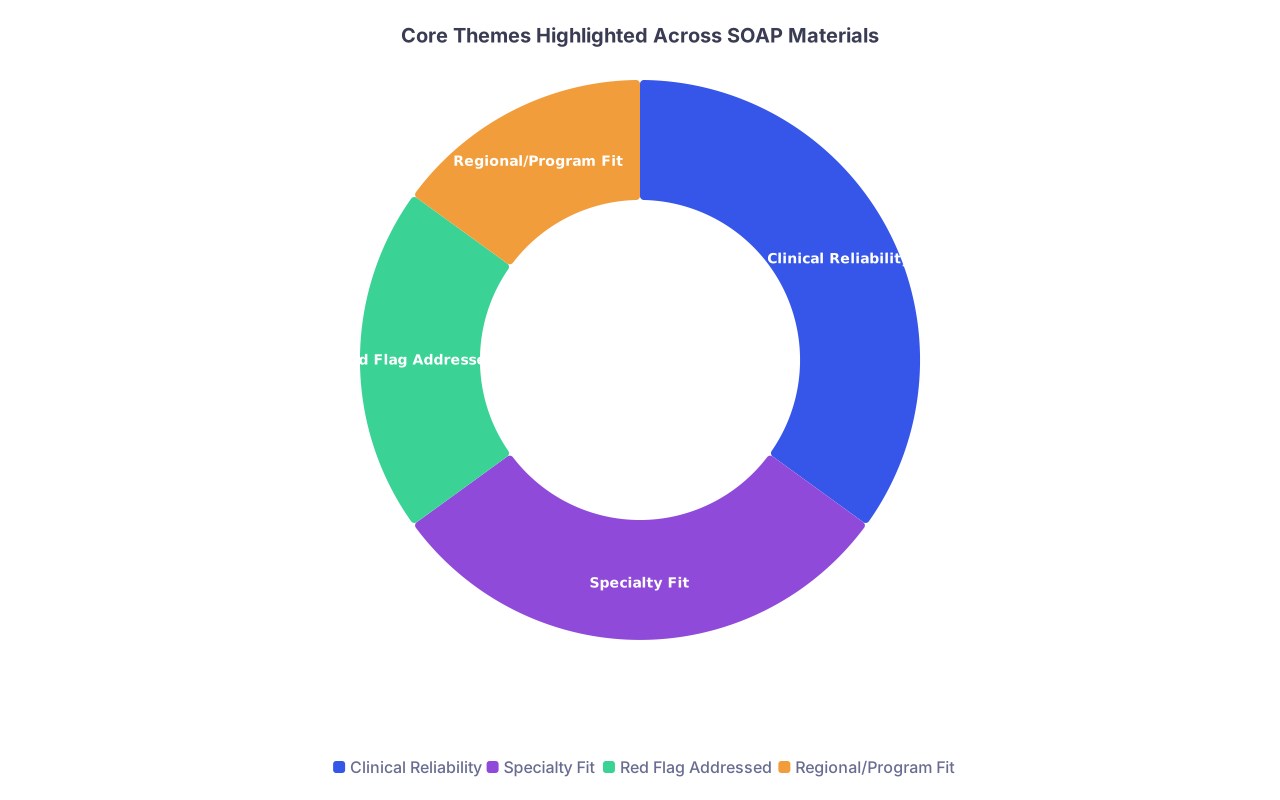
| Category | Value |
|---|---|
| Clinical Reliability | 35 |
| Specialty Fit | 30 |
| Red Flag Addressed | 20 |
| Regional/Program Fit | 15 |
Step 2: Build a Micro‑Checklist
For each component, ensure you hit:
- Clinical reliability (evidence of showing up, following through)
- Specialty fit (rotations, interests, skills that match)
- Red flag acknowledgment (only if you have one)
- Clear goal (categorical vs preliminary, and in what field)
If any of these are missing or contradicted, fix it.
Step 3: Strip Out Anything Unnecessary
Ask of every line: “Does this help a SOAP‑time‑crunched PD rank me higher?”
If the honest answer is no → cut it.
Sentimentality rarely helps. Specificity almost always does.
A Quick Process Map: How to Build the Portfolio in 48 Hours
If you are already in SOAP week, you do not have time for perfection. You need a clear order of operations.

| Step | Description |
|---|---|
| Step 1 | Start - 48 hours pre SOAP |
| Step 2 | Define 1-sentence core narrative |
| Step 3 | Draft 450-word SOAP PS |
| Step 4 | Condense and clean 1-2 page CV PDF |
| Step 5 | Create 3 email templates by specialty |
| Step 6 | Cross-check for consistency |
| Step 7 | Have 1 trusted person review for clarity |
| Step 8 | Final edits and upload to ERAS |
| Step 9 | Begin targeted email outreach |
You do not need more than that. You need clarity, not endless revision loops.
Common SOAP Portfolio Mistakes (And How To Fix Them Fast)
I see the same errors year after year. Most are fixable in under an hour.
PS longer than 700 words
Cut entire paragraphs. Aim for 400–500 words. You will not be penalized for being brief. Long is more likely to be skipped.No explicit mention of SOAP/unmatched status
One calm sentence near the top is enough. Silence can look evasive.CV looks like a 5‑page academic CV
Shrink fonts to 11, tighten spacing a bit, cut high‑school‑level activities, group research, and get it to 1–2 pages.Emails are emotional or apologetic
Remove phrases like “I am devastated,” “I beg you to consider,” “this has been my lifelong dream.” Replace with factual, grounded language.Mixed signals on specialty interest
If you SOAP into Family Medicine, do not send an email that reads like it was meant for Orthopedics with a few words swapped out. Every email should sound like it is meant for that specialty and that region.Unclear availability or contact
Put your phone number in email signature, CV header, and PS header if allowed. Answer unknown numbers during SOAP week. Voicemail full? That is an own goal.
FAQs
1. Should I write different personal statements for each SOAP specialty I apply to?
If you are applying to truly different specialties in SOAP (for example, Internal Medicine and Family Medicine), I recommend at least 2 versions. However, keep a common spine: same exam info, same red flag explanation, same core work ethic themes. Only shift the specialty‑specific parts—rotations you highlight, long‑term goals, and the specific clinical skills you emphasize. Do not try to use one generic PS for surgery, psych, and FM; it looks lazy and misaligned.
2. Do programs actually read SOAP emails, or is it a waste of time?
Some ignore them entirely. Others use them as a tiebreaker when deciding who to call from a pool of similar candidates. I have seen applicants get interviews specifically because they matched a regional or language need they mentioned in an email. So no, it is not a waste—if you send targeted, concise emails. What is a waste: blasting 200 programs with the same vague message and no attention to fit.
3. Should I include my Step scores in SOAP emails if they are not strong?
If your scores meet the bare minimum most programs in that specialty expect, I lean toward including them (or at least stating “Step 1 Pass, Step 2 CK passed on first attempt”). It signals transparency and speeds up their decision-making. If you have a failure, you do not need to lead with numbers in the email, but be ready to discuss and clarify during an interview. Do not lie by omission on ERAS; emails are for emphasis, not for hiding.
4. How do I handle a big gap (2+ years) on my CV during SOAP?
You address it once, cleanly, and pair it with structure. In your PS and CV, give a neutral description: “From 2021–2023 I worked full‑time as a medical assistant while preparing for USMLE exams, which I completed in 2023.” If the gap involved significant family or health issues, you can mention this briefly, but shift quickly to what you have done recently to stay clinically engaged and current. The more your recent 12–18 months look structured and clinical, the less the older gap matters.
5. Is it better to emphasize research or clinical work in SOAP materials?
In SOAP, clinical reliability beats research 9 times out of 10, especially in core fields like IM, FM, peds, psych. Research is a nice differentiator, but nobody is filling a SOAP spot primarily for research output. On your PS and CV, lead with clinical rotations, sub‑Is, and hands‑on work; list research later. The exception: very research‑heavy fields (like radiation oncology) or when the program itself is strongly academic—but those are rarely the bulk of SOAP positions.
6. Can I reuse my main Match personal statement for SOAP?
You can, but often you should not reuse it unchanged. Main‑Match PSs are usually longer, more narrative, and sometimes tailored to a narrower set of programs or a slightly different angle (e.g., academic career vs. “I just need a spot now and will be a solid intern”). For SOAP, trim the essay, bring the focus to current clinical readiness, clarify your unmatched status, and sharpen the specialty fit. Think of the SOAP version as the “distilled, high‑signal” cut of your original, not an entirely new script but definitely not a simple copy‑paste.
Key points, so you walk away with something actionable:
- Keep everything short, specific, and aligned: 400–500 word PS, 1–2 page CV, 150–200 word emails.
- Choose one clear professional angle and repeat it consistently across PS, CV, and outreach.
- Address red flags once, calmly, and then spend most of your words proving you can function as a reliable, low‑maintenance intern on day one.