
The smartest SOAP candidates do not “spray and pray.” They hunt prelim and transitional spots with sniper-level precision.
Let me break down exactly how to do that.
1. Know What You Are Actually Applying For
Most applicants blur prelim and transitional year positions into one vague backup idea. That is how people end up miserable, mismatched, or scrambling again next year.
You need a sharp mental model first.
Prelim vs Transitional: Functional Differences
Preliminary year (usually Internal Medicine, sometimes Surgery):
- One-year position, not intended to continue there for categorical IM unless explicitly stated.
- Commonly used as:
- A required intern year before advanced specialties (Radiology, Anesthesia, Derm, PM&R, Neuro, Rad Onc).
- A “bridge year” while you reapply for a different field.
- Workload often similar to categorical interns. Less continuity clinic, more floating and night coverage.
- Culture can be: “You are here for a year. Then gone.” That is not universally true, but you must assume it.
Transitional year (TY):
- Rotations are more balanced: mix of medicine, surgery, ER, electives, sometimes outpatient, ICU.
- Historically cushier schedules and better lifestyle than most IM or surgery prelims. Not always, but often.
- Designed for people who already have an advanced spot or will reapply, and who want a broad clinical base.
- Extremely competitive relative to number of spots, especially at “good lifestyle” community programs.
You are not just “trying to get any job.” You are buying one year of your life, with consequences for:
- Letters of recommendation quality.
- Your Step 3 timing and performance.
- Your ability to interview again and rank for the following cycle.
- Your mental and physical health.
So you must decide which of these you are targeting and why, before SOAP opens.
2. Before SOAP Starts: Set Your Strategy Like an Adult, Not a Panicked MS4
The worst SOAP decisions happen in the first 2 hours of Monday when people are shaking, crying, and clicking random programs.
You cannot be thinking from zero at 10:59 AM ET when the list drops.
Clarify Your Primary Objective
Be brutally clear with yourself:
- Are you trying to:
- A) Salvage your path into a specific advanced specialty (e.g., Anesthesia, Derm, Rads)?
- B) Get solid clinical training while you rebuild your application and reapply in a different field?
- C) Secure any ACGME-accredited year so you are not unmatched and can regroup?
Those are three different games.
If your main aim is A (advanced specialty path), a solid IM prelim at a place respected by advanced fields is usually better than a random TY that “sounds cushy” but has zero academic cachet.
If your aim is B (rebuild and reapply), you need:
- A place with faculty who actually write letters.
- Protected time (or at least not malignant scheduling) so you can work on research, Step 3, and reapplication.
- Leadership that is not hostile to reapplicants.
If you are at C (any year, keep the lights on), your threshold will be very different. But you should still avoid obvious toxic programs if possible.
Line Up Your Data Sources Early
Do not wait until SOAP week to figure out where these positions even exist.
You should have, before Match Week:
- A list of prelim IM, prelim surgery, and TY programs in your target regions from prior years’ NRMP data and program websites.
- A short list of programs where:
- Your school has sent grads before.
- Your own faculty have contacts.
- You know residents personally.
You cannot predict which of them will have SOAP openings, but when they appear, you will move faster and more intelligently than your peers.
3. Reading the SOAP List: Pattern Recognition, Not Panic
When the NRMP SOAP list opens, people freeze. It is a long, ugly spreadsheet of:
- Specialty
- Institution
- Program name and NRMP code
- Positions available
You have limited time and 45 applications total. That cap matters.
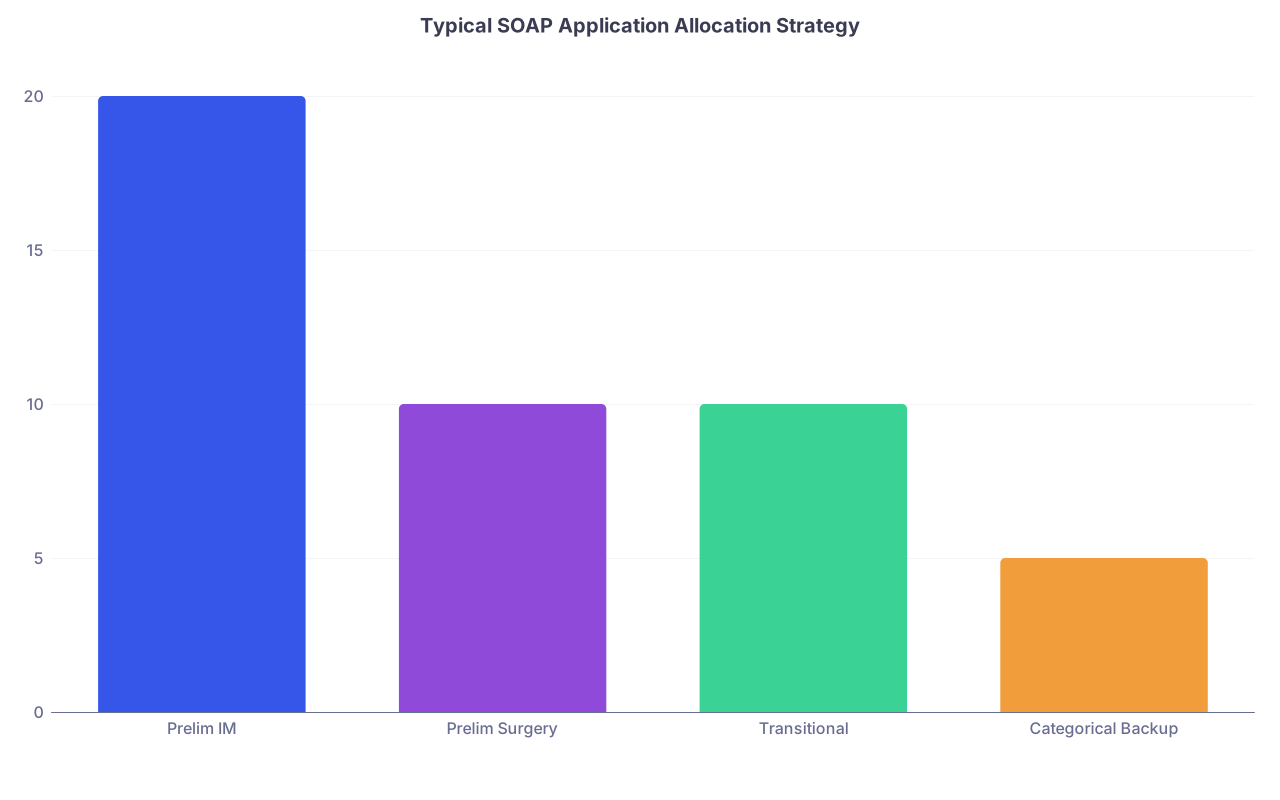
| Category | Value |
|---|---|
| Prelim IM | 20 |
| Prelim Surgery | 10 |
| Transitional | 10 |
| Categorical Backup | 5 |
This is a common distribution I have seen work well for someone targeting advanced specialties but still wanting coverage.
How to Triage the List in the First Hour
You should move through it in passes, not linearly from A to Z.
First pass (fast filter):
You are answering three questions:
- Is this geographic region acceptable?
- Is this hospital type acceptable (university, strong community, small community, safety-net)?
- Does this fit my objective (advanced-supporting IM prelim vs “just need a year”)?
Mark them (literally in a spreadsheet or on paper) as:
- High-priority target
- Possible
- Hard pass
Do not overthink individual program reputations on pass one. You are just cutting obvious no’s: completely wrong region, non-ACGME, known disasters.
Second pass (program-specific reality check):
Now go narrower, focusing first on your “high-priority target” list:
- Check program website: Is this actually a pure prelim track? Any hidden clauses?
- Look at their categorical IM or surgery size. Larger programs often have:
- More structure.
- More opportunities for letters and electives.
- Less dependence on prelims to carry service alone.
- Check if they have related advanced programs (Anesthesia, Rads, Derm, etc.). That matters for networking and post-call hallway conversations that turn into opportunities.
If time allows, check:
- Reddit / SDN comments over the years (grain of salt, but patterns matter).
- FREIDA for program size, call structure, and scholarly environment.
Where Transitional Year Fits During SOAP
Transitional years are a trap for some people and a gift for others.
Reality:
- “Dream” TY programs (big-name academic centers, super cush community programs in coastal cities) rarely go into SOAP. When they do, they get obliterated by applications.
- The majority of SOAP TYs are at mid-sized community hospitals, often attached to IM, FM, or smaller advanced programs.
Target a TY in SOAP if:
- You already have a secured advanced position for next year (rare in SOAP context, but possible for prior unmatched advanced applicants who re-matched).
- Your board scores and application are reasonably strong, and you simply got squeezed out of your first-choice specialty. A decent TY can give you a year for research and reapplication without burning you out.
If your Step scores are marginal and you are not particularly competitive on paper, focusing heavily on TYs during SOAP is usually unproductive. You will waste applications on hyper-competitive spots.
4. Application Targeting: How to Use Your 45 Shots Intelligently
People either underapply (“I sent 12 apps, hope it works out”) or spray randomly. Both are bad strategies.
Let us talk numbers. You have:
- 45 total applications in SOAP.
- Up to 30 per SOAP round (but total across rounds still 45).
You should have a distribution like:
- A clear core of programs where you are a strong fit.
- A secondary ring of “still acceptable, maybe a stretch or less ideal region.”
- A final safety ring that you hold for later rounds if you get no traction.
| Program Type | Round 1 Apps | Round 2/3 Reserve |
|---|---|---|
| Prelim IM (academic-heavy) | 15 | 5 |
| Prelim IM (community, decent rep) | 10 | 5 |
| Transitional Year | 5 | 3 |
| Prelim Surgery | 5 | 2 |
| Wildcard (FM/IM categorical small programs) | 0 | 5 |
This is not a template. It is an example of deliberate allocation.
How to Decide Where You Are Actually Competitive
You need to be honest about three things:
- US vs IMG / DO vs MD
- Step 1/2 scores and failures
- Gap years and red flags
Tiering roughly:
- Top-tier TYs and prelims at high-end academic centers are still looking for solid US grads, usually with no fails. SOAP does not erase their standards.
- Mid-tier academic and strong community prelim IM programs are more open but still have cutoffs.
- Smaller community hospitals, safety-net institutions, and rural programs often fill in SOAP and are more forgiving.
If you failed Step 1 or Step 2, or you are an IMG with modest scores, you should not waste 20 of your 45 applications on marquee-name TYs or elite coastal academic prelims. You can apply to a few if you want, but your core strategy should be where people like you actually match.
5. Communication Strategy: How to Make Yourself Real to Programs
SOAP rules are strict, but they do not prevent you from being strategic.
Understand the Communication Rules
- You cannot directly contact programs about unfilled positions before they contact you.
- Once they reach out (call, email, Thalamus/ERAS message), that program is fair game for more communication.
- Your dean’s office, advisor, or home program faculty can advocate for you. They are not under the same direct limitations.
This is where people waste massive opportunity.
Work Your Network, Not Just ERAS
You should be doing, preferably on Monday afternoon:
- Sending your CV and list of unfilled prelim / TY programs to:
- Your clerkship directors.
- Your department chairs (especially IM, Surgery, Anesthesia, Radiology, PM&R, etc.).
- Any attendings who like you and have institutional or regional pull.
Explicit ask:
“If you have contacts at any of these programs that have prelim/TY positions in SOAP, could you send a quick email or call on my behalf? I am especially interested in [Region X / Program Y].”
Faculty emails like:
“This student worked with us on inpatient medicine, strong work ethic, serious about pursuing Anesthesia. Would strongly recommend for a prelim spot at your program.”
Those actually move the needle. I have seen programs sort their SOAP list by “has prior personal recommendation” first.
How to Answer SOAP Screening Calls
Program calls during SOAP are short, targeted, and not warm and fuzzy. They want to know:
- Can you start on July 1 without visa chaos or licensing delays?
- Are you willing to work hard in a prelim year?
- What are you really trying to do after your intern year?
Have a 1–2 sentence script per objective.
Example (advanced specialty path):
“My goal is to pursue Diagnostic Radiology. I am looking for a strong Internal Medicine prelim year where I will get solid inpatient training and can also meet faculty in related departments. I am ready to work hard and would be fully committed to your program for the year.”
Example (rebuild and reapply in IM):
“I plan to reapply in Internal Medicine. I want a prelim year where I can take good care of patients, earn strong letters, and demonstrate that I can perform at the level expected of a categorical resident.”
Do not lie and say “I want categorical IM” if you clearly do not. Programs know most prelims are short-timers, but they hate obvious dishonesty.
6. Evaluating Prelim and TY Programs During SOAP: Red Flags, Green Flags
You will not get perfect information. But you can still avoid land mines.
Core Questions to Ask (Without Sounding Like a Diva)
During calls or quick interviews, you can ask 2–3 targeted questions:
- “How are prelims integrated into your team structure? Are they mostly on ward rotations, or do they also rotate through ICU, electives, etc.?”
- “What have your prior prelims gone on to do after this year?”
- “Is there any history of prelims converting to categorical spots if there are openings, or is this strictly a one-year track?”
You can also ask:
- “How many prelims do you have each year?” If they have 10 prelims and 8 categoricals, you can imagine who covers the night float and tough services.
Red Flags That Deserve Pause
I have seen the same patterns repeat:
- Program leadership openly disparaging prelims as “just here to fill gaps.”
- No clear structure for prelim education (no continuity clinic, mostly nights and cross-cover with minimal teaching).
- PGY-2+ residents saying, “Prelims work harder than categoricals, and it is just assumed.”
- Zero history of prelims getting meaningful letters or moving into advanced programs.
You might still rank or accept them if you are desperate. But go in with eyes open.
Green Flags That Make a Harsh Year Worth It
- Large IM or Surgery program with a well-defined prelim curriculum.
- Evidence that past prelims matched into:
- Radiology, Anesthesia, Derm, etc.
- Or solid categorical IM/FM/Neuro programs.
- Presence of your target advanced specialties in the same institution.
- Explicit mention that prelims get to do ICU, electives, and some consult rotations.
Those programs are where prelim years become actual career springboards, not just “one year of suffering.”
7. Advanced Tactics: Aligning Prelim/TY with Your Reapplication Plan
Landing a prelim or TY is not the end of the story. It is the start of your reapplication cycle.
You should be thinking: “How will this year set me up for next September?”
Map Your Intern Year to Key Milestones
Rough timeline you should be visualizing:
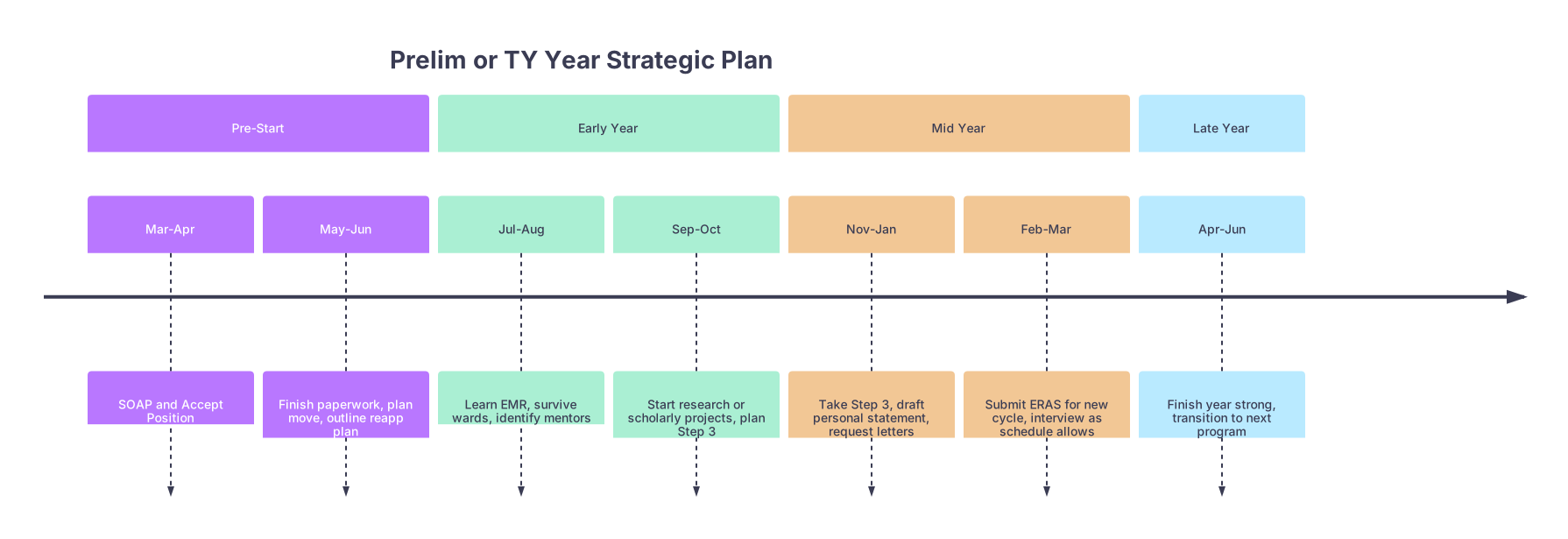
| Period | Event |
|---|---|
| Pre-Start - Mar-Apr | SOAP and Accept Position |
| Pre-Start - May-Jun | Finish paperwork, plan move, outline reapp plan |
| Early Year - Jul-Aug | Learn EMR, survive wards, identify mentors |
| Early Year - Sep-Oct | Start research or scholarly projects, plan Step 3 |
| Mid Year - Nov-Jan | Take Step 3, draft personal statement, request letters |
| Mid Year - Feb-Mar | Submit ERAS for new cycle, interview as schedule allows |
| Late Year - Apr-Jun | Finish year strong, transition to next program |
If you pick a prelim that buries you in 6–7 nights of call with no elective time, your ability to:
- Do research.
- Take Step 3 early.
- Go to interviews next cycle.
…will be crippled.
This is why “cush” is not a dirty word. A reasonable schedule with some elective time is not about laziness; it is about long-term positioning.
Step 3 Timing Relative to Intern Year
For many advanced specialties and for competitive reapplications, passing Step 3 before you apply again is a major plus.
Ideal sequence:
- Take Step 3 between November–February of your prelim/TY year.
- Use IM month experience to strengthen your test performance.
- Have a passing result in hand when ERAS reopens.
You want a prelim/TY where:
- Your PD will not freak out if you take 3–4 days off around a lighter rotation to sit for Step 3.
- You can actually study half decently on wards / call schedule.
Ask subtly:
“Do your prelims typically take Step 3 during the year? Is the program supportive of that?”
The answers are very revealing.
8. Contingency Planning: If You Strike Out in SOAP
You are reading an article about strategy; I assume you can tolerate some hard truth.
Some applicants will not land any prelim or TY in SOAP. Even with good tactics.
If that happens, you need a plan for:
- What you will do in the next 12–18 months.
- How you will explain it.
Options I have seen work:
- Research positions (paid or unpaid) in your field of interest, ideally with clinical exposure.
- Non-ACGME transitional/intern-like years at hospitals abroad or non-match programs (careful with visa/licensing implications).
- A structured year of clinical observerships, quality improvement, and exam remediation, with strong mentorship.
But if your goal is eventual US residency, an ACGME prelim or TY is still far better than a random gap year.
This is why you should be willing, in later SOAP rounds, to drop some of your location preferences or prestige anxieties.
9. Putting It All Together: A Concrete Scenario
Let me walk through a realistic case.
You are:
- US MD, mid-tier school.
- Step 1: Pass, Step 2: 225.
- Applied to Diagnostic Radiology and got zero interviews.
You enter SOAP. On the list you see:
- Prelim IM at large Midwest academic center with Radiology residency. 3 open spots.
- Prelim IM at busy Northeast safety-net community hospital. 8 open spots.
- Transitional year at small community hospital in the Southeast. 2 open spots.
- Several prelim surgery spots at community programs nationwide.
Your priorities:
- You still want Radiology.
- You need strong letters and Step 3 done.
- You can be flexible on geography for one year.
A rational SOAP targeting plan:
Round 1:
- Apply to all prelim IM at academic centers and larger community hospitals, especially those with Radiology or Anesthesia programs on site.
- Apply to a subset of TYs where your profile is reasonably competitive (not the ultra-elite West Coast brand names).
- Maybe 1–2 prelim surgery if you actually can tolerate that year and have some OR interest.
Immediately send your target list to:
- Your IM chair and Radiology faculty you shadowed.
- Ask for behind-the-scenes advocacy.
On calls:
- Emphasize your goal: “Pursue Rads; need strong IM prelim training, willing to work hard, hoping to network with Rads faculty.”
If you get zero movement from academic prelim IM in round 1:
- Round 2:
- Expand to more community IM prelims, accepting higher workload, but still avoid the most notorious malignant ones if you can.
- Keep a handful of apps for final round for absolute last-resort programs.
If by round 3 you still have no offers:
- You start applying to remaining prelim IM and maybe TYs in regions you initially did not want. At this point, one solid year somewhere is better than no training and a massive, unexplained gap.
This is not glamorous. It is adult damage control.
With a clear head and a strategy, SOAP does not have to be chaos. Prelim and transitional positions are not consolation prizes; they are leverage points. Used well, they let you reset your trajectory, earn credibility, and re-enter the Match with a far stronger hand.
The immediate job now is simple: get your lists ready, line up your advocates, and commit to a targeting strategy before the SOAP clock starts. Once that is in place, the next phase is making that intern year work for you instead of swallowing you whole. But that is a story for after you sign your contract.