
The way most applicants talk about “research” and “gaps” during SOAP is exactly backward for community programs.
You are trying to sell academic currency to buyers who primarily value reliability, service, and proof you will actually show up and work.
Let me walk through how to reframe this surgically, so a community PD reading your application in a 90‑second window thinks: “This person will make my life easier, not harder.”
1. Understand What Community Programs Actually Care About in SOAP
Forget the generic “programs like well‑rounded applicants” nonsense. In SOAP, and especially for community programs, three questions dominate:
- Will this person be safe on day one?
- Will this person show up, work hard, and not quit?
- Are they going to be a problem? (disciplinary, professionalism, visa, personality)
Research and gaps matter only as they relate to those three questions.
Community PDs are not sitting there thinking:
- “Where is their first‑author NEJM paper?”
They are thinking: - “Can this person take 8 cross‑cover calls in a row without imploding?”
- “Will they document, communicate, and not blow up my ACGME citations?”
- “Are they going to leave for a different specialty in a year?”
So when you talk about:
- Research → you frame it as proof of discipline, follow‑through, communication, and clinical maturity.
- Gaps → you frame them as discrete, explained, and now-resolved periods that actually matured you and made you more stable.
If you do not do this reframing, PDs will fill in the gaps with their own worst‑case narrative. And they are very good at that.
2. The Core Reframe: Research as Evidence of Reliability, Not Bragging Rights
Your instinct might be to lead with: “I have 7 publications…”
For a community IM or FM program in SOAP, that often reads as:
- “This person wanted academic, did not match, might be unhappy here.”
- “They may leave after PGY‑1 to chase a university spot.”
You need to convert “research hobbyist” into “future dependable resident.”
The three research angles that work for community programs
Angle 1: Research that shows you understand real‑world patients.
Angle 2: Research that proves you can finish what you start.
Angle 3: Research that demonstrates teachability and teamwork.
You push those angles. Not the impact factor.
Examples of how to phrase this in your CV descriptions and emails:
Instead of:
- “Conducted retrospective cohort study published in high‑impact cardiology journal.”
Reframe as:
- “Led a small retrospective project focused on heart failure readmissions that sharpened my data review and documentation skills. I routinely coordinated with inpatient teams and case management to understand why patients bounced back and how our discharge process could improve.”
See the difference? Now your “research” is about:
- Understanding transitions of care.
- Communicating across services.
- Recognizing system failures.
Very relevant to a community hospital trying to keep readmissions down.
Another bad version:
- “First author on three neurosurgery papers. Presented at CNS.”
Better version for a community IM or FM SOAP application:
- “Completed three neurosurgical outcomes projects from IRB submission through presentation. This process taught me to manage deadlines, respond constructively to feedback, and maintain attention to detail while balancing full‑time clinical rotations.”
You are showing:
- You can respect oversight (IRB → think GME rules, policies).
- You can handle revisions (think PD feedback).
- You do not abandon projects mid‑way (think not quitting residency).
How to avoid the “flight risk” flag
Community PDs hate the idea that you are using them as a stepping stone. If your research is overwhelmingly in a different specialty than the one you are SOAPing into, you must handle that head‑on.
Bad:
- Tons of ortho research → now applying FM in SOAP → no explanation.
Better:
- “I previously explored orthopedic surgery in depth, including research in joint reconstruction. Over the last two years my clinical experiences with longitudinal care, chronic disease management, and counseling patients about lifestyle change led me to shift my focus to family medicine. I see my procedural comfort as an asset in a community‑based FM program that performs joint injections and office procedures.”
You just did three critical things:
- You acknowledged the prior interest honestly.
- You tied your new specialty choice to concrete clinical experiences.
- You converted your past into an asset for them.
3. Gaps: How PDs Actually Read Them During SOAP
PDs and coordinators are scanning a massive volume of applications in a compressed timeframe. They do not have time to philosophize about your “journey.” They are doing pattern recognition.
Unexplained or poorly framed gaps trigger three fast assumptions:
- Academic or professionalism trouble.
- USMLE failures or exam instability.
- Lack of resilience / may quit.
You need to kill those interpretations in one or two sentences.
Types of gaps and how to classify them
Most “gaps” fall into one of these buckets:
Structured and defensible:
- Masters / MPH / MBA
- Full‑time research fellowship
- Dedicated Step/CK/CS preparation
- Formal leave of absence for health with now‑documented stability
Neutral:
- Family responsibilities (ill parent, childbirth)
- Visa / administrative delay
- Relocation for spouse or partner, followed by clinical work or observerships
Red‑flag unless explained extremely clearly:
- “Exploring options”
- “Personal reasons”
- Periods where you have nothing on paper: no work, no study, no clear activity
- Multiple years of exam inactivity with no clinical involvement
Your job is to move your situation out of that last category.
4. Building a Clean, PD‑Friendly Gap Narrative
You need three elements, consistently:
- A clear, one‑line label: what was this gap?
- A specific, constructive activity: what did you do?
- A closure statement: why this is resolved and why you are stable now.
Let me give you real-world style templates.
Example 1: Research year that looks like you avoided the Match
Raw version:
- “Took time for research between 2022–2023.”
That reads like: “Did not feel competitive. Avoided risk.”
Stronger version:
- “I took a structured research year from July 2022 to June 2023 at [Institution], working 40+ hours weekly on quality improvement and outcomes projects in internal medicine. During this time I co‑authored two manuscripts, presented a poster at [Conference], and remained embedded on the wards with regular clinical exposure through data collection and chart review. This year strengthened my commitment to internal medicine and reinforced my interest in working in a community setting where QI work can rapidly impact patient care.”
You show:
- Structure.
- Full‑time commitment.
- Ongoing clinical context.
- Specialty commitment.
Example 2: Mental health / burnout gap
This one you must handle with care. PDs respect stability. They fear ongoing crisis.
Disastrous:
- “Took leave for personal/mental health reasons.”
Better:
- “I took a formal leave from January to June 2022 to address an acute mental health issue under the care of a physician. I completed treatment, have maintained stability with regular follow‑up, and successfully returned to full clinical duties for the past 18 months, including demanding sub‑internships and night float without performance concerns. This experience improved my insight, stress management, and empathy for patients facing similar struggles.”
Key moves:
- Time‑boxed the issue.
- Demonstrated treatment and continuity.
- Documented sustained, successful return to high‑stress responsibilities.
- Framed it as maturity, not fragility.
Example 3: USMLE / exam failure gap
Again, do not pretend it did not happen. PDs see the transcript.
Weak:
- “Took time off to focus on exams.”
Effective:
- “After failing Step 1 on my first attempt in 2020, I took a 6‑month academic remediation period supported by my school. I adjusted my study strategy, completed faculty‑guided question blocks, and passed Step 1 and Step 2 CK on the next attempts. Since then I have completed all core and sub‑internship rotations with strong clinical evaluations, which reflect the way I apply medical knowledge in real patient care.”
You are saying:
- “Yes, I failed. Then I adapted. And I am clinically solid.”
Which is exactly the story a community PD can accept.
5. Matching Your Story to Community Program Priorities
Let us be brutally clear. In SOAP, for a community program, the “ideal” candidate looks like this:
- Knows what specialty they want and is not confused about it.
- Has steady, recent clinical activity.
- Has passed all required exams.
- Shows consistent, undramatic reliability.
Your research and gaps should be bent to support those four pillars.
How to align your ERAS content
You do not have time during SOAP to rewrite your entire ERAS from scratch, but you do have time to:
- Edit a few key experience descriptions.
- Adjust your personal statement (you can upload a different one for SOAP).
- Prepare 2–3 email templates to send to PDs.
Focus those edits on:
- Recasting your research toward patient care, teamwork, QI, and documentation.
- Writing one tight, non‑dramatic explanation for any gap.
- Emphasizing consistent work ethic: “full‑time,” “longitudinal,” “finished,” “follow‑through.”
6. Concrete Language: Before and After Examples
Let me give you a few more transformations, because this is where most people stumble.
Research description – academic tone vs community‑friendly tone
Before:
- “My primary interest was in understanding molecular pathways in colorectal cancer, which led to publications in [Journal] and presentations at [Meetings].”
After:
- “I spent a year on colorectal cancer research where my role involved reviewing pathology, staging data, and longitudinal outcomes. This work refined my ability to interpret clinical data, recognize disease patterns, and communicate findings clearly to both attendings and team members—skills that I bring to caring for complex inpatients.”
Now you sound like a future resident, not a future PhD candidate.
Gap explanation – vague vs structured
Before:
- “I had a gap due to personal reasons and relocation.”
After:
- “From August 2021 to April 2022, I relocated to the U.S. and addressed family responsibilities. During this time I arranged two observerships, completed 80+ hours of online CME in internal medicine, and prepared for Step 2 CK, which I passed in [month/year]. Since May 2022, I have maintained continuous clinical involvement.”
You turned a blank space into a training period.
7. Choosing What to Emphasize in SOAP Emails to Community Programs
In SOAP, your direct communication (emails to PDs/coordinators) is often read more attentively than the rest of your file, because it is shorter.
Your email should not be:
- A recap of your whole CV.
It should be: - A surgical strike: “Here is why I fit your type of program and why my past actually helps you.”
A simple structure that works:
- One sentence: who you are (grad year, specialty, exam completion).
- One sentence: why their type of program (community, safety‑net, high‑volume, etc.) matches your real preferences.
- One to two sentences: reframe your research as preparation for community work.
- One to two sentences: acknowledge and neutralize any obvious gap / red flag.
- One sentence: availability and seriousness.
Example for Internal Medicine:
“Dear Dr. [PD],
I am a 2023 graduate who has completed Step 1, Step 2 CK, and Step 3 and am very interested in categorical internal medicine positions at community‑based programs like yours. I prefer a high‑volume, hands‑on training environment where residents manage diverse pathology and work closely with attendings.
During my dedicated research year at [Hospital], I focused on readmission and length‑of‑stay projects in internal medicine, which strengthened my understanding of discharge planning, chart review, and interprofessional communication—skills that translate directly to resident responsibilities. After a 6‑month structured period in 2020 to remediate a Step 1 failure, I have passed all subsequent exams and completed all rotations without academic concerns.
I would be grateful for consideration for any available PGY‑1 positions and am ready to interview on short notice during SOAP.
Sincerely,
[Name], AAMC ID [number]”
Clear. Short. No self‑pity. No theatrics.
8. How Community PDs Interpret Common “Signals” in SOAP
Let me be very explicit about how certain patterns look from their side.
| Applicant Pattern | Likely PD Interpretation |
|---|---|
| Heavy research, minimal recent clinical | Flight risk / may be rusty clinically |
| Large unexplained time gap | Professionalism or exam issue |
| Repeated specialty switches | Lack of commitment / might leave program |
| Long-term unpaid observerships only | Limited independent responsibility |
| Clear story tying gap to growth + stability | Resilient and self-aware |
Your job is to move yourself into that last row as much as reality allows.
If you did primarily research for two years, you must show:
- Ongoing clinical contact.
- Recent clerkships, sub‑Is, or at minimum intensive observerships.
- Concrete patient‑related tasks: notes, presentations (even unofficial), team discussions.
If your gap is big and empty, you cannot magically erase it, but you can at least:
- Show that the last 6–12 months have been consistent and strong.
- Provide a concise, adult explanation instead of a cloudy excuse.
9. Specialty-Specific Nuances for Community SOAP Positions
Community programs are not a monolith. Internal medicine, family medicine, psych, surgery—each reads your story with slightly different filters.
Community Internal Medicine
They want:
- Workhorses who can handle volume and complexity.
- Residents who will manage chronic disease, not just chase procedures.
Your research → emphasize:
- Outcomes, QI, readmissions, chronic disease management, hospital throughput.
Your gaps → emphasize:
- Return to sustained clinical work.
- Ability to function on teams with nursing, case management, and consultants.
Community Family Medicine
They care heavily about:
- Continuity.
- Communication.
- Broad comfort: peds, OB exposure (even if limited), chronic disease, behavioral health.
Your research → spin toward:
- Community health, patient education, adherence, health disparities, primary care interfaces.
Your gaps → frame:
- Any community work, teaching, volunteering, or communication‑heavy roles you did.
- Stability in outpatient-style environments if you have it.
Community Psychiatry
They are used to applicants with non‑linear paths. But they are highly attuned to:
- Your own mental health stability.
- Your capacity to build rapport and communicate clearly.
Your research → highlight:
- Work involving communication, adherence, psychosocial aspects, quality of life, addiction, etc.
Your gaps → you must:
- Show that any mental health–related gap is now well managed and stable.
- Avoid vague, drama‑heavy language. Calm, matter‑of‑fact is your friend.
10. The One-Page Personal Statement Fix During SOAP
You do not have time for a literary masterpiece during SOAP. You do have time to rewrite your personal statement into a tool that does three things:
- Demonstrates a realistic, grounded understanding of the specialty.
- Confirms that a community setting is your preference, not a consolation prize.
- Seamlessly integrates your research and gaps into a growth and reliability narrative.
Basic skeleton:
Paragraph 1 – Why this specialty, with a concrete clinical vignette or moment that actually sounds like something that happens in a hospital, not a Hallmark movie.
Paragraph 2 – Your path: how your rotations, electives, and, yes, research, reinforced this choice. Show maturity: “I considered X, here is why I chose Y.”
Paragraph 3 – Address the major gap or deviation briefly and put a lid on it:
- “I had [type of gap]. This is what I did. This is how I grew. I have since shown stability over [time period].”
Paragraph 4 – Why community and why residency now:
- “I want the breadth, autonomy, and close-knit teams that community programs offer.”
- “My goal is to practice in [community/region/type of practice], and training in a program like yours aligns with that path.”
No long, emotional essays. No three‑page explanations of your “journey.” PDs are scanning.
11. Timing, Recency, and the “Last 12 Months” Rule
In SOAP, what you have done in the last 12 months often matters more than what you did three years ago, especially for community programs.
If your last year has been:
- Full‑time research with minimal patient exposure
Then: - You need to highlight every clinically adjacent piece of that: chart review, conferences, floor time, QI initiatives, case presentations.
If your last year has been:
- A messy mix of study time, family issues, short observerships, and part‑time jobs
Then: - Tighten it into a story of progressive stabilization. End strong.
PDs want to see:
- The trajectory is upward.
- The chaos phase is over.
If your gap or instability is in the distant past and your last 12–24 months are clean, emphasize that clean run aggressively.
12. A Short Reality Check: What Not to Do
Let me be blunt about a few common mistakes I see every SOAP cycle:
- Do not write a multi‑paragraph confession letter about your gap. One clean paragraph is enough.
- Do not oversell your research as if you are applying for a physician‑scientist track. You are not.
- Do not pretend your prior specialty obsession never existed. Acknowledge it and convert it.
- Do not sound bitter about not matching. Community PDs have zero time for resentment.
- Do not send copy‑paste emails with the wrong program name. That one happens every year and gets laughed at.
You are trying to come across as:
- Grounded.
- Grateful for a shot.
- Ready to work hard in a very real, non‑glamorous clinical environment.
That is exactly what community programs need.
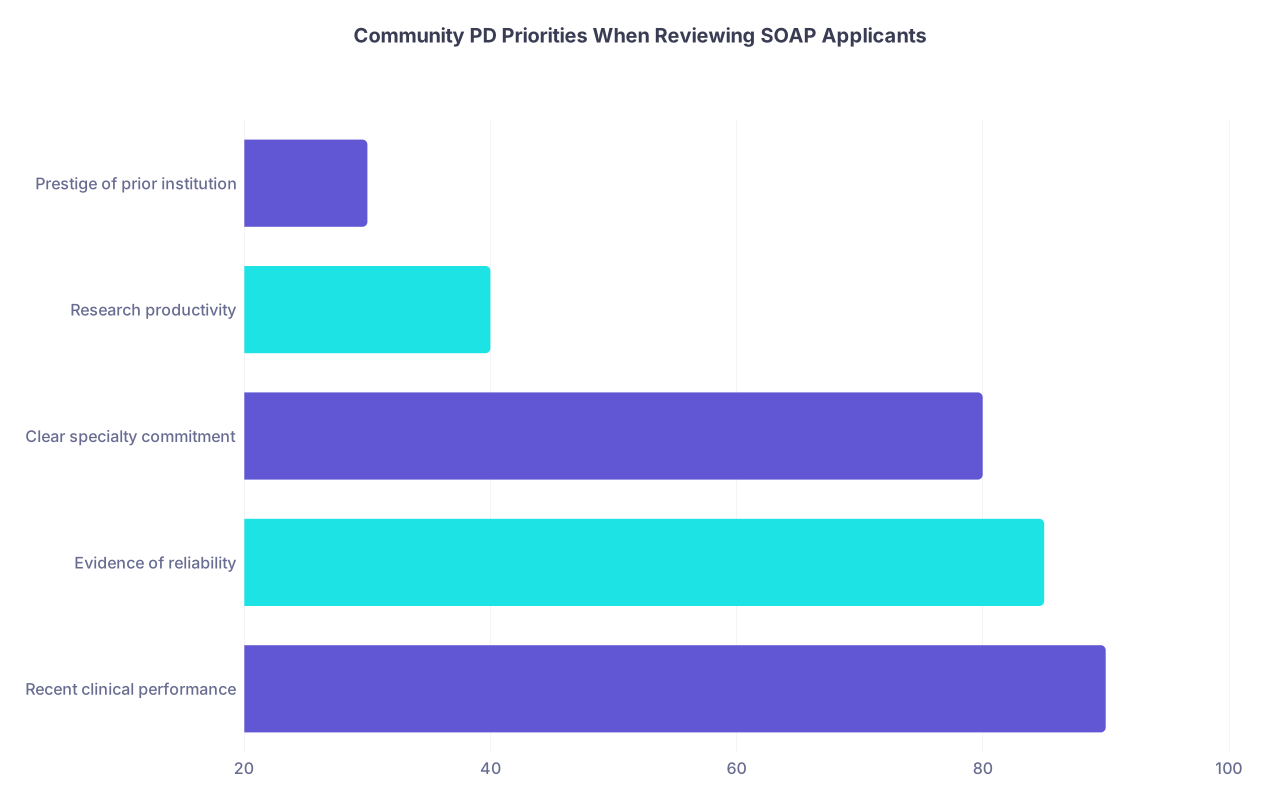
| Category | Value |
|---|---|
| Recent clinical performance | 90 |
| Evidence of reliability | 85 |
| Clear specialty commitment | 80 |
| Research productivity | 40 |
| Prestige of prior institution | 30 |

| Step | Description |
|---|---|
| Step 1 | Applicant with research and gaps |
| Step 2 | Reframe as QI and reliability |
| Step 3 | Classify and define gap type |
| Step 4 | Rewrite ERAS entries |
| Step 5 | Write concise gap explanation |
| Step 6 | Update personal statement |
| Step 7 | Craft SOAP email to community programs |
| Step 8 | Consistent narrative in interviews |
| Step 9 | Identify red flags |
Key Takeaways
First: Stop selling research as prestige. Recast it as evidence that you understand systems, patient care, documentation, and finishing what you start—things community PDs actually value.
Second: Gaps are not fatal if they are named, time‑boxed, and clearly resolved. One concise, structured explanation that shows growth and current stability beats a vague, emotional saga.
Third: Every part of your SOAP presence—ERAS entries, personal statement, and emails—must tell one coherent story: “I know what specialty I want, I prefer a community‑style environment, my past experiences (including research and gaps) have made me a more reliable, mature resident, and I am ready to work.”