Your single most underused weapon in SOAP is a well-positioned faculty advocate who knows exactly when and how to speak up for you.
Most students realize this about three days too late.
I am going to walk through how to use faculty advocates strategically in SOAP. Not “hey can you write me a letter?” nonsense. I mean who to pick, when to contact them, what to ask them to say, what subject lines work, and how to avoid the classic mistakes that programs quietly roll their eyes at.
This is not theory. This is the difference between endless “no response” and a PD emailing back in 12 minutes: “We can interview this afternoon.” I have seen that happen more than once.
1. What a Faculty Advocate Actually Does in SOAP
Most students misunderstand this: a faculty advocate during SOAP is not just a letter writer. They are a real-time, live operator working your case.
Done right, they do three specific things:
- Signal legitimacy
- Compress your timeline
- Push decision-makers to look at your file now, not “when they get to it”
Let me be more precise.
On SOAP Monday–Wednesday, programs are drowning. Hundreds to thousands of applications per unfilled program. They cannot even open them all. They are triaging by:
- Filters (US vs IMG, attempts, graduation year)
- Keywords (home institution, known recommenders)
- Direct communication from trusted faculty
That third category is where your advocate lives. A strong email or brief call from a known faculty name can do two big things:
- Move you from the “unopened stack” to the “review now” group
- Frame your application before the PD even looks at it (“strong clinician, minor Step 1 issue, will show up and work”)
The goal is not to “guarantee” a spot. There are no guarantees in SOAP. The goal is to increase the probability that:
- You get your file reviewed
- You get an interview slot
- Your weaknesses are humanized, not fatal
If you go into SOAP thinking faculty advocates just “support” you, you will underuse them. Think of them as targeted, timed interventions into program decision-making.
2. Who Should Be Your Advocate (And Who Absolutely Should Not)
Not every doctor with a white coat is a good advocate. Some are dead weight. A few are actively harmful.
Here is the hierarchy of who actually moves the needle.
| Priority Tier | Ideal Advocate Type | Example Role |
|---|---|---|
| Tier 1 | Program leadership in your target specialty | PD, APD, former PD |
| Tier 2 | Departmental leadership with regional/national network | Chair, Vice Chair, Clerkship Director |
| Tier 3 | Faculty who directly supervised you and will go to bat | Site director, core faculty |
| Tier 4 | Other respected clinical faculty with weak specialty link | Well-regarded attending in another specialty |
| Avoid | Residents, fellows, faculty who barely know you | Limited or negative impact |
Let me break that down.
Tier 1: Program leadership in the same specialty
These are gold. PDs and APDs know each other. Chairs talk. Emails from them get opened first.
Examples:
- You are SOAPing into IM. Your home IM PD emails the PD at a community IM program with unfilled spots.
- You are SOAPing into FM. Your FM Chair calls a PD at a regional FM program she trained with.
This is the best-case scenario. If you have this and you are not using it, you are wasting leverage.
Tier 2: Department leadership with a broad network
Clerkship directors, vice chairs, sometimes long-standing core faculty who speak at national society meetings. Their names ring a bell. Their email signature alone signals: “I know how this game works.”
They carry less weight than PD-to-PD, but still significant. Especially at community and smaller academic programs.
Tier 3: Faculty who truly know your work
This is often your main clinical champion:
- Site director who saw you hustle on wards
- Sub-I attending who trusted you with near-intern responsibilities
- Faculty you did research or QI with in that specialty
They might not be famous, but they can tell a specific, credible story: “I watched this student take care of 6–8 patients daily and handle cross-coverage overnight. I would take them as my resident.”
Specific anecdotes beat generic praise when the advocate is not a “big name.”
Tier 4: Other clinical faculty
Sometimes you do not have strong connections in your SOAP target specialty. That is common when you are pivoting (for example, you originally applied to surgery, now SOAPing into prelim IM or FM).
In that case, a strong advocate in another field is still useful if:
- They supervised you clinically
- They can speak concretely about your work ethic, reliability, and teachability
What does not help:
- “Family friend who is cardiology faculty” who barely saw you clinically
- Faculty who feel obligated but lukewarm
Who you should avoid
I have watched people tank their chances by choosing the wrong voices.
Avoid:
- Faculty who do not remember you well (“remind me, which rotation were you on?” — that is a bad sign)
- Anyone who hinted they were “concerned” about your performance
- Residents and fellows as primary advocates; they can add color, but they should not be your front-line contact
- Faculty who are notoriously slow to respond to email. SOAP is about speed.
If your gut says, “They might not say glowing things,” do not use them in real-time SOAP advocacy. You cannot un-send a lukewarm email.
3. Timing: When to Line Up Advocates and When to Deploy Them in SOAP
People mess up SOAP timing more than anything else. They panic Monday at noon. They start reaching out to faculty while programs are already hitting “refresh” on ERAS.
You need two timelines in your head: pre-SOAP and SOAP week.
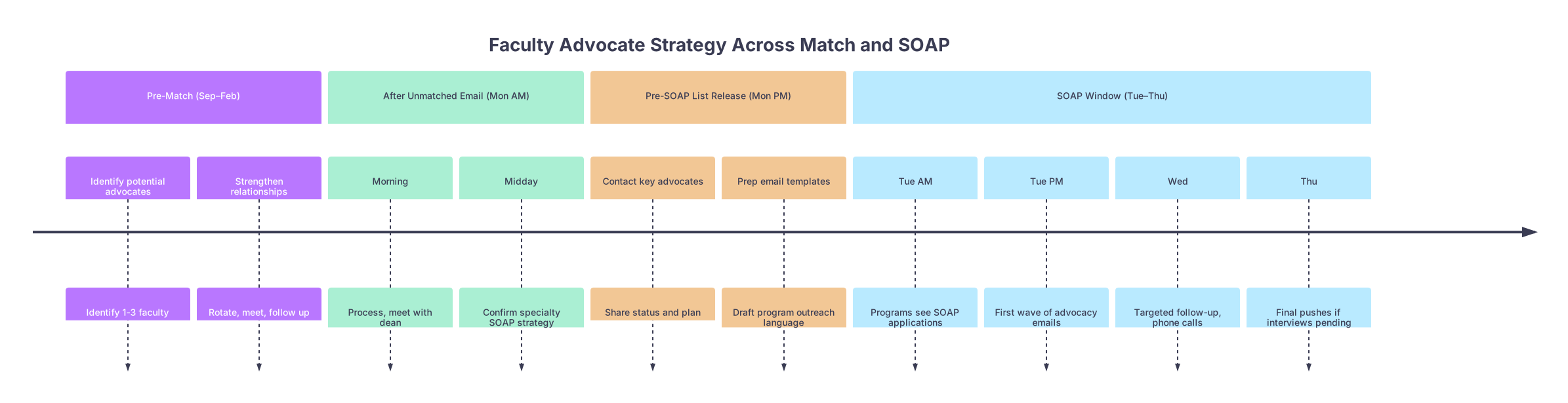
| Period | Event |
|---|---|
| Pre-Match (Sep–Feb) - Identify potential advocates | Identify 1-3 faculty |
| Pre-Match (Sep–Feb) - Strengthen relationships | Rotate, meet, follow up |
| After Unmatched Email (Mon AM) - Morning | Process, meet with dean |
| After Unmatched Email (Mon AM) - Midday | Confirm specialty SOAP strategy |
| Pre-SOAP List Release (Mon PM) - Contact key advocates | Share status and plan |
| Pre-SOAP List Release (Mon PM) - Prep email templates | Draft program outreach language |
| SOAP Window (Tue–Thu) - Tue AM | Programs see SOAP applications |
| SOAP Window (Tue–Thu) - Tue PM | First wave of advocacy emails |
| SOAP Window (Tue–Thu) - Wed | Targeted follow-up, phone calls |
| SOAP Window (Tue–Thu) - Thu | Final pushes if interviews pending |
Pre-SOAP (ideally months before)
You should be identifying and cultivating potential advocates during:
- Core rotations in your target specialty
- Sub-I / acting internship
- Electives where you worked closely with faculty
Concrete actions:
- Ask for feedback midway through rotation
- Ask if they would “feel comfortable supporting your application strongly”
- If they say yes enthusiastically, that is your potential SOAP advocate
You do not have to say “if I SOAP” months ahead. You are simply building a network.
Immediately after you learn you are unmatched (Monday morning)
You will be wrecked. That is normal. But you do have moves to make the same day.
Your sequence should be:
- Meet with your dean or advisor. Clarify:
- Which specialties you will SOAP into
- Whether you are aiming for categorical vs prelim vs transitional
- Make a clean advocate list:
- Tier 1–3 faculty in your target SOAP specialties
- One or two “general” advocates (e.g., medicine faculty for prelim, FM, IM)
By Monday afternoon, you should have:
- A short, updated SOAP CV (1–2 pages max)
- A current personal statement tailored to the SOAP specialty
- A one-paragraph summary of your story: strengths + the “why I did not match” narrative
Monday late afternoon / early evening (before the SOAP list goes live)
This is when you prep your advocates, not when they contact programs.
You send them:
- A concise status update
- Your updated CV and PS
- The list of specialties you are targeting
- A heads-up that you may ask them to reach out Tuesday–Wednesday
You do not want to be introducing the topic of SOAP to them on Wednesday at 3 pm. That is how you lose 24 hours.
Tuesday–Thursday (active SOAP phase)
Programs receive your SOAP applications Tuesday morning. Most start reviewing by late morning.
Your advocacy timing here:
Tuesday late morning–afternoon:
First wave of emails from your top advocates (Tier 1–2) to priority programs where you have applied.Wednesday:
Follow-up or second wave of advocacy: additional programs, phone calls for especially strong fits, brief updates (“student just completed another strong ICU rotation”).Thursday:
Only targeted pushes, not mass emails. Some programs are still making lists, especially for prelim and community spots.
You should not be spamming all 50 programs your ERAS auto-applied to. That is lazy and obvious. Better to choose 8–15 realistic targets and coordinate those.
4. How to Brief Your Advocate (So They Say What Programs Actually Care About)
Most poor advocacy emails fail for one of three reasons:
- Vague fluff (“hard-working, compassionate, team player”)
- No context about why you are in SOAP
- Generic subject line that PDs will ignore
You fix this by giving your advocate a tight, structured brief.
Here is what you send them (by email) Monday evening or early Tuesday:
- One-paragraph status summary
- PDF of your ERAS CV (or a 1–2 page SOAP CV)
- Your personal statement tailored to the SOAP specialty
- Bullet list: which programs you have applied to that you want them to contact
- A suggested email template they can modify
- Your cell phone, and your willingness to interview on short notice
Do not make them dig for anything. They will not. They are in clinic, they are on service, they have 14 minutes between patients.
5. Email Templates: From You to Faculty, and From Faculty to Programs
Let me give you concrete language. You will adjust details, but the structure should stay.
A. Your email to a potential advocate (pre-SOAP or Monday)
Subject line matters. Professors skim.
Template 1: Initial outreach to faculty advocate (before SOAP activity)
Subject: Request for support during SOAP – [Your Name, MS4]
Dr. [Last Name],
I am writing to share some difficult news and to ask for your guidance and support.
I did not match this cycle. After meeting with our dean, I will be entering the SOAP with a focus on [specialty, e.g., Internal Medicine categorical and Prelim Medicine positions]. I very much enjoyed working with you on [rotation / project] and have always appreciated your feedback and mentorship.
I am attaching my updated CV and a brief statement of interest for [specialty]. If you feel comfortable doing so, I would be grateful for:
- Your honest feedback on how I can present myself most effectively in this setting, and
- Your potential support in reaching out to a small number of programs where your name might carry weight, once I know which positions I can apply to.
I know this is an exceptionally busy week. I would appreciate any level of help you are able to provide, and I understand if your schedule does not permit active involvement during SOAP.
Thank you for considering this, and for all of your teaching this year.
Best regards,
[Full Name], MS4
[School]
Cell: [number]
This gives them:
- The situation
- Your target specialty
- A clear ask
- An easy out (so only the truly willing say yes)
B. Your follow-up email once the SOAP list is live (to confirmed advocates)
Template 2: Program-specific briefing to a confirmed advocate
Subject: SOAP update + suggested programs to contact – [Your Name]
Dr. [Last Name],
Thank you again for your willingness to support me during SOAP.
The list of unfilled positions is now available. I have applied through ERAS to the following [specialty] programs where I believe your name or network may be helpful:
- [Program Name, City, State] – [brief reason, e.g., “Affiliated with [Your School]” or “You know PD Dr X”]
- [Program Name] – [reason]
- [Program Name] – [reason]
I have attached:
- My updated SOAP CV
- My [specialty] personal statement
If you are able, would you consider emailing the program director or associate program director for 3–5 of these programs to briefly recommend me for an interview? I have included a suggested template below for convenience, but please feel free to adapt it.
I am available by phone or video at any time if a program contacts you or me. My cell is [number].
Thank you again for your help during a very challenging week.
Sincerely,
[Full Name], MS4
[School]
Then you paste a separate template (below) that they can modify.
C. The faculty advocate email to programs
Now the part that matters most. This email must be:
- Short
- Specific
- Clear about the ask
- Honest but framed
A PD does not want an essay. They want 2–3 sharp lines that help them decide: “worth interviewing or not?”
Template 3: Faculty advocate email to program director
Subject: Strong recommendation for SOAP applicant – [Your Name], MS4 at [School]
Dr. [PD Last Name],
I hope you are managing the SOAP week as smoothly as possible.
I am writing to strongly recommend [Student Full Name], a fourth-year student at [School], who has applied to your unfilled [specialty] positions through SOAP.
[Student Last Name] worked with me on [rotation / service] from [dates], during which I supervised them directly. They functioned at the level of a strong incoming intern: reliable, prepared, responsive to feedback, and an excellent team member. I would be very comfortable having them as a resident in our program.
They did not match this cycle primarily due to [brief, honest explanation framed tightly – see below], but I do not believe that reflects their potential as a trainee.
If you have room for additional interviews, I think [Student Last Name] would serve your program very well. I would be happy to discuss them further by phone if that would be helpful.
Best regards,
[Faculty Name], MD
[Title – e.g., Program Director, Internal Medicine Residency]
[Institution]
[Email]
[Phone]
The key is that middle paragraph: “did not match because…” That is where most advocates either dodge completely or overshare.
You want one controlled sentence.
Examples depending on situation:
For slightly low Step 1/2 but good recent performance:
“They were limited by somewhat below-average test scores compared with the field, but their clinical performance and growth this year have been outstanding.”For overreaching on original specialty:
“[Student] pursued [competitive specialty] initially and limited the number of [SOAP specialty] applications, which did not align well with current competitiveness.”For IMG with visa issues:
“Their match options were constrained this year by visa considerations and a narrow initial program list.”For a prior leave / red flag that is already in ERAS:
“They had a personal leave in M2 which has since been fully resolved; they have performed at a high level across their M3 and M4 rotations.”
Do not let the advocate write a detailed autopsy. You are not trying to relitigate the entire application. You are giving a quick, human explanation and then pivoting to: “I would take this person.”
6. Specialty-Specific Variations: What Programs Care About in SOAP
Different specialties listen for different signals. Your advocate should lean into the right ones.

Internal Medicine / Prelim Medicine
What PDs want to hear:
- Reliability on wards and nights
- Comfort with high patient volume and comorbidities
- Ability to function independently with appropriate supervision
Advocate should mention:
- Number of patients you carried
- Specific rotations where you shined (wards, ICU, night float)
- Any evidence of rapid improvement or strong feedback from residents
Family Medicine
They care about:
- Breadth of clinical skill
- Communication, especially with patients from varied backgrounds
- Commitment to primary care and continuity
Advocate angle:
- How you connected with patients and families
- Ambulatory experiences, community clinics
- Flexibility and adaptability
Pediatrics
They look for:
- Teamwork
- Kindness and patience
- Comfort with anxious parents and sick kids
Advocate should emphasize:
- Your performance in NICU/PICU/general peds
- Feedback from nurses and families
- Your ability to stay calm and empathetic
Surgery / Prelim Surgery
Blunt truth: they care if you are tough, reliable, and show up.
Advocate focus:
- Work ethic on call
- Professionalism and no-drama attitude
- Early mornings, late nights, no complaints
Psychiatry
They want insight, communication, and stability.
Advocate talking points:
- Your ability to handle difficult conversations
- Maturity in managing emotionally intense situations
- Thoughtfulness, reflective capacity
Your faculty should not send the same generic line to IM, FM, and psych. A one-sentence tweak makes a difference.
7. Coordinating Multiple Advocates Without Creating Noise
The worst version of this is uncontrolled chaos: five different faculty emailing the same PD with slightly different stories. PDs notice when it feels orchestrated poorly.
You want a small, coordinated set of voices:
- 1–2 high-yield advocates for your main SOAP specialty
- Maybe 1 additional for backup specialties (prelim, FM, etc.)
- No more than 1–2 advocates contacting the same program
You manage this by:
Creating a simple shared list (even a text or short email) of:
- Programs you are targeting most
- Which advocate is assigned to which program
Telling each advocate:
“I have asked Dr [X] to reach out to [Programs A and B]. If you are able, I would be grateful for your help with [Programs C and D], to avoid duplicating emails.”
Most faculty will appreciate that you are organized and not blasting every PD in the country.
8. Phone Calls: When an Advocate Should Pick Up the Phone
Email is the default. Phone calls are for high-yield, high-relationship situations.
Here is when a phone call is appropriate:
- Your advocate personally knows the PD (trained together, society committees, prior colleagues)
- You are a particularly strong fit for that institution (geography, language skills, personal ties)
- Time is short and the PD has not replied to email
Your advocate’s script should be brutally simple:
“Hi [First Name], this is [Advocate Name] from [Institution]. I know this is a crazy week. I just wanted to put a quick plug in for a student of ours, [Student Name], who applied to your [specialty] SOAP positions. I supervised them directly and think they would be a really solid intern for you. If you have five minutes to glance at their application, I would appreciate it.”
That is it. Short, collegial, no pressure.
If your advocate starts arguing, begging, or overselling, it backfires. PDs remember pushy calls more than polite, professional ones.
9. Common Mistakes That Quietly Kill the Impact of Advocates
I have seen the same avoidable errors over and over:
Last-minute scrambling.
Emailing a potential advocate Wednesday afternoon with no CV, no PS, and a vague “can you help?” message. By the time they respond, the program list is already finalized.Over-contacting programs.
Having three different faculty email the same small community program. It looks desperate and disorganized.Advocates who barely know you.
“I met this student once at grand rounds” quality emails. PDs can smell it. It can actually undermine your credibility.No explanation for why you are in SOAP.
Trying to pretend the red flags or context do not exist. Silence lets PDs assume the worst.Over-sharing about your problems.
Advocates writing three paragraphs on your failed Step 1, family crisis, mental health hospitalization. You do not need that level of detail in an initial email. At all.Generic mass emails.
“Dear program director, I strongly recommend Student X to any program.” With no reference to their specialty, no specific rotation details. That is weak.You disappearing.
Advocate emails the PD, the PD replies, and you take 6 hours to answer. SOAP is measured in minutes. Keep your phone on you at all times.
10. A Quick Reality Check: What Faculty Advocates Can and Cannot Do
Let me be blunt.
A faculty email does not:
- “Override” program filters that auto-screen out major red flags everywhere
- Guarantee an interview at a top-tier academic name that has 200+ SOAP applicants
- Erase a pattern of unprofessional behavior that is in your MSPE
What it does:
- Moves you from “anonymous applicant #173” to “person X recommended by PD Y”
- Gives PDs a reason to look twice at an application they might have skimmed past
- Frames your weaknesses as survivable and your strengths as real
You are playing probabilities, not absolutes. But in SOAP, small probability bumps at 7–10 programs can be the difference between 0 and 1 offer.
11. Practical Action Plan: What You Should Actually Do
To make this concrete, here is the sequence I would expect from a student using advocates intelligently.
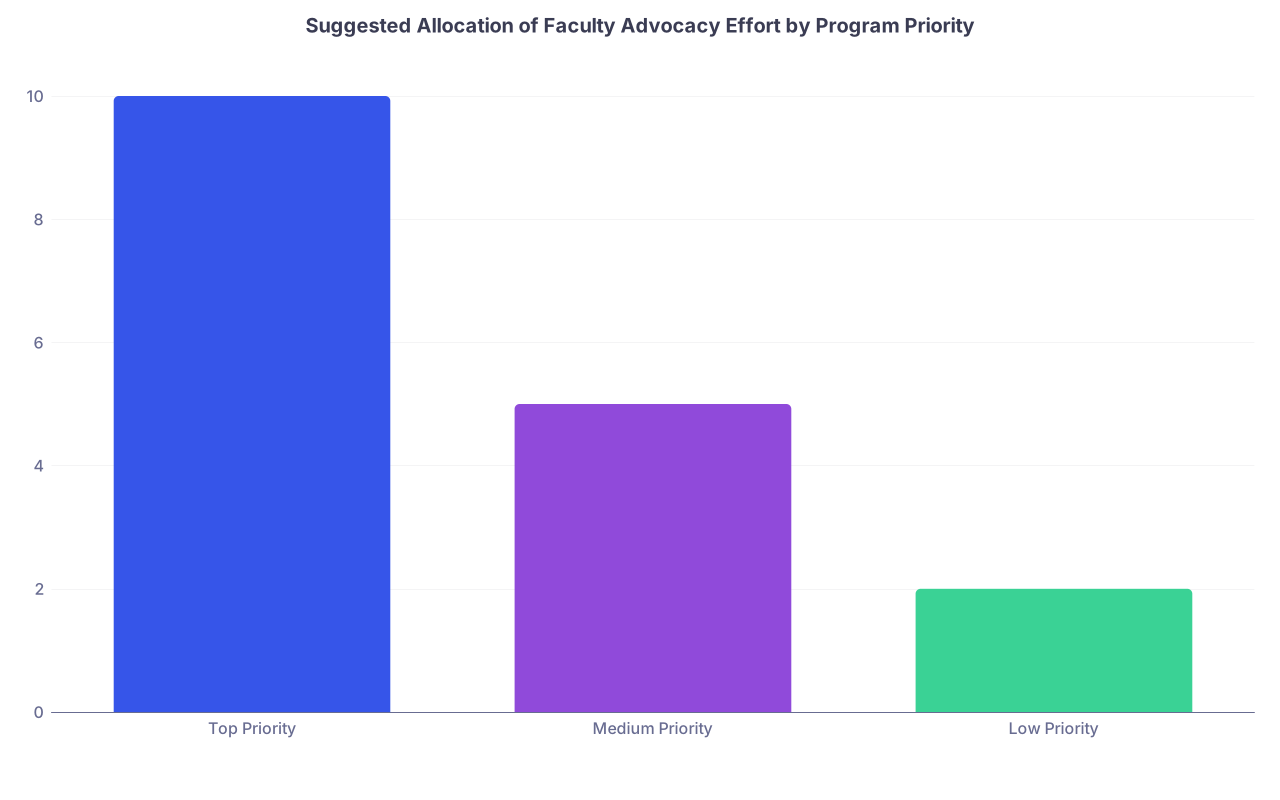
| Category | Value |
|---|---|
| Top Priority | 10 |
| Medium Priority | 5 |
| Low Priority | 2 |
Interpretation: For 10 top-priority programs, you deploy your strongest advocates; for 5 medium-priority programs, you still attempt advocacy; for 2 low-priority programs, you rely on your application alone.
Now, your steps:
Before Match Week (if you still have time):
- Identify 2–3 faculty who would “strongly support” you.
- Let them know you may reach out if SOAP becomes necessary.
Monday (after the “you did not match” email):
- Meet with dean, pick target SOAP specialties.
- Update CV, personal statement.
- Email potential advocates with Template 1.
- Confirm who is willing and available to help.
Monday evening:
- Build your target program list per specialty tier (realistic, not fantasy).
- Prep your brief for each advocate: your story, your strengths, your explanation.
Tuesday morning:
- Apply to SOAP programs immediately when allowed.
- Send advocates your program list (Template 2) and your documents.
- Confirm they have bandwidth to send a few emails by afternoon.
Tuesday afternoon–Wednesday:
- Advocates send emails (Template 3) to 3–10 programs each, depending on their role and relationship.
- You monitor email and phone constantly.
- You respond to any program outreach immediately, graciously, and professionally.
Thursday:
- If no offers yet, ask advocates if they are comfortable with one or two targeted follow-ups or calls to particularly good-fit programs that still appear unfilled.
- You keep your schedule completely free and communication lines open.
That is how you use faculty advocates strategically, not desperately.
12. Final Thoughts
Three points to hold onto:
The quality and timing of advocacy matters more than the sheer number of emails sent. One well-timed message from the right PD can beat ten generic notes from random attendings.
You must do the logistical heavy lifting for your advocates: updated documents, clear program lists, tight explanations. If you make it easy for them, they are far more likely to act quickly.
Faculty advocacy cannot fix everything, but in SOAP’s compressed chaos, it can be the deciding factor that gets your file opened, your interview scheduled, and your name on a rank list. Use that lever deliberately, not as an afterthought.