
Most SOAP CVs fail for one simple reason: they are written for the Match, not for the scramble.
Let me be blunt: a SOAP CV that worked for September applications will quietly kill you in March. Different game. Different audience. Different priorities.
You are not trying to look like “the perfect categorical resident” anymore. You are trying to look like “the safest, most adaptable fix to a program’s urgent problem in 48–72 hours.”
Let me break this down specifically.
1. The SOAP Mindset: What Your CV Really Has To Do
During Main Match season, your CV supports a narrative: your long-term interest in a specialty, your scholarly productivity, your trajectory.
During SOAP, your CV does something else entirely: it de-risks you.
Programs in SOAP read fast and think in questions:
- Will this person show up in July?
- Will they handle nights, cross-coverage, floor chaos?
- Do they have a history of quitting, failing, or drama?
- Can I sell this person to my clinical competency committee and my PD in 30 seconds?
They are not reading to be impressed. They are reading to be reassured.
So your SOAP-specific CV layout has to:
- Put “evidence of reliability and flexibility” in the top 1/3 of page 1.
- Make it idiot-proof to see that your red flags (if any) are addressed and contained.
- Show that you have functioned in varied contexts (different hospitals, systems, patient populations, roles).
- Compress academic vanity and expand workmanlike competence.
This means your SOAP layout is not a cosmetic tweak. It is a structural rewrite.
2. Overall SOAP CV Architecture: The Skeleton
You have limited time and reviewing faculty have even less. You need a layout that surfaces what matters for SOAP in about 10–20 seconds of scanning.
Use this order. It is not negotiable if you want maximum impact.
- Header + Rapid Contact
- Emergency Snapshot Block (I am calling this out because almost nobody does it, and it works)
- Education + Key Exams (SOAP-relevant, simplified)
- Clinical Experience (rotations + hands-on roles)
- Flexibility & Systems Exposure (this section is SOAP gold)
- Work Experience / Leadership / Service (collapsed, but curated)
- Research / Publications (only if not empty calories)
- Explanations / Clarifications (strategic, short, near the end)
- Skills (procedural + language + EMR)
You are not building a pretty academic CV. You are building a fast triage document.
Let me show you what that looks like visually.
| Section Order | SOAP Priority |
|---|---|
| Header + Contact | Essential |
| Emergency Snapshot Block | Critical |
| Education + Exams | High |
| Clinical Experience | High |
| Flexibility & Systems Exposure | Critical |
| Work / Leadership / Service | Moderate |
| Research / Publications | Low–Moderate |
| Explanations / Clarifications | Critical if red flags |
| Skills (Procedural/Language/EMR) | High |
Notice what is missing from the top: awards, hobbies, random committee memberships. Those go down or out.
3. The Header and Emergency Snapshot Block
Your header itself is straightforward:
- Full Name, expected degree and year (if still finalizing requirements).
- Phone, professional email, ERAS AAMC ID.
- Optional: Current location (city, state).
Under normal circumstances, you would jump straight into education. For SOAP, I prefer an “Emergency Snapshot Block” right under the header. Two to three lines, visually boxed or bolded, that answer:
- Who are you?
- What can you start as?
- Why are you low risk?
Example:
Emergency Snapshot:
US MD 2024 graduate • Passed Step 1 (P) and Step 2 CK 233 on first attempt • 8 months recent US inpatient IM exposure at academic and community sites • Fully eligible to start PGY-1 July 2026, no visa required.
This is not a personal statement. This is a risk summary.
Put your strongest SOAP-relevant selling points here:
- All exams passed, no pending tests.
- Visa status if clean and simple (e.g., “US Citizen”, “Green Card holder”).
- Clear ability to start on time.
- Specialty-agnostic strengths: inpatient experience, night shifts, cross-coverage, language ability in high-need populations.
If you have a perceived red flag but a strong containment story, you can hint at it here without dwelling:
US IMG 2022 graduate • Step 1 (P), Step 2 CK 221 (1st attempt), Step 3 216 (1st attempt) • 6 months recent USFMG-supervised inpatient rotations, strong letters available.
You are saying: “Yes, I am not perfect. But I am tested and stable now.”
4. Education and Exams: Compressed, SOAP-Optimized
Programs in SOAP do not want an essay about your high school achievements. They want to know: what medical school, when, any extended gaps, and where your exams stand.
Layout:
Education
[Institution Name], [Degree], [City, Country]
[Dates (Month Year – Month Year)], GPA or class rank if actually impressive and standardized.
List only:
- Medical school
- Prior degree(s) if clinically or scientifically relevant (e.g., RN, MPH, PhD).
Do not waste space on high school or irrelevant short courses.
Exams
Keep it simple and in a tight, scannable format:
USMLE Step 1 – Pass (first attempt), 2022
USMLE Step 2 CK – 238 (first attempt), 2023
USMLE Step 3 – Planned: May 2026
Or for COMLEX, same model.
If you have a fail, you do not hide it. You normalize it and show progression:
USMLE Step 1 – Pass (second attempt), 2020
USMLE Step 2 CK – 222 (first attempt), 2022
USMLE Step 3 – 225 (first attempt), 2024
Progression tells them: “Pattern improved. Risk of failure in-training is lower.”
To drive home how exam data feeds SOAP triage decisions, here is how programs often think.
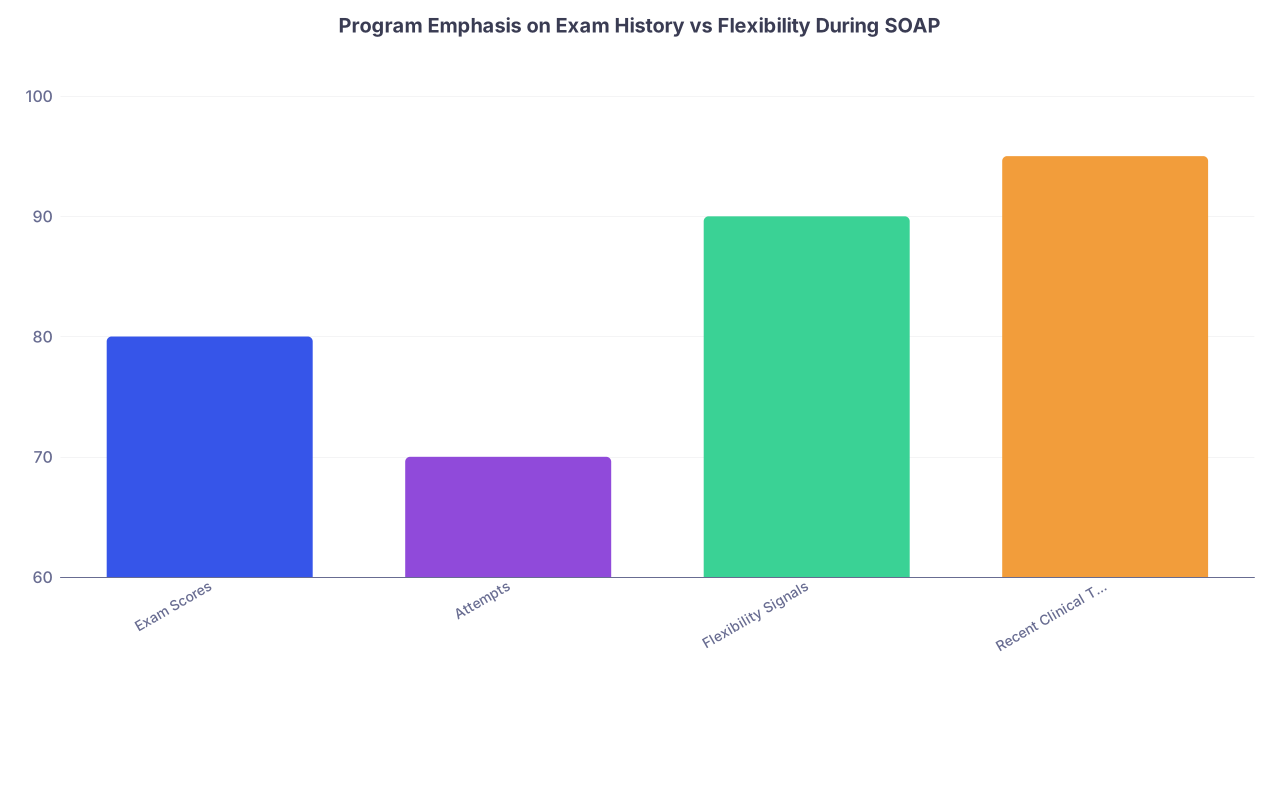
| Category | Value |
|---|---|
| Exam Scores | 80 |
| Attempts | 70 |
| Flexibility Signals | 90 |
| Recent Clinical Time | 95 |
During September, exam scores might be the glamour metric. During SOAP, recent clinical activity and flexibility cues can outweigh a just-okay score.
5. Clinical Experience: Make Flexibility Obvious
This is where most SOAP CVs make their biggest mistake: they list rotations in a boring, chronological dump that hides the good stuff.
You need to structure this to scream: “I have worked in different settings, learned fast, and operated at intern-level tasks.”
Break clinical experience into:
- Core Rotations
- Subinternships / Acting Internships
- Additional Clinical Experience (externships, observerships, hospital roles)
For each entry, you must telegraph flexibility and function, not just presence.
Example:
Internal Medicine Subinternship – 4 weeks
University Hospital, Tertiary Academic Center, State, USA | 08/2023
- Functioned at intern level managing 6–8 patients on general medicine service.
- Participated in night float, cross-covering up to 30 patients with resident oversight.
- Managed admissions from ED, including initial orders, H&P, and early management plans.
That “night float” and “cross-cover” are SOAP gold. Programs read that and think: “This person has at least seen real responsibility.”
For IMGs, be extremely clear about US-based vs home rotations and recency:
Inpatient Internal Medicine Rotation – 8 weeks
Community Hospital, State, USA | 11/2023–12/2023
- Worked on hospitalist service with exposure to high census and limited ancillary support.
- Regularly updated handoffs, communicated with nursing and case management.
- Accepted direct feedback to adapt to US documentation and EMR workflows (Epic).
Flexibility is encoded in phrases like:
- “Adapted from [home system] to [US hospital] documentation and workflow.”
- “Covered multiple services/units during a single month.”
- “Worked at both academic and community sites with differing protocols.”
6. The Flexibility & Systems Exposure Section: Your SOAP Engine
This section does not exist in most standard CV templates. That is precisely why you should include it.
Label it clearly:
Flexibility and Systems Exposure
This is where you group experiences that prove you can handle change, heterogeneity, and imperfect conditions. That is what SOAP programs want.
You can categorize briefly, then give bullets.
For example:
Settings
- Academic tertiary center (Level 1 trauma, quaternary referrals) – 3 months (IM, Neurology)
- Community hospital (limited subspecialty support) – 4 months (IM, FM, Night Float exposure)
- Safety-net / FQHC clinic – 2 months (FM, high social complexity)
Roles and Responsibilities
- Covered both day and night shifts in different hospitals.
- Assisted teams managing high boarding census in ED and hallway care.
- Floated between wards and step-down depending on census needs.
Adaptability Examples
- Transitioned from paper-based documentation at home institution to Epic and Cerner within 1–2 weeks.
- Worked effectively in two languages (English and Spanish) with no interpreter for simple visits.
- Stepped into extra call shifts to cover sick residents, maintaining handoff quality.
You are building an argument: “I do not crumble when the system is messy. I adjust.”
To map this to what programs actually need during SOAP, think about their pressure points.

| Step | Description |
|---|---|
| Step 1 | Unfilled Positions |
| Step 2 | Need fast learners |
| Step 3 | Need reliable workers |
| Step 4 | Need schedule flexibility |
| Step 5 | Highlight varied settings |
| Step 6 | Highlight stability and no drama |
| Step 7 | Highlight nights and extra shifts |
| Step 8 | Why unfilled |
Your Flexibility section directly plugs into nodes F, G, H.
7. Work Experience, Leadership, Service: Curate Ruthlessly
You do not have the luxury of a 9-page CV. Two to three pages max. Anything that does not sell reliability, responsibility, or adaptability gets cut or shortened.
You want entries that say:
- You showed up consistently.
- You handled responsibility.
- You worked outside your comfort zone.
Fine. So how does that look?
Example of good SOAP-relevant non-clinical work:
Emergency Department Scribe
City Hospital, State, USA | 05/2020–08/2021 (Part-time)
- Documented 15–20 patient encounters per shift for multiple attendings.
- Adapted to varying provider styles and high-volume shifts.
- Maintained accurate documentation under time pressure.
Versus useless fluff:
Member, Photography Club
Nice, but no.
Leadership should be framed to show people-management, conflict handling, or system navigation. Not just titles.
Chief Medical Student (Internal Medicine Rotation)
Home Institution | 01/2023–03/2023
- Coordinated schedules and call coverage for 12 students across 3 teams.
- Served as liaison between faculty and student cohort to address workflow concerns.
- Organized peer teaching sessions on SOAP note efficiency and presentation skills.
That is what a PD reads as: “This person might keep the intern group from falling apart at 2 a.m.”
8. Research and Publications: Demote, Do Not Worship
For SOAP into research-heavy academic IM or Rad Onc, your traditional research layout may still matter.
For most SOAP situations (IM, FM, peds prelim, TY), research is a bonus at best. It is never your headline.
You include it, but you strip the bloat:
- Group abstracts together.
- Use standard citation format but keep to 1–2 lines.
- Emphasize projects with clinical relevance, quality improvement, or system adaptation.
For example:
Quality Improvement Projects
- “Reducing Discharge Delays on Medicine Service through Structured Handoffs,” poster, Regional ACP Meeting, 2023. Implemented revised discharge checklist; observed 15% reduction in mean discharge time.
That single bullet is more SOAP-relevant than three basic science posters that show no systems thinking.
9. Explanations / Clarifications: Put the Fire in a Box
SOAP is where red flags come home to roost: failures, gaps, LOA, probation, specialty switches, unmatched cycles.
You cannot hide them. But you can contain them.
Create a short section near the end titled Clarifications or Additional Information.
Each clarification should be:
- One to two sentences.
- Factual, non-defensive.
- Ended with evidence of resolution or improvement.
Examples:
USMLE Step 1 – Second Attempt
Failed initial attempt in 2019 during a period of family illness. Remediated with faculty support, passed on second attempt, and subsequently passed Step 2 CK and Step 3 on first attempts.
Gap (07/2022–02/2023)
Seven-month period spent completing required coursework after a delayed clerkship due to COVID-related scheduling changes. During this time, I also participated in volunteer telehealth support for home institution clinic.
For a prior unmatched year:
Prior Application Cycle (2024)
Applied to categorical Internal Medicine positions in 2024 and did not match. Since then, I have completed 4 additional months of US inpatient rotations and passed Step 3, with updated letters of recommendation reflecting improved clinical readiness.
You are telling PDs: problem existed, now stable, I have upgraded since.
10. Skills Section: Make It Clinically Useful
Do not bury your actual operational skills under generic “Microsoft Office” nonsense.
Break it into:
- Clinical / Procedural
- Systems / EMR
- Languages
Example:
Clinical/Procedural
Basic airway management (BVM, oral airway), peripheral IV placement, ABG sampling, simple suturing, NG tube placement, Foley catheter insertion (male and female), bedside ultrasound exposure (IV access, FAST).
Systems/EMR
Epic, Cerner, Meditech; familiar with computerized order entry, discharge summaries, and admission H&Ps.
Languages
Fluent: English, Spanish. Conversational: Arabic.
You will be surprised how many programs in high Spanish-speaking areas light up when they see a real second language they can actually use on wards.
To give you a sense of what PDs often scan for last-minute:
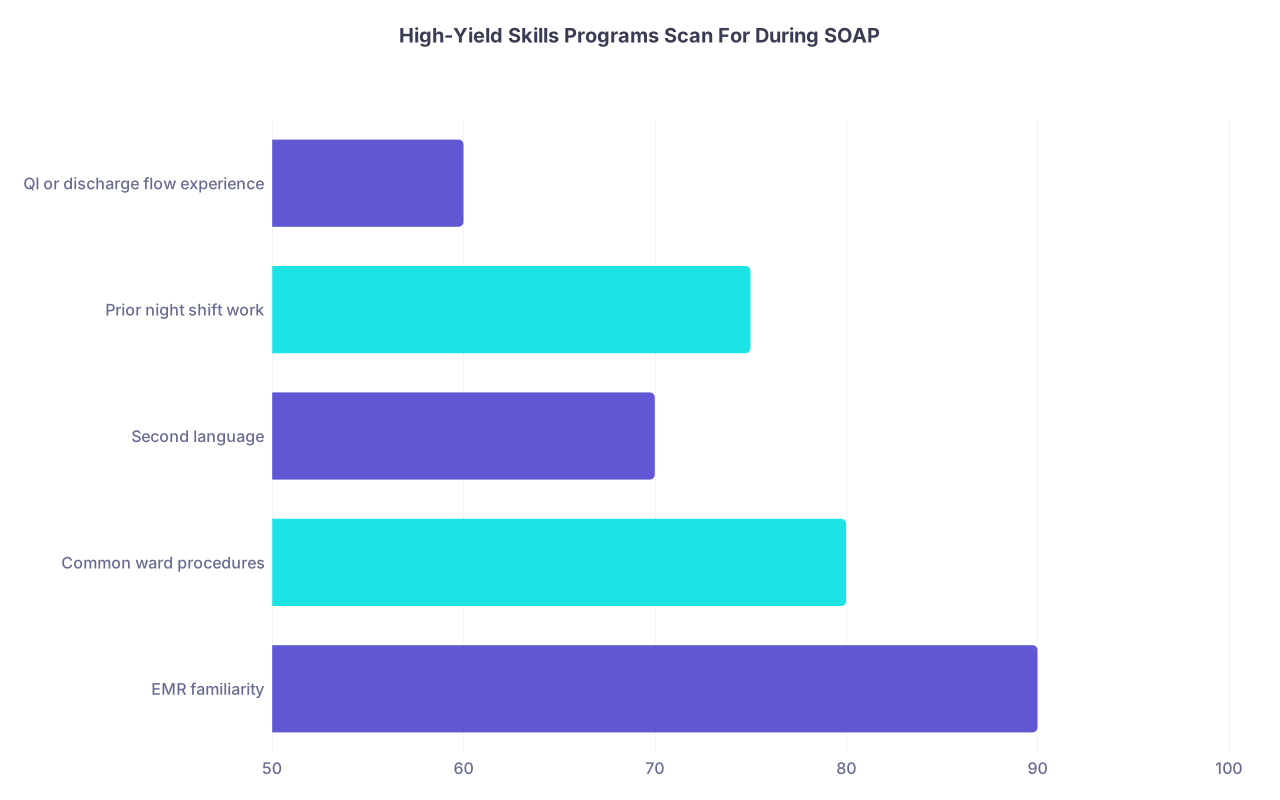
| Category | Value |
|---|---|
| EMR familiarity | 90 |
| Common ward procedures | 80 |
| Second language | 70 |
| Prior night shift work | 75 |
| QI or discharge flow experience | 60 |
You design your skills section accordingly.
11. Formatting Rules That Matter More During SOAP
SOAP is chaos. Programs skim. Layout is not aesthetics; it is usability under pressure.
Keep these hard rules:
- Length: 2–3 pages max. If you are under 1.5, that is fine, but do not exceed 3. They will not read it.
- Font: Clean, readable (11–12 pt). Calibri, Arial, Garamond, whatever—just consistent.
- Margins: Standard. Do not cram by shrinking margins to 0.3 inches. It looks desperate.
- Spacing: Clear section headings, consistent bullet levels, adequate white space.
- No color complexity: One accent color at most (e.g., dark blue for section headers), or just black/gray.
- File name:
LastName_FirstName_CV_SOAP_2026.pdf— not “finalCVnewnew2.pdf.”
You are making it easy for:
- The PD to screenshot or circulate.
- The coordinator to attach and retrieve.
- The faculty reviewer to skim on a phone at 11 p.m.
12. Adapting the Same CV to Multiple SOAP Specialties
This is where flexibility really gets tested. Many SOAP applicants cast a wider net: IM, FM, prelim surgery, TY, maybe peds.
You do not need four totally different CVs. You need one core layout with a few tunable elements:
- Emergency Snapshot Block
- Order of Clinical Experiences
- A few phrases in Flexibility and Skills
For example, for IM vs FM:
- IM version emphasizes: inpatient time, cross-cover, ICU exposure, complex medical management.
- FM version emphasizes: outpatient clinics, continuity, behavioral health, community and underserved care.
For a prelim/TY angle:
- Emphasize: willingness to rotate through multiple services, prior exposure to surgery/OB/ED, night shifts.
You can map which experiences float to the top.

Create a “master” CV and then, before upload, quickly:
- Adjust the Emergency Snapshot focus line (e.g., “5 months recent inpatient FM exposure” vs “4 months IM wards + 2 months ICU”).
- Reorder clinical experiences: put IM-heavy first for IM SOAP, FM-heavy first for FM SOAP.
- Slightly tweak the Flexibility and Skills bullets to align with each specialty’s usual pain points.
This is 15–20 minutes of work, not a full rewrite, and it pays off.
13. Common SOAP CV Mistakes That Quietly Sink You
I have seen these destroy otherwise workable applications:
Old, “academic vanity” CV. 9 pages, detailed descriptions of premed clubs, but nothing about recent clinical work. Programs cannot see if you can function in July.
No date clarity. Gaps, no months, only years. During SOAP, ambiguity = risk. Always list month and year.
Hiding Step failures. PDs see them in ERAS anyway. Not addressing them in Clarifications makes you look evasive.
Overemphasis on research. Three full pages of bench work, two vague lines about clinical rotations. Looks like you do not actually want to be in the hospital.
Poor file hygiene. Typos in section headings, inconsistent bullet styles, random capitalization. Programs extrapolate: sloppy CV, sloppy notes, sloppy patient care.
No evidence of recency. Last dated clinical entry is 2022, but you are SOAPing in 2026 with no explanation. That will kill you if not addressed.
14. Putting It All Together: A Simple Build Sequence
If you are building or rewriting your SOAP CV under time pressure, follow this sequence:
- Write the header and Emergency Snapshot Block.
- Add Education and Exams with clean, honest data.
- Build Clinical Experience with SOAP-optimized bullets that highlight responsibility and varied settings.
- Construct the Flexibility & Systems Exposure section from across your experiences.
- Add Work / Leadership / Service with ruthless curation.
- Drop in Research / Publications briefly, if meaningful.
- Add Clarifications for any red flags.
- Finish with a high-yield Skills section.
- Tighten formatting and file naming.
There is your skeleton. You can tune specialty emphasis later.
To visualize the flow:

| Step | Description |
|---|---|
| Step 1 | Start CV |
| Step 2 | Header and Snapshot |
| Step 3 | Education and Exams |
| Step 4 | Clinical Experience |
| Step 5 | Flexibility and Systems Exposure |
| Step 6 | Work Leadership Service |
| Step 7 | Research Publications |
| Step 8 | Clarifications |
| Step 9 | Skills |
| Step 10 | Format and Export |
FAQ (Exactly 5)
1. Should I explicitly label the CV as “SOAP CV” on the document itself?
No. Label the file name with “SOAP” so you and coordinators can track versions, but the document header should just be your name and credentials. You do not need “SOAP” stamped on the top screaming “backup plan.”
2. How far back should I go with experiences on a SOAP CV?
As a rule, keep detailed entries to the last 5–7 years, with emphasis on the last 2–3. Older, highly relevant items (prior nursing work, EMT, etc.) can stay, but simplify them. Programs are most interested in what you have done recently and consistently.
3. If I switched specialties (e.g., from surgery to IM), how do I show that without looking unstable?
Use the Clarifications section. One to two sentences: acknowledge the prior interest, state what you learned, then clearly state your current commitment. On the CV itself, highlight internal medicine–relevant rotations and experiences at the top. You are selling a matured decision, not indecision.
4. Do I need separate CVs for each SOAP specialty I apply to?
You need one core CV with tunable elements. Create modestly tailored versions for major specialty shifts (e.g., IM vs FM vs prelim/TY) by changing the Emergency Snapshot and reordering clinical experiences. Do not create 6 totally different documents that you cannot track under time pressure.
5. How “personal” should the Emergency Snapshot Block be?
Not personal at all. This is not a personal statement. It is a clinical and logistical snapshot: degree, graduation year, exam status, recency of US clinical experience, visa/start eligibility. Save any narrative or “why this specialty” for other parts of the application, not the CV.
You are not trying to build the prettiest CV on earth. You are building a battlefield tool for a 4-day window where programs are scared of making a bad choice.
Design your SOAP-specific layout so that, on a tired PD’s laptop at midnight, your flexibility, stability, and readiness jump off page 1. With that foundation in place, you will be in far better shape when those sudden SOAP interview calls start coming in—how to handle those, though, is a different strategy entirely.