
It is Monday of SOAP week. You did not see your name on the “Congratulations, you matched” email. Now you are staring at a list of 150+ unfilled programs: “Preliminary Surgery (categorical track possible)”, “Transitional Year – community based”, “Internal Medicine – broad-based clinical training,” “Hybrid IM/Neuro with flexible career outcomes.”
And you realize your existing personal statement is laser‑targeted to one thing: “I want to be an academic cardiologist at a tertiary-care center.”
That statement will actively hurt you with half the programs now on your SOAP list.
Let me walk through how you fix that. Fast. And correctly.
1. What “Broad-Scope” Really Means in SOAP (And Why Your Old PS Is a Problem)
Broad-scope programs are those that are not promising a single, narrow career lane. They emphasize flexibility, generalist training, and wide applicability.
You see phrases like:
- “broad-based clinical training”
- “preparation for a variety of specialties”
- “ideal for undecided applicants or those seeking solid foundation”
- “transitional year—strong exposure across disciplines”
These programs are filling seats in SOAP for several reasons:
- Applicants originally chased ultra-competitive categorical spots.
- People ignored broad, flexible programs in the main match because they were “backup” or “too general”.
- Programs expanded class size or created new tracks that did not completely fill.
Your old personal statement usually has at least one of these problems:
- Hyper-specific career target: “I am committed to becoming a pediatric interventional cardiologist.”
- Name-dropping: “My dream is training at an academic powerhouse like XYZ.”
- Specialty-locked narrative: months of “Since childhood I knew I would be a dermatologist.”
- Prestige fixation: “I am seeking a top-tier, research-intensive, quaternary care institution.”
For SOAP broad-scope programs, this is bad for one simple reason: it screams “You are a consolation prize. I do not want what you are offering. I am treating you as a holding pattern.”
They want the opposite. They want:
“This kind of broad, flexible, high-volume environment is actually exactly what I want, here is why, and here is what I am going to do with it.”
2. What Broad-Scope SOAP Programs Are Actually Screening For
Forget the brochure copy. Let me translate what program directors are thinking when they read SOAP personal statements for broad-scope positions.
They are asking:
- Will this person show up and work hard, or will they sulk because they did not get their dream specialty?
- Is this applicant resilient enough after not matching to still be coachable and professional?
- Does their story fit a generalist or flexible path, or are they clearly using me as a stepping stone and will be gone at first transfer opportunity?
- Are they safe? (Professionalism. No drama. No attitude.)
- Can they function broadly—different services, different specialties, varied patient populations?
If you give them a narrow, rigid, single-specialty manifesto, they see:
- Inflexible
- Poor insight
- High risk for dissatisfaction, complaints, or attrition
You must pivot the narrative to:
- Breadth of interests
- Comfort with uncertainty and diverse clinical exposure
- Long-term value of a broad foundation, even if you still have a specific interest
Let me be blunt:
For SOAP, they are not choosing the “most brilliant”. They are choosing the safest solid worker with a believable story.
3. Core Strategy: From “Narrow Dream” to “Broad Foundation”
You do not have days to reinvent yourself. You have hours. So you keep your core identity, but you reframe it.
The main shift:
From: “I must enter X specialty now or my career is over.”
To: “My long-term goal remains X‑ish, but right now the smartest move is to build a broad, durable clinical base in a program like yours, and my track record shows I thrive in that environment.”
Key moves:
De-specialize your language.
- Change “my passion for cardiology” → “my interest in complex internal medicine and longitudinal patient care.”
- Change “I am committed to plastic surgery” → “I am drawn to procedural care, perioperative medicine, and interdisciplinary teamwork.”
Emphasize foundation-building.
- “I value a strong clinical foundation that will support multiple possible career directions, from hospital-based practice to subspecialty training.”
Align your experiences to breadth.
- Highlight rotations where you handled varied patient types, flexible roles, or shifts across specialties.
- Downplay hyper-niche subspecialty research unless you can frame its broader skills: data analysis, attention to detail, interprofessional collaboration.
Signal realistic humility after not matching—without self-sabotage.
- One line is enough: “Not matching this cycle has pushed me to reflect, refocus, and prioritize programs that offer broad clinical exposure and mentorship.”
Do not write a confession letter. You are not at church. Acknowledge, reframe, move on.
4. Concrete Template for a Broad-Scope SOAP Personal Statement
You want speed and alignment. So here is a structure that works specifically for SOAP and broad-scope programs.
Paragraph 1 – Grounding in Broad Clinical Interest
Goal: Show you are not fixated on one microscopic niche.
Example skeleton:
Start with a concise clinical moment that shows you functioning in a broad or mixed environment.
Medicine floor admitting all-comers. Night shift on surgery cross-cover. TY rotation seeing pediatrics in the morning and adult ED in the evening.Then one or two lines framing your interests as broad and flexible.
Concrete example (rough):
“In my sub-internship on the internal medicine service, I carried a list that ranged from new-onset DKA in a young adult to septic shock in an elderly patient with advanced malignancy. I found that what mattered most to me was not a single organ system, but the process of integrating complex information, coordinating teams, and guiding patients and families through uncertain situations. That experience confirmed that I want a residency that emphasizes broad clinical exposure and adaptable skills.”
This works for:
- Broad IM
- Transitional year
- Prelim internal med
- Many hybrid programs
You can tweak the details per specialty, but keep the theme: breadth, complexity distribution, adaptability.
Paragraph 2 – Your Path + Honest Pivot (Without Melodrama)
Goal: Briefly acknowledge your prior focus and show you are now strategically choosing breadth.
Example skeleton:
- One sentence: your original interest or leaning.
- One sentence: not matching or the competitive nature changed your focus.
- Two to three sentences: what you learned and why a broad-scope program makes strategic sense now.
Sample:
“Throughout medical school, I gravitated toward [original field or type of work], and I initially applied to programs with a narrow subspecialty focus. Not matching this cycle was difficult, but it has forced me to step back and consider what I need for a durable, flexible career in medicine. I realized that the skills I most value—clinical reasoning across diverse conditions, comfort with high patient volume, and effective communication with many services—are best developed in a broad-based program. I am now seeking a residency that will give me wide exposure while I refine my long-term direction and contribute meaningfully from day one.”
Notice what this does:
- Acknowledges reality. No gaslighting.
- Shows reflection, not desperation.
- Tells the PD: This person may still have ambitions, but they see value in what we offer.
Paragraph 3 – Concrete Evidence You Thrive in Broad or Rotating Roles
You cannot just say “I like diverse cases.” You must prove it.
Focus on:
- Rotations with variety: ED, IM ward, TY-like subI, night float, rural rotations.
- Roles where you moved between services or patient populations.
- Specific skills: triage, handoffs, managing uncertainty, quick learning.
Example structure:
“I have sought out and excelled in roles that demand adaptability. On my [ED / IM / surgery / rural] rotation, I was responsible for [X], which required me to shift rapidly between [types of cases]. I learned to prioritize efficiently, communicate clearly with multiple teams, and remain calm with uncertain diagnoses. Preceptors consistently commented on my ability to [quote or paraphrase strength], which is exactly the mindset I will bring to a broad-based internship or residency.”
You can directly quote feedback from an attending:
“Dr. ___ noted that I ‘handle a high volume of patients without losing attention to detail.’”
That reads like exactly what a broad-scope program wants: a safe, high-throughput, teachable intern.
Paragraph 4 – Targeted Alignment Based on Program Type
Now we get specific. You will adapt this paragraph depending on whether you are applying to:
- Transitional year (TY)
- Preliminary internal medicine
- Preliminary surgery
- Broad-scope categorical IM or FM
Use language that shows you actually understand their role, not generic filler.
| Program Type | Emphasis to Highlight | Red Flag to Avoid |
|---|---|---|
| Transitional Year | Flexibility, undecided, base | Overly fixed subspecialty plan |
| Prelim Medicine | Broad inpatient skills | Treating it as “gap year” |
| Prelim Surgery | OR + peri-op + work ethic | “I hate floor work” vibe |
| Categorical IM/FM | Longitudinal care + breadth | Calling it a “backup” specialty |
Examples:
Transitional year version: “A transitional year appeals to me because it will expose me to multiple specialties while I strengthen core skills such as patient assessment, cross-cover management, and effective sign-out. I value the opportunity to work closely with different departments and understand their perspectives before committing to a long-term path. My goal is to finish the year not only more clinically prepared, but also with a clearer, more informed career direction.”
Prelim medicine: “A preliminary year in medicine will allow me to build a strong foundation in managing acute and chronic conditions, coordinating complex care, and leading inpatient teams. I know that a demanding, broad-based intern year is essential preparation regardless of where I ultimately focus, and I am committed to using this year to become a reliable, efficient, and thoughtful clinician for both patients and colleagues.”
Prelim surgery: “A preliminary surgery position fits my interest in procedural care, critical illness, and team-based acute management. I enjoy the combination of time in the OR and responsibility for patients on the floor and in the ICU. I am prepared for the workload and intensity of a surgical internship and see it as an opportunity to develop strong habits, from meticulous preoperative preparation to clear communication with nursing and ancillary staff.”
Categorical IM / FM: “I am drawn to a categorical position in [internal / family] medicine because it offers exactly the kind of breadth I value—caring for diverse adult patients with a wide range of medical and psychosocial needs. I enjoy longitudinal relationships, but I am equally energized by the variety of conditions encountered on a busy ward or clinic day. Over time, I hope to build a practice that balances continuity with enough diversity to keep me constantly learning.”
Paragraph 5 – Close With Professionalism and Stability
Last paragraph should do three things:
- Reassure: You will show up, work hard, not be a problem.
- Emphasize teachability and team orientation.
- End with one clear sentence about what you want to contribute and gain.
Example:
“I am fully prepared to commit myself to the demands of internship—long hours, steep learning curves, and the responsibility of caring for vulnerable patients. Colleagues have described me as dependable, calm under pressure, and receptive to feedback, qualities I know are essential in the first year of residency. I am eager to join a program that values broad clinical exposure, strong mentorship, and a collaborative culture, and I will bring consistent effort, humility, and a genuine interest in learning from every rotation.”
That is it. Five paragraphs. Direct. Clean. Broad-scope aligned.
5. Handling Multiple Program Types in SOAP Without Losing Your Mind
You may be applying across several program types during SOAP: TY, prelim IM, prelim surgery, categorical FM, maybe hybrid IM/Neuro or IM/Anesthesia tracks.
You do not have time to write ten unique essays from scratch. But you also cannot send a surgery-focused statement to a transitional year that is mostly outpatient.
Use a modular approach:
- Keep Paragraphs 1–3 the same for all broad-scope programs, written in intentionally broad language.
- Create 2–3 versions of Paragraph 4 tailored to clusters:
- Version A: Transitional year / hybrid generalist programs.
- Version B: Prelim internal medicine / broad IM-based.
- Version C: Prelim surgery / surgically oriented.
- Keep Paragraph 5 essentially identical, maybe with one phrase tweaked (e.g., “in a surgical internship” vs “in a broad-based clinical internship”).
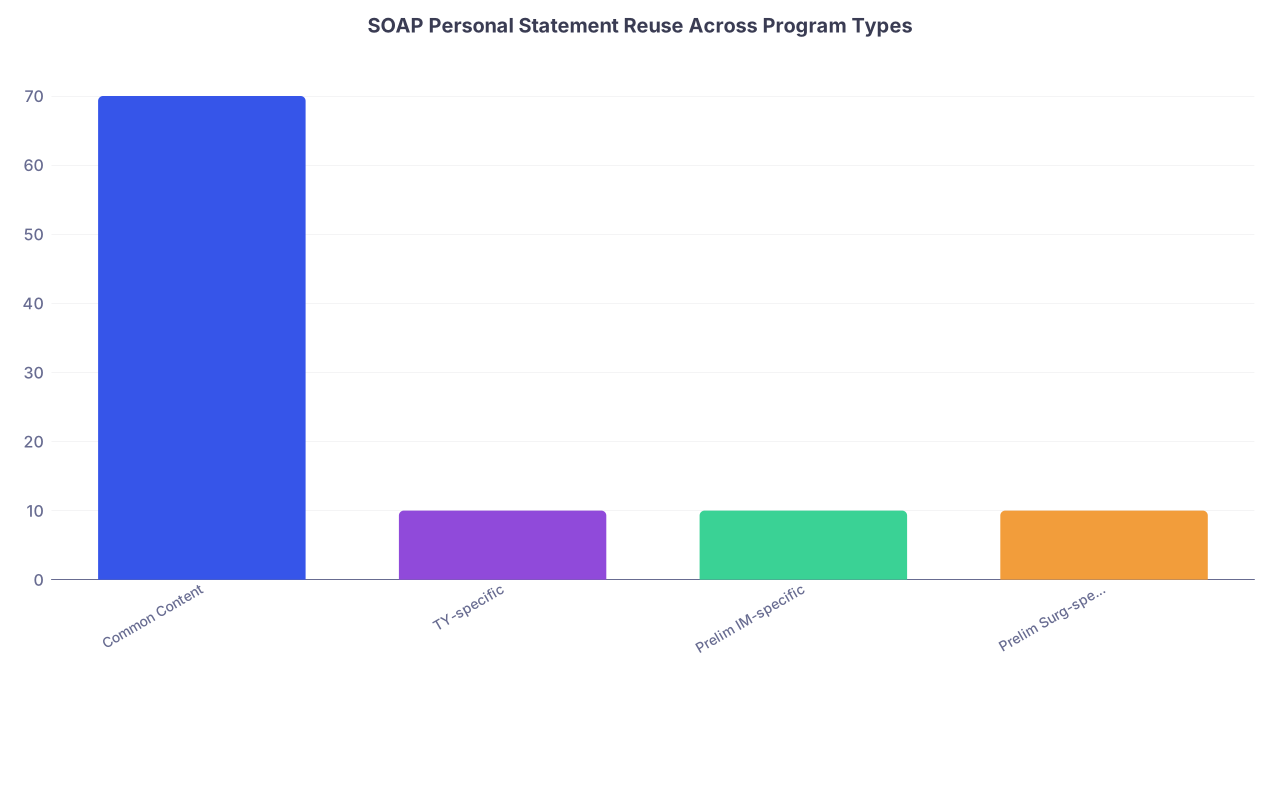
| Category | Value |
|---|---|
| Common Content | 70 |
| TY-specific | 10 |
| Prelim IM-specific | 10 |
| Prelim Surg-specific | 10 |
About 70% of your statement can be the same across broad-scope SOAP programs if you write it right. The remaining 30% is where you insert the program-type specificity to look intentional instead of scattershot.
6. Common SOAP Personal Statement Mistakes (And How to Fix Them Fast)
Mistake 1: Over-explaining why you did not match
You are not writing an appeal letter. One or two tight sentences is plenty. PDs already saw your scores, attempts, gaps. They know.
Bad:
“I did not match this year due to a combination of my Step scores, lack of research, and personal difficulties. During my third year my grandmother died and I had to travel home…” – too much, too personal, too defensive.
Better:
“Not matching this cycle was disappointing, but it has pushed me to reassess my goals and focus on programs that will give me a solid clinical foundation and strong mentorship.”
Save detailed context for an interview if asked.
Mistake 2: Leaving Narrow Specialty Language Intact
If you still have phrases like:
- “As a future neurosurgeon…”
- “My single-minded goal is dermatology…”
- “I will pursue a highly subspecialized academic career only…”
Delete or reframe. Immediately.
Do this editing pass:
- Replace specialty names with functions: “procedural care,” “complex medical management,” “longitudinal care,” “acute care,” “critical illness,” etc.
- Broaden goals from “X subspecialist in Y city” to “a career balancing [clinical interest] with [research/teaching/community work]”.
Mistake 3: Sounding Bitter or Entitled
This sneaks in as tone more than content. Phrases to cut:
- “Despite my strong application, I was surprised not to match…”
- “I believe I deserved…”
- “Programs overlooked…”
You might feel it. Do not put it in writing. PDs smell resentment a mile away and do not want it on their ward at 3 a.m.
Mistake 4: Generic, Content-Free Fluff
SOAP PDs are reading on speed. If your first paragraph feels like a template, they tune out.
Weak:
“Medicine has always been my passion. Growing up, I was fascinated by the human body and inspired by physicians around me.”
Stronger:
A specific clinical moment, rotation, or role showing you doing the work you now claim to want to do.
Mistake 5: Ignoring the “Broad” Part
Some applicants rewrite their statement but still aim it at a narrow future fellowship and treat the broad program as just a stepping stone.
That is a fast way to get ranked very low.
Your job: Genuinely articulate how breadth now supports expertise later.
Line to steal:
“A broad-based internship will make me a better [future X] by strengthening my skills in [A, B, C] which are foundational across specialties.”
7. Speed Workflow: How to Actually Do This in SOAP Week
You are tired, stressed, and probably getting ten different pieces of advice by text. So here is a simple workflow that works in real life.

| Step | Description |
|---|---|
| Step 1 | Open Old Personal Statement |
| Step 2 | Strip Hyper Specific Specialty Language |
| Step 3 | Rewrite Intro to Emphasize Broad Clinical Interest |
| Step 4 | Add Brief Reflection on Not Matching |
| Step 5 | Add Evidence of Thriving in Diverse Roles |
| Step 6 | Insert TY Paragraph 4 |
| Step 7 | Insert IM Paragraph 4 |
| Step 8 | Insert Surg Paragraph 4 |
| Step 9 | Standard Professional Closing |
| Step 10 | Proofread for Tone and Alignment |
| Step 11 | Program Type? |
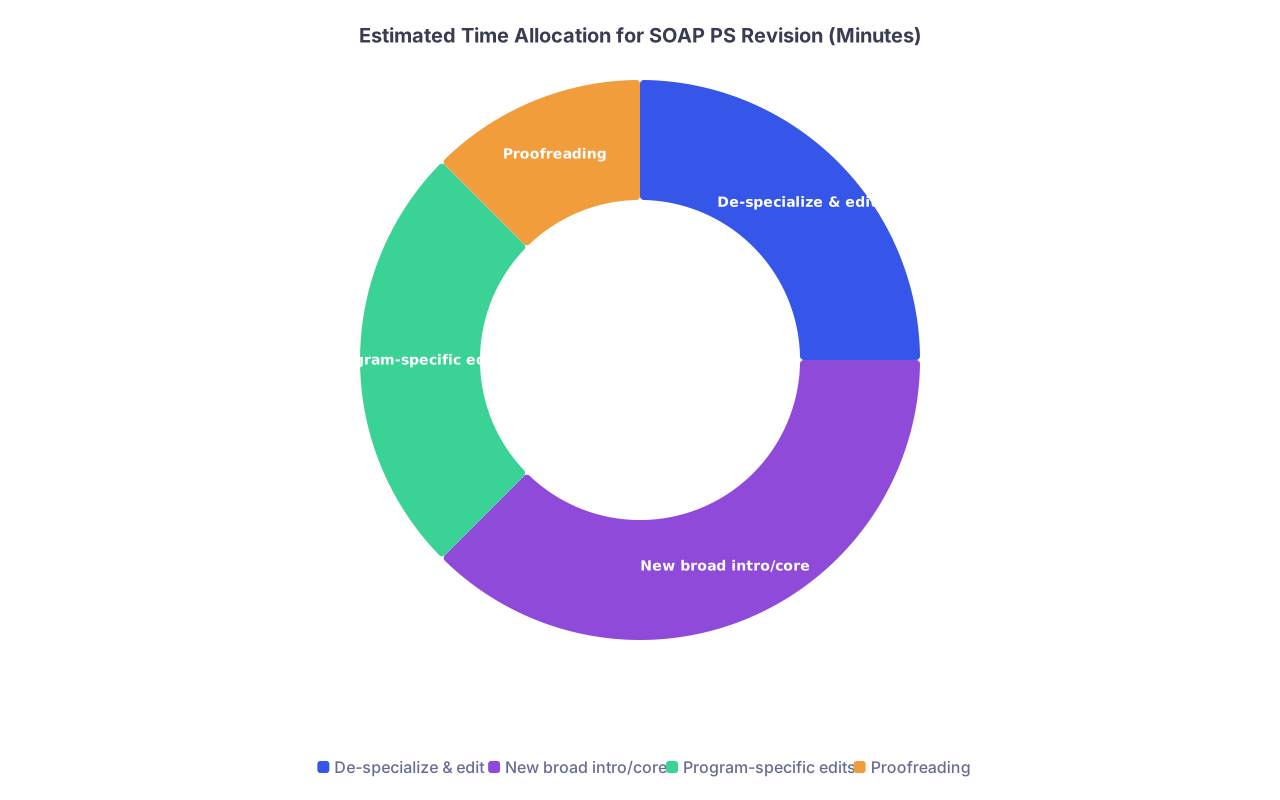
Time budget:
- 20–30 minutes to brutally edit the original.
- 30–45 minutes to craft your new broad-focused skeleton (Paragraphs 1–3, 5).
- 15–20 minutes each to create 2–3 versions of Paragraph 4.
- 15 minutes to proof for tone and typos.
You are looking at 1.5–2 hours for a fully repurposed, aligned, SOAP-ready set of statements.
| Category | Value |
|---|---|
| De-specialize & edit | 30 |
| New broad intro/core | 45 |
| Program-specific edits | 30 |
| Proofreading | 15 |
You have that time. Even in SOAP chaos.
8. Fine-Tuning for Specific Broad-Scope Contexts
Let me quickly touch on a few particular scenarios I see often.
A. You Absolutely Still Want Your Original Specialty
For example, you aimed at Radiology, did not match, and are applying to TY and prelim medicine.
You do not have to pretend radiology never existed. You just need to show maturity.
One clean line: “I remain interested in radiology long term, but I am very aware that my immediate priority is to become a strong, broad-based clinician who can care for diverse patients safely and effectively.”
Then everything else is about broad training, not radiology fantasies.
B. You Are Genuinely Undecided Now
Use that. Broad-scope loves healthy uncertainty.
“I entered the match with a specific plan, but this process has made me recognize that I am still exploring where I fit best. Rather than commit prematurely to a narrow path, I want a year of intensive, broad clinical training that will reveal where my strengths and interests truly align.”
Undecided but thoughtful beats “fake certainty in the wrong place.”
C. You Have Gaps, Repeats, or Remediation
Do not write a paragraph trying to litigate your MS3 remediation. But you can do one sentence that flips it to growth:
“My prior need for remediation in [X] led me to seek more feedback and develop stronger study and reflection habits, which I carried into later rotations where my evaluations improved significantly.”
Then show that improved trajectory with one concrete example. No need to dwell.
9. Visualizing the Broad-Scope Fit
Sometimes it helps to literally map how your experiences plug into what broad-scope programs want.

Your personal statement should essentially walk around this mindmap in prose form.
FAQ (Exactly 5 Questions)
1. Should I write a completely different personal statement for SOAP than I used in ERAS?
Yes, if your original statement was tightly locked to a single niche specialty or “top-tier academic only” mindset. You can reuse some paragraphs, but you must rewrite the intro, the goal framing, and at least one body paragraph to emphasize broad clinical training, flexibility, and foundation-building.
2. Do I need to explicitly mention that I did not match in my SOAP personal statement?
A brief, mature acknowledgment is fine and often helpful: one sentence that notes the setback and pivots immediately to reflection and your new focus on broad-based training. Do not spend a paragraph dissecting reasons or sounding defensive. PDs already have your application; they know the context.
3. Can I still mention a specific future fellowship or specialty interest in a broad-scope SOAP statement?
You can, but carefully. Frame it as a possible direction, not a non-negotiable demand. Tie that future interest to the value of broad training: “A strong preliminary year in medicine will make me a better future [X] by strengthening my skills in [general skills].” If it feels like you are using the program purely as a stepping stone, that hurts you.
4. How long should my SOAP personal statement be?
Aim for about 3/4 to 1 page single-spaced. Around 600–800 words is enough to make a coherent, specific case without rambling. SOAP PDs are reading quickly under pressure. Shorter, sharp, and aligned beats long and generic.
5. What if I am applying to both prelim surgery and prelim medicine—do I need two separate statements?
You should have at least slightly different versions. Keep your core broad-focused paragraphs the same, but create a program-type paragraph for each: one that emphasizes procedural care, perioperative work, and OR/team dynamics for surgery, and one that emphasizes complex medical management, inpatient skills, and multidisciplinary coordination for medicine. Using one generic statement for both is transparent and weak.
Key Takeaways
- Broad-scope SOAP programs want safe, adaptable, non-bitter interns who see genuine value in wide clinical exposure.
- Reframe your story from “narrow dream now” to “broad foundation first, flexible but thoughtful long-term goals.”
- Build one strong, broad-core statement and swap a targeted paragraph for each program type to stay efficient without sounding generic.