
The fastest way to tank your SOAP chances is to pretend your sudden specialty pivot came out of nowhere.
Programs are not stupid. If you applied categorical surgery in the main Match and now you are SOAPing into family medicine, they will look for one thing immediately: a coherent story grounded in your prior rotations. If they cannot see it in 30 seconds, you drop to the bottom of the pile.
Let me break down how to use your existing rotations as ammunition instead of evidence against you.
1. How Program Directors Actually Read SOAP Applications
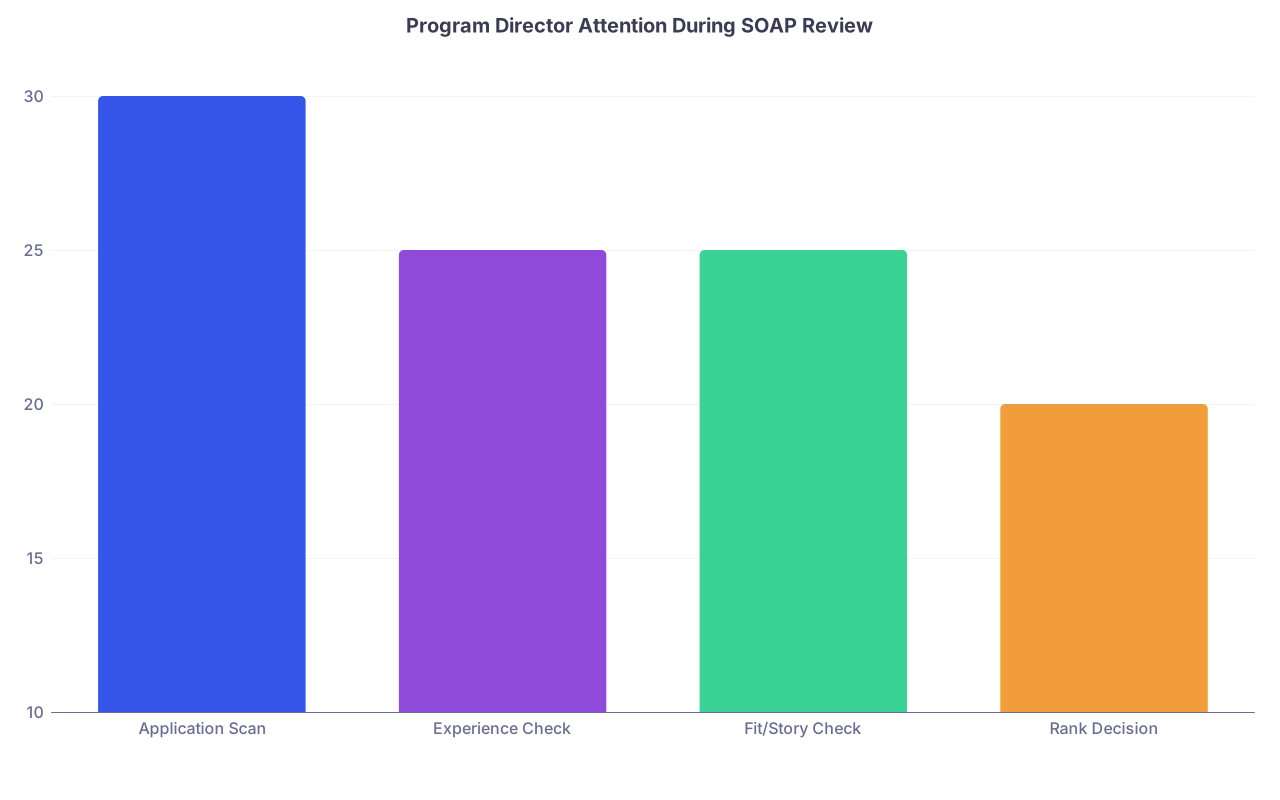
| Category | Value |
|---|---|
| Application Scan | 30 |
| Experience Check | 25 |
| Fit/Story Check | 25 |
| Rank Decision | 20 |
Nobody “deep reads” SOAP applications. They skim under pressure.
During SOAP, PDs and APDs are triaging dozens to hundreds of applicants in hours. The mental sequence I have seen repeatedly (sitting in those rooms):
- Filter by basic eligibility: graduation year, visa, USMLE/COMLEX status.
- Confirm they can actually function on day 1: clerkship performance, no catastrophic professionalism flags.
- Ask one question: “Does this applicant make sense for us?”
That third question is where your prior rotations either make your pivot look thoughtful and grounded… or desperate and random.
They look for:
- Evidence you have actually seen this specialty in real life.
- Signs you did not completely tank in related rotations.
- Any continuity between your previous “identity” and this new target.
If your application reads like: “Applied radiology, now SOAPing pediatrics, no peds sub‑I, no pediatrics letter, PS about loving imaging”… you are done.
Your goal: make them say, “Oh. They always had a primary care / inpatient medicine / OB angle. This shift is logical.”
2. Step One: Audit Your Rotations for Transferable Threads
You cannot justify a pivot if you do not know what you are selling.
Grab your transcript, your MSPE (Dean’s letter), your rotation evaluations, and your original ERAS. Now do an honest audit.
You are looking for three things:
- Rotations that are directly relevant to the new specialty
- Rotations that demonstrate overlapping skill sets
- Written comments or patterns you can quote or paraphrase
A simple way to categorize your rotations
Make three columns on paper or in a doc. Do not overthink this.
| Category | What Goes Here | Example for Switching to IM |
|---|---|---|
| Directly Relevant | Core + electives in target field | Medicine core, medicine sub-I |
| Partially Overlapping | Adjacent specialties | Surgery (for procedural mindset), psych (for communication) |
| Indirect but Useful | Shows work ethic / acuity / teaching | ICU, EM, night float |
Now, for each rotation, quickly label:
- Grade (Honors/HP/Pass/etc.)
- Setting (inpatient, outpatient, mixed)
- Any standout comments (“excellent with complex patients”, “strong team player”, “independent on night float”)
You are not just trying to remember what you did. You are mining for:
- Evidence you have already behaved like a [insert new specialty] resident.
- Language that supports continuity of interest (e.g., “enjoyed long-term relationships,” “excelled in acute care,” “thoughtful about end-of-life”).
Example: Pivoting to Internal Medicine (from Surgery track)
What helps you:
- Medicine core: grade, inpatient exposure, any attending mentioning “would be a strong IM resident.”
- ICU or CCU: comfort in high-acuity settings, procedures, cross-cover.
- Night float: independence, triage, cross-disciplinary communication.
- Sub-I in medicine (if you have it): gold.
What you can still use:
- Surgery core: managing complex inpatients, post-op medical issues, fluid management.
- EM: differential diagnosis, acute stabilization, dispo planning.
If all your “big” performance was on surgical services, you must translate those behaviors into internal medicine language. I will show you exactly how in a bit.
3. Different Pivot Types Require Different Justifications
Not all SOAP pivots are equally suspicious. Some are completely believable. Others need surgical-level repair work.
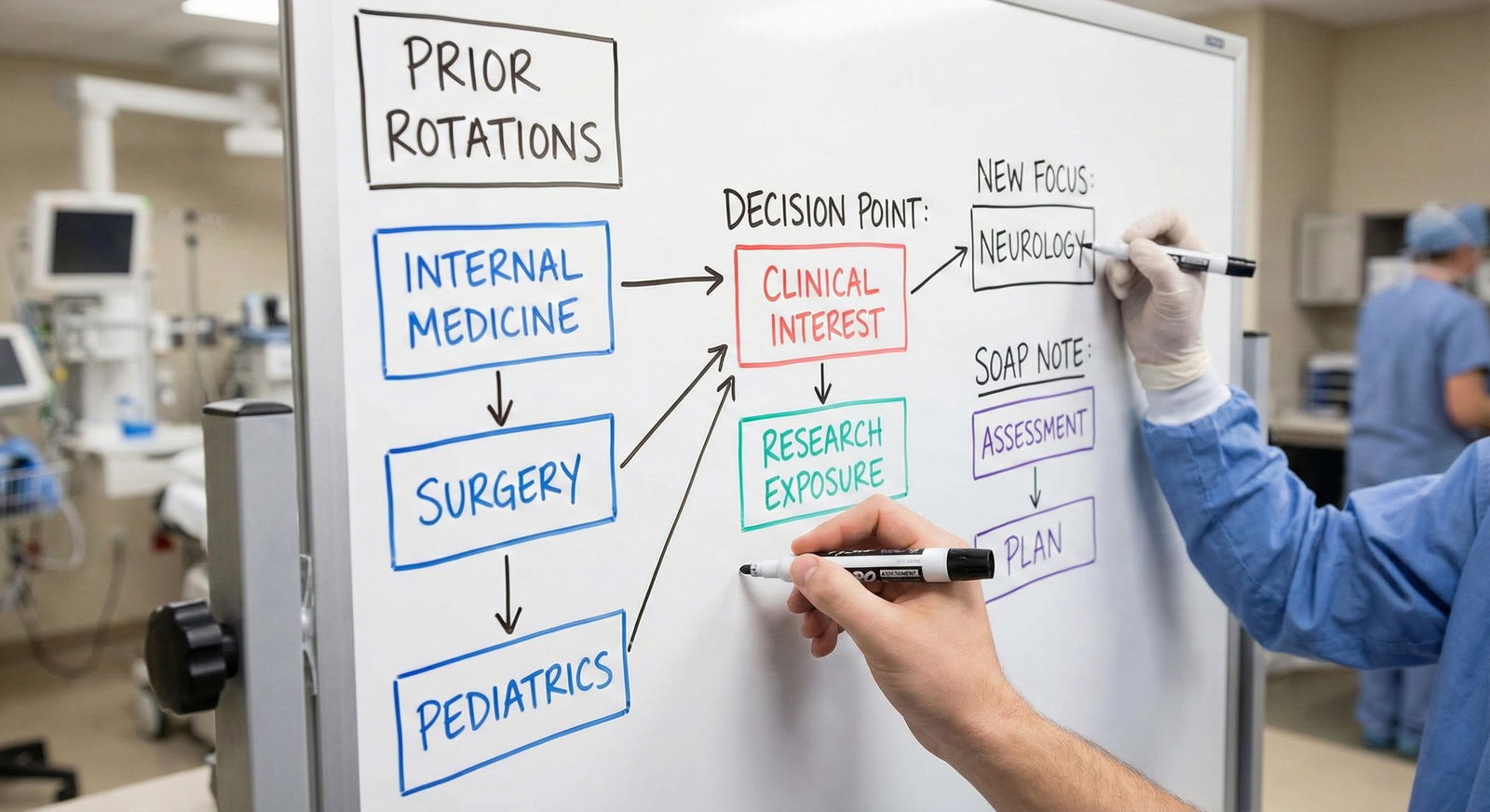
A. “Adjacent” Pivots (Easy to Justify)
Examples:
- OB/GYN → Family Medicine
- General Surgery → Internal Medicine or Anesthesiology
- Pediatrics → Family Medicine
- Radiology → Internal Medicine, Neurology, EM
Here, the story is: “The version of patient care I am actually drawn to is slightly different than I initially thought.”
You lean on:
- Overlapping patient populations
- Shared procedural or diagnostic skills
- Similar clinical settings (inpatient/outpatient mix)
Programs in SOAP have seen this before. They will believe it if your rotations support the story.
B. “Cross‑universe” Pivots (Harder, but Salvageable)
Examples:
- Dermatology → Psychiatry or Pediatrics
- Neurosurgery → Psychiatry
- Pathology → Family Medicine
These raise eyebrows. PDs will ask: “Have they even seen real-world [new specialty]?” You must:
- Point to any rotation, selective, elective, or continuity clinic that touched the new field.
- Show personality traits and feedback consistent with the new specialty culture (communication heavy, longitudinal, procedural, etc.).
- Explicitly acknowledge the change in direction and give a grounded reason (clinical exposure, mentorship, values).
C. Disaster Pivots (You Must Repair The Narrative)
Example pattern:
- Applied to an ultra-competitive field with limited exposure (ortho, derm, ENT, plastics)
- Now SOAPing into a backup you never mentioned anywhere
- Personal statement, experiences, and letters are all laser-focused on the original field
This is where rotations can save you.
You must find:
- That one internal medicine attending who wrote, “Would do well in any field, particularly IM.”
- That rural family medicine elective where you got an Honors and helped manage chronic disease.
- That ICU month where you discovered you liked complex decision making more than the OR.
You then build the narrative around: “I realized during [specific rotation] that what I liked most about [original specialty] actually lives in [new specialty].”
If you skip that, you look indecisive or opportunistic.
4. Translating Rotation Experiences Into a Coherent New-Field Story
Here is where most students fail. They list rotations. They do not translate them.
You are not writing a CV. You are building a logical case: “My hands-on clinical history already aligns with this new specialty, even if my initial ERAS choices did not.”
Step-by-step translation process
Pick three to five key rotations. For each, answer three questions:
- What did I actually do (specific tasks)?
- What behaviors or skills did I consistently demonstrate?
- How does that map onto the new specialty’s core work?
Then compress that into one tight sentence or two that you can reuse in SOAP communications (PS updates, emails, interviews).
Example: Surgery → Internal Medicine
Rotation: General Surgery Sub‑I
Raw reality: You pre-rounded at 4 am, wrote notes, scrubbed cases, managed post-ops.
Translation for IM story:
- Tasks: daily management of complex inpatients with multi-system issues, coordination with consultants (cardiology, nephrology), frequent phone updates to families.
- Skills: thorough data gathering, meticulous follow-through on plans, cross-disciplinary communication, comfort with acutely ill patients.
- Mapping to IM: Those are exactly the skills IM uses on wards—just without the scalpel.
Sentence you might use:
“During my general surgery sub‑internship, I found that the part of my day I enjoyed most was longitudinally managing complex inpatients on the floor—reviewing overnight events, refining the differential for complications like AKI or respiratory failure, and coordinating with consultants—more than the time in the operating room itself. That experience pushed me toward internal medicine, where this type of problem-solving is central rather than peripheral.”
Notice what that does:
- It acknowledges the pivot.
- It grounds the change in a specific rotation.
- It reframes a “surgery-heavy” past as medicine-relevant experience.
Example: Radiology applicant → Pediatrics during SOAP
Rotation: Pediatrics core, Radiology elective
Peds core translation:
“On my pediatrics core rotation, I consistently gravitated toward family conversations and longitudinal outpatient follow-up, especially in our continuity clinic, where I tracked asthma management and obesity counseling across visits. Attending feedback highlighted my ability to connect with children and their parents and to explain complex issues at an appropriate level.”
Radiology elective translation:
“While I enjoyed the intellectual puzzle of radiology, I missed direct patient contact. Reviewing pediatric films with my attendings reinforced for me that I was most energized when I could take that diagnostic information back to the bedside and work with families over time.”
Now the pivot reads as: “Tried imaging, realized I cared more about kids and families.” Reasonable. Human.
5. Using Rotations Strategically in SOAP Communications
SOAP is compressed chaos. You do not get full personal statements for every program. Some programs ask for updated letters or short statements; some just see your ERAS as-is.
You need prebuilt rotation-based talking points that you can deploy in three formats:
- Short update emails or messages
- Supplemental statements / brief SOAP essays
- Phone / Zoom interviews during SOAP week
A. Short Email to Programs (if allowed)
Subject line: “SOAP Applicant – [Your Name], [AAMC ID], Interested in [Program Name]”
Body (tight, rotation-centered):
“I am an unmatched applicant applying to your PGY‑1 Preliminary Internal Medicine positions through SOAP. While I initially focused my ERAS application on categorical surgery, my clinical experiences this year have clarified that my strengths and long-term interests align more closely with internal medicine.
On my medicine core and ICU rotations, I consistently enjoyed managing complex medical patients, refining diagnostic plans day-to-day, and communicating with families about goals of care. Attendings described me as thorough, thoughtful, and well-suited to internal medicine. I would be grateful for your consideration and am eager to contribute as a hard-working, team-oriented intern.
Thank you for your time,
[Name]”
Notice: one sentence cleanly acknowledges the original specialty, then immediately uses rotation language to justify the switch.
B. Brief SOAP Statements (Some Programs Ask)
They might ask: “Why this specialty?” or “Why our program?” in 150–250 words.
Structure it:
- One sentence name the pivot.
- Two to three sentences about specific rotations.
- One to two sentences about fit with their program.
Example (Psychiatry SOAP from Neurology track):
“I entered fourth year planning a career in neurology, but my psychiatry core and subsequent inpatient psych elective made it clear that my strongest interests lie in treating severe mental illness. On my psychiatry rotation, I valued the extended interviews, the nuanced diagnostic formulation, and collaborating with social work and families on realistic discharge plans. Attending feedback consistently cited my patience, nonjudgmental approach, and ability to build rapport with difficult patients. Your program’s strong inpatient training and emphasis on integrated care align closely with the work I found most meaningful on those rotations.”
That is enough. They see the through-line.
C. SOAP Interviews: How to Talk About Rotations on the Fly
You will be asked one version of this question repeatedly:
“So you originally applied to [X]. Why are you interested in [our specialty/program] now?”
Bad answer: “I did not match [X] so I am keeping an open mind.” Death sentence.
Good answer structure:
- Anchor in a specific rotation.
- Name what you realized about yourself.
- Connect that realization to their specialty’s daily work.
Example (OB/GYN → Family Medicine):
“On my OB/GYN sub‑I, I expected to love the OR most, and I did enjoy the procedures. But what surprised me was how much I looked forward to continuity clinic—seeing the same patients throughout pregnancy, managing their chronic conditions, and then caring for the baby at newborn visits. My attendings frequently commented that I was strongest in counseling and long-term planning. Over the year it became clear that family medicine would let me build those kinds of relationships across the lifespan, rather than focusing narrowly on the pregnancy interval.”
That has credibility. You did the rotation. You reflected. You adjusted.
6. Tactical Use of Letters and MSPE During SOAP
You do not have time to chase a dozen new letters in SOAP week. But you might have more support encoded in your file than you realize.
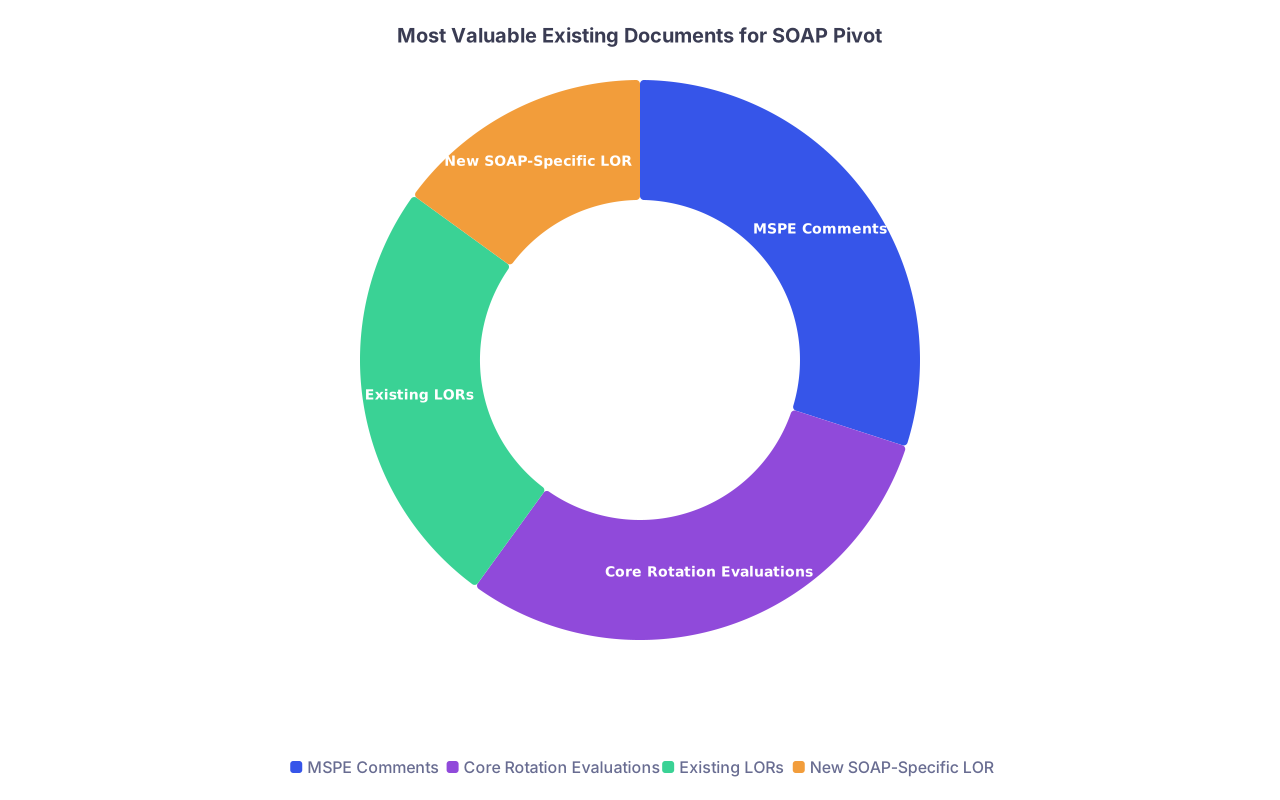
| Category | Value |
|---|---|
| MSPE Comments | 30 |
| Core Rotation Evaluations | 30 |
| Existing LORs | 25 |
| New SOAP-Specific LOR | 15 |
A. Mining Your MSPE (Dean’s Letter)
Programs actually read the rotation comment blocks during SOAP—much more than in the main Match, because they are trying to quickly test your story.
Look for:
- Comments from attendings in the target specialty, or related fields, that explicitly say: “strong potential [specialty] resident,” “would excel in internal medicine,” “great with children,” etc.
- Patterns: “outstanding communication,” “handles high acuity calmly,” “meticulous follow-through.”
You then quote or paraphrase them in your SOAP communications:
“On my medicine core, my attending noted that I ‘showed the maturity and analytical skills of a future internist.’ That feedback, combined with how much I enjoyed managing complex chronic disease on that service, ultimately led me to pursue internal medicine through SOAP.”
Now you are not just claiming the pivot is logical. You have documented backup.
B. Repurposing Existing Letters
Even if your letters are labeled “Surgery LOR,” read them carefully. Many are actually about general clinical competence.
If a surgeon wrote:
“[Student] was one of the strongest applicants I have worked with in recent years. She managed complex inpatients effectively, communicated clearly with families, and collaborated smoothly with medicine and ICU teams. She will be an asset in any residency program.”
That helps you for IM, anesthesia, EM, even FM.
In SOAP interviews, you can mention:
“My letters speak to my work managing complex inpatients and my communication with both team members and families, which are core to [new specialty].”
The program will see the letter through that lens.
C. When (and How) to Get a New SOAP-Specific Letter
You only try this if:
- You have a very recent rotation in the new specialty or a close neighbor.
- The attending actually knows you and liked you.
- Your school allows a late letter upload that programs might realistically see.
What you ask for is very focused:
- One page, commenting on your performance and explicitly endorsing you for [new specialty].
- Turnaround in 24–48 hours maximum.
You do not need poetry. You need: “I supervised this student doing real [specialty] work, and they were good at it.”
7. Common Mistakes Students Make When Trying to Justify a Pivot
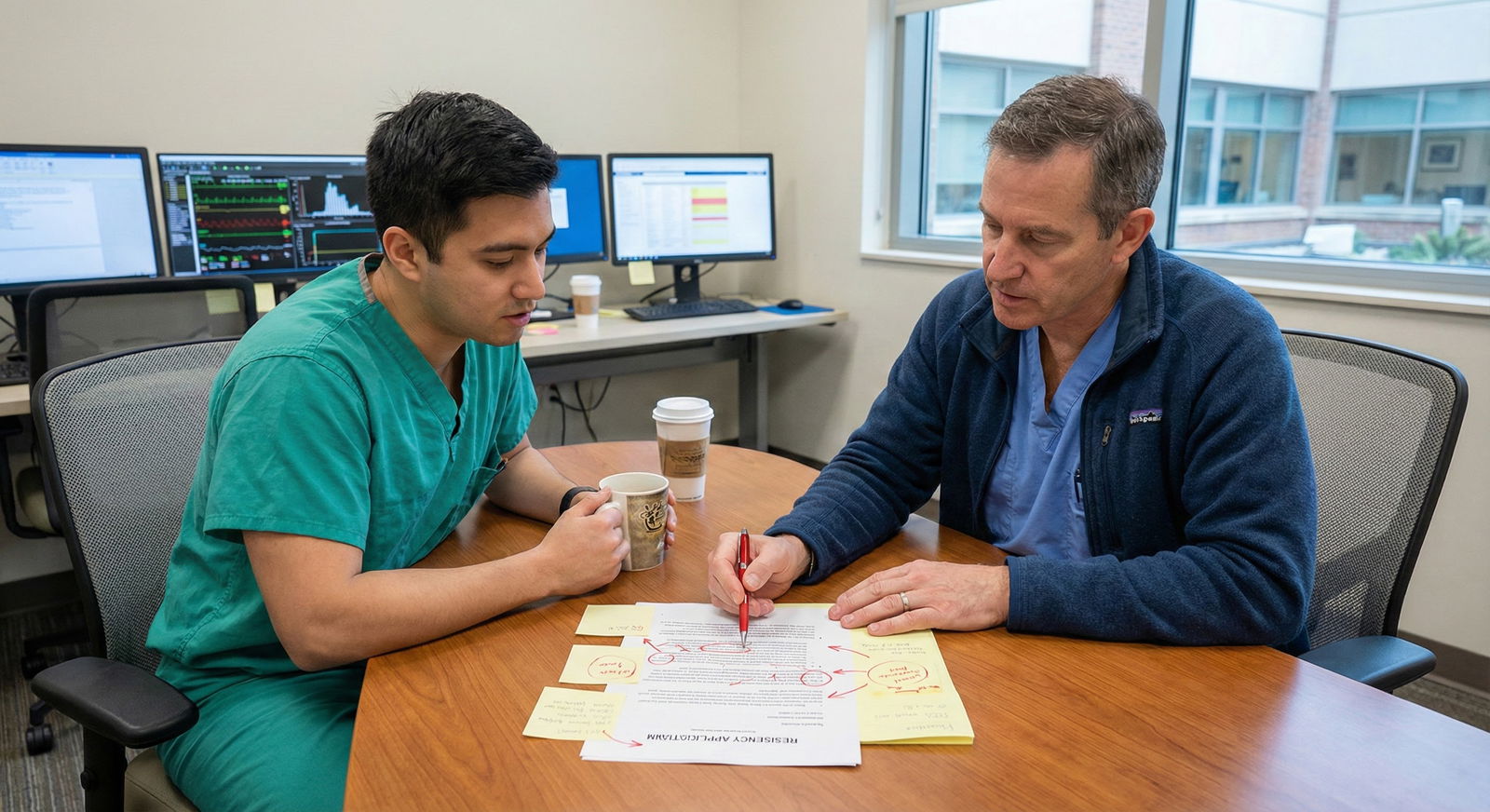
Let me be blunt. I see the same errors every year.
Mistake 1: Erasing Your Past Specialty
Pretending you never wanted ortho or radiology or derm does not fool anyone. Programs saw your original ERAS or at least your overall pattern.
You must acknowledge it briefly and then pivot. Denial looks immature.
Mistake 2: Over‑the‑top “Lifelong Calling” Stories
Do not suddenly “discover” that you were destined for psychiatry because of one undergrad psychology course—especially if your entire application said “surgery or bust” three months ago.
SOAP is not about romance. It is about convincing someone you can function and will not bail.
Ground your story: recent rotations, recent feedback, recent experiences.
Mistake 3: Ignoring Rotation Weaknesses in the Target Area
If you barely passed your medicine core and now you are SOAPing into IM, you cannot just hope nobody notices.
You preempt it. Example:
“I struggled initially on my medicine core with efficiency and note-writing, but during my ICU month and medicine sub‑I I made specific improvements—streamlining my data gathering and focusing my assessments. Those later evaluations reflect the progress I made and the reason I feel ready to enter internal medicine training.”
Owning growth is stronger than pretending.
Mistake 4: Over‑selling One Tiny Elective
Do not build your entire pivot on a 2‑week elective from M3 if everything else contradicts it.
Use it as one piece of a larger story:
“That elective planted the seed, but it was my later [core/sub‑I/ICU] experience that confirmed this direction.”
Mistake 5: Generic, Copy‑Paste Justifications
Programs will see dozens of SOAP essays in the same specialty. Clichés jump out:
- “I enjoy working with people.”
- “I love teamwork.”
- “I find this specialty to be the perfect blend of intellectual challenge and patient care.”
You have no time for fluff. Use concrete rotation details: patient types, tasks, feedback.
8. Specialty‑Specific Angles: What To Highlight From Rotations
Different programs care about different aspects of your prior rotations. Here is how to angle it.
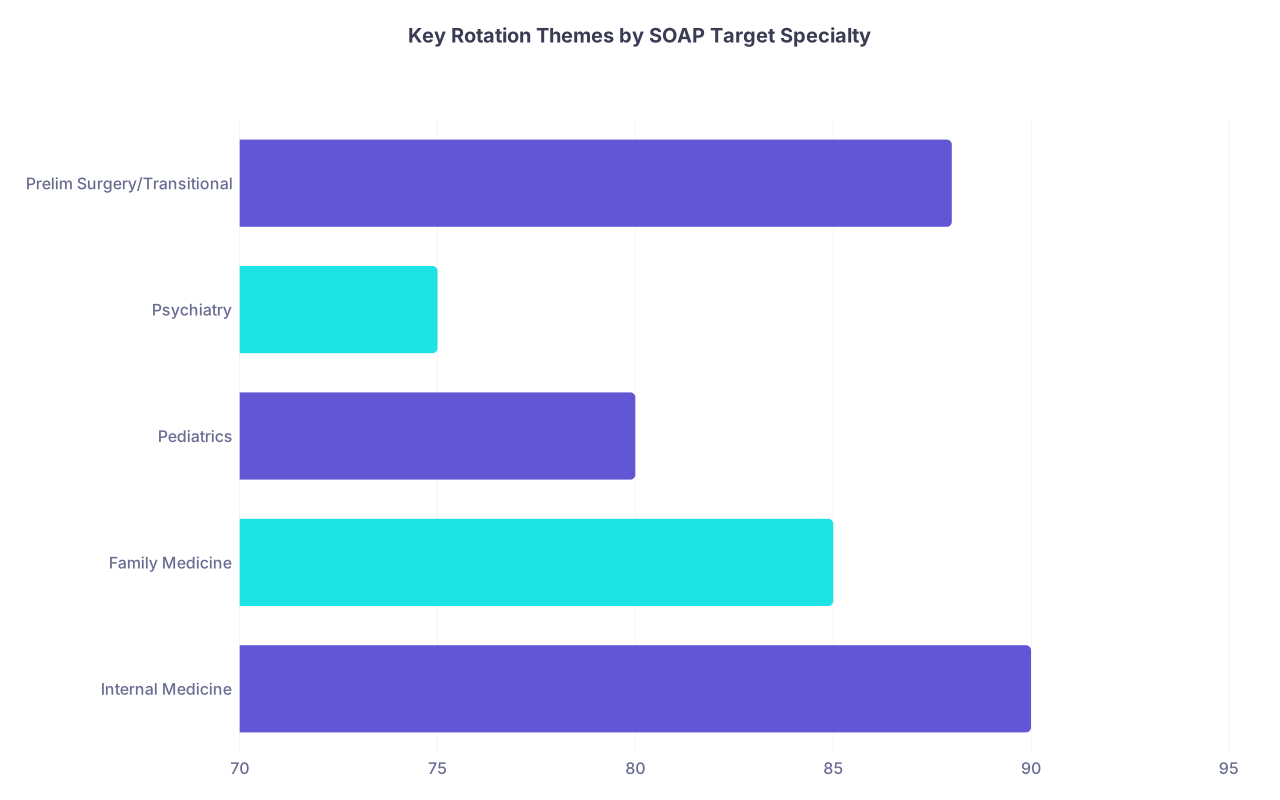
| Category | Value |
|---|---|
| Internal Medicine | 90 |
| Family Medicine | 85 |
| Pediatrics | 80 |
| Psychiatry | 75 |
| Prelim Surgery/Transitional | 88 |
(The numbers are just relative “emphasis” scores to force you to rank priorities in your head.)
Internal Medicine
Use:
- Medicine core and sub‑I
- ICU, CCU, night float
- Any rotation where you led daily rounding, handled cross-cover calls, or managed chronic disease
Language to emphasize:
- Complex diagnostic reasoning
- Longitudinal inpatient management
- Careful follow-up, communication, and documentation
- Comfort with medically complex/elderly patients
Family Medicine
Use:
- Outpatient continuity clinics (FM, IM, peds, OB)
- Community health or rural rotations
- OB/GYN, pediatrics, psychiatry experiences with ambulatory focus
Language to emphasize:
- Lifespan care
- Preventive medicine
- Chronic disease management in the outpatient setting
- Relationship-building, motivational interviewing, community engagement
Pediatrics
Use:
- Peds core, NICU, PICU, newborn nursery
- Family medicine rotations with strong pediatric volume
- Any teaching roles with children/adolescents
Language to emphasize:
- Comfort with children and parents
- Developmentally appropriate communication
- Patience, playfulness balanced with seriousness
- Working with schools, social services when relevant
Psychiatry
Use:
- Psych core and electives (especially inpatient or CL)
- Emergency psych exposure, substance use work
- Any rotation where you were praised for patient rapport with challenging personalities
Language to emphasize:
- Diagnostic formulation beyond checklists
- Tolerance of uncertainty and ambiguity
- Teamwork with social work, case management
- Listening skills, nonjudgmental stance, boundary management
Prelim Surgery / Transitional Year / Prelim IM
Use:
- Any high-acuity inpatient rotation
- Surgery, EM, ICU, night float
- Sub‑Is in medicine or surgery
Language to emphasize:
- Work ethic, reliability, ability to function like an intern
- Handling cross-cover calls, night shifts, and rapid responses
- Procedural competence (for surgery/ICU‑heavy TYs)
- Flexibility and communication across services
9. A Quick Mental Flowchart For Your SOAP Pivot Story
You can visualize your justification logic. Here is a stripped down version of how I think through it with students.

| Step | Description |
|---|---|
| Step 1 | Original Specialty |
| Step 2 | Target SOAP Specialty |
| Step 3 | Use core and sub I as anchor |
| Step 4 | Use adjacent rotations |
| Step 5 | Quote feedback and tasks |
| Step 6 | Highlight growth and later rotations |
| Step 7 | Write 2 3 key sentences linking past to target |
| Step 8 | Use in emails, statements, interviews |
| Step 9 | Any direct rotations in target? |
| Step 10 | Strong evaluations? |
If at node C you truly have “No,” as in you have never touched anything remotely related to the new specialty, you need to be very conservative with what you apply to. Choose fields where your adjacent rotations at least mirror the workflow (e.g., surgery/ICU to prelim IM or anesthesia, not derm).
10. Final Check: Does Your File Tell One Coherent Story?
By the time SOAP opens, your ERAS is mostly locked. You cannot rewrite your entire life. But using your rotations correctly, you can tilt perception.
Here is a quick checklist I use with applicants:
- Can you name at least two rotations that directly or indirectly support your new specialty?
- Do you have at least one specific attending quote or evaluation comment you can reference?
- Can you explain your pivot in under 60 seconds with one clear rotation-based turning point?
- Does your SOAP communication (emails, short statements) explicitly mention those rotations and connect them to daily work in the new field?
- Have you stopped pretending your original specialty never existed, and instead reframed it as part of the path that led you here?
If you can honestly answer “yes” to those, you are ahead of most SOAP applicants.
Key Takeaways
- Your prior rotations are not a liability in SOAP; they are your only credible evidence to justify a new specialty focus.
- You must translate rotation experiences into specialty-specific language—tasks, skills, and feedback that make your pivot look logical, not desperate.
- Acknowledge the original specialty briefly, then anchor your new direction in concrete clinical experiences and documented evaluations that match the work of the field you are now targeting.