
You are here
It is Monday afternoon of Match Week. The email has already landed:
“We are sorry to inform you…”
You have the NRMP status page open, and the word “UNMATCHED” is sitting there like a lab value you hoped was a lab error. Your original specialty—let’s say Orthopedic Surgery—has almost no available SOAP positions. The list drops at 11 AM. You already know what it will say: prelim medicine, prelim surgery, transitional year, categorical IM, family med, peds, psych.
You have about 24–36 hours to do three things:
- Decide where you are willing to pivot.
- Rewrite your entire specialty story.
- Upload something coherent enough that a PD does not instantly reject you as “ortho-gunner trying to hide.”
This is where most people flail. They tweak their original personal statement, delete the word “orthopedics,” add “internal medicine,” and hope no one notices the whiplash.
Let me walk you through how to build credible, concrete specialty pivot narratives for SOAP, with examples that can actually survive a PD’s 30-second skim.
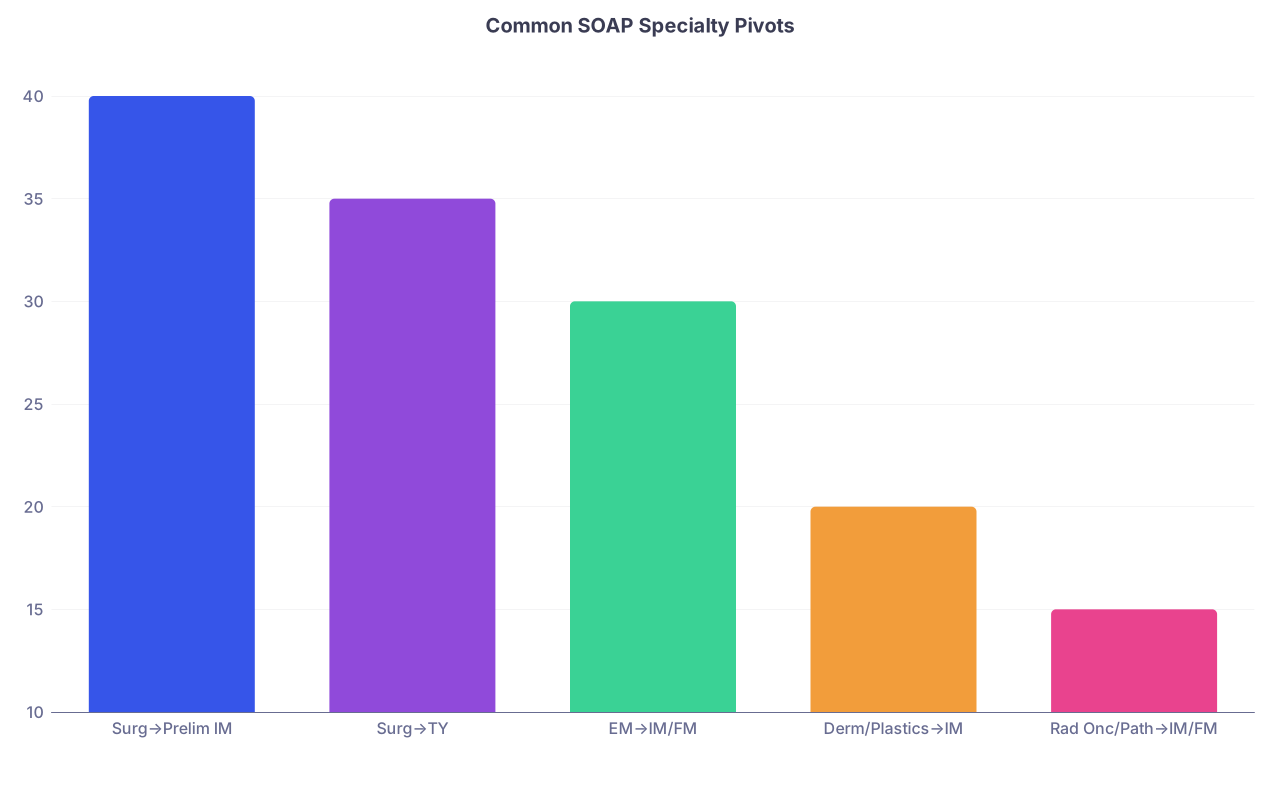
| Category | Value |
|---|---|
| Surg→Prelim IM | 40 |
| Surg→TY | 35 |
| EM→IM/FM | 30 |
| Derm/Plastics→IM | 20 |
| Rad Onc/Path→IM/FM | 15 |
Core rules of a SOAP pivot narrative
Before the examples, you need the rules. If your narrative violates these, it does not matter how pretty the sentences are.
1. You must close the “why this, why now?” gap
PDs know your ERAS history. They see:
- Prior specialty choice (letters, experiences)
- Research topic
- Away rotations
- Original personal statement (if they dig)
If your SOAP narrative reads like a hostage statement—“I have always loved internal medicine”—you are done.
You need:
- A believable through-line from your prior path to this specialty.
- A specific catalyst or reframing (not “I did not match,” which they already know).
- A clear statement of long‑term alignment with this pivot, not just “I need a job this July.”
2. You cannot pretend your first specialty never existed
Trying to erase your original specialty looks dishonest. Programs know you applied there. Many can see your original application materials.
You acknowledge it. Briefly. Then you show how the skills and interests from that path make sense in the new context.
3. You must neutralize, not spotlight, the red flag
Your SOAP application itself is the red flag: you did not match. Do not write a personal statement that becomes a four-paragraph reflection on failure, unfairness, or “I know my scores are low.”
One line acknowledging the reality. Then move directly to what you are bringing now.
4. You have to write for the exact seat you are applying for
Prelim medicine ≠ categorical IM. Transitional year ≠ backup EM. Family medicine in a rural community program ≠ urban university IM.
If your narrative sounds like you are just waiting to jump back to the original specialty at the first chance, categorical programs will not touch you. Prelim programs might. Know which seat you are targeting.

| Step | Description |
|---|---|
| Step 1 | Unmatched Status |
| Step 2 | Consider Prelim IM or TY |
| Step 3 | Consider Categorical IM/FM/Peds |
| Step 4 | IM/FM/Peds/Psych Pivot |
| Step 5 | Build Long Term Narrative |
| Step 6 | Short Term Prelim Story |
| Step 7 | Original Specialty Type |
| Step 8 | Willing to Reapply Same Field? |
Structure of a strong SOAP pivot statement
Think in five parts. You do not have time for much more.
- Opening: 2–3 sentences
- Origin of interest: 1 short paragraph
- Concrete alignment: 1–2 paragraphs
- Honest pivot explanation: 3–4 sentences
- Clear, specific future anchor: 1 paragraph
I will break that down with specialty‑specific examples.
Example 1: Surgery → Prelim Internal Medicine (re‑apply to surgery later)
Classic scenario. Student applied general surgery, did aways, did not match. SOAP list shows several prelim IM and prelim surgery spots. They want to reapply to surgery, but they need a prelim year.
You do not write a “lifelong dream of internal medicine” essay. You write a bridge essay that makes sense to an IM PD who knows you will probably leave after a year—but still wants someone reliable, diligent, and functional on their ward team.
Key moves in this narrative
- Be transparent: you are pursuing a surgical career.
- Frame prelim IM as a training asset, not a consolation prize.
- Show respect for medicine as a discipline, without pretending it was your first love.
- Emphasize reliability, work ethic, and being low‑maintenance as an intern.
Sample pivot paragraph set (annotated)
I will write it as if it were the core of a personal statement.
My long‑term goal remains a career in general surgery. Through my sub‑internships at [Hospital A] and [Hospital B], I found that I am most energized in the operating room and managing surgical patients through complex recoveries. After not matching this cycle, I am seeking a preliminary internal medicine position to strengthen the clinical foundation that will make me a more capable, independent surgical resident.
This is blunt and clean. No games. PD reads that and knows exactly who you are.
My best days on surgery were never limited to the OR. On our hepatobiliary service, I often started rounds early in the ICU, reviewing pressor doses, ventilator settings, and lab trends before presenting to the team. I enjoyed working with our intensivists to adjust anticoagulation in cirrhotic patients or tease out the cause of new fevers after major resections. Those experiences made it clear that I value understanding the complex physiology behind our surgical decisions, not just the technical steps of an operation.
Now you are building respect for medicine, and showing you understand the kind of thinking IM values.
A preliminary year in internal medicine offers exactly the type of responsibility and repeat exposure that will push me in that direction. I welcome a year of managing decompensated heart failure, sepsis, and undifferentiated respiratory failure. I want to refine my ability to create prioritized assessment and plans, to lead family discussions under uncertainty, and to coordinate care with subspecialists. These are skills I will carry into any surgical residency.
This tells the PD: you are not here to coast; you want high‑acuity, real responsibility.
I understand that accepting a preliminary resident who ultimately pursues another field is an investment. My commitment in return is to function as a reliable, hard‑working member of your team who does not require excessive oversight to handle routine floor issues, who communicates clearly, and who takes ownership of patients regardless of their “service.” On surgery, I routinely stayed to help cross‑cover general medicine patients when the night float was overwhelmed. I expect to bring that same mentality—as well as my comfort with procedures and end‑of‑life conversations—to your program.
That last paragraph directly addresses the unspoken PD fear: “I will be babysitting this person who is just marking time until surgery.” You flip it: “I will make your life easier.”
Do not promise you will change careers. Many PDs prefer the honest “I am here for a year and I will be excellent” over a fake conversion story.
Example 2: EM → Categorical Internal Medicine (true pivot)
Next scenario: you applied EM, did not match, and now genuinely want to pivot to categorical IM. This happens more than people admit, especially after seeing the EM job market and lifestyle up close.
Here, you must explain both:
- What drew you to EM.
- Why, in real clinical terms, IM is the better fit long term.
And you must do it without throwing EM under the bus or sounding like you are rationalizing a forced change.
Narrative strategy here
- Use your EM experiences to highlight skills IM also prizes: acute management, triage, dealing with uncertainty.
- Then show dissatisfaction with the episodic nature of EM.
- Anchor your IM interest in continuity, diagnostic depth, longitudinal complexity.
Core example
I entered fourth year committed to a career in emergency medicine. My rotations at [County ED] and [Suburban ED] were intense, hands‑on, and rewarding: rapidly assessing undifferentiated patients, running stroke codes, and working alongside residents in high‑acuity trauma bays. I enjoyed the pace, the procedures, and the team‑based culture.
You acknowledge EM without shame. Good.
What I found myself wanting, however, was to stay with my patients after the initial crisis. I remember an older man I admitted with new‑onset heart failure and atrial fibrillation with RVR. After stabilizing him in the ED, I walked him upstairs to the telemetry unit. The next morning, I came in early to see how he was doing and joined the medicine team for rounds. Listening to the resident synthesize his years of poorly controlled hypertension, subclinical thyroid disease, and silent ischemia into a coherent story that guided both his hospitalization and outpatient follow‑up was the most intellectually satisfying part of that week.
That is how you pivot. Not “EM was wrong,” but “I discovered what I missed.”
Experiences like this repeated throughout my emergency clerkships. I enjoyed ruling out pulmonary embolism; I was more drawn to understanding why this patient, at this time, with this set of comorbidities, presented as he did. On my subsequent internal medicine sub‑internship, that curiosity became central to my day. I thrived when I could follow complex patients over days: adjusting diuretics based on changing renal function, revisiting diagnoses when trajectories did not match expectations, and coordinating goals‑of‑care discussions with families I had met multiple times.
Now we are reframing: your deepest satisfaction comes from things IM owns.
Not matching this cycle forced me to reflect candidly on where I see myself in ten years. The answer is on a general medicine service, caring for a panel of patients whose lives I know beyond a single shift, teaching students how to think through ambiguous problems, and possibly subspecializing in cardiology or pulmonary critical care. Categorical internal medicine is not a fallback for me; it is the specialty that best matches the way I already practice when given the opportunity.
That sentence—“is not a fallback for me; it is the specialty that best matches the way I already practice”—is doing heavy lifting.
I recognize that my application reflects a prior focus on emergency medicine. I bring from that path a comfort with acutely ill patients, efficient data gathering, and calm under pressure. My goal now is to pair that skill set with the longitudinal, relationship‑based practice that only internal medicine offers. I am seeking a categorical IM position where I can grow into a resident who owns her patients, embraces the diagnostic gray zones, and contributes meaningfully to a team over three years, not just three hours.
Honest, forward‑looking, and specialty‑specific.

Example 3: Ortho / ENT / Derm → Categorical IM or FM (real long‑term pivot)
Highly competitive to core fields is common in SOAP. PDs are on guard for “I will disappear to reapply” behavior.
If you are truly done chasing the prior specialty, you must say so directly. And your narrative has to sound like a genuine re‑alignment, not just “I lost the numbers game.”
Let us do Orthopedics → Family Medicine, because that is one of the more jarring on paper.
What you have to solve
- Why did you choose ortho initially?
- What changed—specifically, clinically?
- Why FM now, not “I will SOAP into FM and then reapply ortho?”
Sample narrative chunk
I came into fourth year focused on orthopedic surgery. As a former collegiate athlete and someone who spent years in physical therapy, the appeal of restoring function through operative care was obvious. My away rotations reinforced that attraction: I enjoyed the technical precision in the OR and seeing post‑operative patients regain mobility.
You name the prior path without dressing it up.
During those same months, though, I found myself increasingly drawn to the pre‑ and post‑operative clinic visits rather than the operative lists themselves. I remember one patient in particular, a middle‑aged woman with severe knee osteoarthritis and poorly controlled diabetes. In our orthopedic clinic, much of the conversation revolved around whether she was “optimized” enough for surgery. The most meaningful part of the visit for me was counseling her on diet changes, coordinating with her primary care physician, and discussing non‑operative options that fit her caregiving responsibilities and financial constraints.
The pivot begins: function, context, whole patient.
On my subsequent family medicine rotation at [Community Clinic], that type of interaction was no longer the side story. It was the core of each day. I appreciated managing hypertension and diabetes in the context of housing insecurity, job loss, or postpartum depression. I liked that no problem was “too small” if it mattered to the patient—whether that was shoulder pain from childcare, contraception choices, or navigating subspecialty referrals.
Now you sound like someone who knows what FM actually is, not just “more time with patients.”
Not matching this cycle pushed me to confront a question I had been circling for months: Am I more motivated by the procedures themselves, or by the relationships and broader context that surround them? The honest answer is the latter. I do not plan to reapply to orthopedic surgery. I am seeking training in family medicine where I can commit fully to longitudinal primary care, with a particular interest in musculoskeletal medicine and sports‑related injury prevention within a comprehensive outpatient practice.
That sentence—“I do not plan to reapply”—you only write if it is true. PDs are very good at smelling lies here. If you are not sure, do not over‑promise; instead emphasize open‑ended interests like PCSM fellowships, which still live inside FM.
I bring from my orthopedic experiences a comfort with procedural skills, multidisciplinary teamwork, and helping patients weigh risks and benefits of interventions whose outcomes are uncertain. In family medicine, I look forward to pairing those strengths with preventive care, chronic disease management, and continuity that spans years rather than weeks.
That connects the old and new, instead of disowning the past year of your life.
| Target Slot | Narrative Goal | How Honest About Reapplying? |
|---|---|---|
| Prelim IM | Short-term bridge, skill building | Very explicit |
| Prelim Surgery | Commitment to surgery, flexible about path | Very explicit |
| Transitional Year | Broad foundation, undecided or reassessing | Moderately explicit, nuanced |
| Categorical IM/FM | Long-term alignment, roots in current field | Only if truly done with prior |
| Categorical Psych | Motivated by patient population and approach | Same as other categorical spots |
Example 4: Transitional Year pivot – “I am still choosing”
There is a legitimate version of “I am not sure yet.” That is what TY programs exist for. What you cannot do is write a statement that sounds like:
“I do not know what I want and this is a placeholder.”
A good TY pivot narrative says:
- You value broad exposure.
- You have specific, not vague, interests.
- You understand the role of a TY resident in the system.
- You will not be a nightmare to schedule because you “do not care” what you are doing.
Example core
I am pursuing a transitional year position because my clinical interests span multiple disciplines, and I want a rigorous, broad‑based intern experience before committing to a categorical residency. My strongest rotations have been in internal medicine and neurology, with additional enjoyment of emergency medicine. What links them for me is the need to rapidly assess undifferentiated patients, build differential diagnoses, and communicate clearly with families and consultants.
You articulate the through‑line instead of listing random likes.
On my medicine sub‑internship, I appreciated following complex patients over days, adjusting management as new data emerged. On neurology, I enjoyed the detailed histories and focused exams that could localize a lesion before imaging. In the emergency department, I valued the tempo and the chance to initiate workups and dispositions efficiently. At this point, my likely long‑term path is in internal medicine with a subspecialty interest in neurology or critical care, but I want to ground that decision in a year of real responsibility across services.
That last sentence is a key: direction without pretending absolute certainty.
A transitional year appeals to me because it will challenge me to function as a fully integrated intern from day one, rotating through medicine, surgery, emergency medicine, and critical care. I am looking for a program where I can take primary call, manage cross‑cover responsibilities, and develop the habits of a safe, reliable resident no matter the service. In return, I bring a strong work ethic, calm demeanor under pressure, and a genuine curiosity about how different specialties approach the same patient.
This tells the PD you understand what they need: a safe intern, not an existential philosopher.
Although I did not match into a categorical position this cycle, I see this year not as a detour but as an opportunity to better define my role in patient care. I plan to use it to solidify my clinical skills, seek mentorship across departments, and prepare a focused, realistic application for a categorical spot that reflects what I have learned about my strengths and interests.
Honest, concrete, and forward‑leaning.

Example 5: Psych or Peds pivot – handling “soft” interest without sounding fluffy
Psychiatry and pediatrics SOAP narratives often collapse into vague “I care about people/children” statements. That is noise. PDs want to see:
- Evidence you actually liked their patient population.
- Tolerance for frustrations specific to that field.
- Some idea what hard days look like in that specialty, not just the brochure version.
EM → Psychiatry pivot sample
My initial residency applications focused on emergency medicine. I was drawn to the acuity, the procedures, and the need to make rapid decisions with limited information. Over the course of my core clerkships, however, I found that the most memorable patients were those whose primary challenges were psychiatric rather than medical.
On my psychiatry rotation at [State Hospital], I met a man in his thirties admitted after a suicide attempt in the context of severe depression and opioid use disorder. The intern I worked with modeled how to explore his story without judgment, address acute safety, and begin the slow work of rebuilding hope and structure. I left each interview mentally exhausted but also more engaged than after almost any trauma activation I had seen.
One patient story, not a montage. That is enough.
What I valued in psychiatry was the depth of narrative and the way diagnostic formulation integrated biological vulnerability, development, and social context. I appreciated that progress was often measured not by lab values but by a patient’s willingness to participate in groups, reconnect with family, or take ownership of their medication plan. I did not find this slow pace frustrating; if anything, I found it grounded.
Not matching this cycle made it possible—if uncomfortable—to admit that my day‑to‑day satisfaction on psychiatry exceeded what I experienced in the emergency department. I am seeking training in psychiatry where I can develop the skills to care for patients across inpatient and outpatient settings, with a particular interest in acute care and addiction. I bring from emergency medicine a comfort with agitation and behavioral crises, a focus on safety, and experience collaborating closely with psychiatry colleagues. I am ready to commit that energy to psychiatry as my primary field.
Again: clear, specific, grounded in real rotations.
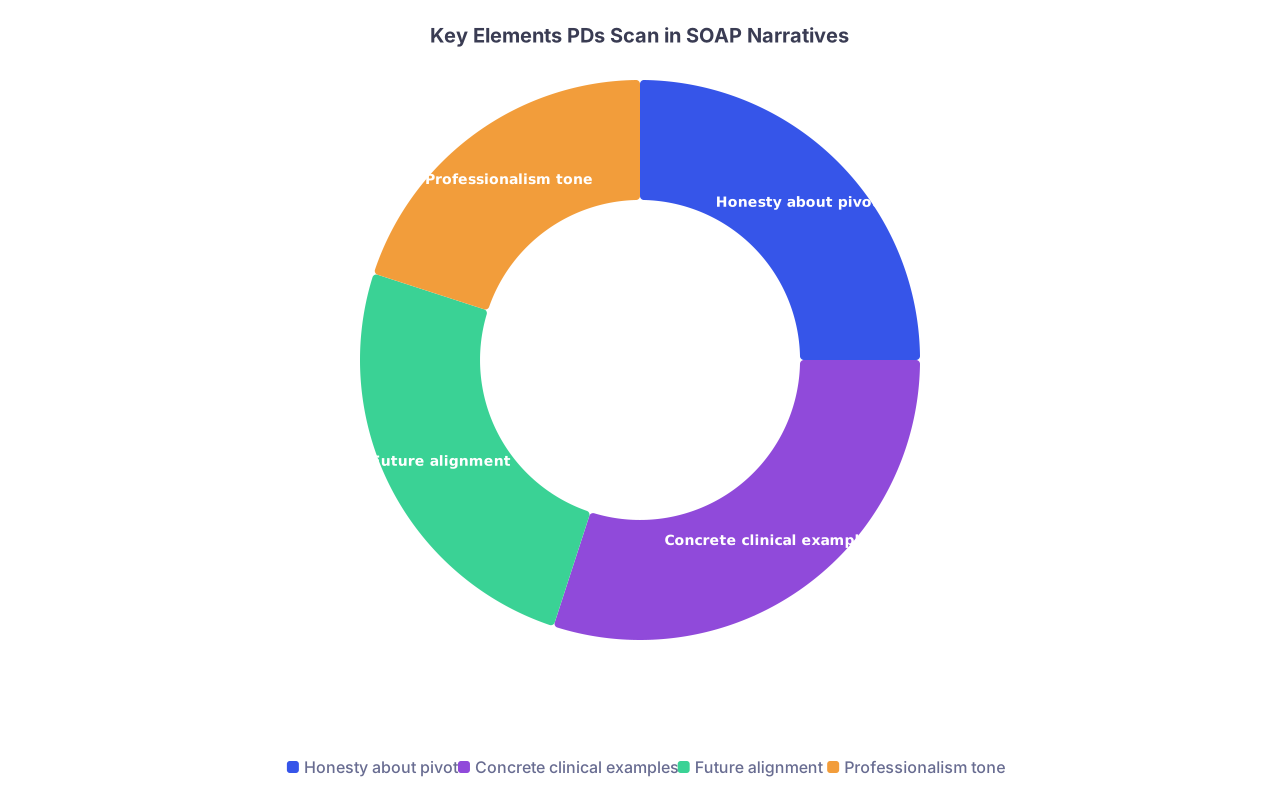
| Category | Value |
|---|---|
| Honesty about pivot | 25 |
| Concrete clinical examples | 30 |
| Future alignment | 25 |
| Professionalism tone | 20 |
Tactical edits under SOAP time pressure
You will not have three days. You might have three hours. So you need a fast method.
Step 1: One-line thesis for each program type
Before you open Word, write, by hand, one sentence per pivot:
- “For prelim IM: I am a surgery‑bound applicant who will be a strong, low‑maintenance intern and wants ICU/floor experience.”
- “For categorical IM: I discovered I value longitudinal, complex medical care more than shift‑based work.”
- “For FM: I realized I care most about whole‑person, community‑rooted care and do not plan to reapply to ortho.”
This anchors every paragraph. If a sentence does not support that thesis, delete it.
Step 2: Steal your own best clinical stories
Open your original personal statement. Highlight:
- 1–2 patient stories that are NOT purely procedural or specialty‑specific.
- Any paragraph where you talk about decision‑making, continuity, or values that are cross‑specialty.
Reframe those stories in the new specialty’s language. Example:
- Original EM story: “Undifferentiated chest pain in the ED, quick triage, STEMI.”
- IM reframing: “Same patient, but your focus is how you followed them upstairs, adjusted heparin, coordinated cath, watched troponins.”
Step 3: Write the “honest pivot” paragraph last
Do not start with the red flag. Build your strengths and alignment first, then add:
- 1 sentence acknowledging non‑match (“I did not match into my initial choice of X this cycle.”)
- 1–2 sentences framing reflection and learning.
- 1 clear sentence on your current commitment.
If you start with the non‑match, you risk spiraling into apology mode.
Step 4: Strip out desperation language
Delete phrases like:
- “I will work harder than anyone.”
- “I beg you to consider me.”
- “This is my only chance.”
They read as panic. You are not writing a plea; you are making a professional case.

Closing: what actually matters
You do not need a perfect essay. PDs know you wrote this under duress.
You do need three things:
- A believable story that connects your past, your pivot, and your future without pretending your first specialty never happened.
- Concrete clinical examples that show you understand the work and patient population of the new field, not just its stereotypes.
- An honest stance on your long‑term plan—whether this is a bridge year or a true change—expressed clearly enough that a PD can decide, quickly, if you fit the seat they have.
If your narrative does that, you are already ahead of most SOAP applicants frantically delete‑replacing “orthopedics” with “family medicine” at 2 AM.