
It is Monday afternoon of SOAP week. You just got the email: “We are sorry to inform you that you did not match.” Your phone is charged, ERAS is open, and you are staring at a blank Word document where your “scripts” are supposed to be.
You know the questions are coming:
- “So why do you think you did not match?”
- “Can you tell me about your exam failure?”
- “What did you do during this two‑year gap?”
If you improvise vague answers here, you are done. Programs are screening dozens of SOAP candidates in minutes. They are actively looking for stability, insight, and risk control. Weak, defensive answers = hard pass.
Let me break this down specifically. You need:
- Clear, honest, but tightly framed explanations.
- Language that acknowledges problems without making you look like a walking liability.
- Short, repeatable scripts you can use on the phone, in emails, and in ERAS messages.
We will go through the major “red flag” buckets and I will give you word‑for‑word examples you can adapt.
Core SOAP Strategy Before You Open Your Mouth
Before individual scripts, you need a simple framework. Otherwise your answers ramble and you sound scattered.
Use this 4‑part structure for any difficult SOAP question:
- Name the issue plainly. No euphemisms. “I failed Step 1.” “I took a year off.”
- Give a concise, concrete reason. One sentence, maybe two. Not a whole life story.
- Show what changed. Specific actions, data, or outcomes that prove the problem is addressed.
- Connect to this program. Why you are a good bet now and how their program benefits.
Keep each full answer around 60–90 seconds. Longer than that, you lose them.
Here is the meta‑script you should keep in front of you during SOAP calls:
“Yes, that is correct – I [briefly name issue]. The short reason is [1 sentence explanation, no drama]. Since then, I have [specific corrective actions and objective improvements]. As a result, I am confident I can perform at a high level, and my recent [scores / clerkship grades / letters] reflect that. In your program specifically, I see a strong fit because [1–2 program‑specific points].”
We will plug different problems into this skeleton.
When They Ask: “Why Did You Not Match?”
This is the SOAP classic. If you blow this question, everything else is irrelevant.
You must choose one primary reason and stick with it. Most unmatched applicants fall into 3 patterns:
- Late or weak application strategy (not enough programs / wrong mix)
- Scores / red flags relative to competitiveness of specialty
- Significant geography or specialty preference constraints
Do not throw 6 different excuses at them. It sounds like chaos.
Script 1: Competitive Specialty / Not Broad Enough
Scenario: You applied mainly to Derm, Ortho, ENT, or very competitive academic IM with borderline scores and limited backup.
“I targeted a very competitive specialty this cycle and, frankly, I did not apply broadly enough outside that field. I received some interest but not enough interviews to secure a match.
Since realizing that, I have taken a hard look at my strengths and where I can realistically build a solid career. My clinical evaluations, Step 2 score of 244, and letters from internal medicine and surgery attendings point toward me being a strong fit for a broad‑based, inpatient‑oriented residency like yours.
In SOAP, I am focusing only on programs where I can start contributing on day one and develop into a reliable, hard‑working resident. Your emphasis on high‑volume general medicine and direct attending mentorship is exactly the environment I am seeking now.”
Key points: You own the strategic error. You pivot to realistic fit. You emphasize their program’s strengths.
Script 2: Enough Interviews, But Did Not Match
This one makes programs nervous because it suggests interview or professionalism problems. You must be careful here.
“I obtained a reasonable number of interviews – eleven total – but I did not match. After reviewing my application and feedback from mentors, I believe two things hurt me. First, I aimed heavily for academic programs in very competitive urban areas, which was probably too narrow given my profile. Second, my personal statement and interviews may not have clearly conveyed that I was open to a wide range of training environments.
I have since reworked my personal statement to be much more direct about my goals and flexibility, and I have done multiple mock interviews with faculty who gave very specific feedback on clarity and structure.
Going through this process has made me more realistic and more focused. I am not chasing prestige. I want a program like yours where I can work hard, be trained well, and be part of a stable, supportive team.”
No self‑pity. No complaining about the Match “system.” Take responsibility for communication and targeting.
Script 3: Limited Geography / Complex Personal Situation
Use this when you were geographically rigid due to spouse, visa, family, etc.
“I was very geographically restricted this cycle. My spouse’s job and family health issues meant I initially applied almost entirely within one metropolitan area. That significantly limited my interview opportunities, and I ultimately did not match.
Those constraints have changed. We have relocated, and I have full flexibility to train where I am needed. That is why, in SOAP, I am prioritizing programs based on fit and training quality rather than zip code.
Your program’s patient population and case mix match my interests closely, and I would be fully committed to relocating and building my life around residency here.”
Do not overshare medical details about relatives. Just enough to explain the earlier constraint and clearly state the constraint is gone or significantly reduced.
Step/COMLEX Failures: Owning the Hit Without Killing Your Application
This is the biggest red flag bucket. Programs will absolutely ask you to explain any exam failure.
Your goal: short, factual, and followed immediately by evidence that the issue is resolved.

Script 4: Single Step 1 / Level 1 Fail, Then Pass Higher
Scenario: Failed Step 1 once, then passed with a reasonable score; Step 2 significantly better.
“Yes, I did fail Step 1 on my first attempt. I underestimated the exam and relied too much on passive review without enough timed, mixed question practice.
After that, I changed my approach completely. I created a structured schedule with daily UWorld blocks, weekly self‑assessments, and regular meetings with a faculty mentor. I passed Step 1 on my second attempt, and my Step 2 score of 247 reflects that the changes I made were effective.
I am confident in my ability to handle in‑training exams because I have already demonstrated that I can identify a weakness, change my study habits, and produce a stronger performance.”
You admitted the mistake, demonstrated insight, then immediately pointed to Step 2 as proof of change.
Script 5: Step 2 / Level 2 Fail – Higher Risk Scenario
Programs worry more here because Step 2 predicts board readiness and in‑training performance.
“I did fail Step 2 on my first attempt. My mistake was trying to take the exam during a particularly demanding stretch of clinical rotations and underestimating how much uninterrupted time I needed.
I postponed retaking any major exam until I had at least six dedicated weeks. During that time, I treated studying like a full‑time job: daily question blocks, weekly NBME practice tests, and review sessions with a study group that included two residents. On my second attempt I passed with a 236, which was a 22‑point increase from my predicted practice scores before.
Since then, I have also passed my school’s comprehensive exams on the first attempt. I am now very disciplined about balancing clinical work with early, consistent board preparation.”
You are not blaming rotations. You are saying: I misjudged it, fixed it, proved improvement.
Script 6: Multiple Failures or Low Pass + Fail
This is tricky. You cannot spin it into something pretty. You focus on stability and recent performance.
“My exam history does include more than one unsuccessful attempt. That is a significant concern, and I understand why programs pay close attention to it. For me, the issues were both content gaps and poor exam strategy.
I addressed this by enrolling in a formal board review course, working with a learning specialist at my medical school, and dramatically increasing my volume of timed practice questions. Since then, I have passed all required licensing exams and my last two standardized assessments were both well above the passing threshold.
I expect to work closely with my program on in‑training exam preparation and to be proactive about seeking feedback early. My recent track record suggests that, with the correct structure, I can meet and maintain the necessary standard.”
Do not over‑promise (e.g., “I will score in the 90th percentile on in‑training exams”). They do not believe that. They want stability and evidence of recent adequate performance.
Fails, Remediation, and “Academic Difficulty” in Medical School
Programs care less about a single shelf fail than about patterns of instability.
You want to convert “academic problem” into a story of remediation and now‑stable clinical performance.
Script 7: Single Clerkship Remediation
“I had to remediate my internal medicine clerkship. Midway through the rotation, my feedback noted that my clinical documentation was often incomplete and my presentations lacked structure.
I met with the clerkship director, completed an additional four weeks of medicine with explicit goals, and worked closely with a senior resident who drilled me on one‑liner presentations and assessment‑plan structure. I passed the remediation rotation with strong evaluations, and my subsequent clerkships in surgery and family medicine were both honors.
That experience forced me to become much more intentional about how I present and follow patients. The systems I built then – daily patient lists, standardized templates for notes, pre‑rounding checklists – are things I still use, and I believe they would help me contribute early as an intern.”
Notice the specifics: feedback, structure, subsequent success.
Script 8: Course Repetition or Pre‑clinical Trouble
“In my second year, I struggled with the pathophysiology sequence and had to repeat one course. I tried to rely on independent reading without asking for help early when I fell behind.
During the repeat term, I met weekly with faculty, joined a small study group, and used a lot more active learning – practice questions and teaching concepts back to others. After that, I passed all remaining courses on the first attempt and performed significantly better in clinically oriented subjects.
That period is not something I am proud of, but it taught me to ask for help early and to use resources aggressively. On the wards, my evaluations consistently highlight that I am prepared, reliable, and responsive to feedback.”
Pre‑clinical issues are survivable if your later clinical performance is solid. So you emphasize the later part.
Explaining Gaps: Months or Years Out of Training
Programs hate unexplained time. A one‑year research fellowship is fine. Two years of “figuring things out” with nothing to show? Not fine.
You must label the gap clearly and show either productivity or a resolved personal issue.
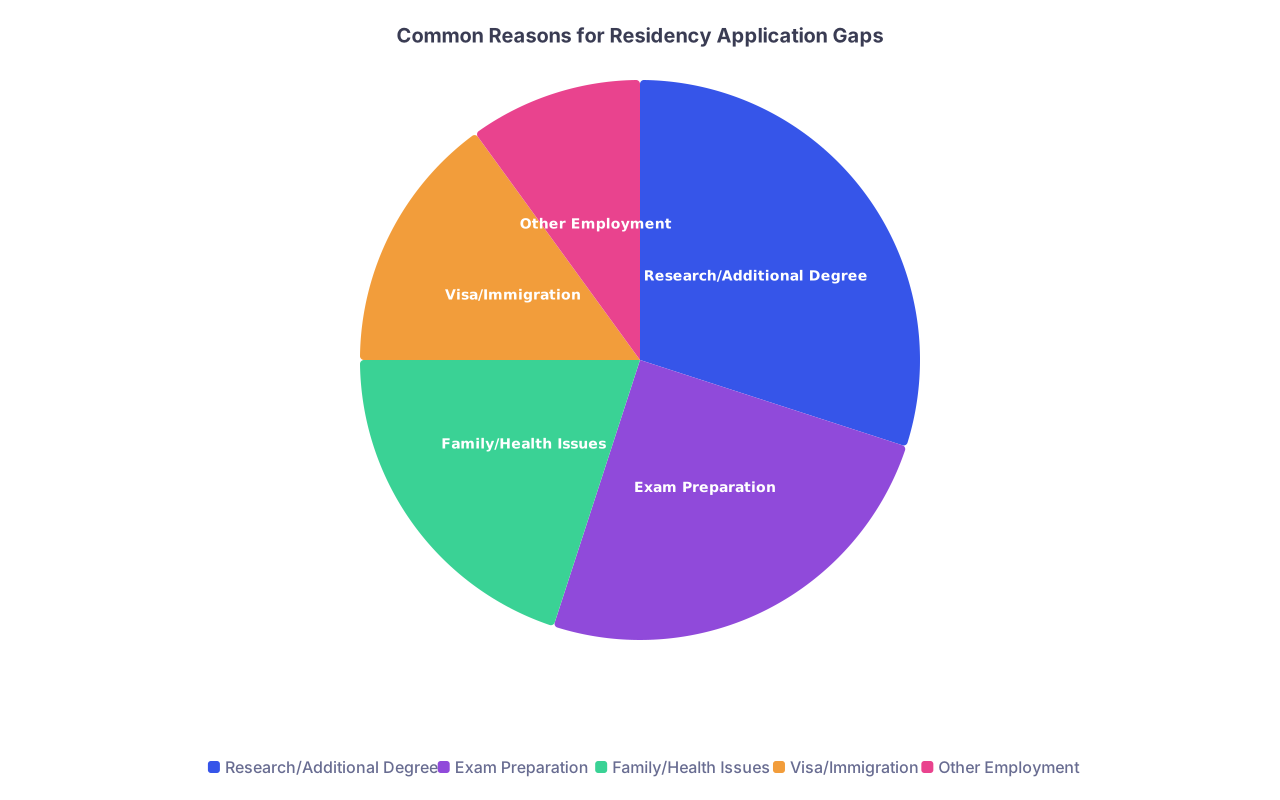
| Category | Value |
|---|---|
| Research/Additional Degree | 30 |
| Exam Preparation | 25 |
| Family/Health Issues | 20 |
| Visa/Immigration | 15 |
| Other Employment | 10 |
Script 9: Research Year or Extra Degree
This is the easy version, yet many people undersell it.
“Between third and fourth year, I completed a dedicated research year in cardiology at [Institution]. I worked on outcomes analyses for heart failure patients and co‑authored two abstracts presented at regional meetings.
That year strengthened my data literacy and comfort with evidence‑based decision making, but it also confirmed that I am more interested in full‑time clinical work than a primarily research career.
I am now focused on residency programs, like yours, where I can care for a broad internal medicine population while still having opportunities to participate in quality improvement or smaller clinical projects.”
Short, factual, no need for drama.
Script 10: Exam‑Focused Gap (No Clinical Work)
This is more common than program directors like. You need to avoid sounding like you did absolutely nothing else.
“After graduation, I spent an extended period focused on preparing for and completing my licensing exams. I recognize that having a longer gap without formal clinical training is not ideal.
During that time, I structured my weeks with full‑time study hours and regular clinical exposure through [observerships / volunteering in a clinic / working as a scribe]. That helped me keep my clinical reasoning and documentation skills active.
I have now completed all required exams and am fully focused on clinical training. I understand that there will be a transition back into full‑time patient care, and I am prepared to put in the extra work early to come up to speed.”
If you truly had no clinical contact, you must be honest but then pivot hard to readiness and willingness to grind.
Script 11: Personal / Health / Family Gap
You do not need every detail. You do need to show resolution and current stability.
“I had a significant family health situation that required my direct involvement for several months, which interrupted my training. I chose to step away temporarily to address that.
That situation is now fully resolved, and I have been back to full‑time work/study for [X] months without difficulty. During the latter part of that period, I volunteered in a community clinic two days a week and completed an online clinical update course to re‑engage my medical knowledge.
I am ready and able to commit fully to residency, including long hours and call responsibilities, without ongoing outside obligations.”
The key sentence they are listening for: “This is resolved and will not interfere with residency.”
Professionalism, Dismissals, and “Tell Me About This Incident”
Now we are in the high‑risk zone: professionalism citations, leaves of absence, code of conduct issues. You cannot hide these in SOAP. Many programs will ask directly.
Your answer must:
- Accept responsibility.
- Avoid arguing about fairness.
- Show specific behavioral change.
| Issue Type | Program Risk Perception |
|---|---|
| Single Step 1 fail, Step 2 solid | Low–Moderate |
| Step 2 fail, later pass | Moderate–High |
| One clerkship remediation | Moderate |
| 1–2 year exam/gap with activity | Moderate–High |
| Dismissal or major professionalism | Very High |
Script 12: Minor Professionalism Flag (Tardiness, Documentation)
“During my third year, I received a professionalism citation for repeated tardiness to morning sign‑out. I was not accounting properly for pre‑rounding and transportation time, and it became a pattern.
I met with the clerkship director, who was very direct with me about expectations. I started arriving at the hospital at least 30 minutes earlier, and I used a written checklist for pre‑rounding and sign‑out prep. I did not receive any further professionalism concerns for the remainder of medical school, and my later evaluations specifically mentioned reliability and punctuality as strengths.
That was an embarrassing but valuable lesson. As a resident, I know that being on time and prepared is a basic requirement, and I treat it that way.”
Specific, humble, corrected.
Script 13: More Serious Incident (Unprofessional Communication, Conflict)
“In my MS3 year, I was involved in an incident where my communication with a nurse during a busy call night was disrespectful. The interaction was reported, and I received formal feedback and a professionalism notation.
I met with the nursing supervisor and apologized directly. I also completed communication workshops offered by the school and asked a faculty mentor to observe my team interactions on a subsequent rotation. Since then, I have focused deliberately on staying calm and respectful, especially when I am stressed or tired.
My later evaluations show strong teamwork and communication, and I have not had any further incidents. I recognize how critical interprofessional respect is to safe patient care and to the functioning of a residency program.”
If there was a pattern or dismissal, you need to be even more careful and specific. But the structure is the same.
Behavioral SOAP Questions: “Tell Me About a Time…”
Do not underestimate these. In SOAP, PDs will often do 5‑minute phone screens using 1–2 behavioral questions plus the red‑flag question.
Use the STAR structure (Situation, Task, Action, Result). Brief but specific.
Script 14: “Tell Me About a Time You Received Critical Feedback”
“On my OB/GYN rotation, midway feedback said that my notes were too long and my assessments unfocused. The attending told me directly that if I did not tighten my documentation, my grade would suffer.
I asked for an example of a strong note and compared it line by line with mine. I created a one‑page template focusing on problem‑based assessments. For the next two weeks, I pre‑charted and then asked the resident to review a few notes each day.
By the end of the rotation, my notes were consistently concise, and my final evaluation mentioned that I had made one of the biggest improvements of the group. That experience reinforced for me that I should seek specific, actionable feedback early rather than waiting for final evaluations.”
Programs care less about the initial weakness than about your response.
Script 15: “Tell Me About a Failure and What You Learned”
Tie this to your existing red flag so you are not introducing new ones.
“My largest failure was my first attempt at Step 1. I did not pass. I was embarrassed and initially pretty defensive about it.
After a week, I sat down with my advisor and reviewed my study schedule, NBME scores, and habits honestly. The reality was that I was doing a lot of passive review and not enough timed, mixed questions. I created a new plan built almost entirely around active problem solving and weekly self‑testing.
I passed on my second attempt and went on to perform significantly better on Step 2. More importantly, I changed how I approach any weakness: I look at the data, ask for help, and build a system around it. That is exactly how I intend to approach in‑training exams and feedback in residency.”
Email and ERAS Message Templates During SOAP
Not all contact will be by phone. You will also send quick messages through ERAS or email.
You need a concise written version of your script. Something like this:
Short Intro Email to a SOAP Program
Subject: SOAP Applicant – [Your Name], [Specialty]
Dear Dr. [Program Director Last Name],
My name is [Name], and I am an unmatched applicant in the SOAP for [Specialty]. I am very interested in your program at [Institution] because of [1 specific program feature – e.g., community‑based training with strong inpatient volume].
I want to acknowledge up front that my application includes [brief issue – e.g., a prior Step 1 failure]. I addressed this by [1–2 actions], and my subsequent performance on Step 2 and clinical evaluations reflects sustained improvement.
I would be grateful for consideration for any available PGY‑1 positions and would welcome the opportunity to speak with you or a member of your team briefly during SOAP.
Sincerely,
[Name, AAMC ID, contact information]
Do not write long confessionals in email. Keep the deeper explanation for the phone.
Putting It All Together: Prep Sheet for SOAP Week
You should have a one‑page document open during SOAP calls with:
- 2–3 bullet points for “Why I did not match” (your chosen narrative)
- 2–3 sentences explaining each red flag (fail, gap, professionalism)
- 3 program‑independent strengths you always weave in: e.g., work ethic, communication, procedural interest
- 2–3 specific questions you will ask each program

| Step | Description |
|---|---|
| Step 1 | Identify Red Flags |
| Step 2 | Write 3-line Explanation |
| Step 3 | Draft 60-90 sec Script |
| Step 4 | Practice Out Loud |
| Step 5 | Refine for Clarity |
| Step 6 | Use During SOAP Calls |
Then you practice. Out loud. Several times. If you can, with someone who has actually sat on a rank committee.
FAQs
1. How honest should I be about why I did not match?
Be honest about the category of problem (competitiveness, limited geography, exam performance, etc.), but you do not owe programs every emotional detail. Give a clear, factual explanation that matches what is visible in your application. If you lie or significantly distort, it often shows: faculty can see your score report, transcript, and application pattern.
2. Is it better to bring up red flags myself or wait for them to ask?
On short SOAP calls, wait for them to ask directly, but be prepared the instant they do. In emails or ERAS messages, a single sentence acknowledging a major issue (like a Step failure or dismissal) can help, as long as you immediately follow with what changed and your recent performance. The worst move is to sound evasive when they raise it.
3. How much detail should I give about personal or family health issues?
Minimal. State that there was a significant health‑related situation, that it required your involvement, and that it is now resolved and no longer interferes with your ability to commit fully to residency. Do not share diagnoses, lab results, or extended stories. Programs are not your therapists; they are assessing reliability and current capacity.
4. What if my gap was truly unproductive – I just studied slowly and was burnt out?
You still frame it, but you must avoid sounding lazy. Own that you took longer than ideal to complete exams and that you have now finished them. Emphasize any structure you built later (study schedule, mock exams) and your readiness to work full time again. If you absolutely did nothing clinical, say you are prepared to put in extra work early in residency to get back to speed.
5. Should I mention wanting to re‑apply to a more competitive specialty later?
No. During SOAP, you are asking a program to invest in you for their specialty. Talking about using them as a bridge or backup is a great way to get rejected. Your scripts should make it clear that you understand and accept the specialty you are pursuing now and can build a fulfilling career in it.
Key takeaways:
- Every difficult SOAP question needs the same backbone: name the issue, give a concise reason, show specific corrective action, and connect to why you are now a safe, motivated hire.
- Scripts are not optional; under pressure you will default to rambling unless you prepare tight, honest, 60–90 second answers for your particular red flags.
- Programs are not looking for perfection in SOAP. They are looking for self‑awareness, stability, and evidence that your past problems are solved, not ongoing.