
The most common advice you will hear about SOAP is dangerously oversimplified. Some of it will quietly destroy your chances of ever matching.
You are vulnerable this week. Sleep‑deprived, humiliated, flooded with emails and texts from people “trying to help.” That is exactly when bad advice does the most damage.
Let me walk you through the advisor guidance you must treat with suspicion, push back on, or ignore outright if you want to get out of SOAP with a position instead of a cautionary tale.
1. “Apply to Everything. Cast the Widest Net Possible.”
This is the classic panic-line from advisors who are scared of your unmatched status and more scared of being blamed later.
On the surface, it sounds safe: more applications, more chances. In SOAP, that logic is wrong.
Why “apply to everything” is bad strategy
You get a hard cap: 45 programs. That cap is not flexible. Every slot you waste on a program where you are clearly not a fit is a slot you steal from a realistic option.
The mistake pattern I keep seeing:
- Student unmatched in Internal Medicine.
- Advisor: “In SOAP just apply to IM, FM, transitional year, prelim surgery, prelim anything. Fill all 45.”
- Student throws 10–15 applications at prelim surgery and transitional programs with zero surgical exposure, no real interest, and no coherent narrative.
- Result: No interviews. Not because SOAP is impossible. Because the applications were incoherent junk.
SOAP is not a lottery. Programs are still selective. Many will see your application for 20 different, loosely related programs and conclude one thing: “This applicant is desperate and unfocused.”
How to correct the mistake
You must:
Define 1–2 realistic target categories (not 5):
- Example: Unmatched in categorical IM with 224/230, 2 IM letters, U.S. grad → realistic: community IM, FM, maybe prelim IM.
- Unrealistic: prelim surgery at academic powerhouse, cush TY with 200+ apps per spot.
Use your 45 slots strategically:
- Majority: categorical or prelims that are consistent with your background and story.
- Minority: one “adjacent” path that you could actually defend living with for a year.
Check the obvious fit filters before applying:
- Will they consider your visa status?
- Do they accept your type of medical school?
- Do they have minimum Step/COMLEX cutoffs you clearly miss?
| Category | Number of Programs | Rationale |
|---|---|---|
| Categorical IM | 25 | Primary realistic target |
| Family Medicine | 10 | Strong match with application |
| Prelim IM | 8 | Secondary path if categorical fails |
| Transitional | 2 | Only if genuine fit and interest |
The mistake to avoid: filling all 45 slots just to “feel productive” on Monday and ending up with 45 bad choices that all say no.
2. “Brand Does Not Matter In SOAP. Just Get Any Spot.”
I hear this constantly in hallways: “Once you’re in residency, it does not matter where you are.” That is not always true, and it is especially not true in SOAP.
No, you should not be picky about prestige when sitting unmatched on Monday morning. But you also should not blindly accept any position with a heartbeat.
The hidden landmines in “any spot”
There are programs in SOAP for reasons:
- New programs that are excellent but unknown.
- Solid community programs that just expanded.
- Programs with chronic issues: toxic culture, malignant leadership, insane workloads, or terrible board pass support.
I have watched students rush into:
- Prelim surgery at a notoriously malignant program “just to get in the system” and burn out so hard they cannot realistically apply to anything competitive later.
- PGY‑1 positions at barely functional new programs that later lose accreditation or get placed on probation.
Those choices can trap you. A bad residency fit is not a short-term inconvenience. It can damage:
- Your health.
- Your record.
- Your letters.
- Your ability to ever transfer or re‑apply.
How to ignore the wrong version of this advice
You cannot be a diva in SOAP. But you must draw a line between:
- Non-ideal but workable, and
- Program with glaring red flags.
Quick triage on programs:
- Look at recent ACGME status.
- Search residents’ names on social media/LinkedIn to see actual retention and career paths.
- Ask upperclassmen: “Have you heard anything specific about X program?”
If your advisor says, “Brand does not matter, just accept,” push back with:
- “I am willing to go to a lower-profile place, but I am not willing to go somewhere with clear evidence of chronic abuse or failing outcomes.”
The mistake to avoid: treating SOAP as “anything is better than nothing” and signing yourself into a multi-year disaster.
3. “Fix Your Personal Statement Overnight.”
SOAP is not the time to reinvent your narrative from scratch. I have seen advisors urge unmatched students to:
- Rewrite their personal statement for an entirely new specialty in one night.
- Completely remove any mention of original specialty interest.
- Stuff the statement with artificial “lifelong passion” for a specialty they decided on 11 hours ago.
Programs can smell that from across the country.
Why “new specialty, new PS ASAP” often backfires
Here is how it looks from the program side:
- On ERAS: Student applied categorical EM in September with a detailed EM narrative.
- In SOAP: Student suddenly sends 35 FM applications with generic cliché paragraphs and no actual FM content beyond “I love continuity of care.”
It reads like desperation, not insight.
Worse:
- Hasty rewrites are full of typos, inconsistencies (different names of mentors, conflicting goals), and tone-deaf lines about “finding my true calling” between Sunday and Monday.
Instead of proving flexibility, you prove panic.
What to actually do with your written materials
Minor surgery, not total organ transplant.
- Tweak your existing statement to de‑emphasize the unmatched specialty.
- Shift focus to general skills: communication, teamwork, resilience, patient-centered care.
- Add 1–2 sincere paragraphs about what you now value in the new specialty or in a prelim year.
Avoid fake backstory.
- Do not create a fake “since childhood I dreamed of FM” narrative if that is clearly revisionist.
- Say something like:
- “My experiences this year have made me appreciate the role of primary care in ways I underestimated initially.”
- “I am drawn to programs where I can develop a strong foundation in inpatient medicine applicable to multiple career paths.”
Keep it clean and short.
- One clean, well-edited, believable statement beats a rushed specialty-specific essay that sounds like ChatGPT and a pamphlet had a baby.
The mistake to avoid: burning credibility by pretending you had a sudden epiphany at 11:59 PM on Match Week Monday.
4. “Do Not Bother Programs. They Are Too Busy During SOAP.”
This one is subtle but deadly. A lot of well-meaning deans tell students: “Programs are overwhelmed. Do not email. Do not call. Just submit and hope.”
That is how you become invisible.
The reality: programs still read cues
During SOAP, program coordinators and PDs are:
- Sorting through dozens to hundreds of applications.
- Looking for quick filters to decide who is serious and who is blasting out 45 random applications.
A concise, respectful email can:
- Put your name on their radar.
- Signal genuine interest.
- Answer obvious questions (visa, geography, career goals) before they wonder.
But advisors often overcorrect out of fear of “annoying” programs.
How to engage without becoming a nuisance
You must avoid the opposite mistake: spamming, calling five times in one day, or sending huge emotional paragraphs.
Reasonable approach:
- One targeted email per program you care about most.
- From you, not your mom, not your friend, not your school unless there is a specific backchannel connection.
- 6–8 sentences: who you are, why their program, 1–2 concrete points that show you actually looked them up.

| Step | Description |
|---|---|
| Step 1 | Identify Priority Programs |
| Step 2 | Check Eligibility and Fit |
| Step 3 | Draft Short Email |
| Step 4 | Send Once to Coordinator or PD |
| Step 5 | Reply Briefly if Needed |
| Step 6 | Do Not Follow Up Repeatedly |
| Step 7 | Response? |
Sample structure, not a script:
- Line 1: Your name, current status, and what you are applying for.
- Line 2–3: Why this program specifically (location/mission/patient population/structure).
- Line 4: One or two strengths that match what they say they want.
- Line 5: Offer availability for interviews and thank them.
The mistake to avoid: being so afraid of “bothering” them that you never signal any genuine interest while other applicants do.
5. “Hide Your Original Specialty. Pretend You Always Wanted This.”
Terrible advice. Common as oxygen.
Plenty of advisors will tell you to:
- Erase any trace of your original matched specialty from your CV or application.
- Never mention it on SOAP calls or interviews.
- Act as if this new specialty was always your dream.
That is not how adult physicians talk about their careers. Program directors know SOAP exists. They know people pivot.
Why erasing your history looks worse
From the PD chair, a resident who:
- Knows where they started,
- Knows why they shifted, and
- Can articulate that without bitterness or fantasy,
is more trustworthy than a candidate who suddenly claims overnight devotion.
I have watched interviews where candidates dodge direct questions:
- “So you applied to EM originally, is that right?”
- Candidate: “Well, I have always liked family medicine too, and I realized that…”
By denying reality, they sound dishonest or confused.
How to discuss the pivot without self-sabotage
You must answer three questions clearly:
- What happened?
- What did you learn?
- Why are you a good fit for this path now?
Example answer skeleton:
- “Yes, I applied to EM initially because I enjoyed acute care and fast-paced decision making.”
- “Through the year and particularly during my IM rotation, I realized I value longitudinal relationships and broader internal medicine knowledge more than I expected.”
- “I see this program as a place to build a strong foundation in inpatient and outpatient medicine that fits my long-term goals in X.”
No self-flagellation. No blaming. No melodrama.
The mistake to avoid: rewriting your entire story so aggressively that you come across as inconsistent, inauthentic, or shallow.
6. “Your Scores Are The Problem. SOAP Is Hopeless For You.”
There is a special kind of demoralizing advisor who fixates on one weak metric and basically writes you off.
- “Your 205 means nobody will look at you.”
- “Your failure on Step 1 will scare all programs.”
- “SOAP is just a formality. You will not match.”
You cannot afford that mindset in Match Week. It shuts down the creativity and disciplined aggression you need.
What that advice ignores
SOAP outcomes are messy. I have personally seen:
- A student with a Step 1 fail, then 220+, match into prelim IM in SOAP and transfer to categorical later.
- A DO grad with unimpressive scores and no home IM program land a solid FM categorical spot in SOAP because:
- He had strong, believable FM letters.
- He communicated clearly with PDs and coordinators.
- His school advocated strategically.
No, SOAP is not magic. Severe red flags do reduce options. But writing yourself off guarantees the outcome your advisor predicted.
How to respond to demoralizing “realism”
You need to:
- Acknowledge constraints: Some specialties are out of reach right now. Some geographic regions are brutal.
- Redirect energy: “Given these realities, where do I still have a legitimate shot?”
This is where you use data:
- Look at the previous years’ SOAP outcomes by specialty for your school, if available.
- Ask your dean or advisor directly: “Which programs or specialties have historically taken our students in SOAP with profiles like mine?”
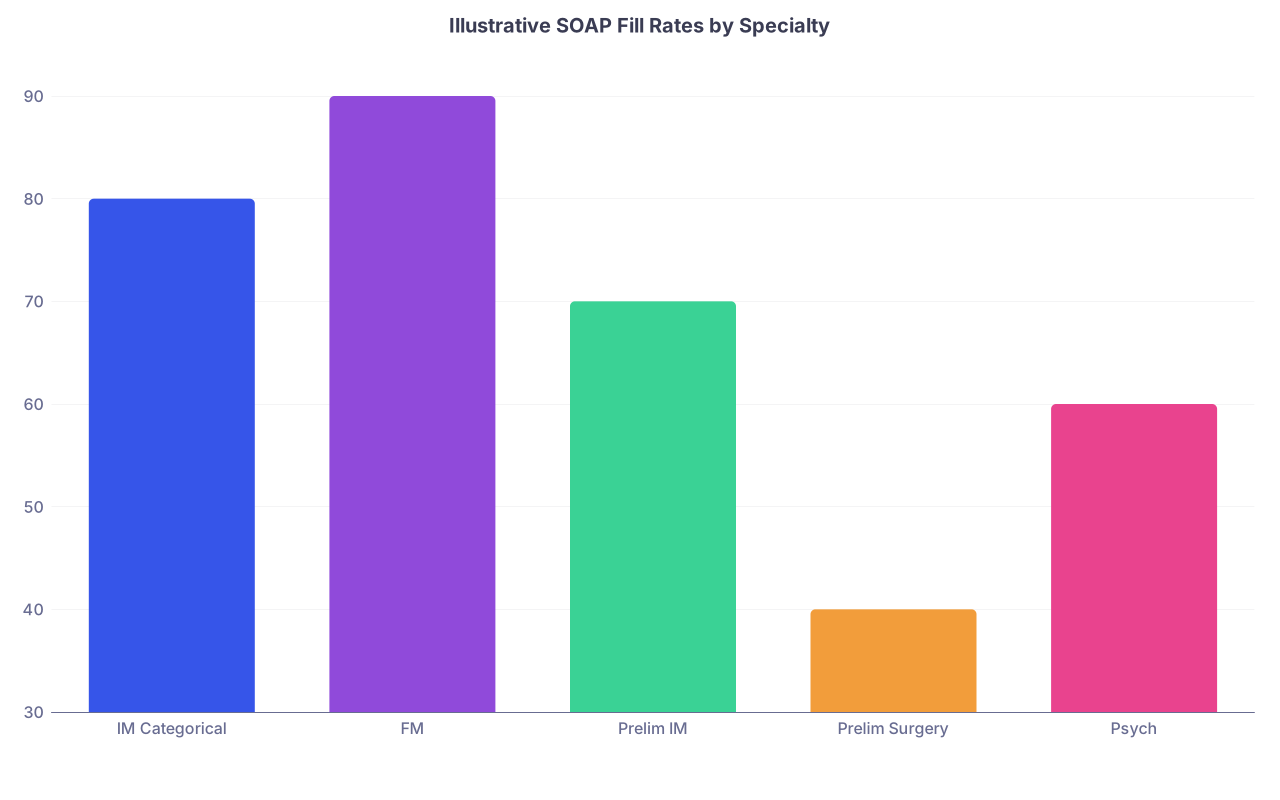
| Category | Value |
|---|---|
| IM Categorical | 80 |
| FM | 90 |
| Prelim IM | 70 |
| Prelim Surgery | 40 |
| Psych | 60 |
This is illustrative, not exact national data, but the point stands: some fields soak up SOAP candidates; others barely move.
The mistake to avoid: letting one demoralizing conversation convince you not to fight intelligently for the options you actually do have.
7. “You Can Always Reapply Next Year. Do Not Worry About This SOAP Round.”
This one sounds comforting. It is also often reckless.
I have heard advisors say:
- “If you do not see something perfect, just skip SOAP and try next year.”
- “Better to wait than to take something you are not sure about.”
Sometimes that is true. Often it is not.
The real cost of “I’ll just try again”
The second time applicant penalty is real:
- Programs wonder why you did not match the first time.
- They assume, often correctly, that something else is wrong or unspoken.
- You now have a gap year to explain convincingly.
Worse, if you:
- Do nothing clinically for a year, or
- Drift into unrelated work without strong letters or clear plan,
your application becomes weaker, not stronger.
Is it ever right to skip SOAP? Yes:
- If the only offers you might realistically get are from seriously troubled programs where training quality and your safety are suspect.
- If you have a robust, structured plan for the next year:
- Legitimate research with publications expected.
- A strong, clinical, supervised role with new letter writers.
- Clear remediation of whatever sunk you (exams, professionalism, etc.).
But that is the exception, not the default.
How to think about “reapply next year” safely
Ask your advisor directly:
- “If I skip SOAP, how will I concretely improve my application in the next 12 months?”
- “Have you seen many students from our school skip SOAP and then successfully match later? In what specialties and after doing what?”
If they cannot answer with specifics, not anecdotes, you are being handed vague reassurance, not strategy.
The mistake to avoid: treating “I will reapply” as an automatic safety net when in reality it is an uphill, uncertain climb.
8. “Your School Will Handle SOAP For You. Just Do What We Say.”
This one is tricky. Some schools run SOAP extremely well. Others… do not.
Blind obedience is a problem either way.
The two dangerous extremes
Over-control from the school
I have seen deans insist on:- Choosing all 45 programs “for you.”
- Banning direct student contact with programs.
- Forbidding applications outside a very narrow specialty range, even when the student has legitimate reasons.
Total abdication
- “Here is your ERAS login. Good luck. We will write a generic MSPE update.”
Both are dangerous. You are the one who lives with the outcome.
How to work with your school without surrendering your judgment
You need a collaborative, not submissive, posture:
- Listen to their data about where prior unmatched grads landed.
- Respect their insight on program reputations and realistic chances.
- But come prepared with:
- Your own ranked list of programs and specialties.
- Clear reasons for each.
- A few nonstandard options you want them to consider.
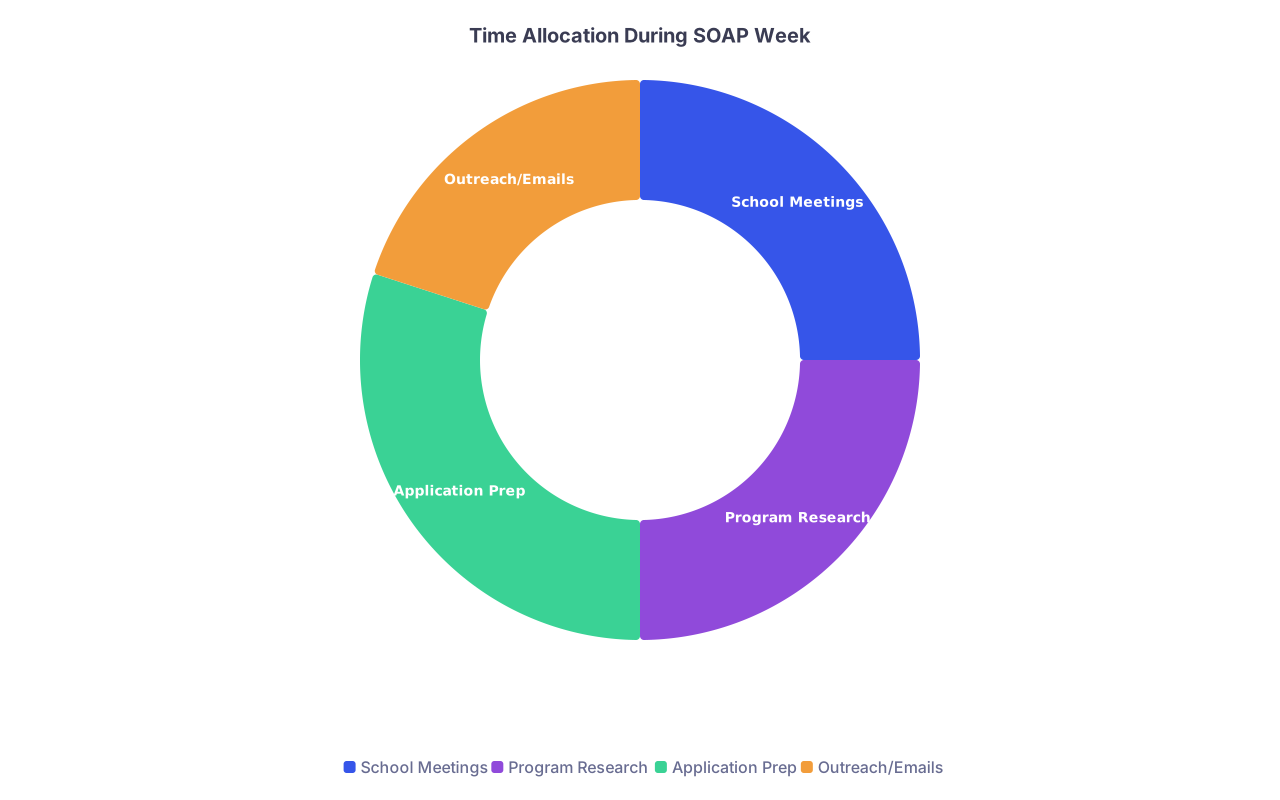
| Category | Value |
|---|---|
| School Meetings | 25 |
| Program Research | 25 |
| Application Prep | 30 |
| Outreach/Emails | 20 |
You cannot outsource:
- Reading program websites.
- Checking your own eligibility.
- Choosing between prelim vs categorical paths given your career dreams.
The mistake to avoid: assuming that “the school knows best” in a way that excuses you from any independent thinking or pushback.
9. “Say Yes To The First Offer. Do Not Risk Losing It.”
I know exactly where this advice comes from. Fear.
And yes, in SOAP, offers are time-limited and can vanish. But reflexively accepting the first call without thought can lock you into a worse position than you needed.
The nuance people gloss over
You are allowed to:
- Ask clarifying questions.
- Confirm what kind of position it is (prelim vs categorical, funded vs non-funded, PGY‑1 vs advanced).
- Take a brief moment (minutes, not hours) to weigh it against your priorities.
You are not allowed (practically speaking) to:
- Stall endlessly.
- Hold multiple offers.
- Negotiate like it is a regular job market.
I have seen students accept:
- A prelim surgery slot in blind panic,
- Then get an FM categorical interview later the same day,
- And spend the next year trying to claw their way back toward their real goals, instead of starting in a field aligned with their skills and temperament.
How to handle an offer call without blowing it
You should be ready with:
- A simple mental hierarchy before the calls start:
- Categorical in acceptable specialty > prelim year that fits your long-term plan > anything clearly misaligned.
- A short script:
- “Thank you very much for the offer. To confirm, this is a categorical [specialty] position starting this July at [site], correct?”
- If it fits your pre‑defined “yes” category → accept promptly.
- If it is borderline, and you genuinely need a moment, you can carefully say:
- “I am very interested. Could I have a short time to confirm one detail with my dean and get right back to you?”
You risk them moving on. You weigh that risk consciously.
- “I am very interested. Could I have a short time to confirm one detail with my dean and get right back to you?”
The mistake to avoid: either grabbing the first thing automatically with zero thought, or trying to play hardball with no leverage and losing your only realistic shot.
Key Takeaways
- Do not let panic or bad advisor advice turn SOAP into a random 45‑application lottery. Strategy, focus, and honest self‑assessment still matter.
- Be wary of anyone telling you to erase your history, rewrite your entire story overnight, or “just wait for next year” without a concrete plan.
- Use your school’s support, but do not outsource your judgment. You are the one who will live in whatever program you choose for the next several years. Guard that decision fiercely.