
What do you actually do when one of you matches, the other doesn’t, and it’s 10:59 a.m. on Monday of Match Week?
This is the article for that exact nightmare.
You’re not thinking big-picture strategy right now. You’re thinking: We couples matched. It failed. SOAP is in 1 minute. How do we not blow up our relationship and both end up unemployed?
Let me walk you through what to do, step by step, like we’re sitting in the call room with NRMP open and a whiteboard between us.
First: Get Clear on Your Real Situation (Not the Fantasy One)
Before you touch SOAP, you need brutal clarity.
There are a few common “gone wrong” couples scenarios:

| Scenario ID | Partner A | Partner B |
|---|---|---|
| 1 | Matched | Unmatched |
| 2 | Unmatched | Unmatched |
| 3 | Both Unmatched (different competitiveness) | |
| 4 | Both Matched but Far Apart | |
| 5 | One SOAP-eligible only |
You’re probably in one of these:
- You matched, your partner did not.
- Your partner matched, you did not.
- Both of you are unmatched.
- Both matched, but in different cities far apart, and one (or both) of you want to try SOAP anyway.
- Only one of you is SOAP-eligible (failed exams, SOAP-ineligible specialties, etc.).
Here’s the harsh part: couples matching is over. SOAP is an individual game.
There is no couples SOAP. No pairing. No linked lists. You are now two separate applicants trying to coordinate outcomes as best you can.
So your first job isn’t to list programs. It’s to decide your joint non‑negotiables.
You have about 10–20 minutes to do this well before you must start clicking.
Decide Your Priorities in 20 Minutes or Less
This is the part people skip because they’re panicking. Then they make SOAP choices based on vibes and regret it for years.
Shut the door. Close Instagram. You and your partner need a 15–20 minute war room.
Use this frame:
What’s our hierarchy of priorities for the next 1–3 years?
- Geography together at all costs?
- Staying in the same region?
- Preserving specialty choice?
- Preserving prestige/academic trajectory?
- Avoiding a gap year?
What are each of your red lines?
- “I will not do prelim IM and reapply.”
- “I will not move to X state for 1 year; I’ll do a gap year instead.”
- “I’m okay being apart for 1 year, not 3.”
What time horizon are we optimizing for?
- Short-term (this year only, just get any job)?
- Medium-term (can we both be in the same city by PGY2?)
- Long-term (I must do neurosurgery or this was all pointless)?
You don’t need a perfect consensus. You need a guiding rule you both agree to. Something like:
- “We will prioritize both having categorical positions this year, even if we’re in different cities. We’ll aim to reunite by PGY2 through transfers or re-applying.”
- Or: “We will prioritize geography first; the unmatched partner will consider prelim/TY in partner’s city/state rather than a categorical spot far away.”
Write that single principle on a piece of paper. Keep it visible. Refer back to it when you’re exhausted at 4 p.m. and about to click something dumb.
Understand SOAP Mechanics As They Actually Affect Couples
You probably kind of know SOAP. But “kind of” is not good enough right now.

| Step | Description |
|---|---|
| Step 1 | Mon 10 am - Learn status |
| Step 2 | See unfilled list |
| Step 3 | Prepare applications |
| Step 4 | Mon 3 pm - Apps open |
| Step 5 | Programs review and interview |
| Step 6 | Offers go out in rounds |
| Step 7 | Accept offer |
Key points that matter specifically to couples:
- Maximum 45 applications per person, total. Not per round.
- You can’t withdraw from SOAP to re-enter it. Once you accept a SOAP position, game over for that person.
- Offers are binding. You accept an offer, you are done. No “just kidding, we got a better one later.”
- No new applications after the initial submission window. You get your 45, that’s it.
So as a couple, your constraints compound. Two people, 45 each, but your options are linked by geography and timing.
You must assume:
- You might not get the same timeline of offers. One can be offerless while the other has 2 minutes left to respond.
- You might get strong offers in different cities at the same time.
- You will not have time to have deep conversations during each offer window.
That means you need pre‑decided rules for:
- When is one of you allowed to accept without waiting on the other?
- Under what conditions do you decline and risk getting nothing?
- Who is “allowed” to be more selfish about specialty or career track?
Do this now, not at 11:58 a.m. on Wednesday.
Strategy by Scenario
Let’s go scenario by scenario. This is where most people screw it up or get paralyzed.
1. You Matched, Your Partner Didn’t
You’re going to feel guilty. They’re going to feel ashamed. Ignore that for now; you’re both in triage mode.
The key question:
Should the unmatched partner prioritize being near your program, or prioritize the best categorical opportunity anywhere?
This splits into two rational strategies:
A. Geography-First Strategy
Use this if:
- Your relationship is non-negotiable.
- Your program is in a saturated city with many hospitals (NYC, Boston, Chicago, Philly, Houston, etc.).
- Your partner is okay with prelim, TY, or off-cycle paths if needed.
Action plan:
- Filter the unfilled list by:
- Your city first.
- Then your state/region.
- Apply to:
- All prelim/TY slots in your city/region.
- Any categorical in their specialty or close cousin in your city/region.
- Accept the first solid offer in your city/region that’s not obviously career-suicidal.
Common example:
- You match categorical EM in Boston.
- Your partner (applying IM) is unmatched.
- SOAP: They apply to IM, FM, prelim medicine, TY in Boston and greater New England. If they get a prelim in your hospital system, that’s a pretty decent outcome.
B. Career-First Strategy
Use this if:
- Your partner is in a competitive specialty or has already taken a hit (low Step, red flags).
- You’re both okay with long distance for 1–3 years.
- Their trajectory depends on something more than geography.
Action plan:
- Your partner builds a SOAP list purely based on:
- Categorical > prelim.
- Programs that can realistically set them up to re-apply or stay on.
- Academic/tertiary centers if future fellowship matters.
You, as the matched partner, stay put. You focus on being the stable anchor: insurance, income, benefits, and future transfer possibilities.
What’s dumb?
Trying to do half-and-half. “We’ll mostly rank near you, but also throw in a bunch of random categorical spots across the country and see what happens.” That just gives you scattered, hard decisions under time pressure.
Pick A or B. Commit.
2. Your Partner Matched, You Didn’t
Same mechanics, flipped roles. But I’ll say this plainly: the unmatched partner should drive the SOAP strategy.
I’ve seen matched partners push too hard: “Just SOAP into prelim in my city; we’ll figure it out.” That’s generous emotionally but sometimes reckless.
If you’re the unmatched one, look at:
- Your specialty competitiveness
- How bad your application really is (not how it feels)
- Whether your partner’s city has real options for you
Then choose:
- “I will prioritize being near you and accept a more roundabout career path.”
or - “I will prioritize the best training I can get anywhere, and we’ll do 1–2 years apart.”
Say it out loud. Then build your list accordingly.
3. Both of You Are Unmatched
This is the purest chaos scenario, but also the one with the most flexibility. You both have 45 shots.
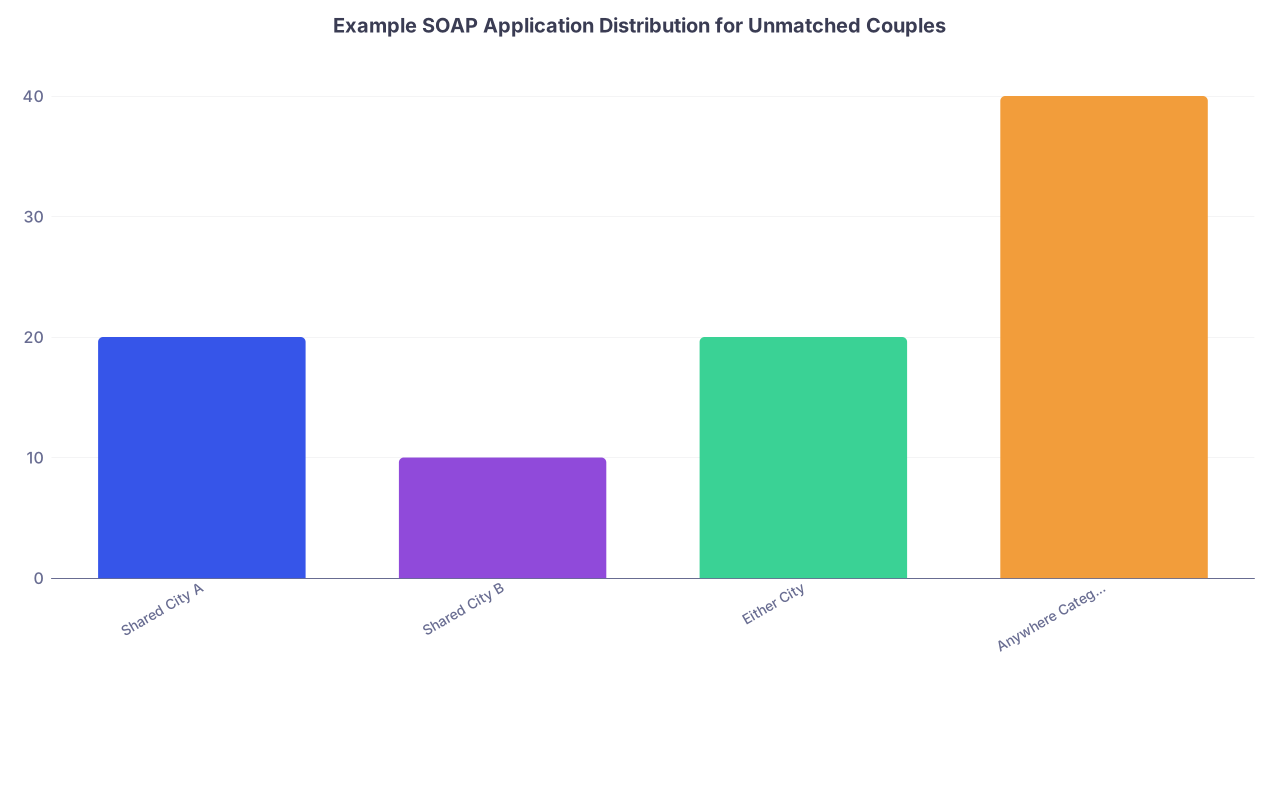
| Category | Value |
|---|---|
| Shared City A | 20 |
| Shared City B | 10 |
| Either City | 20 |
| Anywhere Categorical | 40 |
What you do depends heavily on:
- Same specialty vs different specialties
- How competitive each of you are
- Whether you have any existing geographic anchor (family, cost of living, visas)
Here’s a practical way to design your lists:
Step 1: Pick 1–3 anchor regions
Not 10. 1–3. For example:
- “Midwest home state,” “Partner A’s home city,” and “Major coastal academic hubs.”
Step 2: Define roles – who is flexible, who is not
You rarely have two equally competitive people. Be honest.
- The stronger applicant aims for categorical spots with some geographic preference.
- The weaker applicant focuses more on geography around wherever the stronger one has the best odds.
This sounds harsh, but it’s better than both of you going all‑in on random, highly competitive categorical positions in five different cities and ending up both unmatched again.
Step 3: Divide your 45 applications strategically
Rough example for different-specialty couple (IM + Psych):
Partner A (stronger, IM):
- 20 apps to categorical IM in 1–2 chosen regions.
- 15 apps to categorical IM anywhere.
- 10 apps to prelim/TY in anchor regions.
Partner B (psych, weaker app, limited psych SOAP spots):
- All psych SOAP spots in anchor regions.
- Then FM/IM/TY in same regions where Partner A is heaviest.
- If still under 45, some “anywhere but good” categorical backups.
You’re trying to create clusters of applications in the same cities/regions, not scatter them like confetti.
4. Both Matched, But Far Apart – And You’re Considering SOAP
This is where people make impulsive career-killing decisions.
You already have jobs. SOAP is not for you. Unless:
- One of you is in a prelim with no secured advanced position.
- Or one of you is truly miserable with the match outcome (toxic program reputation, wrong specialty, deal-breaking geography) and willing to risk ending up with nothing.
Most of the time, in this scenario, SOAP as a couple is a terrible idea.
It’s usually smarter to:
- Start PGY1.
- Explore transfers after you have a foot in the door.
- Or plan coordinated re-applications in 1–2 years.
If one of you does try SOAP from a matched position (which requires resigning, with a lot of complications you probably don’t fully appreciate right now), at least follow this rule:
No one resigns a secured spot unless the other already has a SOAP offer in hand that materially improves your joint situation.
Otherwise, you’re trading a known (imperfect) outcome for two unknowns, in 72 hours, under pressure. Not smart.
5. One of You Is SOAP-Ineligible
This is reality for some couples: failed Step/COMLEX, specialty issues, too many prior attempts, etc.
One can SOAP. One cannot.
What this really means:
- SOAP-eligible partner’s main responsibility: secure a job with at least some geographic/financial stability.
- Ineligible partner’s responsibility: design a 1-year plan that keeps them viable (research year, MPH, prelim-repeat, tutoring + Step retake, etc.) in a location that doesn’t sabotage the relationship.
So instead of:
“How do we both SOAP?”
It becomes:
“How do we align SOAP outcome with a realistic plan for the other person for the next year?”
If you’re the SOAP-eligible one, and your partner can realistically do something productive in multiple places, you regain some geographical freedom. Use it.
Building Your SOAP Lists as a Couple (The Actual Tactics)
Now the part everyone wants: who applies where.

Step 1: Pull the Unfilled List and Mark “Couple-Friendly” Programs
Couple-friendly doesn’t mean “has a heart.” It means:
- Multi-specialty hospital or big system (more positions, more turnover, more transfer potential).
- City with multiple residencies (more options for the other partner in future cycles).
- Places that are known to take off-cycle residents or transfers (ask upperclassmen or mentors fast).
Highlight those. Those are higher-value for you than some random rural program with one residency and zero mobility.
Step 2: Do Quick Risk Tiers – Together
On a shared screen or piece of paper, categorize programs loosely for each of you:
- Tier 1: I’d be happy here; strong program or great geography.
- Tier 2: Acceptable; decent backup.
- Tier 3: I’d take it only to avoid unemployment.
You’re not doing 10 tiers. You’re doing 3. Fast.
Then cross-check:
- Where do both of you have Tier 1 or Tier 2 options in the same city/region? Those get priority.
- Where does at least one of you have Tier 1 while the other has at least Tier 2 in nearby spots? Those are second priority.
This is how you cluster intelligently inside the 45 limit.
Step 3: Protect at Least 10–15 “Independence” Slots Each
Even as a couple, you need some individual bets.
You should each reserve some applications for:
- Strong categorical programs that you personally want, even if the other doesn’t have much nearby.
- Places where your specialty is valued and you’d thrive.
Why? Because the worst long-term outcome is: you both end up in mediocre or toxic programs in the same town, both resentful, just because you tried too hard to force proximity in SOAP.
You’re a couple, not a single organism. Protect some career sanity.
Offer Day Rules: How Not to Panic-Click Your Future Away
SOAP offer rounds are emotional carnage. People freeze. People accept too quickly. People decline everything and end with nothing.
You don’t have that luxury as a couple.
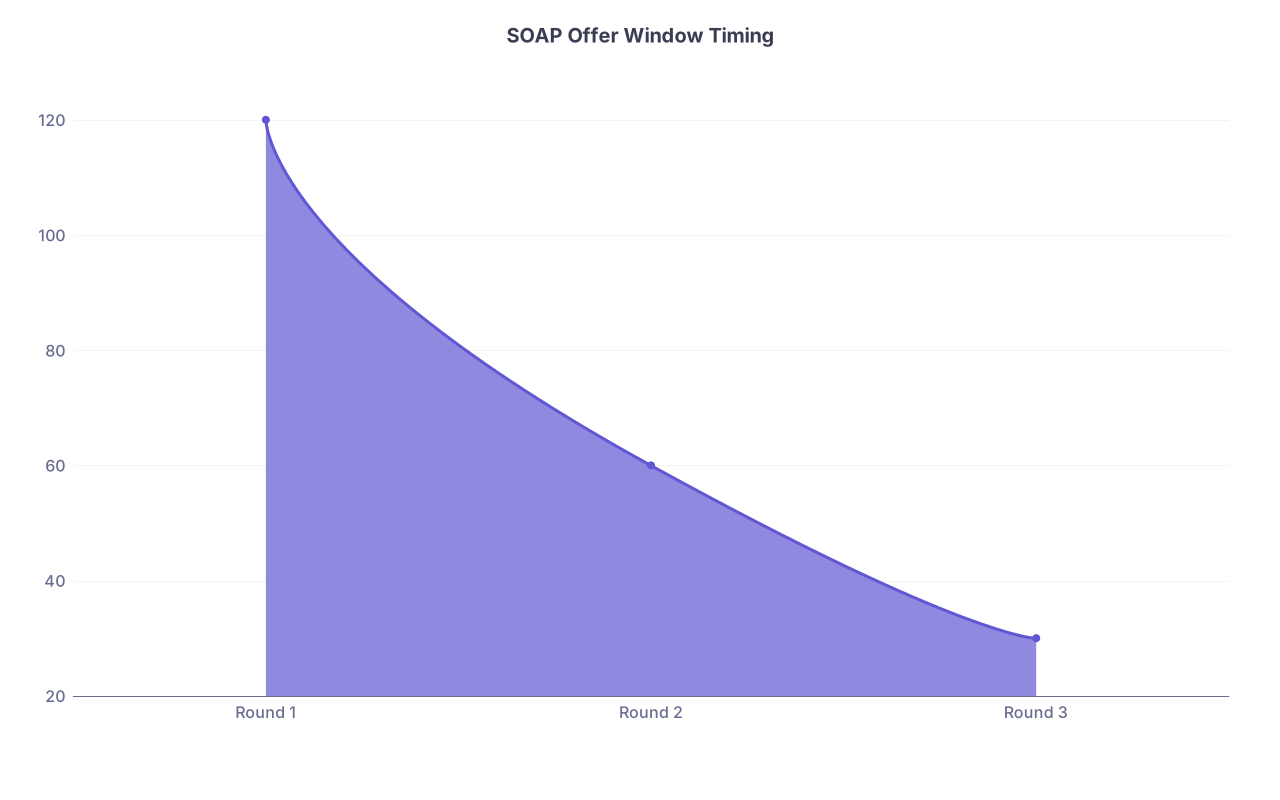
| Category | Value |
|---|---|
| Round 1 | 120 |
| Round 2 | 60 |
| Round 3 | 30 |
(Think: decision windows shrink, stress rises.)
Here are rules that work in real life:
Decide in advance the minimum acceptable scenario for each of you.
- “Any categorical in X, Y, Z regions = automatic accept.”
- “Prelim-only in distant place = accept only if other partner has at least a decent offer elsewhere.”
Assign one person as the “final call” on each offer.
- If it’s your offer, you decide. Your partner can advise, but they don’t get to override you in the last 60 seconds.
- This avoids screaming at each other over a timer.
Have a simple script for simultaneous misaligned offers:
- “If we both get categorical offers in different cities, both acceptable, we each accept. We will deal with distance.”
- Or: “If only one gets a categorical offer and the other has nothing, the person with the offer accepts, no guilt. Stability first.”
Do not decline a solid categorical offer hoping for a prettier one later in SOAP.
That’s gambling. Sometimes it pays off. When it doesn’t, it’s ugly.
Managing the Emotional Fallout Without Blowing Up the Relationship
Let’s not pretend this is just logistics. One of you will feel like the “anchor” and one like the “problem.”
You’ll hear things in your own head like:
- “I dragged us down.”
- “They’re holding my career hostage.”
- “If I were stronger, we’d both be matched in the same place.”
You need a few ground rules:
- No blaming during SOAP week. You can process feelings later. During SOAP, you’re coworkers on a crisis team.
- No weaponizing sacrifices. If one of you takes a prelim or moves somewhere less ideal, that was a joint decision. Don’t throw it back in arguments later.
- No “I’ll just not SOAP so you can be free.” That sounds noble but usually isn’t thought through. Talk to a mentor before self-sabotaging like that.
And try hard not to compare:
- Your friend-couple who both matched at their #1.
- The classmate who bragged about 20 interviews.
- The Instagram match posts.
None of that helps you make better decisions this week.
After SOAP: Stabilize, Then Strategize
Once the dust settles, you’ll probably land in one of four broad outcomes:

| Outcome | Description |
|---|---|
| A | Both categorical, same city/region |
| B | Both categorical, different cities |
| C | One categorical, one prelim/TY |
| D | One matched, one still unmatched |
- Outcome A: You won Match Week. Even if it doesn’t feel like it. Staff up, get to work, look for PGY2 transfer opportunities if needed later.
- Outcome B: You’re long-distance but both employed. Set a 1–2 year horizon to converge (transfers, reapply, fellowships). It’s survivable. Many do it.
- Outcome C: You have a bridge year for one partner. Use it wisely:
- Impress everyone.
- Grab research and letters.
- Re-apply early and strategically, ideally near partner.
- Outcome D: Stabilize the matched partner; get the unmatched one into a structure: research, MPH, chief year extension, something with a mentor and a plan.
Last thing: if you had a couples match flameout, and SOAP was rough, that doesn’t mean you “shouldn’t have couples matched.” It means the system is rigid and often dumb, and you had one bad roll of the dice.
Your job now is to turn a panic week into a survivable setup for the next 1–3 years.
Key Takeaways
- You must choose clear priorities as a couple before you start SOAP: geography vs career trajectory vs categorical security.
- SOAP is an individual process; act like two coordinated applicants, not a single unit, and cluster your applications in overlapping regions instead of scattering them.
- Pre-decide your rules for accepting offers so you do not panic-click into or out of life-altering decisions with 60 seconds left on the clock.