
SOAP is not a lottery. It only feels like one when you do it wrong.
Every year I hear the same fatalistic nonsense from unmatched applicants: “SOAP is random,” “Programs already know who they want,” “It’s all luck by Wednesday.” That attitude is comforting because it removes responsibility. It’s also mostly false.
SOAP is chaotic, brutally fast, and deeply imperfect. But random? No. There are clear, repeatable patterns in who turns SOAP chaos into a salvageable match and who gets crushed by it. And those patterns have very little to do with cosmic luck and a lot to do with preparation, realism, and execution under pressure.
Let’s pull this out of the superstition zone and into the data and mechanics of how SOAP actually works.
What SOAP Really Is (And Isn’t)
SOAP (Supplemental Offer and Acceptance Program) is not some mysterious back channel. It’s a structured, time-boxed redistribution of unfilled positions to unmatched or partially matched applicants. Think speed dating meets ERAS.
Here’s the key non-myth: programs aren’t throwing darts. They’re still using filters, still ranking based on specific needs, still using your actual application. You’re just compressing an entire recruiting cycle into a few days.
The core drivers in SOAP are:
- Supply and demand (how many spots are open vs how many unmatched in your lane)
- Program risk tolerance (how desperate they are to fill, and with whom)
- How well your application fits the real SOAP market, not the fantasy one in your head
- Whether you can rapidly assemble and target materials that show “I can do this job on July 1”
I’ve watched people with mediocre stats SOAP into decent categorical IM. I’ve watched people with 250+ board scores crash out because they clung to prestige, ignored red flags, or simply choked on logistics.
Luck is the tie‑breaker. Not the game.
The Numbers: Chaos, But Not Coin Flip Chaos
We do not have perfect granular SOAP data by specialty the way we have Match data, but we have enough to disprove the “pure luck” narrative.
Look at NRMP’s “Results and Data: SOAP” and the main Match data sets over recent years:
- Roughly 6–7% of positions enter SOAP in a typical year.
- The majority of SOAP positions are not in derm, ortho, or radiology. They’re in IM, family, peds, psych, prelim surgery, prelim medicine, and transitional year.
- US MDs who go into SOAP still match at much higher rates than IMGs doing the same. That alone tells you something: if it were random, those differences would flatten.
Let me show you a simplified view to make this less abstract.
| Category | Approx Share of SOAP Spots | General Fill Dynamics |
|---|---|---|
| Internal Medicine | High | Many spots, many applicants |
| Family Medicine | High | Many spots, moderate demand |
| Pediatrics | Moderate | Fewer spots, competitive |
| Psychiatry | Low–Moderate | Fills quickly |
| Prelim (IM/Surg) | High | Lots of turnover, backup path |
No one looks at this and thinks, “Ah yes, pure randomness.”
You see clearly: if you enter SOAP insisting on psych only, or “categorical only, no prelims,” you just voluntarily stepped into a much smaller pool of opportunities. That is not luck. That’s a choice.
Where You Actually Have Control (And Where You Don’t)
Let’s separate the part you can’t touch from the part you’re pretending you can’t touch.
You do not control:
- How many total positions go into SOAP this year
- Which hospitals in which cities end up unfilled
- How many other unmatched people are in your specialty/score range
- The arbitrary quirks of individual PDs (“no IMGs,” “must have Step 2 > 240,” etc.)
- The fact that some spots will be quietly reserved for home students or known quantities
That’s the background noise. You’re stuck with it.
You do control much more than people admit:
- How realistic your SOAP target list is for your profile
- Whether your ERAS is already SOAP‑ready before Monday
- How many backup pathways you’re willing to tolerate (prelim, TY, FM instead of IM, etc.)
- The speed and clarity of your communication with programs
- Whether your letters and personal statement actually address the obvious red flags (gap year, fail, prior unmatched attempt)
Control isn’t “get whatever you want.” Control is “tilt the odds hard enough that you’re not relying on a miracle.” That’s possible. Many people do it every year. The common thread is always the same: they treat SOAP like a second, shorter Match, not like a scratch-off ticket.
Myth: “If I Didn’t Match, SOAP Is Just More Rejection”
No. For some people, SOAP is actually easier than the main Match. Especially for those willing to pivot.
Here’s the uncomfortable truth: programs entering SOAP are not in the same position of power as programs in September. They have failed to fill in a hyper‑competitive environment. Chairs are asking uncomfortable questions. GME is breathing down their neck. They need warm bodies who can show up July 1 and not be a disaster.
That changes the calculus. A lot.
I’ve seen this scenario more than once:
- Applicant: US MD, Step 1 pass, Step 2 217, mid‑tier school, no failures, no strong home program backing, applied only to categorical IM/EM.
- Result: Unmatched.
- SOAP: Applies widely to community IM, FM, and a few prelim IM/TY. Personal statement rewritten to emphasize reliability, team orientation, willingness to work underserved community.
- Outcome: Several interviews, multiple SOAP rounds, secures categorical FM at a smaller community program in the Midwest.
Did the universe suddenly get kinder? No. The applicant finally aligned their self‑image with how programs actually view them. Main Match them was an unrealistic IM/EM candidate. SOAP them was a very reasonable FM candidate and a viable internal medicine community backup.
Same person. Same boards. Different strategy.
SOAP gives you a sharp moment to cut fantasy away from reality. Some people refuse. They “hold out” for categorical IM in one metro area with a red‑flag application and then blame luck when it fails. That’s not luck. That’s denial.
How Programs Actually Select in SOAP
If you imagine PDs roaming ERAS in Wednesday panic, randomly clicking, you are living in fanfiction.
Here’s closer to what happens in many programs, especially in core specialties:
- They generate a filtered list: US grads vs IMG, visa needs or not, Step 1/2 cutoffs, graduation year cutoffs.
- They flag obvious home students, rotators, and known entities.
- They quickly scan for glaring red flags: multiple failures, huge time gaps, prior dismissals, no clinical activity.
- They spend their limited time actually reading a subset of the filtered list that seems plausible.
In other words, they’re still ranking based on criteria. Just with a lot less time.
This is where your control creeps back in. A SOAP‑optimized applicant does a few things very differently:
They prune fantasy choices before Monday. They’re not burning application slots on top‑tier academic IM if they’re a DO with a Step 2 of 210, no research, and no home IM powerhouse. They’re aiming squarely at community, smaller cities, and safety nets.
Their personal statement doesn’t read like a recycled EM essay when they’re applying to FM and prelim medicine. It explicitly answers: “Why this specialty, why now, why you’re not going to bail after a prelim year.”
Their CV highlights actual clinical readiness: sub‑I performance, concrete responsibilities, concrete skills. Not just, “I’m passionate about medicine ever since I was a child.”
Luck matters at the margin—who gets read first, who gets a call when there are three similar applicants. But you decide whether you are in that final pile or not.
SOAP Strategy: The Part Everyone Pretends Is Out of Their Hands
Let me be brutally straightforward: the fastest way to convert SOAP into pure misery is to decide you “have standards” and therefore:
- Won’t apply to prelims
- Won’t consider FM or IM if you wanted something more competitive
- Won’t leave your preferred geographic bubble
- Won’t honestly confront that your red flags mean your previous strategy failed for a reason
You can absolutely do that. But do not then blame “luck” when you’re unmatched on Friday.
A rational SOAP strategy, especially for someone with any red flag, often includes:
- A broad specialty net that reflects your realistic prospects. Example: EM applicant in trouble? Better have a fully thought‑out IM/FM/TY SOAP plan.
- A willingness to take prelim or TY when categorical is not mathematically plausible this cycle. Your goal, if you are in a hole, is to stay in the system, not to win Instagram.
- Aggressive geographic flexibility. The spots in Manhattan and LA will vanish instantly. The spot two hours from an airport in the Midwest might not. That might still be your ticket.
You don’t control which rural program has a surprise vacancy. You control whether you refuse to consider it.
The “Prepared vs Panicked” Divide
SOAP exposes one thing mercilessly: who planned for the possibility of not matching and who spent all year pretending failure wasn’t an option.
Two very different fourth‑years, same stats, same outcome on Monday (unmatched). Watch what happens next.
Student A (Prepared):
- Had a SOAP advisor meeting in January.
- Already has a generic prelim/TY/FM personal statement tight and ready.
- Has letters that are not specialty‑specific only (“This student will make an excellent surgeon”) but talk about work ethic and clinical skill more generally.
- Knows their red flags cold and has a two‑sentence, honest explanation ready.
Student B (Panicked):
- Still thinks something went wrong “by mistake” and clings to original specialty.
- Scrambles to beg for last‑minute letters from attendings who barely remember them.
- Rushes a brand‑new personal statement Tuesday afternoon in full crisis mode.
- Avoids FM preemptively because “that’s not what I really want.”
Now guess which one ends Friday with a position and which one is still telling friends “SOAP is just random” in April.
Evidence From Who Actually Matches in SOAP
You want another proof that SOAP isn’t just luck? Look at patterns across years.
- Strong US MDs who aimed too high often land in SOAP but then match into less competitive specialties or smaller programs. Consistently.
- Reapplicants with persistent red flags who refuse to broaden or fix what’s broken tend to go unmatched repeatedly, SOAP or no SOAP.
If SOAP were random, you’d expect far more noise: high‑achieving unmatched applicants missing out constantly, high‑risk, low‑fit candidates getting scooped up in droves. That’s not what the aggregate picture shows.
Programs still pick the least risky, most reliable, most credible candidate for their need—within a very limited and imperfect pool. Your job is to move yourself as far up that “least risky” ladder as you can.
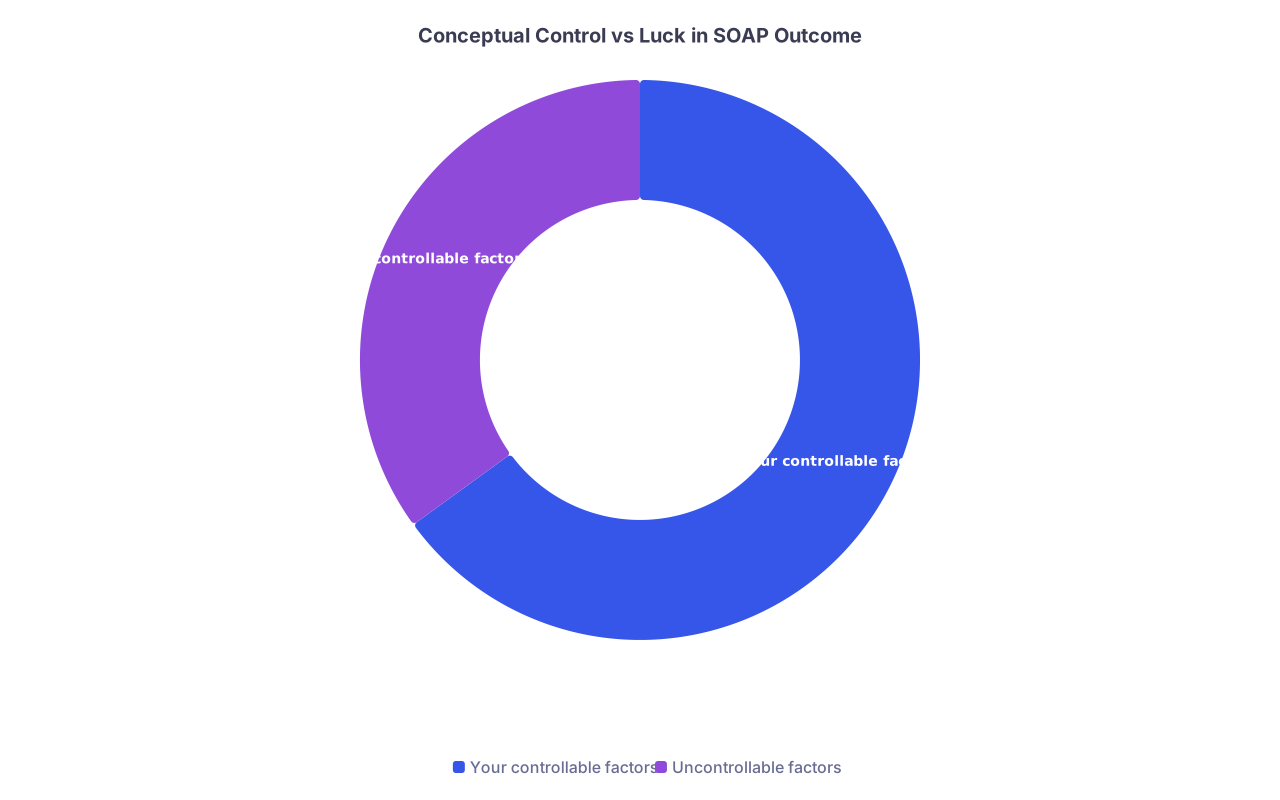
| Category | Value |
|---|---|
| Your controllable factors | 65 |
| Uncontrollable factors | 35 |
No, those percentages are not mathematically precise. They’re conceptually accurate from what I’ve seen: most of your SOAP fate is driven by configuration and execution, not roulette.
How To Stop Telling Yourself It’s Luck
If you want to approach SOAP like an adult instead of a lottery player, here’s the mindset shift:
Own the profile you actually have, not the one you wish you had. Your specialty history, scores, school, gaps, and prior attempts are real. Design a SOAP plan that fits that person.
Assume you might need SOAP months before Match Week. Have backup personal statements. Have flexible letters. Have a candid talk with an advisor who’s not afraid to say, “You’re at risk.”
Prioritize being in any ACGME‑accredited position over staying unmatched if you’ve already missed once or have significant red flags. Fixing brand issues from inside the system is hard but possible. From outside? Brutal.
Expect logistics chaos and preempt it. Transcripts, MSPE, Letters, ECFMG stuff if you’re an IMG—don’t let a missing document sabotage you while you’re busy blaming luck.
You cannot bully SOAP into giving you dermatology. But you can dramatically change the probability that you end Friday with zero offers versus at least one viable path forward.
You do not control the SOAP board. You control where you place your chips.
Stop calling SOAP random just because it is uncomfortable and fast and sometimes unfair. The process is flawed, but predictable in its own ways. Applicants who accept that, plan for it, and execute accordingly consistently outperform those who hide behind “luck” as an excuse.
Boiled down to the essentials:
- SOAP is not a lottery; it’s a compressed, desperate hiring market with rules and patterns.
- You control your realism, preparation, and flexibility—and those three things decide most of your outcome.
- Luck decides the margins. Your strategy decides whether you’re even close to those margins in the first place.
That’s how much control you really have. More than you want to admit. Less than you wish. Enough to matter.