
The belief that “only low stat applicants end up in SOAP” is fantasy. Comfortable fantasy for high‑scorers. Cruel fantasy for everyone else.
The Supplemental Offer and Acceptance Program (SOAP) is not a ghetto for weak applicants. It’s a pressure valve for a lopsided, data‑driven system where even objectively strong applicants can get shut out for reasons that have very little to do with ability.
Let’s walk through what actually pushes people into SOAP—and what smart strategy looks like once you’re there.
Who Really Ends Up in SOAP?
SOAP is full of people you’d happily have as co‑residents. I’ve seen:
- A 252 Step 1 (back when it had a number), AOA, 10+ pubs, unmatched in derm because they applied to 30 ultra‑competitive programs and nothing else.
- A 250+ Step 2 CK applicant with solid IM letters who SOAPed into a very respectable university internal medicine program after over‑aiming in radiology.
- A non‑traditional FM applicant with average scores who got squeezed because they applied late and had weak geographic signaling.
None of those are “low stat” stories. They’re strategy, timing, and market‑dynamics stories.
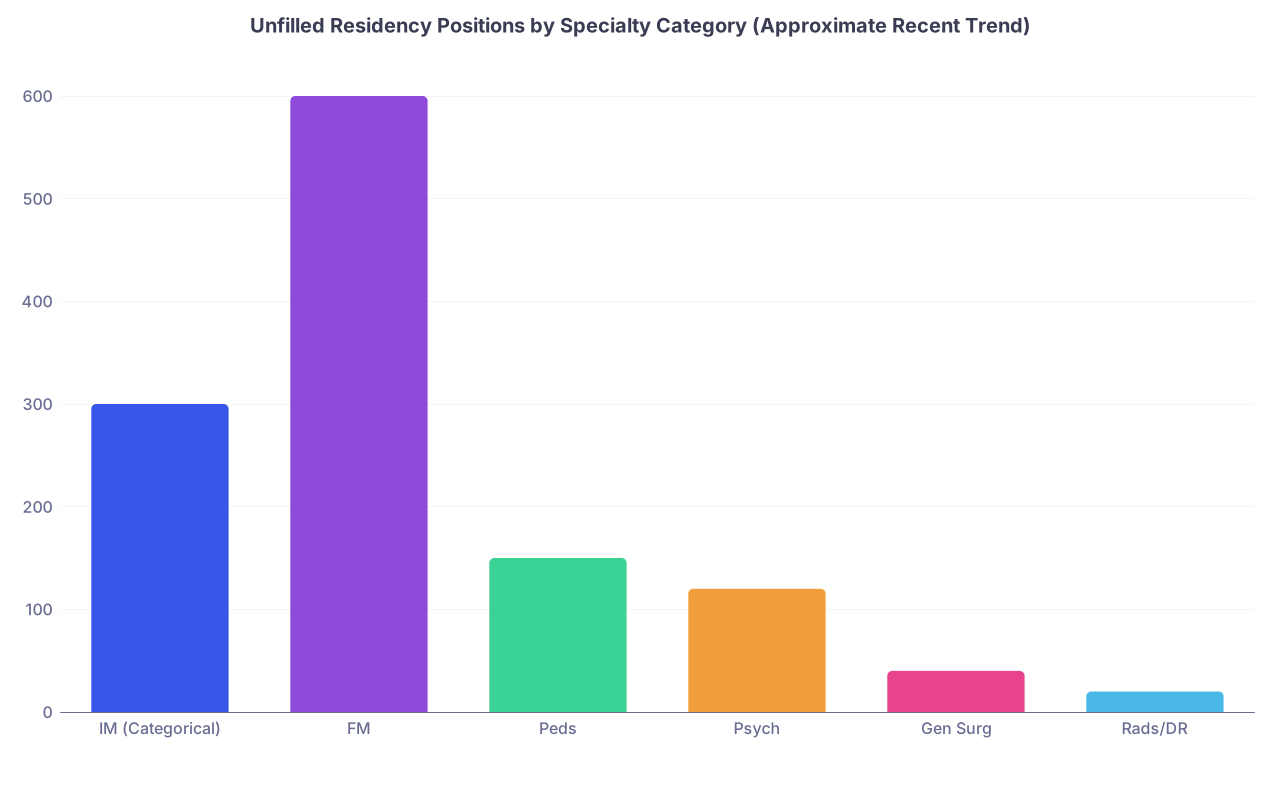
Let’s anchor this in some data, not anecdotes.
| Category | Value |
|---|---|
| IM (Categorical) | 300 |
| FM | 600 |
| Peds | 150 |
| Psych | 120 |
| Gen Surg | 40 |
| Rads/DR | 20 |
The specialties that feed the most positions into SOAP—internal medicine prelims, family medicine, peds, psych, some prelim surgery—are not “low stat dumping grounds.” Many of those programs prefer at least average or above‑average scores. If SOAP were only for low stat applicants, a large fraction of those spots would never fill. Yet they do.
So the myth collapses quickly:
- Low scores increase risk of SOAP. True.
- Only low stat applicants end up in SOAP. False. Very false.
You should think of SOAP as the output of mismatched markets, not just weak applicants.
The Real Reasons Applicants Land in SOAP
Scores matter. But they’re one piece. The bulk of SOAP stories, when you peel them back, look like some combination of these:
1. Overreach and Poor Portfolio Construction
This is the classic: “I’m a 238 applicant who only ranked competitive university anesthesia programs in coastal cities.”
They had enough interviews to match—barely. But the rank list was thin and top‑heavy. A couple of programs went further down their own lists than expected, a few other candidates looked marginally stronger, and suddenly: unmatched.
That applicant is not “low stat.” They’re strategically naive.
Programs play the numbers game; many applicants don’t. They trust vibes and optimism instead of data:
- NRMP charting outcomes clearly shows where your score and profile are in the danger zone for a given specialty.
- People ignore it, or they look at it and say, “Yeah, but my letters are really strong.”
SOAP then becomes the penalty phase for ignoring probability.
2. Late or Weak Application Execution
I’ve watched high‑scoring applicants drift into SOAP because they played the application process like it was college admissions:
- Personal statement reworked 20 times, submitted late.
- Letters delayed because they were afraid to ask attendings directly.
- ERAS submitted near the end of September “so everything would be perfect.”
Programs don’t reward perfectionism. They reward completeness and timeliness. Late applications in competitive specialties can push you just below the interview cutoff. Once you have too few interviews, the rest is math.
Again: not a score problem. A process problem.
3. Misaligned Signaling and Geography
Programs care about:
- Will this person actually come here?
- Do they have any ties to this region?
- Do they understand this patient population?
An applicant with 245+ applying to midwest psych programs from a coastal med school with zero Midwest ties and generic “I love your training” language is frequently less appealing than a 225 applicant clearly dedicated to that region.
I’ve seen applicants with strong scores and decent research SOAP because they:
- Scattered applications nationally.
- Did not do away rotations in target regions.
- Wrote vague, interchangeable “fit” language.
- Ignored rural or community programs that might have loved them.
SOAP is full of people who didn’t think strategically about geography until it was too late.
4. Red Flags That Have Nothing to Do With Scores
Failed Step attempt, professionalism issue, leaves of absence, significant grade remediation—these heavily impact matching, regardless of your numerical stats.
Some applicants respond by:
- Under‑applying (“I don’t want to ‘waste’ money on places unlikely to take me.”)
- Over‑aiming (“If I just get three interviews at great places, I’ll show them who I really am.”)
Both approaches are fantasies. Programs are risk‑averse. SOAP then becomes their second chance—if they’re realistic and prepared.
5. The Supply–Demand Reality: Too Many Applicants, Not Enough Spots
We need to be blunt. The system is structurally designed to produce SOAP participants:
- The number of US MD/DO grads plus IMGs is larger than the number of categorical PGY‑1 positions in desirable specialties.
- Programs over‑interview and then aggressively prune.
- A decent portion of “borderline” but not “bad” applicants end up unmatched in their primary specialty simply because the bar moves year to year.
You can be in the top half of your class, score in the “average to good” range, and still wind up in SOAP if you ignore that this is a ruthless funnel, not a merit badge system.
What SOAP Actually Looks Like From the Inside
SOAP is not some chaotic scramble of desperation at the end of Match Week. It’s structured. It’s fast. And if you’re unprepared, it will eat you alive.

| Step | Description |
|---|---|
| Step 1 | Unmatched Notification |
| Step 2 | Access Unfilled List |
| Step 3 | Meet With Advisor |
| Step 4 | Update Personal Statement and CV |
| Step 5 | Submit SOAP Applications |
| Step 6 | Program Reviews |
| Step 7 | Offer Rounds |
| Step 8 | Accept Offer |
Every year, I watch the same split:
- Group 1: Shell‑shocked, unprepared, scrambling to write a new personal statement, asking for letters at the last minute, applying randomly.
- Group 2: Stunned but organized. They had SOAP documents prepped, knew realistic specialties and programs, understood how many applications to send, and had a clear decision hierarchy.
Guess which group tends to land the better SOAP outcomes.
And again: plenty of Group 2 people are not “low stat.” They’re just victims of bad odds or slightly over‑optimistic original strategy.
Data Reality Check: Score Alone Doesn’t Predict SOAP
Let’s put some structure to this. Rough, but directionally accurate:
| Factor | Risk Impact on Matching |
|---|---|
| Low board scores only | Moderate |
| Overreaching specialty choice | High |
| Too few programs applied to | High |
| Late/weak application | Moderate–High |
| Serious red flag (fail, LOA) | High |
| No geographic focus | Moderate |
| Poor interview performance | Moderate–High |
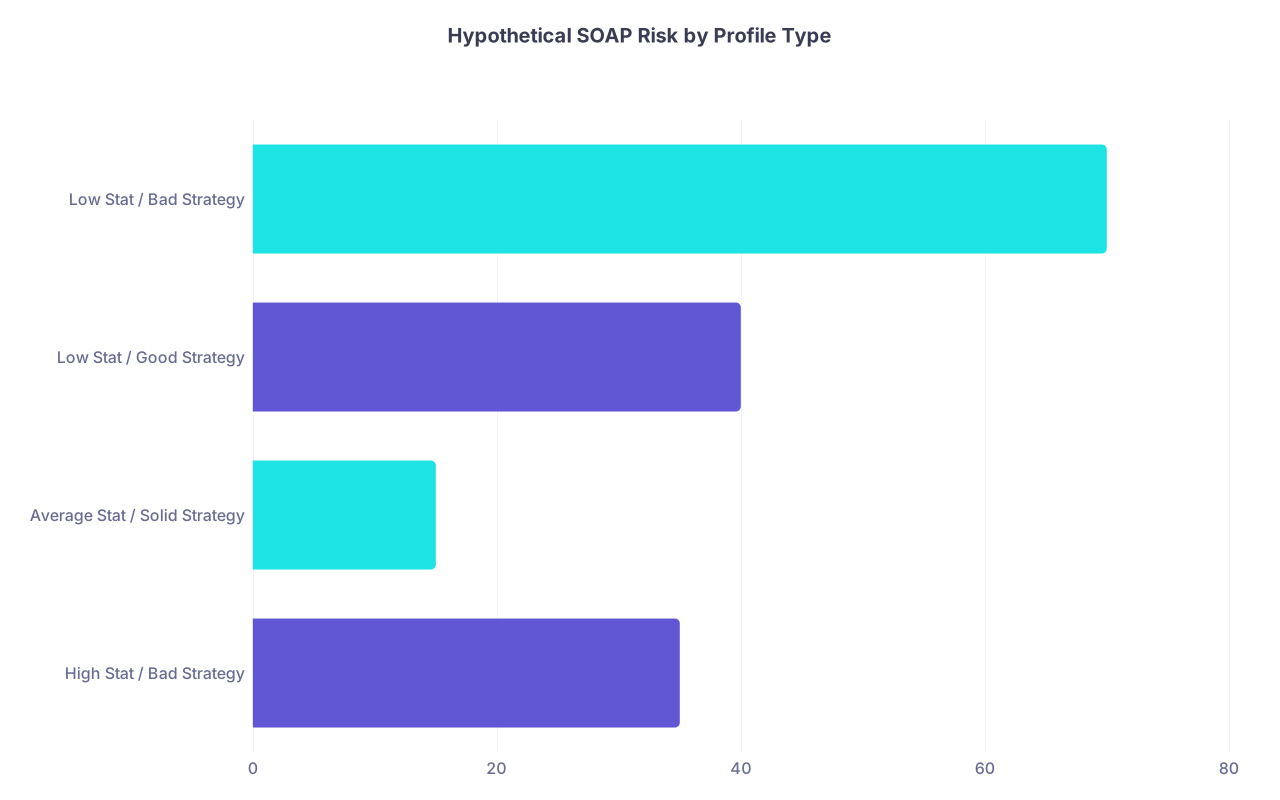
You’ll notice “low scores only” is not the top risk. Low scores plus any other mistake? Now you’re in danger.
But a 250 with aggressive specialty choice and weak geographic strategy is absolutely in SOAP territory too. I’ve seen that movie more than once.
| Category | Value |
|---|---|
| High Stat / Bad Strategy | 35 |
| Average Stat / Solid Strategy | 15 |
| Low Stat / Good Strategy | 40 |
| Low Stat / Bad Strategy | 70 |
The lesson: strategy multiplies your stats. Good or bad.
How to Think About SOAP Before You Ever Need It
Here’s the contrarian take nobody wants to hear: the best SOAP strategy is built months before SOAP.
If you line up your main application wisely, you reduce your SOAP risk and give yourself leverage if you end up there anyway.
Build a Realistic Specialty Plan
If you’re going into something competitive—derm, ortho, ENT, rads, gas, ophtho—you should have:
- A backup specialty you would actually do.
- Concrete signals that support that backup (electives, a letter, at least a plausible narrative).
No, this does not “jinx” you. It gives you options when the math does not break your way.
Balance Your Program List
The “I’ll just apply to 40 dream programs” crowd are frequent SOAP participants. They think volume equals safety, but they ignore program tiers.
You want a mix:
- Reach programs that might take a shot on you.
- Solid mid‑tier programs where you’re comfortably within their usual range.
- A few safer options that have historically interviewed and matched applicants like you or weaker.
That last category is what many proud, high‑stat students refuse to touch. Then they’re stunned on Match Monday.
What To Do During SOAP If You End Up There
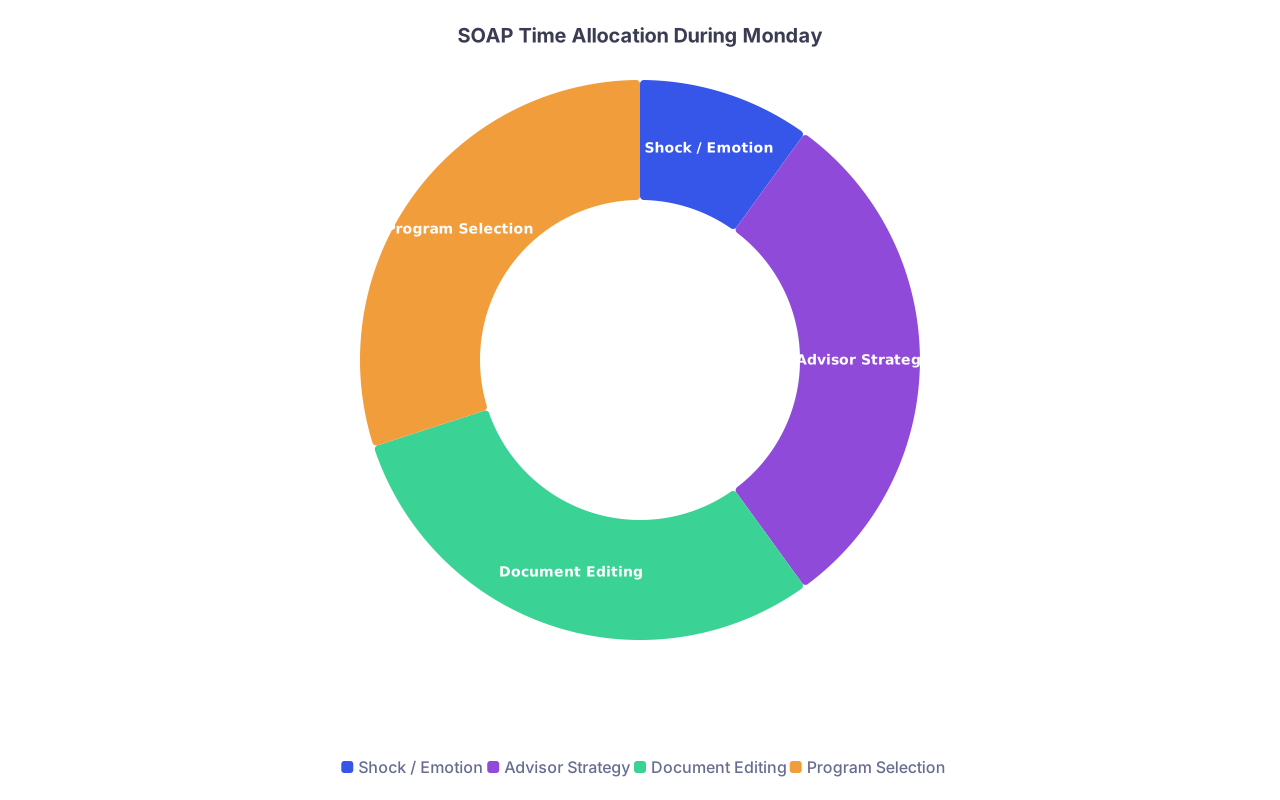
If Match Monday hits and you see “You did not match,” your stats don’t matter for about 10 minutes. What you do next does.
| Category | Value |
|---|---|
| Shock / Emotion | 10 |
| Advisor Strategy | 30 |
| Document Editing | 30 |
| Program Selection | 30 |
You do not have the luxury of denial.
Step 1: Get a Hard, Honest Assessment
Within hours, you need someone—dean, advisor, PD, mentor—who will answer three blunt questions:
- Was your original specialty choice realistic for your profile?
- How strong are your letters and clinical performance really?
- Where do you fall on the risk spectrum? (Low scores, red flags, or just bad luck?)
That determines whether you:
- Re‑target within your original field (prelims, less competitive programs).
- Pivot to another specialty in SOAP (often IM, FM, peds, psych).
- Brace for the possibility of a reapplication cycle.
Step 2: Rewrite Your Narrative for SOAP
Your previous personal statement may be useless for SOAP. If you’re pivoting specialties, you need a focused, believable story:
- Why this specialty, now?
- What parts of your background fit this choice (even if not originally tailored)?
- What can you contribute to a program immediately?
It does not have to be perfect. It does have to be coherent and specific. “I like working with people and continuity of care” written in a panic at 2 p.m. Monday is not it.
The Programs’ Perspective: Why Strong Applicants SOAP In and Still Get Picked
Here’s what program directors care about during SOAP:
- They need reliable interns in seats. Fast.
- They have little time to do a deep dive on every applicant.
- They scan: scores roughly acceptable, no obvious disaster, narrative makes sense, letters not terrible.
That’s why strong but unlucky applicants often match quickly in SOAP once they shift specialties or adjust expectations. Their file reads “safe and capable,” even if their original Match result said “unmatched.”
I’ve watched a 230s, middle‑of‑class applicant who missed in radiology SOAP into a solid community internal medicine program and thrive. They weren’t broken; their original target was simply out of sync with their profile.
SOAP didn’t mark them as “low stat.” It just redirected them.

What Actually Separates the People Who Land Well in SOAP
It’s not just numbers. It’s how they play the hand they’re dealt.
The ones who do well:
- Accept reality in hours, not days.
- Are willing to pivot specialties if needed.
- Do not cling to prestige fantasies after the game has changed.
- Have pre‑prepared generic but solid documents that can be tailored quickly.
- Listen to data, not ego.
The ones who crash:
- Spend half of Monday in shock or denial.
- Refuse to apply to anything but “good” programs.
- Try to force a field that clearly burned them.
- Write incoherent SOAP essays that read like therapy notes.

The Hard Truth: SOAP Is a System Outcome, Not a Moral Verdict
Matching is not a spiritual reward for virtue or grind. It’s a market. SOAP is what happens when the market is mispriced.
High stat applicants in SOAP are not unicorns. They’re normal in a system where:
- Too many people aim too high.
- Too many deans still sugarcoat risk.
- Too many students think numbers guarantee outcomes.
So let’s bury the myth cleanly:
- SOAP is not a low‑stat penalty box.
- It’s where under‑strategized, unlucky, or risk‑misjudged applicants land—many of whom are perfectly capable and sometimes numerically strong.

Key Takeaways
- SOAP is not reserved for “bad” or “low stat” applicants; strong applicants with poor strategy or bad luck end up there every year.
- Strategy, timing, specialty choice, and geography often matter as much as scores in determining who matches versus who SOAPs.
- The best SOAP outcomes go to those who prepare early, pivot quickly, and make data‑driven—not ego‑driven—decisions when the clock is ticking.