
The worst ERAS mistake couples make isn’t rank lists. It’s timing—and it hits hardest when one of you is “ready” and the other is not.
You’re not just deciding when to submit ERAS. You’re deciding how much risk you’re willing to dump onto the weaker application, the stronger application, and your relationship all at once.
Let’s untangle this.
The One Rule You Cannot Ignore
Let me start with a hard line:
In a couples match, you submit when the weaker application is ready, not when the stronger one is.
If you reverse that, you pay for it later in one of three ways:
- Fewer interviews for the weaker partner
- Compromised geographic options for both
- Massive stress and resentment when you build the rank list
If you’re reading this, you’re probably in one of these situations:
- One partner has everything polished by ERAS opening; the other is waiting on Step 2, a weak personal statement, or late letters
- One partner is applying to a hyper-competitive specialty, the other to something more forgiving
- One of you is reapplying, the other is first‑time, and the timelines do not align nicely
I’m going to walk through how to decide when to hit submit in each of those, with clear “do this / don’t do this” guidance.
First, though, you need to be brutally honest about competitiveness.
Step 1: Get Real About Who’s Actually “Ready”
I’ve watched couples blow this by assuming “I feel ready” means “my app is strong enough to submit on Day 1.”
Feeling ready doesn’t matter. Your profile matters.
Here’s a quick comparison to calibrate.
| Factor | Partner A (Stronger) | Partner B (Weaker) |
|---|---|---|
| Step 2 CK | 247 | 229 (pending score) |
| Specialty | IM | Neuro |
| Letters in | 3/3 | 1/3 |
| Personal Statement | Final | Rough draft |
In this situation, only one person is actually ready to submit early. The couple is not.
Do this together, on paper or a shared doc:
- List each partner’s:
- Step 2 status (taken? score back? borderline?)
- Number and quality of letters already uploaded
- Personal statement status (final vs “vibes-based draft”)
- Transcript/MSPE timing (especially for IMGs/DOs)
- Research / specialty expectations (is one of you aiming for derm, ortho, ENT, etc.?)
Whoever has the weaker combination sets the submission timing. Period.
Step 2: Understand How Much Timing Actually Matters
There’s a lot of superstition about “submit at 9:01 AM on opening day or you’re doomed.”
Reality is less dramatic, but timing still matters—especially for couples where both need robust interview numbers.
For most years:
- Programs start downloading applications right after the ERAS release date to programs
- Interview offers are heavily front-loaded in the first 2–4 weeks after that
- Applying a few days late rarely kills you
- Applying weeks late can
Think in these buckets:
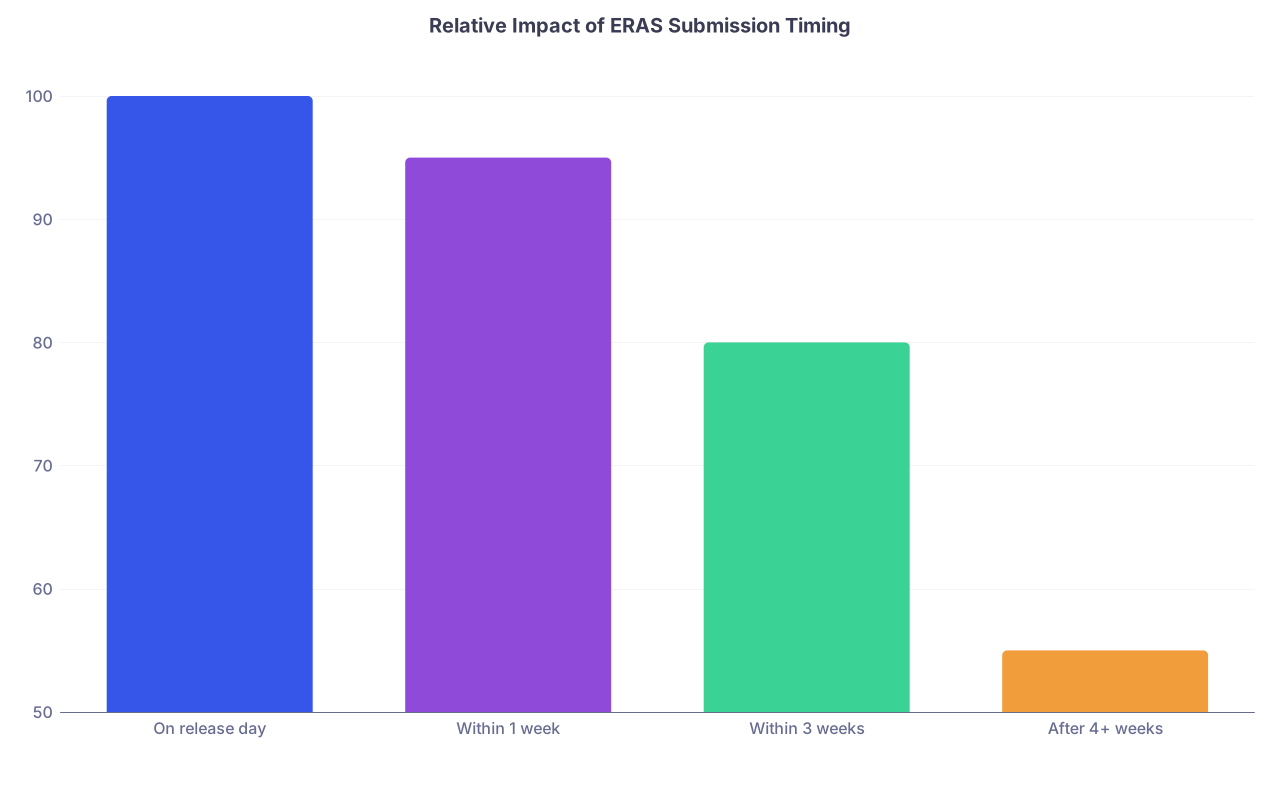
| Category | Value |
|---|---|
| On release day | 100 |
| Within 1 week | 95 |
| Within 3 weeks | 80 |
| After 4+ weeks | 55 |
Those numbers aren’t official, but they reflect what I’ve seen: the farther you are from that first wave, the more you bleed interview chances, especially at competitive or popular locations.
For a couples match, the goal is not “earliest possible.” The goal is:
Submit early enough that both of you are in the first serious wave of review, with both applications in final form.
Scenario 1: One Partner Waiting on Step 2 CK
This is the classic timing nightmare.
Example setup:
- Partner A (FM applicant): Step 2 back, 240. Letters done. PS done. Could submit Day 1.
- Partner B (IM or Neuro applicant): Taking Step 2 on Sept 1; scores back late Sept or early Oct. Their Step 1 is mediocre/pass. Step 2 is crucial.
Here’s the decision tree.

| Step | Description |
|---|---|
| Step 1 | Partner B Step 2 crucial? |
| Step 2 | Submit both as early as possible |
| Step 3 | Wait and submit both together after score posts |
| Step 4 | Submit both early, update when score available |
| Step 5 | Delay both, accept later review |
| Step 6 | Score available before apps released to programs? |
| Step 7 | Can Partner B pre-submit safely? |
How to interpret that:
If Partner B’s Step 2 is make-or-break (weak Step 1, competitive specialty, or IMG):
- If score will be back before programs download applications:
→ Wait. Submit both together after the score hits ERAS. - If score will be back after downloads start:
- Ask: Is Partner B’s current profile so weak that an early submission without Step 2 will just get them screened out?
- If yes → delay both. You’d rather be “a bit late with a salvageable app” than “early and auto-screened.”
- If no (e.g., decent Step 1, solid CV) → you can submit both on time and let the score upload later. But this is riskier for competitive specialties.
- Ask: Is Partner B’s current profile so weak that an early submission without Step 2 will just get them screened out?
- If score will be back before programs download applications:
If Partner B’s Step 2 is helpful but not crucial (solid Step 1 or pass/fail era with strong clinical record):
- Submit both early.
- Let Step 2 post when it’s ready.
The couples-specific twist: if the more competitive specialty partner is the one waiting on Step 2, you lean more towards waiting. Because that partner’s application usually drives geography and program tier options.
Scenario 2: Letters of Recommendation Delayed for One Partner
You’ve got this mess:
- Partner A: 3 letters in, including a strong specialty letter. Ready.
- Partner B: Only 1 letter in. Two “promised” letters still not uploaded.
And it’s the week before you’d ideally hit submit.
Here’s the brutal truth: an on-time application with missing specialty letters can be worse than a slightly late but complete one. Especially in competitive or mid-tier specialties where letters matter.
What I tell couples in this spot:
- If the missing letter is:
- A generic medicine letter for an FM or IM applicant → submit on time with 2; add the 3rd when it arrives. This usually does not tank you.
- A key specialty letter (surgery letter for gen surg, neuro letter for neuro, etc.) → you strongly consider waiting up to 1–2 weeks to get it in before you submit.
The couples angle: you don’t stagger submission by weeks just so the more ready partner can be “maximally early.” Programs don’t coordinate timing between partners on their end that tightly. You want both applications hitting their system clearly within the main wave.
What you can do:
- Submit both once the weaker partner has at least:
- 2 solid letters total
- 1 specialty-specific letter
- If a 3rd letter arrives later, it can still help, but you’re not obviously incomplete.
Scenario 3: One Competitive Specialty + One More Forgiving Specialty
Example:
- Partner A: Dermatology, ENT, Ortho, Plastics, Urology, etc.
- Partner B: Internal Medicine, Family Medicine, Peds, Psych
This pairing is common and tricky.
People assume the derm/ortho/etc. applicant’s timing drives everything. It doesn’t. The bottleneck drives timing. That’s usually the weaker app.
Let’s say:
- Derm partner is hyper-organized, Step 2 255, strong research, letters done in July
- IM partner took Step 2 late August, letters dribbling in, PS still rough
Instinct: “We have to submit for derm as soon as possible—everyone says so.”
Reality:
- A derm program that will seriously consider a 255 research-heavy couples applicant is not going to toss them just because the app hit their inbox 5 days after opening.
- But IM programs absolutely might miss the weaker application if it’s sent early but incomplete or unimpressive.
So what do you do?
You submit both:
- As early as you can, after:
- The weaker partner’s Step 2 is back (if it’s needed to offset weaknesses)
- The weaker partner has a clean, edited personal statement
- The weaker partner has at least 2 strong letters, ideally 3
If that means the competitive-specialty partner isn’t hitting Day 1 at 8 AM timing—fine. Their problem isn’t timing. It’s specialty competition. A few days doesn’t decide their season.
Where people screw up: they obsess over timing for the strong applicant and sabotage the weak one.
Scenario 4: One Reapplicant + One First-Time Applicant
Reapplicants bring their own timing anxiety. They were burned once; they’re terrified of any “delay.”
Example:
- Partner A: Reapplying IM. Previously applied late October, low interview count. Step 2 improved now. Wants to submit extremely early.
- Partner B: First-time Peds applicant, taking Step 2 late August.
Here, you have to separate emotional urgency from strategy.
The reapplicant’s brain says: “Last time I was late; this time I must be earliest or I’ll fail again.”
But if you rush both applications for that reason and Partner B’s app goes out unpolished, you just move the failure from one partner to the other.
What actually matters for the reapplicant is:
- Clearly improved Step scores or performance
- Cleaner, tighter personal statement and experiences
- Refreshed and stronger letters
- Early enough submission (not weeks late)
You do not need 9:01 AM on opening day. You need “solidly in the first batch with a clearly upgraded file.”
In couples terms: you aim to submit both once:
- The reapplicant’s upgrades are live in ERAS
- The first-timer’s file is at least as strong as it can realistically be this year (Step 2 back if critical, key letters uploaded, PS finalized)
If that’s 3–7 days after earliest possible? So be it.
How Far Is “Too Late” for a Couples Match?
There’s a line you should not cross unless you’re okay with drastically fewer interviews.
As a rough guide:
- Submit by:
- On or near program download date → Ideal
- Within 7–10 days after → Usually safe, especially for less competitive specialties
- 2–3 weeks after → Noticeable drop, but sometimes acceptable if it means rescuing a weak application
- 4+ weeks after → You are in “late applicant” territory; couples match becomes significantly harder unless both applications are stellar and/or very non-competitive specialties
For couples, I draw the “do not casually cross this” line at:
More than ~2 weeks after programs start downloading, unless you have a very specific reason and a clear upside (like Step 2 moving from “death” to “competitive”).
Tactical Moves You Can Make Before Hitting Submit
If you’re stuck in the in-between window—strong partner ready, weaker partner not quite—this is how you use that time intelligently instead of just spiraling.
Triage the weaker application first each day.
Not the stronger one. The weaker partner’s:- Personal statement
- Experiences descriptions
- Program list
gets priority attention.
Program list strategy:
For the weaker partner:- Increase the number of safety/mid-tier programs if you’re applying even a bit late.
- For couples, err on the side of more programs, not fewer, especially in big cities or popular regions.
Email the slow letter writers—together.
Write a short, respectful nudge. Then both sign it or both send their own. Faculty respond better when they see there’s a couples match at stake.Lock in your couples match ID the minute you’re both ready.
Do not be the couple that finishes everything and then spends 45 min trying to figure out how to link NRMP IDs last-minute.
Mini-Case Walkthroughs: What To Do
Let me walk you through a few quick “if this is you, then do this” situations.
Case 1: FM + IM, one Step 2 pending, both average strength
- FM partner: Step 2 back, 230s, 3 letters, PS done (ready now)
- IM partner: Step 2 taken late August, score due Sept 28, Step 1 okay, letters almost ready
- Programs start downloading around mid-late Sept
What to do:
- Wait for IM partner’s Step 2 score if:
- Step 1 is borderline and Step 2 is expected to be higher
- Submit both as soon as that score is live and letters are in, even if 3–5 days after download date.
- Do not delay past ~2 weeks after downloads begin.
Case 2: Ortho + Psych, ortho super strong, psych average, no pending Step 2
- Ortho partner: 255+, AOA, research, ready to go day 1
- Psych partner: 225–230, decent letters, PS being revised, no pending tests
What to do:
- Submit both together once psych partner’s PS is tight and at least 2 good psych or IM letters are in.
- This might be day 1, might be 3–4 days later. Either is fine.
- Do not rush psych’s PS just to get ortho out the door early. Ortho’s fate is about specialty competitiveness, not 72-hour timing.
Case 3: Both IM, but one is clearly weaker and waiting for Step 2
- Stronger IM: 240+ Step 2, honors, strong letters, ready now
- Weaker IM: Step 1 pass, needs Step 2 to prove competence, score due after programs start downloads
What to do:
- If weaker IM’s Step 2 is expected to be significantly better than Step 1:
- You seriously consider waiting until that score posts, even if that means being ~1–2 weeks late, because early submission without the score risks mass screening-out.
- In the meantime, you expand the weaker partner’s program list (community programs, more geographic spread) to compensate.
One More Landmine: Emotional Pressure From Schools and Peers
You’re going to hear garbage like:
- “Our dean said you must submit on day 1.”
- “Anyone not ready to go at 9 AM is already behind.”
- “In derm/ortho/ENT you’re dead if you’re not first.”
Those statements are lazy and oversimplified. They’re built for class-wide talks, not for the specific math of a couples match with asymmetric readiness.
Your reality:
- Programs do care about timing, but not in a cartoonish “9:01 AM or die” way.
- They care whether you look complete, competent, and interested when they first pull your file.
- If you submit a messy or incomplete file early, you do not get “bonus points for punctuality.” You just get skipped.
For couples? Skipping one partner sinks both.
What To Do Today
Don’t just “keep working on ERAS.” That’s vague. Do this instead:
- Sit down together and label: who is the weaker application this cycle? Not in life. This year.
- Open a calendar and mark:
- Expected Step 2 score release (if relevant)
- ERAS release to programs
- A firm target submit date in that first wave that gives the weaker partner just enough time to be truly ready
- Work backward from that target date and assign 2–3 concrete tasks per day for the weaker partner’s file first—letters, PS edits, experience rewrites, program list.
Then, tonight, write down a single sentence together:
“When X happens (Step 2 score back / last letter uploaded / PS finalized), we will submit ERAS for both of us within 24 hours.”
Decide that trigger now, before stress makes you panic-submit too early—or freeze and submit too late.