
The worst ERAS mistake international grads make is submitting on the wrong day for their situation—either rushing and looking incomplete, or waiting too long and falling off programs’ radar.
If you’re an IMG or a U.S. citizen who graduated abroad, and your graduation date, degree date, or paperwork timing is weird, you’re exactly who this is for. You’re not choosing “when do perfect applicants submit”; you’re choosing “what’s the smartest trade-off between earlier and more complete?”
Let’s walk through it like I would with a nervous IMG on Zoom who’s staring at their diploma date and the ERAS calendar side by side.
The Three Realities You’re Balancing
Forget the generic “submit on day 1” advice for a second. You’re balancing three specific realities:
- ERAS opening / program download behavior
- Your graduation date and document availability
- How IMGs are actually screened by programs
Most people obsess about #1 and ignore #2 and #3. That’s how they end up with an early but weak file and wonder why interviews never came.
How Programs Actually See You
Most residency programs:
- Do one or more early mass downloads of applications in late September / early October.
- Use filters: YOG (year of graduation), USMLE/COMLEX scores, citizenship/visa, attempts.
- Mark applications “incomplete” if key stuff is missing (MSPE, transcript, ECFMG status, sometimes Step 2).
You’re not fighting just the calendar. You’re fighting the filter logic plus perception:
- “Older grad without ECFMG yet” often gets soft-rejected.
- “Recent grad with everything ready by the first download” gets real consideration.
So your job is not “submit as early as physically possible” but “submit as early as possible without looking half-baked.”
Key Dates: What Actually Matters for IMGs
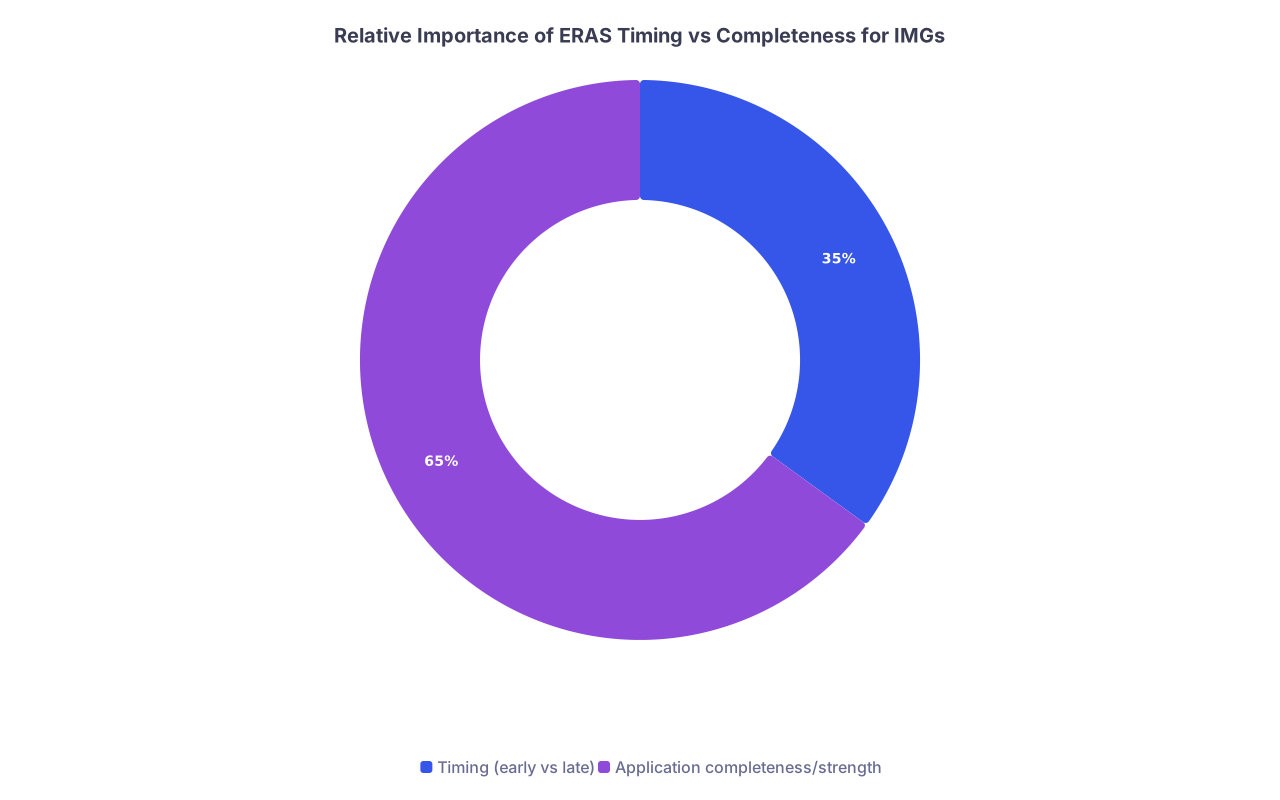
| Category | Value |
|---|---|
| Timing (early vs late) | 35 |
| Application completeness/strength | 65 |
You already know the rough ERAS timeline. Let me slice it the way an IMG actually feels it:
- Mid/late June – July: You can work on ERAS, request letters.
- Early September: ERAS opens for submission.
- Late September (varies by year): Programs can start downloading applications.
- October – December: Most interview invites go out, front-loaded in October.
Here’s the twist for you as an international grad:
- Your graduation date matters for filters (many programs cut off beyond 5 or 7 years).
- Your ECFMG certification timing and USMLE completion matter more than for U.S. seniors.
- Your MSPE and transcript release depend on your school’s bureaucracy, not just ERAS.
So your decision is not just “September 15 vs September 25.” It’s:
- “Do I submit September 15 with Step 2 pending?”
- “Do I wait until my ECFMG status updates?”
- “What if my school only lists my graduation as December even though I’m done in August?”
Let’s break down situations.
Situation 1: You Just Graduated Abroad This Year
You’re Class of 2024 (or 2025, etc.), recent grad, diploma in hand or coming soon. Your main question: How early is early enough without submitting incomplete?
Best-case profile
- Year of Graduation: current year.
- Step 1 and Step 2 CK: done, with scores back by early September.
- ECFMG: you can get certified once your final transcript is posted.
- MSPE and transcript: your school cooperates and uploads on the usual timeline.
If this is you, your strategy is simple:
- Submit on the first or second calendar day ERAS allows—but only if:
- All exam scores are in.
- Your personal statement, CV, and experiences are fully polished.
- At least 3 letters are uploaded or clearly coming within days.
Do not delay for tiny tweaks to wording. Programs see “current year IMG with complete scores and certification in progress” as gold compared to older grads.
Slight snag: Graduation date recorded late by school
Very common: you finished all requirements in June, but your official degree date is listed as September 30 or October 31.
You worry: “If I submit before the official degree date, will programs think I’m not done?”
Here’s how I handle this with applicants:
- Check what’s actually on your transcript. If it says “Expected graduation: 30 September” but your clinicals are done, that’s fine.
- In your ERAS Education section, put the official graduation month/year your school uses. Do not invent an earlier date.
- In your personal statement or additional info, add one clean sentence:
“I completed all graduation requirements in June 2024; my university confers degrees on 30 September 2024.”
Then:
- Submit early (first week ERAS opens) as long as:
- Your exams are all in.
- Your school is responsive enough that transcripts/MSPE will go out on the usual date.
Programs care far more about YOG than whether your official conferral date is the 15th or 30th.
Situation 2: You Graduated 3–5 Years Ago (No Major Gaps)
Now you’re in the “middle-age” of YOG. Not fresh, not old. This is where timing intersecting with graduation date starts to matter more.
Programs often have filters like:
- Acceptable YOG: within 3 years, within 5 years, within 7 years.
If you’re borderline, your exact year matters, not the month.
Example
You graduated in December 2020. You’re applying for the 2025 Match.
- Many “within 5 years” filters will still include you.
- But you’re closer to the cutoff; any hint of being “inactive” or incomplete stings more.
Your timing rule here:
- Submit as early as you can have a complete, tight application.
- One week “earlier but missing a key piece” is usually worse than one week later but whole.
For a 3–5 year grad:
- If your Step 2 CK is strong and already reported → submit Day 1–3.
- If your Step 2 CK is pending and likely to significantly improve your profile, and the score will be back by early October, I’d consider:
- Submitting ERAS with Step 2 pending in mid/late September.
- Updating programs with your Step 2 score once it posts.
You do not wait until November to submit just to have Step 2 on day one. That’s too late, especially as an IMG.
Situation 3: You’re an Older Grad (5+ Years Since Graduation)
This is where the “year on the diploma” becomes a real filter problem.
Here’s the blunt truth:
- Many programs flat out exclude applications if YOG > 5 or > 7 years.
- Those who don’t exclude you will ask, even silently: “What have you been doing all this time?”
So: Does it help to submit “on the first second possible”? Sometimes. But only if it’s not at the expense of showing you’ve been active and improving.
Trade-off for older grads
You’re usually better off:
- Submitting between Day 1 and Day 7 of ERAS submissions
- With:
- All USMLE exams done.
- Strong, current U.S. experience or at least clinical activity.
- Clear explanation of what you’ve been doing since graduation (and why it helped, not hurt, your readiness).
You’re usually not better off:
- Submitting Day 1 with:
- No Step 2.
- No recent clinical activity.
- Vague or empty recent experience section.
Older grad + incomplete = fast delete.
If you need an extra week in September to lock in a strong letter from a recent U.S. attending or to finish rewriting an embarrassing early personal statement, take the week. But do not drift into October.
Situation 4: Your ECFMG Certification Will Be Slightly Delayed
This is the classic IMG stress situation: tests are done, but ECFMG is slow.
The fear: “If I’m not certified on Day 1, should I hold my ERAS submission until I am?”
Usually: No. You submit.
Programs differ on how rigidly they require ECFMG at the application stage versus before rank list or contract. Many will review your file, note that certification is pending, and move on to the next step if you look strong overall.
Practical rule:
- If you’ll be ECFMG certified by December or January:
- Submit ERAS early (Day 1–5).
- Once certification posts, immediately update programs or rely on the ERAS status update if available.
- If your ECFMG will genuinely be in doubt or delayed past Match deadlines:
- That’s not a timing problem; that’s a structural problem. You might need to adjust target year.
Where you do not delay:
- Just to wait until the ECFMG icon flips from “not certified” to “certified,” when your profile otherwise is strong.
Situation 5: You’re Still Taking Step 2 CK or Waiting for Results
This one depends heavily on your Step 1 situation and your YOG.
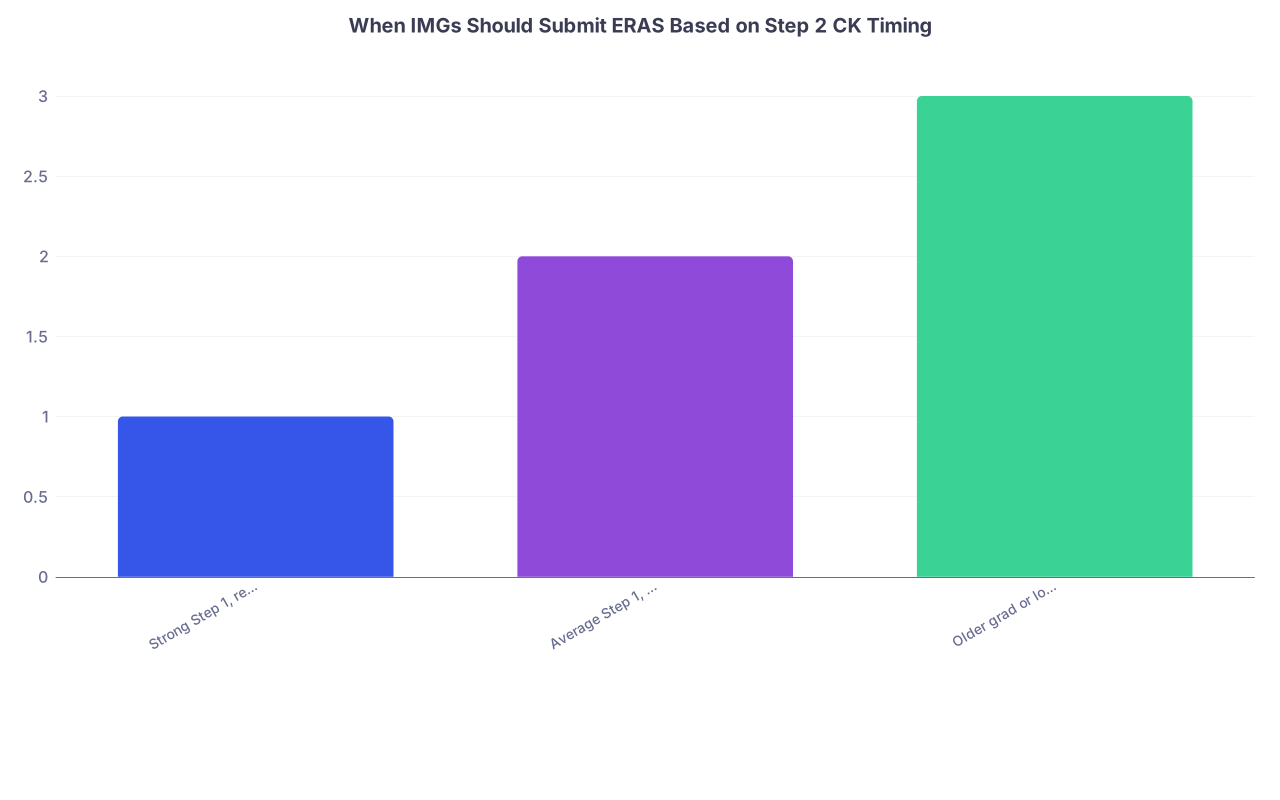
| Category | Value |
|---|---|
| Strong Step 1, recent grad | 1 |
| Average Step 1, recent grad | 2 |
| Older grad or low Step 1 | 3 |
(Scale: 1 = submit Day 1 even if Step 2 pending; 3 = wait as much as possible for Step 2)
If you’re a recent grad with a solid Step 1
- If Step 2 CK result is coming by late September or early October, and you’re otherwise strong:
- Submit Day 1–3 even if Step 2 is still pending.
- Programs will still download; your Step 2 will fill in.
- If Step 2 is not taken until late September:
- You’re in weaker territory. Programs may heavily discount you without Step 2 as an IMG.
- Still, I would:
- Submit ERAS as soon as it opens with an honest test date listed.
- Email priority programs once the score posts if it’s strong.
You do not want your very first presence in their system to be in late October. That’s interview graveyard time for IMGs.
If you have a low Step 1 or are an older grad
Here the Step 2 CK becomes a rehab tool.
- If Step 2 CK is your only chance to prove academic recovery:
- I lean toward having Step 2 results in hand before ERAS submission if:
- You can still submit in mid/late September, not October.
- If waiting for Step 2 score pushes you past early October:
- I’d still submit by late September with “pending Step 2” and then push updates once the score is in.
- I lean toward having Step 2 results in hand before ERAS submission if:
Do not sacrifice the entire front half of the interview season to wait for a test score. Programs won’t even see you to care that your new score is better.
Situation 6: Your School Releases MSPE/Transcript Late
Some foreign schools are slow, disorganized, or both. You know this. I know this. Program directors know this.
Your decision: Do you wait to submit ERAS until your MSPE and transcript are uploaded?
Answer: No. You submit. Then you chase your school mercilessly.
Programs understand international document lag far more than applicants think. An otherwise strong IMG who submits early but has an MSPE that shows up a few days late is absolutely normal.
Where it becomes a problem:
- You submit late + your documents are late.
- That combination sends one message: disorganization.
So:
- Submit on time (Day 1–7) even if your MSPE is not posted yet.
- Keep clear email proof that you’ve requested everything months in advance (in case something explodes later with ECFMG).
How Exact Does “The Day” Really Matter?
You’re probably obsessing over: “Should I submit on the exact first minute ERAS opens or is two days later fatal?”
Calm that down.
Here’s how it plays out at program level:
| Factor | Impact on IMGs |
|---|---|
| Submitting in first 3–5 days | High benefit |
| Submitting in days 6–14 | Moderate |
| Submitting after October 1 | Strongly negative |
| MSPE arriving a few days late | Low |
| Step 2 CK posting after submission | Low–moderate |
Then layer this reality:
- Many programs do their first major download a few days after they’re allowed to.
- Being in that first download batch matters.
- Being in the second batch a week later is not tragic if your file is clearly stronger than it would have been on Day 1.
So your goal isn’t: “timestamp: 8:00:01 AM on opening day.”
Your goal is: “Be fully submitted before the first serious program download wave, which usually means within the first 3–7 days of ERAS submissions.”
Practical Submission Scenarios and What You Should Do
Let me give you concrete mini-cases.
Case A: Recent Grad IMG, All Scores In, ECFMG Pending
- YOG: current year.
- Step 1/2: both done, average to strong.
- ECFMG: certification will likely post in October.
- Documents: MSPE/transcript will be uploaded via standard timeline.
What to do:
Submit Day 1–3. Do not wait for certification. Email nothing unless programs specifically ask about ECFMG; they can see your progress.
Case B: 4-Year-Old Grad, Step 2 CK Pending, Test Just Taken
- YOG: 4 years ago.
- Step 1: marginal (e.g., pass or low 220s).
- Step 2 CK: just taken; score expected early October.
- You’ve got some recent observerships or work.
What to do:
Submit Day 1–5 with Step 2 listed as taken and date provided. When your score posts, if it’s good, send a short, targeted update email to priority programs. Do not hold your entire application waiting for that score.
Case C: 7-Year-Old Grad With Strong, Recent USCE
- YOG: 7 years ago.
- Steps: all done, solid.
- You have 6+ months of recent U.S. clinical experience with letters.
What to do:
Submit Day 1–3. For an older grad who has actually done the work to stay current, earlier is your ally. Filters already work against you; you want to be in the first pile reviewed before interview slots thin out.
Case D: Recent Grad, Step 2 Not Taken Yet, Scheduled Late September
- YOG: this year.
- Step 1: decent or strong.
- Step 2 CK: exam in late September, score in late October or November.
This is weak timing, but it’s reality for some of you.
What to do:
Submit as early as ERAS opens, list your planned Step 2 date, and be realistic: many programs, especially competitive ones, will not seriously consider you without a posted Step 2. Aim for community and IMG-friendly programs, and once your score posts, selectively update.
A Quick Visual: Timing vs Completeness Decision

| Step | Description |
|---|---|
| Step 1 | Ready to Submit ERAS? |
| Step 2 | Submit now; late already hurts |
| Step 3 | Submit now: early & complete enough |
| Step 4 | Wait a few days, then submit |
| Step 5 | Submit by late Sep, update later |
| Step 6 | Within first 7 days? |
| Step 7 | Major component missing? Step 2, letters, PS |
Two Subtle but Important Points About Graduation Dates
ERAS and programs care about the YEAR first.
Whether your diploma says June 10 or December 20 matters far less than “2020 vs 2018.” Don’t overthink intra-year dates.Explaining your graduation timing is better than hiding it.
If you finished requirements in one month but your school only confers degrees later, say so clearly in your application. It makes you look organized, not defensive.
When in Doubt, Here’s the Default Rule
If you’re stuck between two days:
- One day or a few days earlier with:
- All exams done
- Decent letters
- A coherent CV and personal statement
versus
- A week later with:
- One slightly stronger letter
- Tiny edits to personal statement
You almost always choose earlier.
The only time I tell someone to intentionally delay within September is:
- Older grad or weak file
- Major piece that clearly changes perception:
- A Step 2 CK score that transforms the academic story
- A key U.S. letter from a PD or chair
- And that piece will be ready in under 7 days.
Then we tolerate a small delay, but we don’t slide into October.
Final Takeaways
Three things to keep straight in your head:
- For IMGs, “early enough and complete enough” beats “earliest but half-baked.” First 3–7 days good. After October 1, bad.
- Your graduation year and activity since graduation matter more than the exact diploma date. Use your submission timing to support that story, not to hide from it.
- Do not wait for perfection that costs you the season’s front end. Submit once your core is strong: exams, narrative, key letters. Update programs for everything else.