

A low-volume service is only a wasted rotation if you let it be.
You got assigned to the black hole of rotations: low census, sleepy attending, barely any new admits. While your classmates brag about 20-patient lists and middle-of-the-night codes, you’re sitting at the workroom computer refreshing the EMR and contemplating reorganizing the supply closet.
Good. This is where we see whether you can actually create your own learning or only function when chaos forces it on you.
Here’s exactly what to do if you’re on a low-volume rotation and you don’t want to walk away having learned nothing.
1. Get Oriented: What Kind of “Low-Volume” Are You In?
Not all quiet services are the same. Your strategy changes depending on why it’s low-volume.
Quickly figure out which type you’re dealing with:
| Type | Main Issue | Primary Strategy |
|---|---|---|
| Chronically quiet | Few patients year-round | Build structured self-curriculum |
| Seasonally slow | Wrong time of year | Front-load reading and skills |
| Uneven volume | Feast or famine days | Exploit busy days, plan for off-days |
| Attending-dependent | Some preceptors underutilize students | Proactively ask and propose tasks |
The fastest way to orient:
Ask the senior resident:
“Is this usually a low-volume service, or are we just in a slow patch?”Ask the coordinator or previous student (if you can find them):
“What did you actually do all day on this rotation?”Look at last week’s census/admissions if you can. One slow day is noise. A slow month is a pattern.
Once you know which world you’re in, you stop hoping it’ll magically get busy and start building your own plan.
2. Make Yourself Useful When There “Isn’t Anything To Do”
The worst thing you can say on a quiet service is: “I finished my note…what should I do now?”
That screams: “I need you to invent learning for me.”
Instead, you want attendings and residents to think:
“This student hunts for work. I can trust them.”
Concrete moves:
A. Use the “Menu, Not Question” Approach
Don’t ask open-ended: “Is there anything I can help with?”
Use specific, low-friction offers:
- “I can pre-chart on tomorrow’s follow-ups if that’d help.”
- “Do you want me to update the problem lists or med recs on our patients?”
- “I can draft discharge instructions for Ms. X for you to review.”
You give them options. They just pick one. Much easier for a busy brain.
B. Steal Work From the Team (In a Good Way)
Target tasks that:
- Actually help the team
- Force you to think medically
- Don’t put patients at risk
Examples:
- Draft progress notes: “I’ll write a full SOAP note on Patient Y; you can edit it later.”
- Call primary care or outside hospitals for records.
- Update a concise sign-out in the handoff tool.
- Build mini-timelines in the chart: “Here’s a one-page summary of her cardiac history.”
If you become the person who makes the notes cleaner and the sign-out better, suddenly people want you around. That’s when attendings start teaching more.
3. Build a Daily Personal Learning Plan (Not Just “Reading Up”)
If you just vaguely “read UpToDate when it’s slow,” you will retain almost nothing. You need structure.
Here’s a simple frame that’s actually sustainable on a slow service:
The 3–2–1 Rule for Low-Volume Days
Every day, aim for:
- 3 focused clinical topics
- 2 written products
- 1 micro-skill
1) Three Focused Clinical Topics
Don’t read randomly. Anchor to what might reasonably show up on this service, plus exam-relevant material.
Example on a low-volume inpatient cards rotation:
- Morning: Diuresis strategy in HFpEF vs HFrEF
- Midday: Anticoagulation choices in AF with CKD
- Afternoon: Approach to syncope in older adults
For each topic, force an output:
- 5-bullet summary
- 1 “if/then” algorithm
- 1 “I will never forget this pitfall again” line
You’re not trying to become a cardiologist. You’re building fast, clinical recall (which is what shelf exams want anyway).
2) Two Written Products
You must write. Even if you have few patients.
Ideas:
- A full H&P on any new admit, even if the resident lets you do “just the HPI”
- A “golden” progress note: clean, concise, problem-based
- A one-page “patient summary” of a complex case
- A mock consult note (e.g., “Medicine consult for pre-op risk evaluation”)
Tell yourself: “By 5 pm, I will have two real notes I could hand to a PGY-3 and not be embarrassed.”
3) One Micro-Skill
Pick a small, very specific clinical micro-skill each day:
- Distinguish crackles from rhonchi reliably
- Present an assessment/plan in 2 minutes without rambling
- Pull the last 6 creatinines and interpret the trend out loud
- Translate a complex discharge plan into 6th-grade language for a patient
You get better at medicine in chunks like this. Not by vague “shadowing.”
4. Hunt for Patients: They Don’t Have To Be “Yours”
On low-volume rotations, you win by being willing to adopt “extra” patients from anywhere.
Sources to look at (with permission from your team):
- The ED board: “If there’s a likely admit to our service, can I go down and do the first H&P?”
- Other services’ patients with your specialty problem (e.g., a medicine patient with a big ortho issue if you’re on ortho)
- Outpatients coming in for procedures or consults
How to ask without being annoying:
“Since our list is pretty light today, if you see any patients that might be good for me to follow or pre-round on — even if they’re technically on another service — I’d really like the practice.”
Most residents like this, because it shows you’re trying. And occasionally it lets them offload some scut.
5. Milk Every Patient For Maximum Learning
Low volume means high depth. If you only have 2 patients, you should know them better than anyone else in the building.
Here’s how to turn 1–3 patients into real learning:
A. The “I Know This Patient Cold” Standard
For each patient, you should be able to answer, without looking:
- Why are they here? (One sentence)
- What are the active problems? (Ranked by importance)
- What’s the contingency plan? (“If they spike a fever/pressure drops, our next move is…”)
- What’s the disposition barrier? (What’s actually keeping them in the hospital?)
Want a benchmark?
If the attending asks something about the patient and the resident has to turn to you for the answer — you’re winning.
B. Build the One-Page Diagnostic Map
For the main problem (say, acute kidney injury), make a mini-worksheet:
- 3 most likely etiologies in this exact patient
- 3 can’t-miss dangerous etiologies
- What workup has already been done
- What’s missing
- What you would do next if today’s labs look worse
You don’t have to show this to anyone. But the thinking process is exactly what you’ll need on exams and as an intern.
6. Create Your Own Teaching: 5–10 Minute “Micro-Talks”
Slow services are prime territory for you to flip the script: you do the teaching.
Yes, really. Most residents love a student who says, “Can I run a quick 5-minute thing on X tomorrow?” That’s five minutes they don’t have to fill with small talk on rounds.
How to do it without being cringey:
Step 1: Ask Early and Be Specific
On day 1–2:
“If we have a quiet afternoon this week, could I do a quick 5–10 minute teaching thing on a topic that’s relevant? Something like ‘initial management of upper GI bleed’ or ‘insulin in the hospital’?”
You’re framing it around their work, not your academic ego.
Step 2: Pick Topics That Help The Team Tomorrow
Bad topics: “Pathophysiology of…”
Good topics: “What do I do at 2 am when…” or “Which labs do I actually order for…”
Examples:
- How to write a safe discharge summary in 5 minutes
- Rapid approach to chest pain on the floor
- Stepwise insulin adjustments for inpatients
- What to do when the creatinine jumps on a diuretic
Step 3: Use the 3–3–1 Format
Three bullet clinical scenarios.
Three “do this, not that” decisions.
One simple algorithm.
You’re not auditioning for a TED Talk. You’re showing you can think like a junior doc.
7. Tie Your Work to Shelf Exam and Step 2 Prep
You’re in the “MEDICAL SCHOOL LIFE AND EXAMS” phase. If you’re on a low-volume rotation and not pulling that time into shelf/Step 2 studying, you’re burning free points.
Structure it like this:
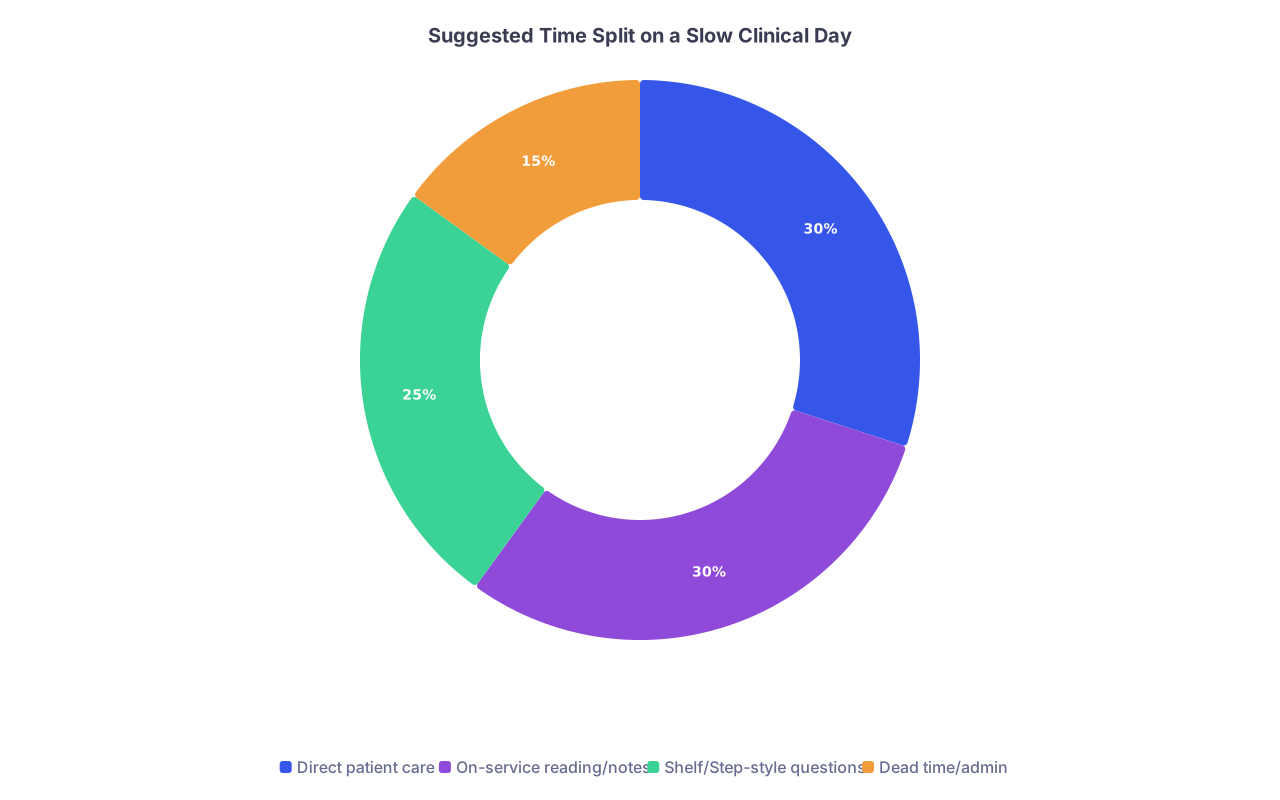
| Category | Value |
|---|---|
| Direct patient care | 30 |
| On-service reading/notes | 30 |
| Shelf/Step-style questions | 25 |
| Dead time/admin | 15 |
Translation for a “9–5” style day:
- ~2.5–3 hours: Patients, notes, presentations, helping team
- ~2–2.5 hours: Reading directly tied to today’s patients
- ~2 hours: Pure exam-mode questions and review
On low-volume services, you actually can hit 40–60 questions/day if you’re focused. That’s a massive advantage compared to classmates being run ragged and doing 10 questions half-asleep.
Specific tactics:
- Do 10–20 questions early (before rounds) if your commute/arrival time allows
- Keep a running list: “Things I keep missing on questions” → turn them into flashcards
- When you learn something clinically, immediately ask: “How would this show up as a test question?”
8. Use the Quiet to Fix Weak Skills You Can’t Fix On Busy Rotations
Busy rotations expose your weaknesses. Low-volume rotations are where you fix them.
Pick 1–2 of these to actively work on:
A. Presentations
Tell your resident:
“I’m trying to tighten my oral presentations. Can you time me and cut me off at 3 minutes if I’m rambling? And maybe give me one thing to fix each day?”
Then practice on every patient, every day. That kind of focused repetition is impossible on a 25-patient medicine service.
B. EHR Efficiency
Sounds boring, but it’s gold.
- Build your own note templates and tweak them daily
- Set up smart phrases/shortcuts for common plans (DVT ppx, delirium workup, COPD exacerbation)
- Learn to pull trendlines for labs and vitals quickly
Future you on sub-I will thank you.
C. Patient Conversations
If volumes are low, you have time for:
- Sitting down and explaining the plan slowly
- Practicing teach-back
- Having the “what matters most to you if you get sicker?” conversation with a stable chronic patient
You don’t get this luxury on “everyone is crashing” ICU days.
9. When Your Attending Is Checked Out (Or Just Quiet)
Sometimes the problem isn’t volume. It’s an attending or resident who sees you as a shadow, not a trainee.
Your move is to gently force more engagement without being obnoxious.
Lines that work:
- “Could I try to present first on this patient and then hear how you’d frame it?”
- “Can I propose my plan before you tell me yours so I can see what I’m missing?”
- “If there’s a patient you’re planning to consent for ___, would it be okay if I watched or even tried a practice consent with you listening?”
You’re not saying, “Teach me more.” You’re saying, “Let me try, then you correct.” That’s much easier for them.
If after a week they’re still giving you absolutely nothing:
Salvage the rotation by leaning hard into self-structured learning, other residents, and shelf prep. Document your effort for yourself; you might want it later if evaluations are weird.
10. Protect Your Evaluation Without Fake-Being Busy
Faculty are not stupid. They can tell when a service is legitimately slow. What they want to know is:
- Did you show up?
- Did you try to contribute?
- Did you grow across the rotation?
So you have to make that visible.
A. Make Your Effort Legible
Don’t do everything silently in the corner. Thread your work into conversation:
- “I put together a one-page summary of Mrs. X’s hospitalizations — could we look at whether my problem list makes sense?”
- “I drafted the discharge for Mr. Y. There were a couple of things I wasn’t sure how to phrase; can I ask quickly?”
Now they see the work, not just the finished product.
B. End-of-Rotation Conversation
Last day or two, say to your attending:
“This was a quieter block census-wise, but I tried to use the time to really work on my presentations and my approach to [core topic]. I’d love feedback on where you think I improved and where I should focus next rotation.”
You’re reminding them: volume was low, but effort was high. That matters when they fill out “initiative,” “work ethic,” and “self-directed learner.”
11. Realistic Day Templates For Different Low-Volume Scenarios
Sometimes it helps to see what this actually looks like hour by hour.
Scenario A: Low-Volume Inpatient Specialty (e.g., Heme/Onc)
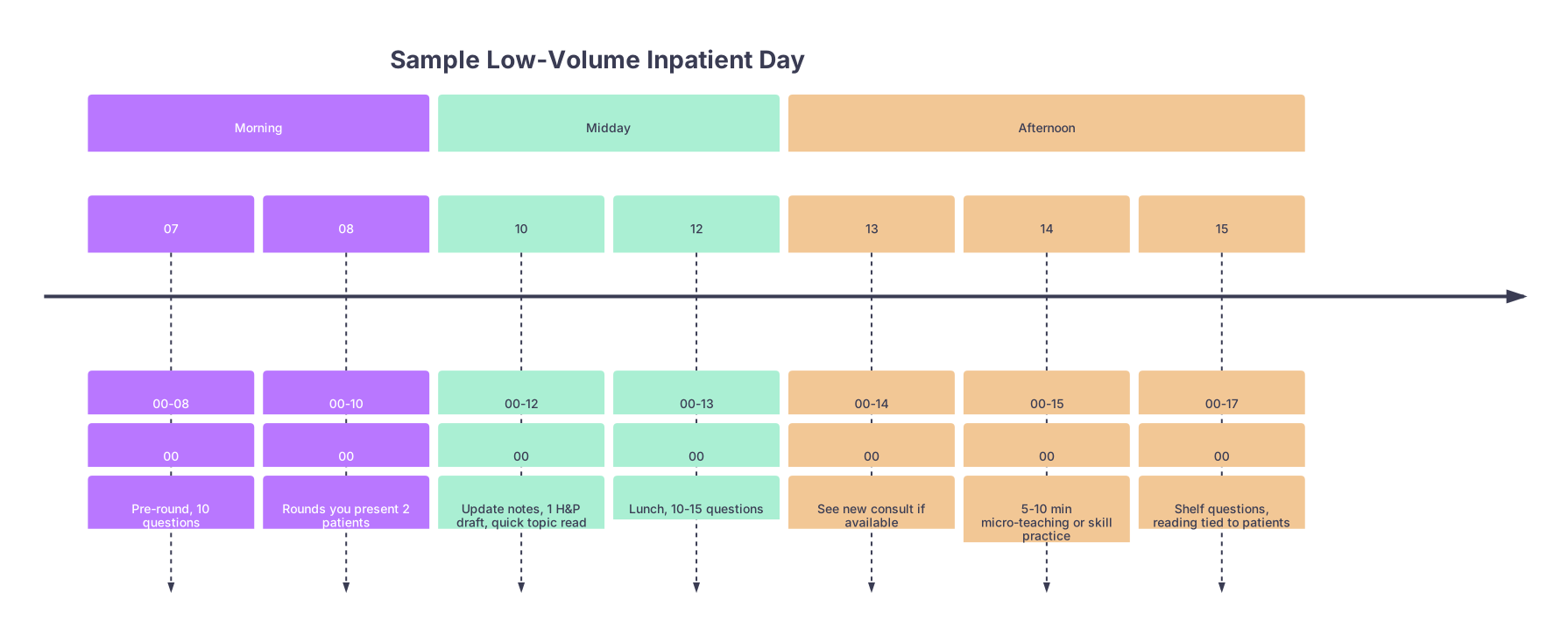
| Period | Event |
|---|---|
| Morning - 07 | 00-08 |
| Morning - 08 | 00-10 |
| Midday - 10 | 00-12 |
| Midday - 12 | 00-13 |
| Afternoon - 13 | 00-14 |
| Afternoon - 14 | 00-15 |
| Afternoon - 15 | 00-17 |
Scenario B: Outpatient Clinic With Lots of No-Shows
- Between patients, quickly review guidelines related to the chief complaint coming up next
- If a patient no-shows, build a one-page “clinic cheatsheet” (e.g., for HTN visit, diabetes med escalation, lipid management)
- Ask the attending if you can see walk-ins or acute add-ons first
12. What Not To Do On a Low-Volume Service
A short list, because I’ve watched students tank rotations by doing these:
- Don’t vanish to the library for three hours “to study” without telling anyone
- Don’t loudly complain that the rotation is useless or a waste (word gets back)
- Don’t spend all your time on your phone in the workroom, then act surprised by a weak evaluation
- Don’t overcompensate by pestering residents every 5 minutes for teaching; offer to help first
Your goal is a simple reputation: “Even when there wasn’t much going on, they hustled.”
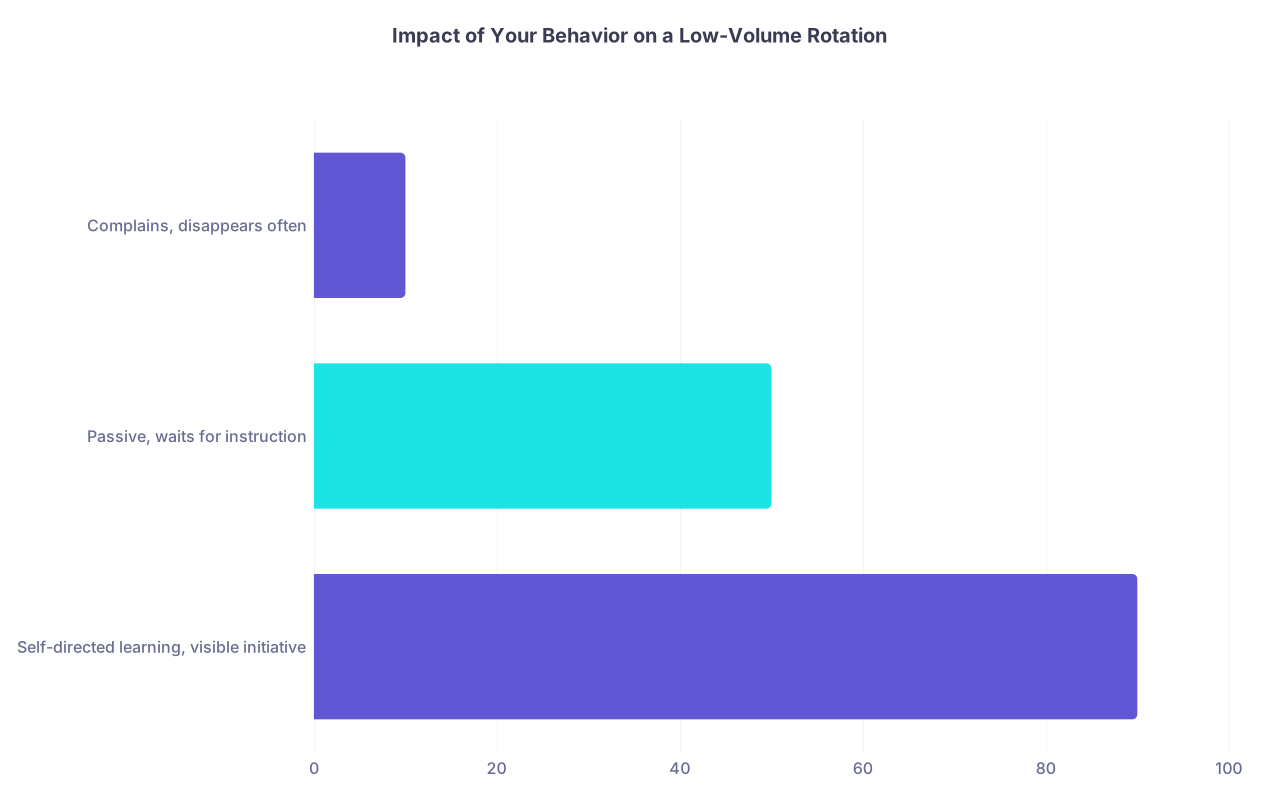
| Category | Value |
|---|---|
| Self-directed learning, visible initiative | 90 |
| Passive, waits for instruction | 50 |
| Complains, disappears often | 10 |
FAQs
1. How much is it okay to study for the shelf exam during a quiet day without looking lazy?
Rule of thumb: always offer to help first. If the team genuinely has nothing else for you, it’s completely appropriate to say, “If there’s nothing else you need right now, I’ll work on some questions/read up on X so I’m better prepared for when we get new admits.” As long as you’re physically present, responsive, and jump back in when something happens, most teams are fine with you using downtime for studying — especially if your studying is clearly linked to patient care (e.g., you’re reading about a condition one of your patients has). The problem isn’t studying; it’s disappearing or being unavailable.
2. What if I’m the only student and feel awkward constantly asking to do more?
You don’t need to constantly ask for teaching. Focus on asking for work: notes, summaries, first-pass consults, discharge drafts. Space your asks: offer to help, then go actually do the thing and come back with something to show. You might say at the start of the day, “I’ll aim to draft notes for our patients and put together a quick summary on Ms. X’s history — I’ll check back with you after rounds unless something comes up sooner.” That way you’re not pinging them every 10 minutes, but you’re still clearly engaged.
3. Can a low-volume service hurt my letters of recommendation or Dean’s letter?
It can, but only if you behave like the rotation doesn’t matter. Most evaluators know when a service is slow and will not hold the census against you. They will notice if you used that fact as an excuse to coast. If you show steady presence, ask smart questions, volunteer for tasks, and demonstrate growth in skills (presentations, notes, clinical reasoning), a low-volume rotation can still generate a strong narrative: “Even on a quieter service, they were self-directed and made meaningful contributions.” That sounds a lot better than, “Rotation was slow; unclear how much they actually did.”
Key points: Low volume is not the same as low value — unless you choose to make it that. Make your effort visible, anchor your self-study to real patients and real tasks, and use the quiet to aggressively fix weak skills and bank exam points.


