The biggest mistake MS4s make is using electives as a victory lap instead of a surgical tool to fix their CV.
You are not “picking fun rotations.” You are sequencing targeted blocks to neutralize weaknesses and amplify strengths before programs see your file.
Below is a concrete, time-stamped guide: month by month, then block by block, with specific advice for common CV gaps (late specialty decision, weak letters, step scores, limited research, spotty clinical feedback).
Big Picture: Your Fourth-Year Electives as Damage Control
At this point you should think of fourth year as a 12–14 block project plan. Not a random set of “aways” and “easy” rotations.
Here is the core structure you are aiming for (for most July-graduating schools):
| Timeframe | Block Role |
|---|---|
| Jul–Sep (Blocks 1–3) | Core audition / sub-I blocks |
| Oct–Nov (Blocks 4–5) | Backup specialty + LOR cleanup |
| Dec–Jan (Blocks 6–7) | Interviews + lighter electives |
| Feb–Apr (Blocks 8–11) | Interest deepening / skills gaps |
At each point in the year, you should be asking one brutal question:
“If a PD opened my application today, what would they see as the biggest risk?”
Your schedule needs to attack that risk in the next 1–2 blocks.
T–18 to T–12 Months Before Match: Early MS3 – Setting Up the Fix
At this point you should be in early–mid MS3, roughly:
- If you will match in March 2027 → you are here around Jan–Jun 2025.
Step 1: Identify Your Actual CV Gaps (Not the Ones You Worry About)
Sit down with your transcript, exam scores, and a rough specialty target. Then categorize yourself:
- Academic concerns
- Step/COMLEX below target for your specialty
- One bad clerkship grade (or more)
- Clinical narrative concerns
- No strong letters in target specialty
- Changing specialties late
- Very average clinical evaluations (lots of “meets expectations”)
- Scholarly concerns
- Minimal or no research for a research-heavy field
- Projects unfinished / no pubs or posters yet
- Fit / story concerns
- Non-traditional path with limited continuity
- Switching from one specialty interest to another very different one
Write the gaps down. Not “I feel behind.” Actual items. Then you schedule to fix those.
T–12 Months: March–April MS3 – Draft the Whole MS4 Year
At this point you should:
- Draft a full-year block plan (even if your school has not opened the official scheduler yet).
- Prioritize the first 4–5 blocks. Those directly impact ERAS.
You want something like this (for a student targeting internal medicine, with a Step 1 pass and modest Step 2 practice scores; weak in research but strong clinical comments):
- Block 1 (Jul): Home IM Sub-I
- Block 2 (Aug): Away IM (audition)
- Block 3 (Sep): IM consults or ICU at home
- Block 4 (Oct): Backup specialty (Family Med or prelim surgery if needed)
- Block 5 (Nov): Research or scholarly elective
- Blocks 6–7 (Dec–Jan): Lighter electives for interviews (radiology, derm, anesthesia, lifestyle fields)
- Blocks 8–11 (Feb–May): Skills/interest electives (renal, cards, heme/onc, etc.)
For you, the specifics will vary, but the logic should be the same: early blocks = audition + letters + evidence of readiness; later blocks = depth and repair.
T–10 to T–8 Months: May–July MS3 – Lock Targets, Talk to People
At this point you should:
- Finalize your specialty or narrow to 2 realistic options.
- Start talking to:
- Your specialty advisor
- A trusted clerkship director
- One resident in your target field who matched recently
Ask them three direct questions:
- “Given my scores and evaluations, what will programs worry about?”
- “Which rotations at our institution produce the strongest letters?”
- “Which away sites are realistic and worthwhile for me?”
Then adjust:
- If they say: “Your scores are solid, but you have no home letters,”
→ front-load home sub-I and key electives in that specialty. - If they say: “You are a long shot for top academic programs without research,”
→ carve out a research elective in the early–mid part of MS4 and start the work now.
T–6 to T–4 Months: January–March MS4 – The Pre-ERAS Grind
Assume you start MS4 in July. I am calling July = Block 1 for simplicity. Adjust for your school.
Now we go block by block, with the mindset: how will this look on your ERAS snapshot in September?
Blocks 1–3 (Jul–Sep MS4): Auditions and Primary Gaps
At this point you should be:
- Making your strongest case in your target specialty.
- Securing 2–3 strong letters before ERAS submission.
- Demonstrating that any earlier concern has a trajectory of improvement.
Block 1 (July): Home Base Sub-I or Core Audition
Use July to show your home program and letter-writers that you function at intern level.
Good choices:
- Home sub-internship in target specialty
- If your school does not have that, then:
- ICU or high-acuity inpatient in a field adjacent to your target
CV gap strategies here:
- Weak clinical evals in MS3
- Choose a rotation with faculty known for detailed, supportive evaluations.
- Be explicit on day 1: “I am applying to [specialty]. I had some average comments in MS3 but have worked hard on [X]. I am hoping to show I function at the level you expect of your interns.”
- Changing specialties late
- Use this block to create the new narrative: immersion in your new specialty, show commitment, get at least one letter.
You want by the end of Block 1:
- 1 attending enthusiastically committed to writing you a specific, detailed letter.
- Clear documentation of strong performance (honors or equivalent if your school uses it).
Block 2 (August): Away Elective (If You Are Going to Do One)
At this point you should:
- Be rotating at one high-yield away in your target specialty, or
- If aways are discouraged in your field (e.g., some IM/Peds), double down at home on a marquee service (ICU, consults, trauma, etc.).
Who should do an away?
Away rotations make sense if:
- Your home program is weak or nonexistent in your specialty (e.g., ortho, derm in smaller schools).
- You have a geographic preference you care about deeply.
- You have something to prove: late switch, lower scores but strong clinical skills.
They are less helpful if:
- You are applying to a non-ultra-competitive specialty.
- Your home program is respected and can give you multiple letters.
- Your CV gap is research rather than clinical.
During this block, your goal is twofold:
- Secure another letter from someone who has seen you work.
- Demonstrate that you can function in a new environment without friction.
Block 3 (September): Clinical Credibility + Time for ERAS
This block sits right at ERAS submission.
At this point you should:
- Be on a rotation that:
- Is not so crushing that you cannot finalize your personal statement and ERAS.
- Still shows clinical maturity.
Good options:
- A lighter consult service in your specialty.
- A related sub-specialty (cards for IM; neuro ICU for neurology; trauma for gen surg).
- A home ICU if it has reasonable hours and strong letter potential.
If you lack a third letter in your field, use this block to earn it. Many programs are happy with 2 specialty letters and 1 wildcard (e.g., medicine letter for radiology applicant), but a third in-field letter helps if you are borderline.
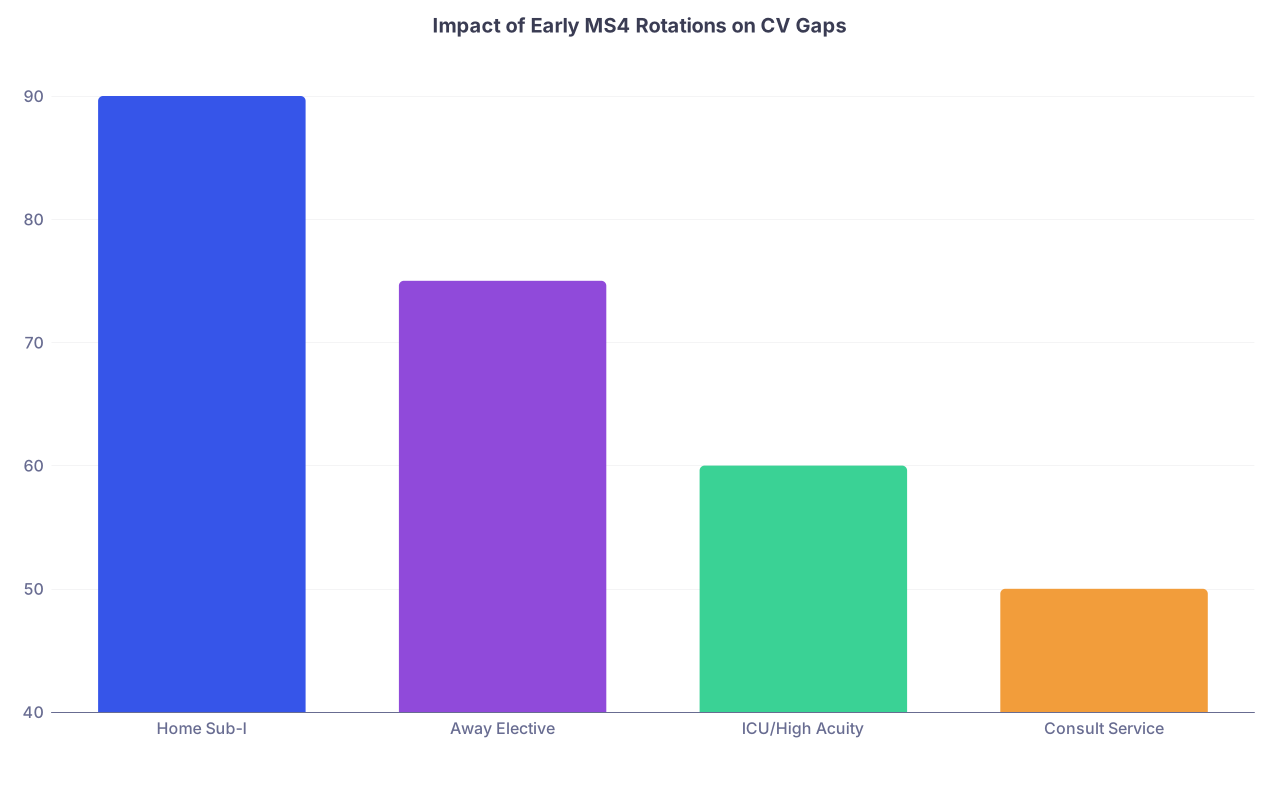
| Category | Value |
|---|---|
| Home Sub-I | 90 |
| Away Elective | 75 |
| ICU/High Acuity | 60 |
| Consult Service | 50 |
(Values approximate relative usefulness for addressing major CV concerns: higher is better.)
Blocks 4–5 (Oct–Nov MS4): Backup Plans and Risk Mitigation
ERAS is in. Now you pivot to shoring up weaknesses that program directors will be silently debating when they see your file.
Block 4 (October): Backup Specialty or Breadth Elective
At this point you should:
- Decide on a realistic backup strategy if your primary specialty is competitive.
Examples:
- Applying EM primary → do an IM or FM inpatient rotation where you can also get a letter.
- Applying Ortho or ENT with marginal scores → do a prelim surgery-style month that proves you can handle the workload in case you pivot.
- Applying Neuro → add IM or ICU month that is letter-friendly.
This block is also where you address:
- Limited breadth on your transcript.
Example: If everything is IM, ICU, cards, nephro, you look narrow. Adding a rotation like palliative care, rehab, or geriatrics shows you have range and empathy.
Block 5 (November): Research / Scholarly / “Fix the Narrative” Block
If you have a research gap, this is your window.
At this point you should:
- Be on a focused research elective or scholarly project related to your specialty.
- Have a concrete deliverable you can list:
- Abstract submitted
- Poster accepted
- Manuscript in preparation with your name clearly visible in the author list
If research is not your main problem, repurpose this block:
- If your Step 2 score is mediocre: choose a high-yield medicine sub-specialty (cards, ID, renal) and show that your clinical performance in cognitive-heavy fields is strong.
- If your MS3 evaluations were poor in professionalism or communication: do a rotation with lots of patient/family interaction (palliative, geriatrics, heme/onc clinic) and get a letter that says the opposite.

Blocks 6–7 (Dec–Jan MS4): Interview Season and Strategic “Easy Wins”
From December through January, your main job is not to destroy yourself with 80-hour weeks while you travel and interview.
At this point you should:
- Be on rotations that:
- Are clinically legitimate.
- Have predictable hours and a leadership that understands interview travel.
Good fits:
- Radiology
- Anesthesia
- Pathology
- Outpatient subspecialty clinics in your field
- EM electives with reasonable shift loads
Use these blocks to:
- Show genuine interest in the breadth of medicine.
- Pick up one more supportive letter if you still feel light. Often from a field that emphasizes teamwork and communication.
For example:
- Radiology LOR for a surgery applicant that says, “This student consistently prepared, knew the relevant anatomy, and communicated well with the team,” reinforces your image as clinically thoughtful.
- Outpatient cards for an IM applicant: “Outstanding follow-up and ownership of patient problems.”
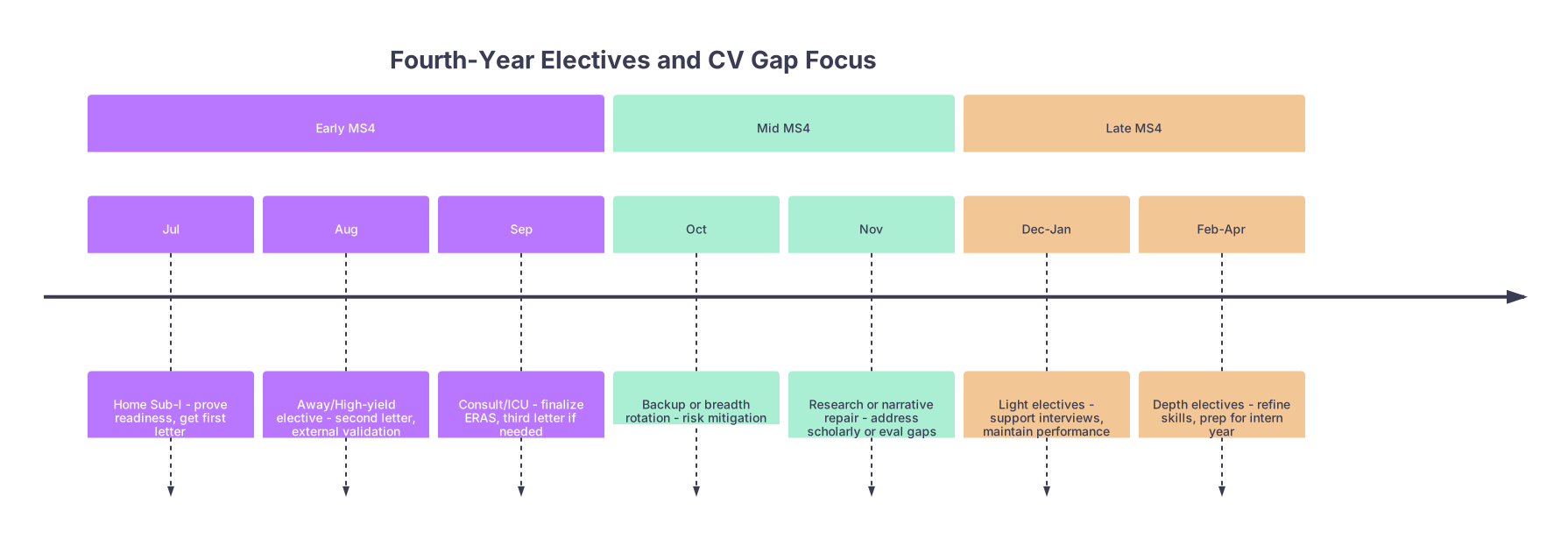
| Period | Event |
|---|---|
| Early MS4 - Jul | Home Sub-I - prove readiness, get first letter |
| Early MS4 - Aug | Away/High-yield elective - second letter, external validation |
| Early MS4 - Sep | Consult/ICU - finalize ERAS, third letter if needed |
| Mid MS4 - Oct | Backup or breadth rotation - risk mitigation |
| Mid MS4 - Nov | Research or narrative repair - address scholarly or eval gaps |
| Late MS4 - Dec-Jan | Light electives - support interviews, maintain performance |
| Late MS4 - Feb-Apr | Depth electives - refine skills, prep for intern year |
Blocks 8–11 (Feb–May MS4): Depth, Skills, and “Intern Prep”
These blocks rarely change your interview invites. But they influence rank lists and how people talk about you after you match. And yes, some programs do ask for updated evaluations if there are concerns.
At this point you should:
- Choose rotations that:
- Make you a better intern in your chosen field.
- Quiet any lingering doubts about your work ethic or clinical skill.
Examples:
- IM-bound: cards, renal, ID, heme/onc, daytime wards, palliative.
- Surgery-bound: trauma, SICU, vascular, colorectal, anesthesia for airway/lines.
- Peds-bound: NICU, PICU, adolescent, complex care.
- EM-bound: ICU, trauma surgery, anesthesia, ultrasound elective.
CV gaps you can still influence here:
- “Too narrow” applicant: add something like palliative, psych consults, rehab. Shows you see the whole patient, not just your organ system.
- Professionalism concerns (e.g., a flagged write-up from MS3):
- Crush a rotation known for tough standards (ICU, heme/onc inpatient, trauma).
- Get an attending to explicitly document in evals that you are reliable, punctual, team-focused.

Specialty-Specific Adjustments: Using Electives to Patch Common Gaps
You are not starting from scratch. Different specialties have known pressure points. Use your schedule to address those explicitly.
Internal Medicine
Common gaps:
- Middling Step 2 score (e.g., 220s–230s).
- Limited research at an academic program.
At this point you should:
- Front-load: Home IM sub-I + ICU + one cards or ID before ERAS.
- Get at least two IM letters that say “top 10–20% of students.”
- Mid-year: 4–6 weeks of research tied to an IM mentor, with an abstract or poster prior to interviews.
General Surgery
Common gaps:
- Concerns about stamina / work ethic.
- No home program or limited operative exposure.
Schedule priorities:
- Early: Home surg sub-I + away at realistic program.
- Add: ICU or trauma to show you tolerate acuity and chaos.
- If research is thin: one block of surg outcomes or QI research with a surgeon as PI.
Emergency Medicine
Common gaps:
- Late decision to switch into EM.
- No EM letters by August.
At this point you should:
- Have 2 EM rotations completed by September (home + one away if possible).
- Follow them with an ICU or trauma month to show critical care comfort.
- Add an outpatient primary care rotation to show continuity skills if your transcript is very ED-heavy.
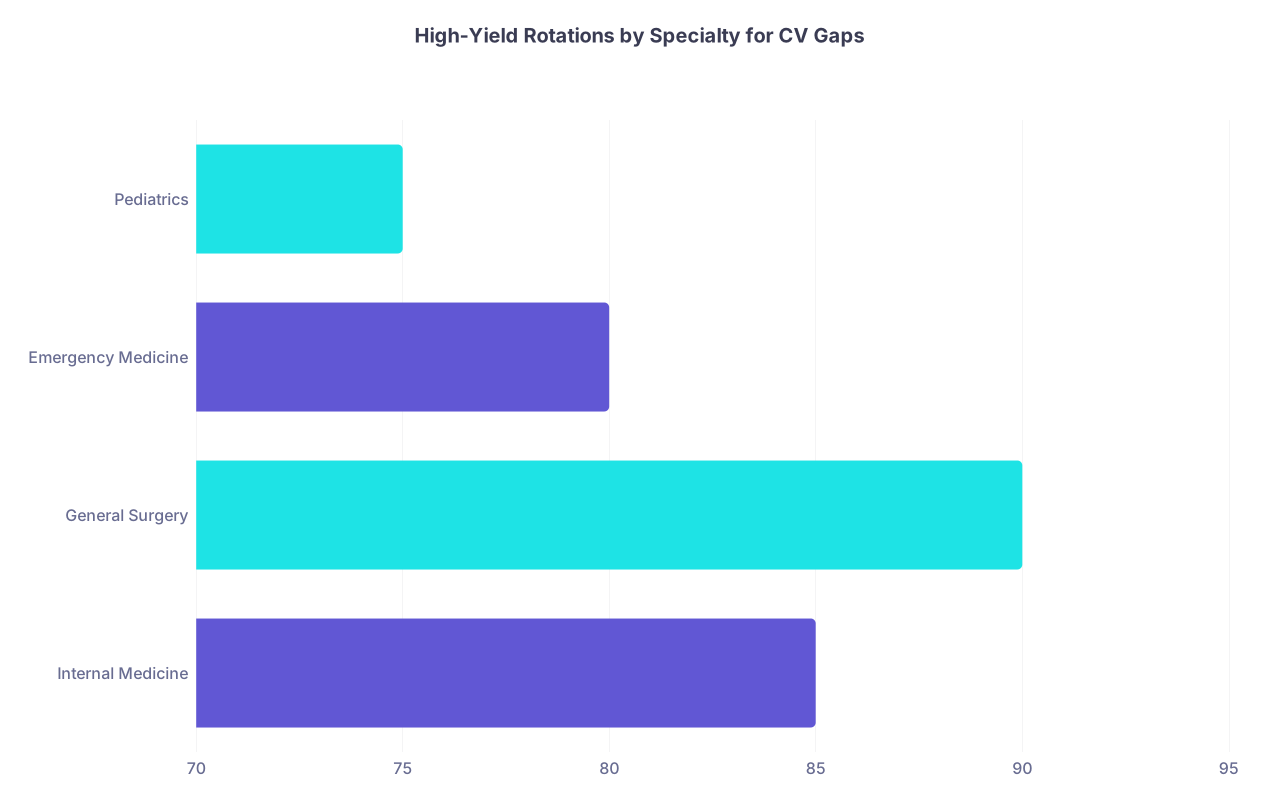
| Category | Value |
|---|---|
| Internal Medicine | 85 |
| General Surgery | 90 |
| Emergency Medicine | 80 |
| Pediatrics | 75 |
(Values reflect relative benefit of well-chosen fourth-year electives for repairing common CV weaknesses in each specialty.)
Common CV Gaps and How to Address Them Chronologically
Let’s get blunt. Here is how I would plan if I saw these patterns in your file.
1. Low or Borderline Board Scores
Risk: PDs worry about your ability to pass in-training exams and boards.
Chronological fix:
- Block 1–2: Cognitive-heavy rotations (IM wards, ICU, cards, renal) where you can show you synthesize complex data.
- Ask attendings to comment on:
- Clinical reasoning
- Knowledge base
- Block 4–5: If still a concern, add another “thinking-heavy” rotation and consider a Step 2 CK-focused elective if your school offers one.
2. Weak MS3 Evaluations / Professionalism Concerns
Risk: Red flags about teamwork, reliability, communication.
At this point you should:
- Block 1: Choose a rotation with a highly regarded, fair, no-nonsense team. Be hyper-visible in:
- Reliability (early, present, responsive)
- Ownership of tasks
- Ask for mid-rotation feedback and adjust aggressively.
- Block 3–5: Double down with at least one more team-heavy month (ICU, wards, trauma). Multiple strong evaluations can drown out one ugly narrative.
3. Limited or No Specialty Letters
Risk: PDs do not know how you function in their actual field.
Fix:
- Block 1–3 must include:
- Home sub-I in specialty
- Away or high-yield service in same field
- Aim for 2–3 letters by end of September:
- Minimum 2 from your field
- 1 from a related but different field that can speak to complementary skills
4. Minimal Research in a Research-Heavy Specialty
Think derm, rad onc, neurosurgery, competitive IM programs.
At this point you should:
- Start project work in late MS3.
- Block 4–5: Dedicated research/scholarly blocks to push projects across the finish line.
- Make sure that by interview season you can say:
- “I am first or second author on [X] poster/manuscript.”
- “We presented at [regional/national meeting].”

How to Adjust Mid-Year if Things Go Sideways
Sometimes you realize in October that invites are thin. Or you had a rough sub-I and the letter is lukewarm.
At this point you should:
- Get honest feedback from a trusted faculty member:
- “Based on where I stand, what would you recommend I change in the next 3–4 blocks?”
- Adjust your remaining schedule:
Examples:
- If you targeted a highly competitive specialty and interviews are sparse:
- Use Blocks 5–7 to complete strong rotations in your backup specialty.
- Get letters there in time to expand your ERAS application if needed.
- If you had a bad sub-I evaluation:
- Immediately schedule another high-intensity rotation with a different team.
- Ask that attending to explicitly address your strengths in the letter.
Do not just ride it out. Fourth year is one of the few times in medicine when you have some control over the sequence of your clinical experiences. Use it.
Final Checkpoint: 3–4 Months Before Graduation
By February or March of MS4, at this point you should:
- Have:
- 2–3 strong letters in your primary specialty.
- 1–2 additional letters showing breadth or backup fit.
- Be finishing rotations that genuinely prepare you for your intern year.
- Have at least one rotation that clearly contradicts whatever your biggest early CV weakness was.
If you can look at your transcript and schedule and see a coherent story of improvement and fit, you have used fourth-year electives correctly.
Key Takeaways
- Treat each block as a deliberate move to solve a specific risk in your application, not as a random clinical experience.
- Front-load sub-Is, aways, and letter-generating rotations in Blocks 1–3; use Blocks 4–5 for backup plans and research or narrative repair.
- Keep adjusting: if invites or feedback expose a new gap, pivot your remaining blocks so your fourth-year schedule tells one story—I know my weaknesses, and I fixed them.