
Most medical students waste their first two years dabbling in “research” and end up with nothing on PubMed. Do not be that person.
If you want a residency‑ready CV, you plan research like a 4‑year campaign, not a random side hobby. Month by month. Milestone by milestone. By MS4, programs should see a coherent story, not a graveyard of unfinished projects.
Here is exactly what to do, and when.
Big Picture: Your 4‑Year Research Timeline
You get four main phases:
- Pre‑MS1 / Early MS1 – Exploration and positioning
- Late MS1 – MS2 – Production and first outputs
- MS3 – Translational and specialty‑aligned work
- MS4 – Closing, polishing, and packaging your CV
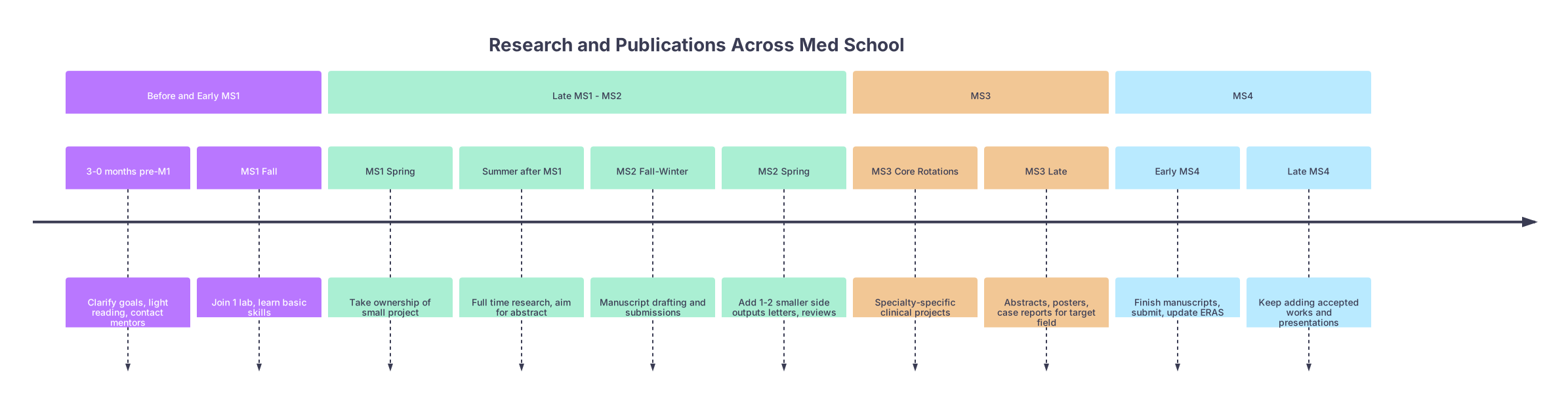
| Period | Event |
|---|---|
| Before and Early MS1 - 3-0 months pre-M1 | Clarify goals, light reading, contact mentors |
| Before and Early MS1 - MS1 Fall | Join 1 lab, learn basic skills |
| Late MS1 - MS2 - MS1 Spring | Take ownership of small project |
| Late MS1 - MS2 - Summer after MS1 | Full time research, aim for abstract |
| Late MS1 - MS2 - MS2 Fall-Winter | Manuscript drafting and submissions |
| Late MS1 - MS2 - MS2 Spring | Add 1-2 smaller side outputs letters, reviews |
| MS3 - MS3 Core Rotations | Specialty-specific clinical projects |
| MS3 - MS3 Late | Abstracts, posters, case reports for target field |
| MS4 - Early MS4 | Finish manuscripts, submit, update ERAS |
| MS4 - Late MS4 | Keep adding accepted works and presentations |
If you follow that rough arc, you will not be scrambling in MS4 to invent “research experience” out of thin air.
Before MS1 and MS1: Set the Foundation
3–0 Months Before MS1: Define your research “angle”
At this point you should:
- Be honest about your competitiveness goals:
- Aiming for derm, ortho, neurosurgery, plastics, ENT, rad onc? You need a heavier research profile.
- Aiming for IM, peds, FM, psych, anesthesia? You still need research, but the bar is more flexible.
- Decide your rough direction:
- Bench vs. clinical vs. outcomes vs. education research.
- One or two probable specialty interests (it will change, that is fine).
Actions:
- Read 5–10 recent papers in areas you might like, just to see the landscape.
- Talk to 1–2 residents or upperclass students at your future school and ask:
- “Which faculty actually get students published?”
- “Which departments are student‑friendly for research?”
Do not email 20 professors with “I am interested in research” and no specifics. That screams amateur.
MS1 Fall (Months 1–4): Join strategically, not desperately
Main goal: Get into one solid, student‑friendly research environment.
At this point you should:
- Attend your school’s research or specialty interest meetings.
- Identify 3–5 potential mentors who:
- Publish consistently.
- Have a track record of student co‑authors.
- Work in fields you could plausibly match into.
When you email, keep it sharp:
- Reference 1–2 of their papers (by topic, not citation dump).
- Offer concrete availability (e.g., “4–5 hours per week this semester, more in summer”).
- Ask for a brief meeting to see where you could help.
In the first 2–3 months in a lab or clinical research group:
- Learn basic workflows:
- How they collect data
- Their IRB rules
- Their file/analysis structure
- Do grunt work well (chart review, data cleaning, lit searches), but immediately ask:
- “Is there a discrete project I could eventually lead to first authorship?”
If you have zero prior experience, you are not leading a randomized trial. But a retrospective project, survey, or case series is realistic.
MS1 Spring (Months 5–10): Attach yourself to one concrete project
By end of MS1, you should be officially on at least one project where your role is clearly defined.
That usually means:
- For a clinical project:
- You are doing chart reviews or data collection with a dataset size and endpoint clearly defined.
- You know the target journal tier and rough timeline.
- For a basic science project:
- You are handling a defined experiment or subset of data, not just washing glassware forever.
Your checklist for MS1 spring:
- Confirm authorship expectations:
- Are you first author? Middle? “We’ll see” is a red flag unless the project is early‑stage but real.
- Nail basic skills you will need in MS2:
- Excel / REDCap data entry
- Basic stats knowledge (or who in the team handles stats)
- Reference managers (Zotero, EndNote, Mendeley)
- Start an output tracker (Google Sheet is fine) with:
- Project title
- Mentor
- Your role
- Status (idea / data collection / analysis / drafting / submitted / accepted)
- Target conference / journal
You are building a pipeline. Not just a to‑do list.
Summer after MS1: First Real Output Push
This summer is often your first big block of free time. Waste this, and you will feel it in MS4.
At this point you should:
- Be working full‑time on 1 major project, not halfheartedly on five.
- Aim to produce at least one of the following by end of summer:
- Completed data collection and preliminary analysis ready for abstract submission
- Draft of a review article or educational piece
- Draft of a case report if you are in a clinical environment

Tactical moves:
- Ask your mentor early:
- “Which upcoming conferences can we realistically target with this project?”
- Identify deadlines now (most fall conferences have spring/summer deadlines).
- Push hard to get:
- At least one abstract submitted
- A manuscript outline started
If things are going nowhere by July, you pivot:
- Ask: “Is there a smaller, faster project I can help drive to completion this year?”
- This could be:
- A short case report
- A brief report or letter to the editor
- A small retrospective chart review
Perfect is the enemy of “anything on your CV.”
MS2: Turn Work into Publications
MS2 is where people either bank their first PubMed entries or let projects die under Step prep.
MS2 Fall (Months 13–16): Lock in, then write
By early MS2, you should:
- Have at least one project where:
- Data collection is complete or nearly complete.
- You have authorship position roughly agreed upon.
- Schedule standing check‑ins with your mentor (every 2–4 weeks).
Your priorities:
- Start drafting the manuscript:
- Methods and results sections can be drafted even while final stats are running.
- Clean the data set and finalize analysis with whoever handles stats.
- Submit to at least one conference (if you missed earlier cycles, target later ones).
MS2 fall is also a great window to:
- Join one small side project that can finish quickly:
- Narrative review
- Education project
- Case series
But only one. More than that, and nothing finishes.
MS2 Winter–Spring (Months 17–22): Manuscripts out the door
This is where you convert effort into a CV line.
At this point you should:
- Have at least one manuscript submitted or very close.
- Have 1–3 abstracts or posters accepted or under review.
Your checklist:
- For your primary project(s):
- Finalize all figures/tables.
- Get the full author list confirmed and in order.
- Choose a realistic, not fantasy, journal.
- For side projects:
- Push case reports and letters to completion; these often have faster turnaround.
Track your growing portfolio like this:
| Output Type | Conservative Goal | Competitive Specialty Goal |
|---|---|---|
| PubMed-indexed papers | 0–1 | 2–3 |
| Conference abstracts | 1–2 | 3–5 |
| Posters/oral talks | 1–2 | 3–4 |
| Case reports/letters | 0–2 | 2–4 |
Are these hard rules? No. But I have watched many successful applicants land in those ranges.
You also start thinking specialty alignment:
- If you are leaning strongly toward a field (e.g., cardiology → IM, peds heme/onc → peds), ask:
- “Can we spin future projects toward this area?”
- If you realize your original lab is nowhere near your future specialty, that is fine. You will pivot in MS3. But you still want those early outputs accepted/published.
MS3: Specialty‑Aligned, Clinical, and Fast‑Turnaround Work
MS3 is dangerous. Clinical rotations eat time, and research gets dropped. That is how you end up with “submitted” but never accepted items on ERAS.
You are going to be more selective and more targeted now.
Early MS3 (Months 25–28): Stabilize existing projects
At this point you should:
- Have:
- 0–3 accepted or in‑press publications, and
- Several abstracts/posters.
- Know your probable specialty (or at least top 2).
First job:
- Close loops on old projects:
- Respond to revisions or reviewer comments quickly (one‑week turnaround whenever possible).
- If a manuscript is rejected, resubmit to a lower‑tier journal within 1–2 weeks, not 6 months.
Second job:
- Signal to your now‑likely specialty departments that you are interested in doing clinical research:
- On your rotation, tell the residents/attendings:
- “I am very interested in [specialty]. Are there any ongoing projects where a student could help with charts, data, or writing?”
- On your rotation, tell the residents/attendings:
You are not asking for a new RCT. You are asking to be plugged into something already in motion.
Mid MS3 (Months 29–32): Quick wins in your target field
This is prime time for specialty‑relevant, fast‑moving projects.
Examples that work well on busy rotations:
- Case reports (classic MS3 move, still valuable):
- Odd presentation
- Rare disease
- Interesting complication
- Small retrospective projects:
- 50–200 patients with a specific condition or intervention.
- Education or QI (quality improvement) projects:
- OSCE redesign
- Protocol adherence projects on your service.
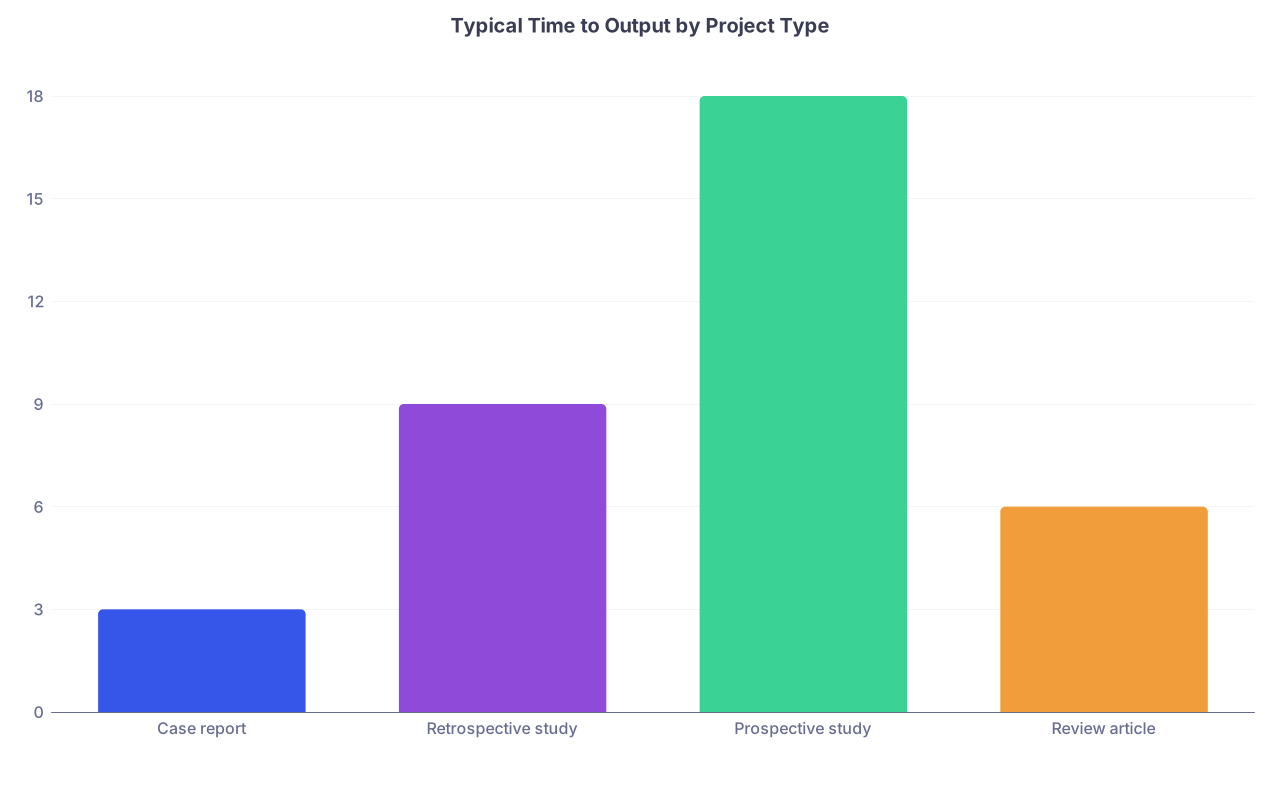
| Category | Value |
|---|---|
| Case report | 3 |
| Retrospective study | 9 |
| Prospective study | 18 |
| Review article | 6 |
Those are rough time‑to‑publication in months, assuming competent mentorship and actual momentum. MS3 favors the left side of that chart.
Your goal by end of MS3:
- In your chosen specialty:
- At least 1–2 abstracts/posters.
- Ideally 1+ publication (even accepted ahead of print).
If your school has a research day, submit everything you can. It looks good, but more importantly, it forces you to finalize figures and results.
MS4: Conversion, Cleanup, and CV Presentation
By now, the game is about closing and packaging.
Early MS4 (Before ERAS Submission – Months 33–38)
ERAS usually opens in early summer and submission happens around September.
At this point you should:
- Have your publication list in three buckets:
- Published / in press (with PMIDs if available)
- Accepted (no PMID yet)
- Submitted / in preparation (these go in “submitted” or not at all, depending on program culture and honesty threshold)
You want as much as possible in bucket 1 or 2 before ERAS locks.
Actions for early MS4:
- Push every near‑complete manuscript to submission.
- Aggressively respond to journal decisions (revise, resubmit, or move on).
- Clean up your ERAS entries:
- Use clear, non‑inflated descriptions of your role.
- Avoid listing 10 “in preparation” papers that will never exist.
Programs can smell vaporware. They may not say it, but I have heard faculty laugh at CVs stuffed with imaginary manuscripts.
Late MS4 (Post‑Interview – Months 39–48)
After interviews, you are doing maintenance.
At this point you should:
- Update programs with major new acceptances if:
- It is a strong journal or clearly relevant to the field.
- It changes your profile meaningfully.
You also do a little forward‑planning:
- If you are considering fellowships or academics, keep 1–2 longer‑term projects alive.
- Keep a master CV (not just ERAS) updated with:
- Full citations
- Posters and talks
- Roles and mentor names
Future‑you (as a resident) will thank you.
How Many Publications Do You Really Need?
The honest answer: it depends heavily on specialty and program tier, but here is a realistic snapshot.
| Target Specialty Tier | Total Pubs Common in Matched Applicants | Emphasis |
|---|---|---|
| Ultra-competitive (derm, PRS, ENT, NSGY) | 5–20+ (many small, some big) | Specialty-aligned, 1st authorships |
| Competitive (ortho, rad onc, rads, ophtho) | 3–10 | Mix of basic and clinical |
| Mid (IM, EM, anesthesia, peds) | 1–6 | Any solid work, some alignment |
| Less competitive (FM, psych, path) | 0–4 | Helpful but not make-or-break |
Again, these are patterns, not rules. But if you are aiming for derm with zero research, you are playing on hard mode.
Day‑to‑Day and Week‑to‑Week: Staying On Track
The timeline is great in theory. Let’s make it practical.
Weekly rhythm (during preclinical years)
At this point you should be doing, every week:
- 3–6 hours of research work:
- One 2–3 hour block for deep work (analysis, writing).
- A few 30–60 minute slots for emails, quick edits, figure tweaks.
- One brief check‑in (email or meeting) with your mentor at least every 2–3 weeks so projects do not drift.
During exam‑heavy weeks, it dips. Fine. But do not disappear for 2 months, then wonder why your mentor forgot you exist.
Micro‑tasks that move projects forward
Keep a running list of 15–30 minute tasks:
- Clean up a figure.
- Draft a paragraph of the introduction.
- Update references.
- Reformat a table for a different journal.
Those small tasks, strung together, are what eventually look like “5 publications” on your CV.
Common Mistakes That Kill Research Productivity
I have seen these sink otherwise strong applicants:
- Joining 4 labs in MS1, producing nothing in any of them.
- Agreeing to be “on a project” where your role is undefined.
- Chasing prestige journals wildly above your level and letting rejections stall you for months.
- Listing “in preparation” papers that have no draft, no target journal, and no timeline. That is fiction.
- Never clarifying authorship until the end, then being shocked when you are 7th name on the paper you basically built.
Avoid all of that by:
- Picking fewer, higher‑yield mentors.
- Demanding clarity about your role and the realistic outcome.
- Pushing for closure and resubmission quickly.
FAQ (Exactly 4 Questions)
1. I am starting MS2 with zero research. Is it too late to build a strong CV?
No, but you no longer have slack. You must:
- Get on 1–2 clinical projects that can move fast (retrospective, case reports, reviews).
- Spend your MS2 summer in full‑time research with a mentor known for student outputs.
- Aim for at least 1 submitted manuscript and 1–3 abstracts by early MS3.
You may not hit “derm‑level” productivity, but for many specialties you can still assemble a solid, believable CV.
2. How do I pick between basic science and clinical research for residency?
For most residency programs, clinical research is more visible and directly relevant. Basic science is valuable if:
- You genuinely enjoy it and might pursue physician‑scientist paths.
- You are in a lab that actually publishes with students.
If your main goal is a strong residency CV and you are not committed to a PhD‑style career, lean toward clinical, outcomes, or education projects you can complete and publish within 12–18 months.
3. Are posters and abstracts actually worth anything, or only full papers?
Full papers are king, but posters and abstracts absolutely count. They show:
- You can finish a project to a presentable stage.
- You are engaged enough to submit to conferences.
- You can talk about your work under pressure.
For competitive specialties, you usually see a stack: multiple abstracts/posters and a subset that became full manuscripts. Do not dismiss “just a poster”; it fills your CV and often forces progress.
4. How should I list research and publications on ERAS to avoid looking inflated?
Follow three rules:
- Separate published/accepted from submitted/in preparation clearly.
- Describe your role honestly (“co‑designed study and performed data analysis” vs. “assisted with data entry”).
- Keep “in preparation” entries to projects with a real draft and plan; otherwise, leave them off.
Program directors read hundreds of CVs. They can tell who is padding. Aim for a portfolio that feels tight, coherent, and verifiable rather than bloated.
Key points:
Plan research as a 4‑year campaign, not a random side project.
At each phase (MS1 → MS4), prioritize a few projects that can realistically produce abstracts and papers on clear timelines.
By ERAS, you want a coherent, specialty‑aligned list of real outputs—finished, submitted, and accepted—that you can confidently discuss in any interview room.