The biggest mistake weak applicants make is trying to “fix” their CV in the last two months before ERAS opens. You are not fixing anything then. You are packaging what already exists. The transformation happens in the 9–12 months before.
Here is how you use one year—month by month, week by week—to turn a questionable CV into something residency programs take seriously.
Overall Strategy: What You Must Build In 12 Months
Before the timeline, you need the targets. By ERAS submission, a previously weak CV should show:
- Clear clinical commitment to your chosen specialty
- At least 1–2 concrete scholarly products (poster, abstract, or small paper)
- A visible pattern of responsibility (leadership, longitudinal volunteering, or teaching)
- 2–3 strong letters from people who actually know your work
- No glaring “what were you doing?” time gaps
At every point in the year, you will work in four lanes:
- Clinical exposure lane – rotations, observerships, sub‑internships
- Scholarly productivity lane – research, QI, case reports
- Leadership / service lane – continuity roles that show reliability
- Documentation lane – tracking, framing, and preparing content for ERAS
You are going to touch all four almost every month. Not evenly, but intentionally.
Months 1–3: Stabilize, Choose, and Stack Opportunities
At this point, you should stop pretending you have time to “figure it out later.” These three months set your ceiling.
Week 1–2: Brutal CV Audit
Sit down with your current CV and a program’s resident profile page (for example, look at University of Michigan IM residents).
Make a quick table like this:
| Area | You Now | Typical Matched Resident |
|---|---|---|
| Clinical exposure | Limited / scattered | Consistent specialty exposure |
| Research | None / minimal | 1–3 posters / papers |
| Leadership | Irregular roles | At least one sustained role |
| Service | Short-term events | Ongoing, 6+ months |
| Letters lined up | 0–1 | 3 strong mentors |
No sugarcoating. You need to know where you are behind.
Week 2–3: Commit to a Specialty Direction
You do not need eternal certainty. You do need a declared direction for the next 12 months.
- If you are torn between two (say IM vs EM), pick one as “primary” and one as “backup.”
- Your CV can be angled to one while staying acceptable for the other, but drifting helps no one.
At this point, you should:
- Identify 10–15 realistic residency programs in your target specialty.
- Skim their resident bios to see consistent patterns: research-heavy? heavy community service? homegrown rotators?
Week 3–4: Build Your Opportunity Pipeline
This is the most important 2-week period of the entire year. You are not doing the work yet. You are locking in the work you will do.
You must:
Secure a research or QI project
- Email 5–10 faculty in your specialty. Short, targeted notes:
- Who you are
- Your timeframe (one year to ERAS)
- What you can realistically do (chart reviews, data collection, lit review)
- Accept that half will not reply. Follow up once after 7–10 days.
- Take the first reasonable project that can produce something presentable by 6–9 months.
- Email 5–10 faculty in your specialty. Short, targeted notes:
Plan key clinical experiences
- If you have control of rotations: line up
- 1 sub‑I / acting internship in your target specialty (ideally 3–4 months before ERAS).
- 1 away rotation if your specialty benefits from it (surgery, ortho, derm, EM).
- If you are done with school or are an IMG: secure observerships/externships in relevant departments.
- If you have control of rotations: line up
Choose one stable leadership or service role
- Clinic coordinator, teaching assistant, student group officer, free clinic volunteer.
- The key: you start now and continue through ERAS submission so it looks longitudinal.
By the end of Month 1 you want your next 9–10 months roughly mapped out.
Months 2–3: Start Execution and Build Credibility
At this point, you should stop browsing opportunities and start showing up consistently.
Week-by-Week Focus
Weeks 1–4 of Month 2
- Begin your research/QI project in earnest:
- Meet with PI or supervisor, define your role and your deliverables.
- Set a monthly goal: data collection complete by Month 5, abstract draft by Month 7.
- Start your longitudinal role (clinic, leadership, tutoring). Show reliability immediately:
- Be early, over-communicate, pick up unassigned tasks.
Weeks 1–4 of Month 3
- Add one more structured thing if possible:
- Teaching: anatomy TA, OSCE coach, peer tutor.
- Or an operational role: schedule coordinator, student leader for a health fair series.
This is where many people overcommit. Do not stack 5 new roles. You need 2–3 things you actually do well, not 9 things you barely show up for.
Months 4–6: Generate Tangible Output
The first quarter was about setup. The second quarter is about proof.
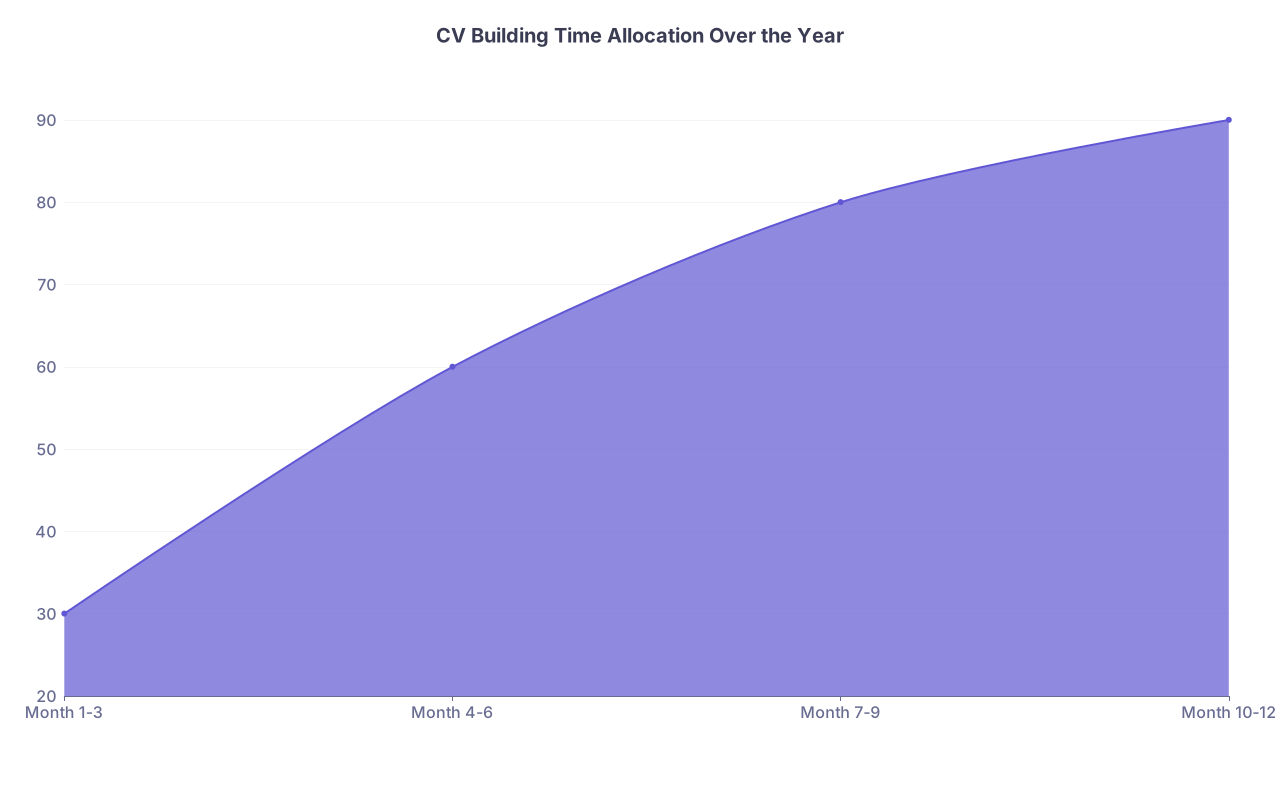
| Category | Value |
|---|---|
| Month 1-3 | 30 |
| Month 4-6 | 60 |
| Month 7-9 | 80 |
| Month 10-12 | 90 |
At this point, you should start converting effort into lines on your CV.
Month 4: Intensify Research and Specialty Presence
Push your project:
- Aim to have a full, clean dataset or clearly outlined case(s).
- If it is a case report, draft the case description and literature review now.
Increase visibility in your chosen specialty:
- Attend every department conference you can: M&M, grand rounds, journal clubs.
- Ask 1–2 intelligent questions over the month. People notice repeat faces.
Clinical:
- If you are on a specialty-relevant rotation, act like this is an extended interview:
- Own your patients. Follow up your labs before anyone asks.
- Offer to give a 5–10 minute mini-presentation on a patient-related topic.
- If you are on a specialty-relevant rotation, act like this is an extended interview:
Month 5: Lock in Presentable Products
By the end of Month 5 you want at least one of the following in motion:
- Abstract submitted to a regional/national meeting
- Case report drafted and under faculty review
- QI project with measurable before/after data and draft for a poster
Push your mentor a bit. Not annoyingly, but clearly:
“I am hoping to have something ready to present by late summer, given ERAS timing. Can we set deadlines for draft review?”
If nothing is moving after 3 months, you pivot:
- Grab low-hanging fruits:
- Case reports from unique patients.
- Short QI projects in clinics (reducing no-show rates, screening completion).
Month 6: Position Yourself for Letters
At this point, you should identify your letter of recommendation (LOR) targets:
- One research or QI mentor who can say you see projects through.
- One clinical attending in your chosen specialty who has observed you for at least 4 weeks.
- One additional attending or supervisor (clinic, sub‑I, or other rotation) who knows your reliability.
Have explicit conversations:
“Dr. X, I am planning to apply to [specialty] this coming cycle and would value your letter if you feel you can speak strongly to my work.”
You are not asking for any letter. You are asking for a strong one. The wording matters.
Months 7–9: ERAS Year – Convert Work into ERAS Content
This is where things start overlapping: finishing projects, doing high-stakes rotations, and drafting application materials.
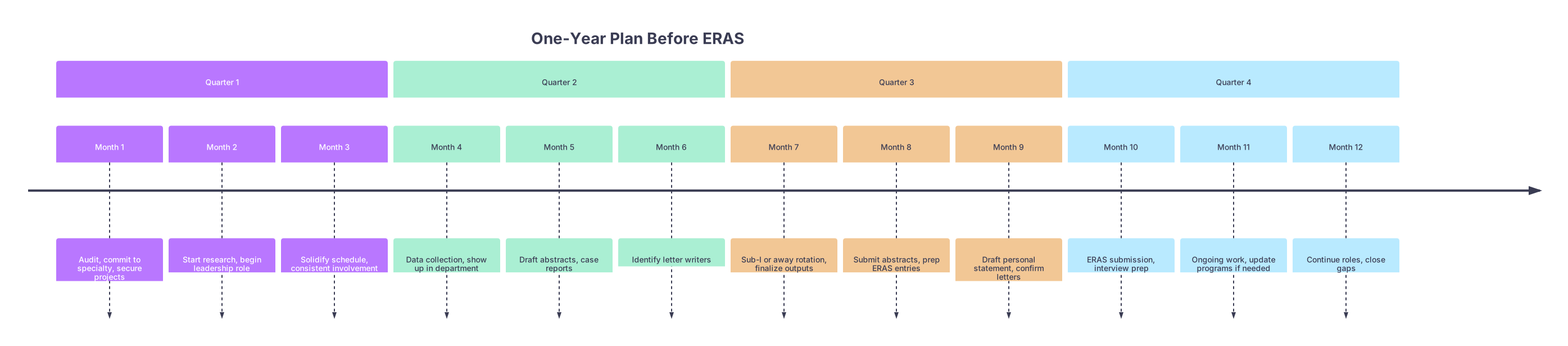
| Period | Event |
|---|---|
| Quarter 1 - Month 1 | Audit, commit to specialty, secure projects |
| Quarter 1 - Month 2 | Start research, begin leadership role |
| Quarter 1 - Month 3 | Solidify schedule, consistent involvement |
| Quarter 2 - Month 4 | Data collection, show up in department |
| Quarter 2 - Month 5 | Draft abstracts, case reports |
| Quarter 2 - Month 6 | Identify letter writers |
| Quarter 3 - Month 7 | Sub-I or away rotation, finalize outputs |
| Quarter 3 - Month 8 | Submit abstracts, prep ERAS entries |
| Quarter 3 - Month 9 | Draft personal statement, confirm letters |
| Quarter 4 - Month 10 | ERAS submission, interview prep |
| Quarter 4 - Month 11 | Ongoing work, update programs if needed |
| Quarter 4 - Month 12 | Continue roles, close gaps |
Month 7: High-Impact Clinical Block (Sub-I / Away)
At this point, you should be on or preparing for your most important rotation of the year.
During the sub‑I or away rotation:
- Show up like an intern:
- Pre-round independently and be ready with a plan.
- Offer to call consults, talk to families, write accurate notes.
- Tell yourself: every day is an audition.
- Make it easy for someone to say, “We would be comfortable with this person as a resident.”
Simultaneously, push your scholarly work:
- Turn that draft abstract into a finalized submission.
- If a conference deadline is months away, aim for:
- Departmental research day
- Institutional poster session
- Even an online or small regional meeting. It still counts.
Month 8: Polish Outputs and Translate to CV Language
This month is about conversion—turning work into clear, high-yield CV entries.
For every experience, you should:
Write a 1–2 sentence “impact statement”
- Bad: “Volunteered at student-run clinic.”
- Better: “Coordinated weekly student-run primary care clinic, managing scheduling and intake for 20–25 underserved patients per session.”
Quantify where possible:
- Number of sessions, patients, charts reviewed, learners taught.
Clarify your actual role:
- “Led,” “coordinated,” “implemented,” “designed,” “analyzed,” not just “helped” or “participated.”
Begin drafting your ERAS “Experiences” section now, even if you do not submit until Month 10. You will rewrite it repeatedly, and you should.
Month 9: Personal Statement + Letter Finalization
At this point, you should stop collecting new roles and focus on presentation.
Personal statement:
- Anchor it in 1–2 real stories from this year’s experiences that show growth and direction.
- Tie your research or service to your specialty choice. Show a narrative, not random activities.
Letters:
- Confirm with all letter writers that they will submit by your target ERAS date.
- Provide them:
- Updated CV
- Draft personal statement
- Brief bullet list of things you hope they might highlight (reliability, improvement, specific project).
You want every letter to reinforce the story your CV is already telling.
Months 10–12: Application, Interviews, and Strategic Updates
By now, the heavy lifting should be done. You are no longer “fixing” your CV. You are using it.

Month 10: ERAS Submission and Early Interviews
At this point, you should submit ERAS early in the opening window. A weak CV does not get stronger by waiting three extra weeks.
Key tasks:
- Final pass on all CV entries:
- Remove fluff.
- Emphasize continuity (e.g., “2019–2024” instead of listing five separate roles for the same clinic).
- Double-check research entries:
- Mark things as “submitted,” “in preparation,” or “accepted” accurately. Do not “future fake.” Programs notice.
While interviews start trickling in, you continue your ongoing roles. The mistake here is dropping everything the second ERAS is sent. Programs can and do ask what you are doing now.
Month 11: Maintain Activity and Send Targeted Updates
For weaker CVs, this month is your chance to show momentum.
If something substantial happens:
- Abstract accepted
- Poster presented
- Paper accepted or published
- New leadership accomplishment (e.g., you organized a major event)
You can send targeted update emails to selected programs, especially those you have already interviewed with or have a strong geographic/mission fit.
Keep them short:
- 2–3 sentences referencing the update
- 1–2 sentences on continued interest
Do not spam every program with trivial updates (“I attended a conference”). That looks insecure, not impressive.
Month 12: Close Gaps and Finish Strong
At this point, you should have:
- Fulfilled your commitments to clinics, leadership roles, and projects
- A neat, internally consistent story of the last year
If Match Day is still ahead and you are on interviews:
- Be ready to talk about how you turned your CV around this year. That narrative—owning your weaknesses and showing concrete growth—is often what convinces PDs to take a chance on you.
If you are post‑Match and entering SOAP or reapplication territory, this same structure applies to your next year, but with even more urgency.
Sample Weekly Rhythm During the Core Build (Months 4–8)
People always ask, “What should a typical week look like?” Roughly this:
| Day | Focus Area |
|---|---|
| Monday | Clinical duties + conference |
| Tuesday | Research data / writing (2 hrs) |
| Wednesday | Longitudinal clinic / service |
| Thursday | Leadership / teaching (1–2 hrs) |
| Friday | Research or QI follow-up |
| Weekend | 1–2 hrs ERAS/PS drafting (later) |
You are not doing 20 different things. You are touching the same core 3–4 things every week so they look serious on paper.
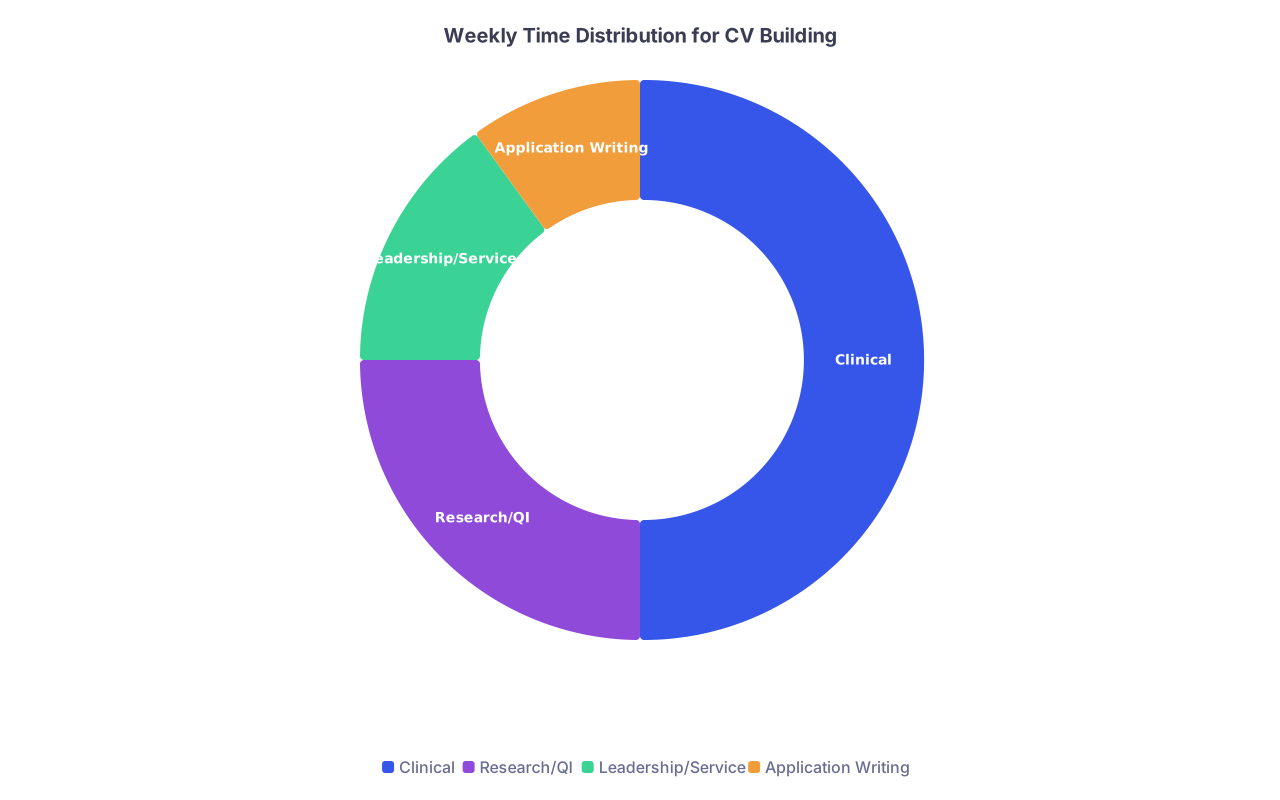
| Category | Value |
|---|---|
| Clinical | 50 |
| Research/QI | 25 |
| Leadership/Service | 15 |
| Application Writing | 10 |
How This One-Year Plan Changes a Weak CV
Let me be concrete. Here is what I have seen in real applicants who followed a version of this plan.
Starting Point (Month 0)
- Scattered volunteering, nothing >3 months
- No research, no posters, no papers
- One lukewarm letter from a preclinical instructor
- Minimal specialty exposure
End Point (Month 12)
- 2 strong letters from specialty attendings + 1 from research mentor
- 1–2 posters (even if just local/regional)
- 1 case report “submitted” and honestly under review
- 12+ months of consistent free clinic or leadership role
- 1 sub‑I with comments like “functions at intern level” in narrative evaluations
- Personal statement that actually references these specific experiences
That is not a “superstar” CV. It is a credible, rising CV. And for many specialties and many programs, that is enough to get you in the door.
Common Ways People Sabotage This Year
I have to mention the traps, because I have watched people fall straight into them.
- Waiting until Month 7 to start research, then wondering why nothing is publishable.
- Collecting titles (“Vice President,” “Chair,” “Coordinator”) with zero actual work or time behind them. PDs see through that in seconds.
- Chasing prestige over practicality: choosing a sexy sounding project that will never finish instead of a modest QI project that actually yields a poster.
- Dropping activities once ERAS is submitted, creating a visible pattern of short bursts followed by silence.
Do the opposite. Fewer things. Done longer. Finished properly.

Final Takeaways
- You do not fix a weak CV at the last minute. You build a different year. One that shows continuity, output, and growth.
- The sequence matters: secure opportunities early, execute consistently, convert work into concrete products, then package it well for ERAS.
- At every point in the year ask one question: “If a PD saw only what I did this month, would they believe I am serious about this specialty?” If the answer is no, change your calendar, not your story.