The worst time to realize your CV is weak is after your letter writers have already agreed to vouch for you.
You get one three‑month window to look like the strongest version of yourself on paper before you start asking attendings and mentors to put their name next to yours. Treat it like a sprint, not a vibe.
This is your 90‑day, week‑by‑week CV cleanup and upgrade plan leading into letter requests, specifically for residency applications.
I’ll assume:
- You’re about 3 months from when you plan to ask for letters (late MS3, early MS4, or research year)
- You already have some experiences but your CV is messy, thin in spots, or out of date
- You want concrete “at this point you should…” steps, not vague motivation
We’re going in strict time order: Month 3 → Month 2 → Month 1 → Final week and day‑of letter asks.
Big Picture: Your 90-Day CV Sprint Roadmap
Before we zoom in, here’s the structure of the next 3 months.
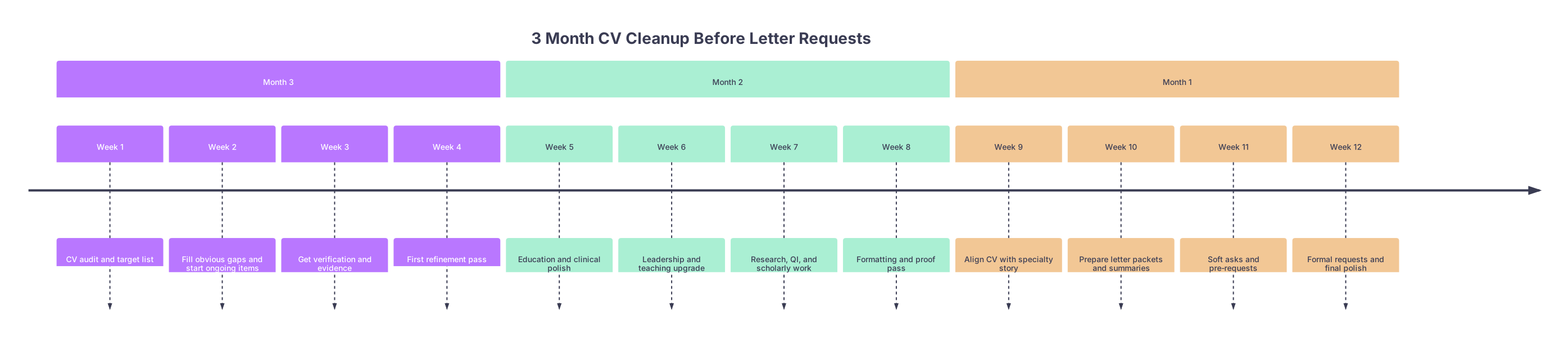
| Period | Event |
|---|---|
| Month 3 - Week 1 | CV audit and target list |
| Month 3 - Week 2 | Fill obvious gaps and start ongoing items |
| Month 3 - Week 3 | Get verification and evidence |
| Month 3 - Week 4 | First refinement pass |
| Month 2 - Week 5 | Education and clinical polish |
| Month 2 - Week 6 | Leadership and teaching upgrade |
| Month 2 - Week 7 | Research, QI, and scholarly work |
| Month 2 - Week 8 | Formatting and proof pass |
| Month 1 - Week 9 | Align CV with specialty story |
| Month 1 - Week 10 | Prepare letter packets and summaries |
| Month 1 - Week 11 | Soft asks and pre‑requests |
| Month 1 - Week 12 | Formal requests and final polish |
At the end of this sprint, you should have:
- A clean, specialty‑focused CV you’re not embarrassed to email to a program director
- Clear, concise bullet points that actually sound like you did something
- Concrete talking points and evidence you can hand to letter writers
Let’s go week by week.
Month 3: Triage and Foundation (Days 1–30)
Week 1: Brutal CV Audit and Target List
At this point, you should stop adding random stuff and take inventory.
Day 1–2: Pull everything into one document
- Grab:
- Old CV versions
- ERAS/VSLO exports
- Med school activities log
- Research tracker, presentations, abstracts
- Dump them into a single doc. Ugly is fine.
Day 3–4: Audit against what residency programs actually care about
Here’s roughly how programs mentally weight your CV categories:
, Leadership and teaching, Service and extracurriculars, Random filler](https://cdn.residencyadvisor.com/images/articles_svg/chart-approximate-emphasis-of-cv-sections-in-residency-a-6624.svg "Approximate Emphasis of CV Sections in Residency Applications")
| Category | Value |
|---|---|
| Clinical and education | 35 |
| [Research and scholarly work](https://residencyadvisor.com/resources/cv-improvement-residency/how-to-plan-research-and-publications-across-med-school-for-a-strong-cv) | 25 |
| Leadership and teaching | 20 |
| Service and extracurriculars | 15 |
| Random filler | 5 |
Look at your current CV and ask:
- Do I have recent, credible entries in each high‑value bucket?
- What looks obviously outdated? (Old high school awards. Random shadowing from 2013.)
- Which sections feel thin, especially for my specialty?
- Example: Applying neurosurgery with zero research? Big problem.
- Applying FM with no community or continuity experiences? Also a problem.
Day 5: Make a “Gap List” by specialty
Pick your target specialty and be honest. By end of this day you should have a one‑page list:
- Must-have or “strongly expected” items you already have
- Missing or weak areas you can realistically improve in 3 months
Example for Internal Medicine applicant:
- Strong:
- 2 IM sub‑I’s, solid comments
- 1 poster at ACP
- Weak:
- No longitudinal clinic work
- Leadership section basically empty
- No teaching bullets
Day 6–7: Identify letter‑worthy attendings now
You’re not asking yet. You’re just mapping.
- Make a list of 5–8 potential letter writers:
- Attendings who watched you work closely
- Research mentors
- Clerkship directors who know your work ethic
- Mark who needs to see stronger, updated CV content before you ask them
At this point you should have:
- One messy master CV
- One “Gap List”
- One target letter writer list
Week 2: Fill Obvious Gaps and Start Ongoing Activities
Now you stop purely organizing and actually add substance.
Day 8–9: Kill filler, upgrade what remains
Open your master CV. For each entry, ask:
- Does this advance my image as a future [X specialty] resident?
- Can I explain this in 1–2 sentences to a PD without rolling my eyes?
Purge or demote:
- Old non‑medical jobs with no transferable skills
- Tiny one‑off volunteer events
- Skills sections like “proficient in Microsoft Word” (no.)
Upgrade with action‑oriented bullets:
- “Helped with clinic” → “Roomed 10–15 patients per half‑day, obtained focused histories, and presented to attending with focused assessments”
- “Volunteer” → “Coordinated weekly blood‑pressure screening for ~25 underserved patients; escalated high‑risk values to supervising NP”
Day 10–11: Add 1–2 quick‑win experiences
Look at your Gap List and plug what you can start this month:
- Email about:
- A small QI project on a current rotation
- Helping an attending with chart reviews or literature tables
- Joining an existing student‑run clinic shift regularly
- Target experiences that:
- Are resume‑able (defined role, recurring, trackable)
- Can produce something to list by the time you ask for letters
Even a 6‑week consistent teaching session (“weekly board review for MS2s”) looks meaningful if done well.
Day 12–14: Start proper tracking
Create a simple tracking sheet (spreadsheet or Notion, do not overthink):
- Columns: Activity, Role, Dates, Hours/Volume, Supervisor, Outcome
- Every time you do something this week, log it immediately
At this point you should:
- Have fewer, sharper entries
- Have at least 1–2 new or ongoing things that will look decent on paper in 2–3 months
- Be tracking experiences in real time
Week 3: Verification, Evidence, and Specifics
This is the week you make your CV provable and specific, so it holds up under scrutiny.
Day 15–16: Nail down dates, roles, and supervisors
Go through each entry:
- Confirm:
- Start and end months/years
- Exact role titles (“Course tutor – Physiology” beats “Tutor”)
- Supervisor names and degrees (MD, DO, PhD)
- If you’re fuzzy, email:
- “Hi Dr. Lee, I’m updating my CV for residency—can you confirm my role title and approximate dates for the diabetes QI project?”
Programs care that your CV is:
- Chronologically clean
- Verifiable
- Not full of “I think it was around 2019…”
Day 17–18: Convert vague bullets to outcome bullets
Every high‑value entry should have at least one bullet that shows impact, not just participation.
Examples:
Old: “Member of student‑run clinic”
New: “Served as primary triage student for ~8 patients per session; created structured HPI templates that cut intake time by ~5 minutes per patient”
Old: “Worked on research project”
New: “Extracted and analyzed data from 120 patient charts for retrospective cohort study on heart failure readmissions; abstract submitted to ACC 2025”
Day 19–21: Gather proof and artifacts
You’re not attaching this to ERAS, but it backs up your story and gives letter writers concrete details.
Collect in one folder:
- PDFs of posters or slides
- Final QI reports
- Clinic schedules showing your consistent involvement
- Teaching evaluations or feedback emails
- Acceptance emails for presentations
At this point you should:
- Be able to defend every major bullet with a document or clear memory
- Have specific numbers or outcomes for your strongest entries
Week 4: First Real CV Draft and Cleanup
Now we pull this into an actual CV and do the first real pass of polish.
Day 22–24: Decide on structure and sections
Use a residency‑appropriate layout. Typical order:
- Name and contact
- Education
- USMLE/COMLEX (if your school’s okay with it on CV)
- Clinical experience (can include key rotations/sub‑I’s)
- Research and scholarly activity
- Teaching and leadership
- Service/volunteering
- Awards and honors
- Skills (concise, relevant)
Build a draft in Word or Google Docs with consistent:
- Font (one)
- Section headings
- Date format (pick one style and stick with it)
Day 25–27: Apply a ruthless 2‑page rule
You’re not a senior faculty member. You don’t need 7 pages.
- Aim for 1–2 pages. Three only if you actually have significant research or prior career.
- Ask: “Would a busy PD care about this line?” If no, delete or compress.
Day 28–30: Quiet peer review
Send this draft to:
- One co‑student who is a strong applicant
- One resident you trust (ideally in your target specialty)
- Optional: A faculty mentor
Ask them for specific feedback:
- “What looks weak or confusing?”
- “Where does this not match someone applying to [specialty]?”
- “What would you cut if this had to be one page?”
At this point (end of Month 3) you should:
- Have a real, formatted CV draft
- Know your major weaknesses and what you’ll try to upgrade in the next 30–45 days
- Have a few ongoing activities you can continue building
Month 2: Upgrade the Content (Days 31–60)
This month is about depth, clarity, and alignment with your chosen specialty.
Week 5: Education and Clinical Sections
Day 31–33: Tighten education
- List degrees in reverse chronological order
- Include:
- Institution, location
- Degree and graduation year
- Major/minor if relevant
- Only meaningful honors (AOA, Gold Humanism, summa, etc.)
Skip:
- High school details
- Tiny undergrad club awards that don’t matter now
Day 34–35: Feature clinical experiences strategically
If your school allows, or for CVs you send to mentors:
Highlight:
- Sub‑internships in your target specialty
- Rotations where letter writers supervised you
- Any longitudinal clinics
For each high‑value clinical experience:
- 1–2 bullets max:
- “Completed 4‑week inpatient cardiology sub‑I; independently managed day‑to‑day care of 6–8 patients under attending supervision, including daily notes and presentations”
Day 36–37: Close obvious gaps in clinical narrative
If you’re switching specialties late or your rotations are oddly spaced:
- Be ready to explain this verbally later
- You don’t need to confess everything on the CV, but:
- Avoid unexplained multi‑month gaps
- Use ongoing clinics or electives to show consistent interest in your chosen field
Week 6: Leadership and Teaching Upgrade
Most med students undersell this section. Programs care a lot more than you think.
Day 38–40: Clarify leadership roles
For each role:
- State the scale
- “Elected class rep for 145‑student cohort”
- “Led 10‑member QI team across 2 clinics”
- State the result
- “Increased event attendance by 40%”
- “Implemented new sign‑out template adopted by rotation”
Day 41–42: Make teaching sound like teaching
If you’ve:
- Tutored
- Led review sessions
- TA’d anatomy
- Taught standardized patients
Don’t write: “Tutored MS1s.”
Instead:
- “Designed and delivered 6 two‑hour review sessions for 30 first‑year students covering cardiology; created question sets later shared by course director”
Day 43–44: Look for a quick teaching or leadership add‑on
If this section is thin:
- Ask course directors or clerkship coordinators:
- “Can I help lead a small‑group review?”
- “Could I join the orientation session for incoming MS3s?”
- These can generate:
- One or two good bullets
- Concrete stories letter writers can mention
Week 7: Research, QI, and Scholarly Work
This is where a lot of CVs either shine or fall flat.
Day 45–47: Clean up research formatting
Group research by type:
- Peer‑reviewed publications
- Submitted or in‑prep manuscripts (clearly labeled)
- Abstracts and posters
- Oral presentations
- QI projects
Use consistent citation style. Do not:
- Hide that a work is “submitted” or “in preparation”
- Inflate your author order
Day 48–49: Push one project forward
Pick the project closest to completion and move it one step:
- Poster abstract submitted
- Draft sent to mentor
- IRB application filed
- Data analysis completed
Then add that progress to your CV accurately:
- “Co‑author on retrospective study of 200 patients with sepsis; abstract submitted to ATS 2025”
Day 50–51: Decide what not to list
You don’t need:
- Every half‑baked idea that never left the group chat
- Projects where your actual contribution was trivial
Better to list 3–4 solid items than 9 barely true ones.
At the end of Month 2 you should:
- Have a CV with clearly organized sections
- See real movement in at least one research or QI item
- Have credible teaching/leadership bullets, not fluff
Week 8: Formatting and Proof Pass
This is your “stop looking like a sloppy MS2” week.
Day 52–54: Standardize every visual detail
Go line by line:
- Dates all right‑justified or same alignment
- Bullet points aligned and consistent
- No random fonts or colors
- 0.5–1.0” margins, readable font (11–12 pt)
Day 55–56: Word‑choice cleanup
Kill:
- “Responsible for”
- “Helped with”
- “Various duties”
Replace with:
- Specific verbs: led, organized, analyzed, implemented, created, coordinated
Day 57–60: External proofing
Ask:
- One person to read only for typos
- One person (ideally in your specialty) to read only for substance
Fix:
- Spelling of drugs, diseases, institutions
- Names and titles of supervisors
- Misaligned bullet tense (past vs present)
At this point your CV should be “safe to send to an attending” even if not 100% final.
Month 1: Align, Prepare, and Ask (Days 61–90)
Now the CV is good. This month is about making it strategic for letters.
Week 9: Align CV With Your Specialty Story
Day 61–63: Read your CV like a PD in your field
Ask:
- Does this read like an obvious [EM / IM / Gen Surg / Peds / etc.] applicant?
- Are my 3–5 strongest experiences actually visible above the fold?
Re‑order within sections if needed:
- Put most relevant research, leadership, and experiences first
- Push older or less related items down
Day 64–65: Highlight letter‑writer‑relevant entries
For each potential letter writer, mark:
- Stuff you did with them
- Activities related to what they value
This becomes the skeleton of the “CV summary” you’ll send them.
Week 10: Build Letter Packets and Talking Points
This is where most students are lazy. Do not be that student.
Day 66–68: Create tailored one‑page summaries
For each likely letter writer:
- Extract 5–8 key items from your CV that they can comment on or that support your specialty choice
- Add:
- 1–2 sentences about your career goals
- Any specific traits you’d love them to highlight (work ethic, team skills, teaching)
This is not a new document for ERAS. It’s a “letter helper” for busy attendings.
Day 69–70: Prepare a brief email template and script
Draft:
- A polite, short email request template
- 3–4 sentence version you can say in person
Include:
- Why you’re asking them specifically
- Your target specialty
- When letters are needed by
- Attached: your updated CV and the one‑pager
Week 11: Soft Asks and Pre‑Requests
Now you warm people up before official ERAS/VSLO systems open (or before the crunch).
Day 71–74: In‑person feeler conversations
For each top letter writer, at the end of a clinic or meeting:
- “I’m planning to apply to [specialty] this coming cycle, and I’ve really valued working with you. Would you feel comfortable writing a strong letter of recommendation for my residency applications?”
You want that word: strong. If they hesitate, pivot and do not force it.
If they say yes:
- Tell them when you’ll send your updated CV and summary (this week or next)
- Note any specific things they say they remember about working with you
Day 75–77: Final micro‑tweaks based on these talks
If you realize:
- An attending remembers a project you forgot to include
- Someone emphasizes a strength not clearly shown on your CV
Adjust your CV bullets slightly to align with what they’ve actually seen you do.
Week 12: Formal Requests and Final CV Lock (Days 78–90)
This is execution week.
Day 78–80: Final CV lock
Do one last pass:
- No new experiences unless they’re completed or clearly defined
- No changing dates around to “look better”
- Freeze formatting
Save as:
LastName_FirstName_CV_Residency202X.pdf
Day 81–84: Send formal email requests
For each letter writer:
- Personalized, short email:
- Thank them again for agreeing in person
- Attach:
- Final CV
- One‑page tailored summary
- Optional: short personal statement draft if you have it
- Clear deadline (ideally 2–3 weeks before the real ERAS deadline)
Example skeleton:
- “I’ve attached my updated CV and a brief summary of experiences we’ve worked on together which might be helpful as you write. My programs will begin reviewing files around [date], so a letter submitted by [earlier date] would be incredibly helpful.”
Day 85–87: Quietly keep building, but don’t wreck the CV
You can:
- Continue research or clinic work
- Add very small updates later (e.g., “abstract accepted”) if ERAS timeline allows
You should not:
- Overhaul sections after multiple attendings already saw your CV
- Send “updated” versions to letter writers unless there’s a major change
Day 88–90: Confirm and politely remind
About a week before your internal deadline:
- Send polite reminders to anyone who hasn’t uploaded yet:
- “Just a quick reminder that ERAS starts reviewing applications on [date], so if you’re still able to complete the letter by [reminder date], I’d be very grateful. I’ve re‑attached my CV here for convenience.”
Quick Comparative Snapshot: Before vs After Your Sprint
| Aspect | Before Sprint | After Sprint |
|---|---|---|
| Length | 3–5 pages of clutter | 1–2 pages, tightly focused |
| Bullets | Vague, passive, “helped with” | Action‑oriented, outcome‑focused |
| Specialty alignment | Generic med student | Clearly aimed at specific specialty |
| Research/QI | Listed by title only | Structured, with status and contributions |
| Leadership/teaching | Underplayed or missing | Concrete roles and impact described |
| Readiness for letters | Embarrassing to attach to email | Confidently sendable to any attending |
Today, open your current CV, set a 25‑minute timer, and do the Week 1 audit: mark every single entry as “keep”, “fix”, or “cut”. When the timer goes off, you’ll know exactly how hard you need to push in the next 90 days.